aman-agent
Health Uyari
- License — License: MIT
- Description — Repository has a description
- Active repo — Last push 0 days ago
- Low visibility — Only 5 GitHub stars
Code Basarisiz
- os.homedir — User home directory access in src/agent.ts
- network request — Outbound network request in src/agent.ts
- fs.rmSync — Destructive file system operation in src/commands.ts
- os.homedir — User home directory access in src/commands.ts
- process.env — Environment variable access in src/commands.ts
- os.homedir — User home directory access in src/config.ts
Permissions Gecti
- Permissions — No dangerous permissions requested
Bu listing icin henuz AI raporu yok.
Your AI companion, running locally — powered by the aman ecosystem

aman-agent
The AI companion that actually remembers you.





An AI companion that learns from every conversation, recalls relevant memories per message,
extracts knowledge silently, and adapts to your time of day — all running locally.
Quick Start • Features • How It Works • Commands • LLMs • Ecosystem
What's New in v0.18.0
Personalized onboarding, showcase templates, and 10 runtime reliability fixes.
| Feature | What it does |
|---|---|
| User onboarding | Interactive first-run setup — captures your name, role, expertise, and communication style |
| Showcase templates | 13 pre-built companion personalities (fitness, freelancer, Muslim, finance, etc.) from aman-showcase |
| User profile | /profile me to view, /profile edit to update — injected into every system prompt |
| Streaming cancellation | Ctrl+C aborts current response instead of killing the session |
| Session checkpointing | Auto-saves every 10 turns — crash-safe, no more lost conversations |
| Sub-agent guardrails | Delegated agents now enforce the same safety rules as the main agent |
| Sub-agent memory | Delegated agents recall relevant memories for better context |
| MCP auto-reconnect | Tool servers automatically reconnect on connection failure |
| Token-safe tool loop | Conversation trimming runs inside the tool loop — no more context blowups |
| System prompt ceiling | 16K token cap prevents unbounded system prompt growth |
| Non-blocking extraction | Memory extraction runs fire-and-forget — never blocks your next message |
| Image-aware trimming | Image blocks properly counted in token estimates for conversation trimming |
The Problem
AI coding assistants forget everything between sessions. You re-explain your stack, preferences, and boundaries every time. There's no single place where your AI loads its full context and just works.
Other "memory" solutions are just markdown files the AI reads on startup — they don't learn from conversation, they don't recall per-message, and they silently lose context when the window fills up.
The Solution
aman-agent is the first open-source AI companion that genuinely learns from conversation. It doesn't just store memories — it recalls them per-message, extracts new knowledge automatically, and uses your LLM to intelligently compress context instead of truncating it.
npx @aman_asmuei/aman-agent
Your AI knows who it is, what it remembers, what tools it has, what rules to follow, what time it is, and what reminders are due — before you say a word.
Quick Start
1. Run
# Run directly (always latest)
npx @aman_asmuei/aman-agent

# Or install globally
npm install -g @aman_asmuei/aman-agent
Zero config if you already have an API key in your environment:
# aman-agent auto-detects these (in priority order):
export ANTHROPIC_API_KEY="sk-ant-..."   # → uses Claude Sonnet 4.6
export OPENAI_API_KEY="sk-..."          # → uses GPT-4o
# Or if Ollama is running locally      # → uses llama3.2
No env var? First run prompts for your LLM provider and model:
◇ LLM provider
│ ● Claude (Anthropic)       — recommended, uses Claude Code CLI
│ ○ GitHub Copilot           — uses GitHub Models API
│ ○ GPT (OpenAI)
│ ○ Ollama (local)           — free, runs offline
Claude — authentication handled by Claude Code CLI (claude login). Supports subscription (Pro/Max/Team/Enterprise), API billing, Bedrock, and Vertex AI. No API key needed.
GitHub Copilot — authentication handled by GitHub CLI (gh auth login). Uses GitHub Models API with access to GPT-4o, Claude Sonnet, Llama, Mistral, and more.
OpenAI — enter your API key directly.
Ollama — local models, no account needed.
2. First Launch — You'll Be Asked About You
On first run, a quick interactive setup captures who you are:
◆ What should I call you?
◆ What's your main thing?     (developer, designer, student, manager, generalist)
◆ How deep in the game?       (beginner → expert)
◆ How do you like answers?    (concise, balanced, thorough, socratic)
◆ What are you working on?    (optional)
◆ Want a companion specialty? (13 pre-built personalities from aman-showcase)
Takes ~30 seconds. Update anytime with /profile edit.
3. Talk
# Override model per session
aman-agent --model claude-opus-4-6

# Adjust system prompt token budget
aman-agent --budget 12000
Usage Guide
A step-by-step walkthrough of how to use aman-agent day-to-day.
Your First Conversation
On first run, you set up your profile, then the agent greets you personally:
$ aman-agent

  aman agent — your AI companion
  ✓ Auto-detected Anthropic API key. Using claude-sonnet-4-6.
  ✓ Profile saved for Aman
  ✓ Loaded: identity, user, guardrails (2,847 tokens)
  ✓ Memory consolidated
  ✓ MCP connected
  ✓ Aman is ready for Aman. Model: claude-sonnet-4-6

You > Hey, I'm working on a Node.js API

 Aman ──────────────────────────────────────────────

  Nice to meet you! I'm Aman, your AI companion. I'll remember
  what matters across our conversations — your preferences,
  decisions, and patterns.

  What kind of API are you building? I can help with architecture,
  auth, database design, or whatever you need.

 ────────────────────────────────────── [1 memory stored]
That's it. No setup required. The agent remembers your stack from this point forward.
How Memory Works
Memory is automatic. You don't need to do anything — the agent silently extracts important information from every conversation:
- Preferences — "I prefer Vitest over Jest" → remembered
- Decisions — "Let's use PostgreSQL" → remembered
- Patterns — "User always writes tests first" → remembered
- Facts — "The auth service is in /services/auth" → remembered
Memory shows up naturally in responses:
You > Let's add a new endpoint

 Aman ──────────────────────────────────────────────

  Based on your previous decisions, I'll set it up with:
  - PostgreSQL (your preference)
  - JWT auth (decided last session)
  - Vitest for tests

 ──────────────────────────────── memories: ~47 tokens
Useful memory commands:
/memory search auth      Search your memories
/memory timeline         See memory growth over time
/decisions               View your decision log
Working with Files & Images
Reference any file path in your message — it gets attached automatically:
You > Review this code ~/projects/api/src/auth.ts

  [attached: auth.ts (3.2KB)]

 Aman ──────────────────────────────────────────────
  Looking at your auth middleware...
Images work the same way — the agent can see them:
You > What's wrong with this schema? ~/Desktop/schema.png

  [attached image: schema.png (142.7KB)]

 Aman ──────────────────────────────────────────────
  I see a few issues with your schema...
Supported files:
- Code/text:
.ts,.js,.py,.go,.rs,.md,.json,.yaml, and 30+ more - Images:
.png,.jpg,.jpeg,.gif,.webp,.bmp(also URLs) - Documents:
.pdf,.docx,.xlsx,.pptx(via Docling)
Multiple files in one message work too.
Working with Plans
Plans help you track multi-step work that spans sessions.
Create a plan:
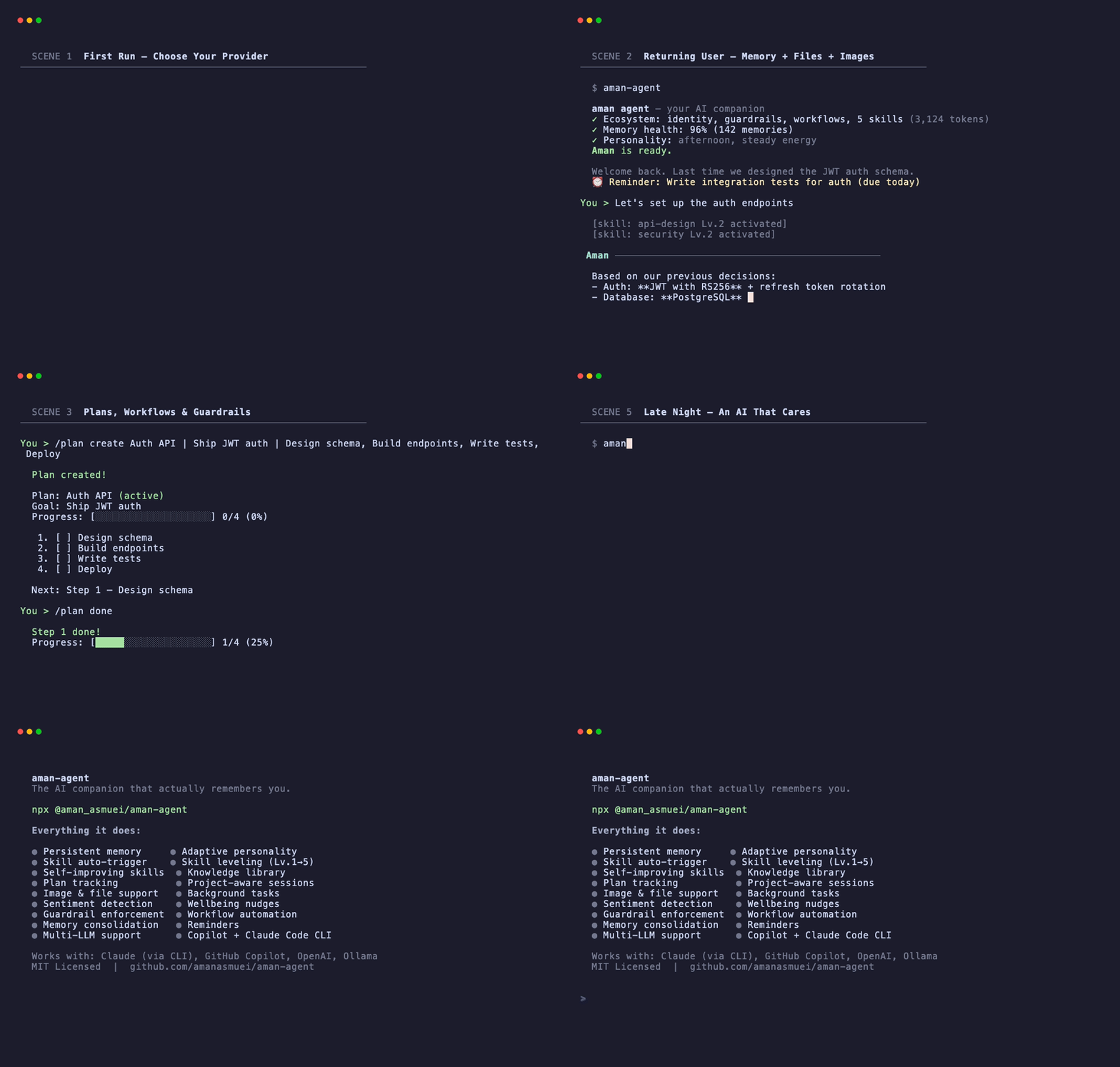
You > /plan create Auth API | Ship JWT auth | Design schema, Build endpoints, Write tests, Deploy

  Plan created!

  Plan: Auth API (active)
  Goal: Ship JWT auth
  Progress: [░░░░░░░░░░░░░░░░░░░░] 0/4 (0%)

     1. [ ] Design schema
     2. [ ] Build endpoints
     3. [ ] Write tests
     4. [ ] Deploy

  Next: Step 1 — Design schema
Mark progress as you work:
You > /plan done

  Step 1 done!

  Plan: Auth API (active)
  Progress: [█████░░░░░░░░░░░░░░░] 1/4 (25%)

     1. [✓] Design schema
     2. [ ] Build endpoints      ← Next
     3. [ ] Write tests
     4. [ ] Deploy
The AI knows your plan. Every turn, the active plan is injected into context. The AI knows which step you're on and reminds you to commit after completing steps.
Resume across sessions. Close the terminal, come back tomorrow — your plan is still there:
$ aman-agent

  Welcome back. You're on step 2 of Auth API — Build endpoints.
All plan commands:
/plan                Show active plan
/plan done [step#]   Mark step complete (next if no number)
/plan undo <step#>   Unmark a step
/plan list           Show all plans
/plan switch <name>  Switch active plan
/plan show <name>    View a specific plan
Plans are stored as markdown in .acore/plans/ — they're git-trackable.
Skills in Action
Skills activate automatically based on what you're talking about. No commands needed.
You > How should I handle SQL injection in this query?

  [skill: security Lv.3 activated]
  [skill: database Lv.2 activated]

 Aman ──────────────────────────────────────────────
  Use parameterized queries — never interpolate user input...
Skills level up as you use them:
| Level | Label | What changes |
|---|---|---|
| Lv.1 | Learning | Detailed explanations, examples |
| Lv.2 | Familiar | Brief reasoning, show patterns |
| Lv.3 | Proficient | Task-focused, skip basics |
| Lv.4 | Advanced | Edge cases, proactive suggestions |
| Lv.5 | Expert | Just execute, no hand-holding |
Skills also self-improve — when the agent learns your patterns (e.g., "user prefers Prisma over raw SQL"), it enriches the skill with your preferences.
12 built-in skill domains: testing, api-design, security, performance, code-review, documentation, git-workflow, debugging, refactoring, database, typescript, accessibility
10 knowledge library items auto-suggested when relevant: security-headers, docker-node, github-actions, env-config, error-handling, rate-limiter, prisma-setup, zod-validation, testing-patterns, git-hooks
Project Workflow
aman-agent is project-aware. When you run it in a project directory, it loads project-specific context.
Set up a project:
cd ~/my-project
npx @aman_asmuei/acore        # Creates .acore/context.md with detected stack
aman-agent                     # Loads project context automatically
What gets scoped to your project:
- Decisions and topology (stored in amem with
project:my-projectscope) - Session state (saved to
.acore/context.mdon exit) - Plans (stored in
.acore/plans/)
Switch projects naturally:
cd ~/project-a && aman-agent   # Loads project-a context + memories
cd ~/project-b && aman-agent   # Loads project-b context + memories
Global preferences (coding style, tool choices) carry across all projects.
Personality & Wellbeing
The agent adapts its tone based on time of day and how you're doing:
- Morning: energetic, direct
- Afternoon: steady, focused
- Evening: warm, winding down
- Late night: gentle, reflective
It also reads your messages for frustration, confusion, or fatigue — and adapts:
You > ugh nothing works, tried everything!!

  [sentiment: frustrated]

 Aman ──────────────────────────────────────────────
  That sounds frustrating. Let's step back and try a different
  angle — what changed since it last worked?
Wellbeing nudges appear when needed:
- Long late-night session → gentle suggestion to rest
- 90+ minutes of frustration → suggest a break
- User seems tired → concise responses, support wrapping up
These are one-time nudges — the agent won't nag.
Customization
Persona presets for different work styles:
aman-agent init
# Choose: Coding Partner, Creative Collaborator,
#          Personal Assistant, Learning Buddy, or Minimal
Guardrails control what the AI should and shouldn't do:
/rules add Coding Always write tests before merging
/rules add Never Delete production data without confirmation
Workflows teach the AI multi-step processes:
/workflows add code-review
Hook toggles in ~/.aman-agent/config.json:
{
  "hooks": {
    "memoryRecall": true,
    "personalityAdapt": true,
    "extractMemories": true,
    "featureHints": true
  }
}
Set any to false to disable.
Showcase Templates
Give your companion a pre-built specialty from aman-showcase:
| Template | What it does |
|---|---|
| Muslim | Islamic daily companion — prayer times, hadith, du'a |
| Quran | Quranic Arabic vocabulary with transliteration |
| Fitness | Personal trainer — workout tracking, nutrition |
| Freelancer | Client & invoice tracking for independents |
| Kedai | Small business assistant (BM/EN) |
| Money | Personal finance & budget tracker |
| Monitor | Price/website/keyword watchdog |
| Bahasa | Malay/English language tutor |
| Team | Standups, tasks, team memory |
| Rutin | Medication reminders for family |
| Support | Customer support with escalation |
| IoT | Sensor monitoring for smart homes |
| Feed | News aggregation & filtering |
Install during onboarding or anytime:
npx @aman_asmuei/aman-showcase install muslim
Each template includes identity, workflows, rules, and domain skills — all installed into your ecosystem.
Your Profile vs Agent Profiles
Your profile is who YOU are — name, role, expertise, communication style. Set during onboarding, injected into every conversation:
/profile me            View your profile
/profile edit          Edit a field
/profile setup         Re-run full setup
Agent profiles are different AI personalities for different tasks:
aman-agent --profile coder      # direct, code-first
aman-agent --profile writer     # creative, story-driven
aman-agent --profile researcher # analytical, citation-focused
Each agent profile has its own identity, rules, and skills — but shares the same memory. Create profiles:
/profile create coder       Install built-in template
/profile create mybot       Create custom profile
/profile list               Show all profiles
Agent Delegation
Delegate tasks to sub-agents with specialist profiles:
/delegate writer Write a blog post about AI companions

  [delegating to writer...]

  [writer] ✓ (2 tool turns)
  # Building AI Companions That Actually Remember You
  ...
Pipeline delegation — chain agents sequentially:
/delegate pipeline writer,researcher Write and fact-check an article

  [writer] ✓ — drafted article
  [researcher] ✓ — verified claims, added citations
The AI also auto-suggests delegation when it recognizes a task matches a specialist profile — always asks for your permission first.
Agent Teams
Named teams of agents that collaborate on complex tasks:
/team create content-team        Install built-in team
/team run content-team Write a blog post about AI

  Team: content-team (pipeline)
  Members: writer → researcher

  [writer: drafting...] ✓
  [researcher: fact-checking...] ✓

  Final output with verified claims.
3 execution modes:
| Mode | How it works |
|---|---|
pipeline |
Sequential: agent1 → agent2 → agent3 |
parallel |
All agents work concurrently, coordinator merges |
coordinator |
AI plans how to split the task, assigns to members |
Built-in teams:
| Team | Mode | Members |
|---|---|---|
content-team |
pipeline | writer → researcher |
dev-team |
pipeline | coder → researcher |
research-team |
pipeline | researcher → writer |
Create custom teams:
/team create review-squad pipeline coder:implement,researcher:review
/team run review-squad Build a rate limiter in TypeScript
The AI auto-suggests teams when appropriate — always asks permission first.
Daily Workflow Summary
Here's what a typical day looks like with aman-agent:
Morning:
  $ cd ~/project && aman-agent
  → Loads project context, active plan, memories
  → "Welcome back. You're on step 3 of Auth API."
  → Work on your plan, skills auto-activate as needed
  → /plan done after each step, commit your work

Afternoon:
  → Personality shifts to steady pace
  → Skills level up as you demonstrate mastery
  → Knowledge library suggests snippets when relevant

Evening:
  → /quit or Ctrl+C
  → Session auto-saved to memory
  → Project context.md updated
  → Plan progress persisted
  → Optional quick session rating

Next morning:
  → Everything picks up where you left off
Intelligent Companion Features
Per-Message Memory Recall with Progressive Disclosure
Every message you send triggers a semantic search against your memory database. Results use progressive disclosure — a compact index (~50-100 tokens) is injected instead of full content (~500-1000 tokens), giving ~10x token savings. The agent shows the cost:
You > Let's set up the auth service

  [memories: ~47 tokens]

  Agent recalls:
  a1b2c3d4 [decision] Auth service uses JWT tokens... (92%)
  e5f6g7h8 [preference] User prefers PostgreSQL... (88%)
  i9j0k1l2 [fact] Auth middleware rewrite driven by compliance... (75%)

Aman > Based on our previous decisions, I'll set up JWT-based auth
       with PostgreSQL, keeping the compliance requirements in mind...
Silent Memory Extraction
After every response, the agent analyzes the conversation and extracts memories worth keeping — preferences, facts, patterns, decisions, corrections, and topology are all stored automatically. No confirmation prompts interrupting your flow.
You > I think we should go with microservices for the payment system

Aman > That makes sense given the compliance isolation requirements...

  [1 memory stored]
Don't want something remembered? Use /memory search to find it and /memory clear to remove it.
Rich Terminal Output
Responses are rendered with full markdown formatting — bold, italic, code, code blocks, tables, lists, and headings all display beautifully in your terminal. Responses are framed with visual dividers:
 Aman ──────────────────────────────────────────────

  Here's how to set up Docker for this project...

 ──────────────────────────────── memories: ~45 tokens
First-Run & Returning Greeting
First session: Your companion introduces itself and asks your name — the relationship starts naturally.
Returning sessions: A warm one-liner greets you with context from your last conversation:
  Welcome back. Last time we talked about your Duit Raya tracker.
  Reminder: Submit PR for auth refactor (due today)
Progressive Feature Discovery
aman-agent surfaces tips about features you haven't tried yet, at the right moment:
Tip: Teach me multi-step processes with /workflows add
One hint per session, never repeated. Disable with hooks.featureHints: false.
Human-Readable Errors
No more cryptic API errors. Every known error maps to an actionable message:
  API key invalid. Run /reconfig to fix.
  Rate limited. I'll retry automatically.
  Network error. Check your internet connection.
Failed messages are preserved — just press Enter to retry naturally.
LLM-Powered Context Summarization
When the conversation gets long, the agent uses your LLM to generate real summaries — preserving decisions, preferences, and action items. No more losing critical context to 150-character truncation.
Parallel Tool Execution
When the AI needs multiple tools, they run in parallel via Promise.all instead of sequentially. Faster responses, same guardrail checks.
Retry with Backoff
LLM calls and MCP tool calls automatically retry on transient errors (rate limits, timeouts) with exponential backoff and jitter. Auth errors fail immediately.
Passive Tool Observation Capture
Every tool the AI executes is automatically logged to amem's conversation log — tool name, input, and result. This happens passively (fire-and-forget) without slowing down the agent. Your AI builds a complete history of what it did, not just what it said.
Token Cost Visibility
Every memory recall shows how many tokens it costs, so you always know the overhead:
[memories: ~47 tokens]
Personality Engine
The agent adapts its personality in real-time based on signals:
- Time of day: morning (high-drive) → afternoon (steady) → night (reflective)
- Session duration: gradually shifts from energetic to mellow
- User sentiment: detects frustration, excitement, confusion, fatigue from keywords
- Wellbeing nudges: suggests breaks when you've been at it too long, gently mentions sleep during late-night sessions
All state syncs to acore's Dynamics section — works across aman-agent, achannel, and aman-claude-code.
Auto-Triggered Skills
When you talk about security, the security skill activates. Debugging? The debugging skill loads. No commands needed.
- 12 skill domains with keyword matching
- Skill leveling (Lv.1→Lv.5): adapts explanation depth to your demonstrated mastery
- Self-improving: memory extraction enriches skills with your specific patterns over time
- Knowledge library: 10 curated reference items auto-suggested when relevant
Persistent Plans
Create multi-step plans that survive session resets:
/plan create Auth | Add JWT auth | Design schema, Implement middleware, Add tests, Deploy

Plan: Auth (active)
Goal: Add JWT auth
Progress: [████████░░░░░░░░░░░░] 2/5 (40%)

   1. [✓] Design schema
   2. [✓] Implement middleware
   3. [ ] Add tests         ← Next
   4. [ ] Deploy
Plans stored as markdown in .acore/plans/ — git-trackable, project-local.
Background Task Execution
Long-running tools (tests, builds, Docker) run in the background while the conversation continues. Results appear when ready.
Project-Aware Sessions
The agent detects your project from the current directory. On exit, it auto-updates .acore/context.md with session state. Next time you open the same project, the AI picks up where you left off.
Reminders
You > Remind me to review PR #42 by Thursday

Aman > I'll set that reminder for you.
  [Reminder set: "Review PR #42" — due 2026-03-27]
Next session:
[OVERDUE] Review PR #42 (was due 2026-03-27)
Reminders persist in SQLite across sessions. Set them, forget them, get nudged.
Memory Consolidation
On every startup, the agent automatically merges duplicate memories, prunes stale low-confidence ones, and promotes frequently-accessed entries.
Memory health: 94% (merged 2 duplicates, pruned 1 stale)
Structured Debug Logging
Every operation that can fail logs to ~/.aman-agent/debug.log with structured JSON. No more silent failures — use /debug to see what's happening under the hood.
How It Works
┌───────────────────────────────────────────────────────────┐
│                    Your Terminal                          │
│                                                          │
│   You > tell me about our auth decisions                 │
│                                                          │
│   [recalling memories...]                                │
│   Agent > Based on your previous decisions:              │
│   - OAuth2 with PKCE (decided 2 weeks ago)               │
│   - JWT for API tokens...                                │
│                                                          │
│   [1 memory stored]                                      │
└──────────────────────┬────────────────────────────────────┘
                       │
┌──────────────────────▼────────────────────────────────────┐
│              aman-agent runtime                          │
│                                                          │
│   On Startup                                             │
│   ┌────────────────────────────────────────────────┐     │
│   │ 1. Load ecosystem (identity, tools, rules...)  │     │
│   │ 2. Connect MCP servers (aman-mcp + amem)       │     │
│   │ 3. Consolidate memory (merge/prune/promote)    │     │
│   │ 4. Check reminders (overdue/today/upcoming)    │     │
│   │ 5. Inject time context (morning/evening/...)   │     │
│   │ 6. Recall session context from memory          │     │
│   └────────────────────────────────────────────────┘     │
│                                                          │
│   Per Message                                            │
│   ┌────────────────────────────────────────────────┐     │
│   │ 1. Semantic memory recall (top 5 relevant)     │     │
│   │ 2. Augment system prompt with memories         │     │
│   │ 3. Stream LLM response (with retry)            │     │
│   │ 4. Execute tools in parallel (with guardrails) │     │
│   │ 5. Extract memories from response              │     │
│   │    - Auto-store: preferences, facts, patterns  │     │
│   │    - All types auto-stored silently             │     │
│   └────────────────────────────────────────────────┘     │
│                                                          │
│   Context Management                                     │
│   ┌────────────────────────────────────────────────┐     │
│   │ Auto-trim at 80K tokens                        │     │
│   │ LLM-powered summarization (not truncation)     │     │
│   │ Fallback to text preview if LLM call fails     │     │
│   └────────────────────────────────────────────────┘     │
│                                                          │
│   MCP Integration                                        │
│   ┌────────────────────────────────────────────────┐     │
│   │ aman-mcp  →  identity, tools, workflows, eval  │     │
│   │ amem      →  memory, knowledge graph, reminders │     │
│   └────────────────────────────────────────────────┘     │
└───────────────────────────────────────────────────────────┘
Session Lifecycle
| Phase | What happens |
|---|---|
| Start | Load ecosystem, connect MCP, consolidate memory, check reminders, compute personality state, load active plan |
| Each turn | Recall memories, auto-trigger skills, inject active plan, detect sentiment, stream response, execute tools (parallel + background), extract memories, enrich skills |
| Every 5 turns | Refresh personality state, check wellbeing, sync to acore |
| Auto-trim | LLM-powered summarization when approaching 80K tokens |
| Exit | Save conversation to amem, update session resume, persist personality state, update project context.md, optional session rating |
Commands
| Command | Description |
|---|---|
/help |
Show available commands |
/plan |
Show active plan [create|done|undo|list|switch|show] |
/profile |
Your profile + agent profiles [me|edit|setup|create|list|show|delete] |
/delegate |
Delegate task to a profile [<profile> <task>|pipeline] |
/team |
Manage agent teams [create|run|list|show|delete] |
/identity |
View identity [update <section>] |
/rules |
View guardrails [add|remove|toggle ...] |
/workflows |
View workflows [add|remove ...] |
/tools |
View tools [add|remove ...] |
/skills |
View skills [install|uninstall ...] |
/eval |
View evaluation [milestone ...] |
/memory |
View memories [search|clear|timeline] |
/decisions |
View decision log [<project>] |
/export |
Export conversation to markdown |
/debug |
Show debug log (last 20 entries) |
/status |
Ecosystem dashboard |
/doctor |
Health check all layers |
/save |
Save conversation to memory |
/model |
Show current LLM model |
/update |
Check for updates |
/reconfig |
Reset LLM configuration |
/clear |
Clear conversation history |
/quit |
Exit |
What It Loads
On every session start, aman-agent assembles your full AI context:
| Layer | Source | What it provides |
|---|---|---|
| Identity | ~/.acore/core.md |
AI personality, your preferences, relationship state |
| User | ~/.acore/user.md |
Your name, role, expertise level, communication style |
| Memory | ~/.amem/memory.db |
Past decisions, corrections, patterns, conversation history |
| Reminders | ~/.amem/memory.db |
Overdue, today, and upcoming reminders |
| Tools | ~/.akit/kit.md |
Available capabilities (GitHub, search, databases) |
| Workflows | ~/.aflow/flow.md |
Multi-step processes (code review, bug fix) |
| Guardrails | ~/.arules/rules.md |
Safety boundaries and permissions |
| Skills | ~/.askill/skills.md |
Deep domain expertise |
| Plans | .acore/plans/ |
Active plan with progress and next step |
| Project | .acore/context.md |
Project-specific tech stack, session state, patterns |
| Time | System clock | Time of day, day of week for tone and personality adaptation |
All layers are optional — the agent works with whatever you've set up.
Token Budgeting
Layers are included by priority when space is limited:
Identity (always) → User (always) → Guardrails → Workflows → Tools → Skills (can truncate)
Default budget: 8,000 tokens. Override with --budget.
Supported LLMs
| Provider | Models | Tool Use | Streaming |
|---|---|---|---|
| Anthropic | Claude Sonnet 4.6, Opus 4.6, Haiku 4.5 | Full | Full (with tools) |
| OpenAI | GPT-4o, GPT-4o Mini, o3 | Full | Full (with tools) |
| Ollama | Llama, Mistral, Gemma, any local model | Model-dependent | Full (with tools) |
Image Support (Vision)
Reference image files or URLs in your message and they'll be sent as vision content to the LLM:
You > What's in this screenshot? ~/Desktop/screenshot.png
  [attached image: screenshot.png (245.3KB)]
Supported formats: .png, .jpg, .jpeg, .gif, .webp, .bmp
Image URLs are also supported — paste any https://...png URL and it will be fetched and attached.
Multiple files can be referenced in a single message (images, text files, and documents together).
Size limit: 20MB per image.
Vision model requirements:
| Provider | Vision Models |
|---|---|
| Anthropic | All Claude models (Sonnet, Opus, Haiku) |
| OpenAI | GPT-4o, GPT-4o Mini |
| Ollama | LLaVA, Llama 3.2 Vision, Moondream, BakLLaVA |
Non-vision models will receive the image but may not be able to interpret it.
Configuration
Config is stored in ~/.aman-agent/config.json:
{
  "provider": "anthropic",
  "apiKey": "sk-ant-...",
  "model": "claude-sonnet-4-6",
  "hooks": {
    "memoryRecall": true,
    "sessionResume": true,
    "rulesCheck": true,
    "workflowSuggest": true,
    "evalPrompt": true,
    "autoSessionSave": true,
    "extractMemories": true,
    "featureHints": true
  }
}
| Option | CLI Flag | Default |
|---|---|---|
| Model override | --model <id> |
From config |
| Token budget | --budget <n> |
8000 |
Hook Toggles
All hooks are on by default. Disable any in config.json:
| Hook | What it controls |
|---|---|
memoryRecall |
Load memory context on session start |
sessionResume |
Resume from last session state |
rulesCheck |
Pre-tool guardrail enforcement |
workflowSuggest |
Auto-detect matching workflows |
evalPrompt |
Session rating on exit |
autoSessionSave |
Save conversation to amem on exit |
extractMemories |
Auto-extract memories from conversation |
featureHints |
Show progressive feature discovery tips |
personalityAdapt |
Adapt tone based on time, sentiment, and session signals |
Treat the config file like a credential — it contains your API key.
The Ecosystem
aman
├── acore       → identity    → who your AI IS
├── amem        → memory      → what your AI KNOWS
├── akit        → tools       → what your AI CAN DO
├── aflow       → workflows   → HOW your AI works
├── arules      → guardrails  → what your AI WON'T do
├── askill      → skills      → what your AI MASTERS
├── aeval       → evaluation  → how GOOD your AI is
├── achannel    → channels    → WHERE your AI lives
└── aman-agent  → runtime     → the engine  ← YOU ARE HERE
| Layer | Package | What it does |
|---|---|---|
| Identity | acore | Personality, values, relationship memory |
| Memory | amem | Persistent memory with knowledge graph + reminders (MCP) |
| Tools | akit | Portable AI tools (MCP + manual fallback) |
| Workflows | aflow | Reusable AI workflows |
| Guardrails | arules | Safety boundaries and permissions |
| Skills | askill | Domain expertise |
| Evaluation | aeval | Relationship tracking |
| Channels | achannel | Telegram, Discord, webhooks |
| Unified | aman | One command to set up everything |
What Makes This Different
aman-agent vs other companion runtimes
| Feature | aman-agent | Letta / MemGPT | Raw LLM CLI |
|---|---|---|---|
| Identity system | 7 portable layers | None | None |
| Memory | amem (SQLite + embeddings + graph) | Postgres + embeddings | None |
| Per-message recall | Progressive disclosure (~10x token savings) | Yes | No |
| Learns from conversation | Auto-extract (silent) + skill enrichment | Requires configuration | No |
| Personality adaptation | Sentiment-aware, time-based, energy curve | None | None |
| Wellbeing awareness | 6 nudge types (sleep, breaks, frustration) | None | None |
| Skill leveling | Lv.1→Lv.5, auto-triggered by context | None | None |
| Plan tracking | Persistent checkboxes, survives resets | None | None |
| Vision / multimodal | Images via base64 (local + URL) | None | None |
| Background tasks | Long-running tools run concurrently | None | None |
| Guardrail enforcement | Runtime tool blocking | None | None |
| Reminders | Persistent, deadline-aware | None | None |
| Context compression | LLM-powered summarization | Archival system | Truncation |
| Multi-LLM | Anthropic, OpenAI, Ollama (all with tools) | OpenAI-focused | Single provider |
| Tool execution | Parallel + background with guardrails | Sequential | None |
| Project awareness | Auto-detect project, scoped memory, context.md | None | None |
amem vs other memory layers
| Feature | amem | claude-mem (40K stars) | mem0 |
|---|---|---|---|
| Works with | Any MCP client | Claude Code only | OpenAI-focused |
| Storage | SQLite + local embeddings | SQLite + Chroma vectors | Cloud vector DB |
| Progressive disclosure | Compact index + on-demand detail | Yes (10x savings) | No |
| Memory types | 6 typed (correction > decision > fact) | Untyped observations | Untyped blobs |
| Knowledge graph | Typed relations between memories | None | None |
| Reminders | Persistent, deadline-aware | None | None |
| Scoring | relevance x recency x confidence x importance | Recency-based | Similarity only |
| Consolidation | Auto merge/prune/promote | None | None |
| Version history | Immutable snapshots | Immutable observations | None |
| Token cost visibility | Shown per recall | Shown per injection | None |
| License | MIT | AGPL-3.0 | Apache-2.0 |
claude-mem excels at capturing what Claude Code did. amem is a structured memory system that works with any MCP client, with typed memories, a knowledge graph, reminders, progressive disclosure, and consolidation.
Contributing
git clone https://github.com/amanasmuei/aman-agent.git
cd aman-agent && npm install
npm run build   # zero errors
npm test        # 111 tests pass
PRs welcome. See Issues.
Built by Aman Asmuei
MIT License
Yorumlar (0)
Yorum birakmak icin giris yap.
Yorum birakSonuc bulunamadi