Sibawayh
Health Uyari
- License — License: MIT
- Description — Repository has a description
- Active repo — Last push 0 days ago
- Low visibility — Only 5 GitHub stars
Code Gecti
- Code scan — Scanned 12 files during light audit, no dangerous patterns found
Permissions Gecti
- Permissions — No dangerous permissions requested
Bu listing icin henuz AI raporu yok.
سيبويه · An Agent Skill that makes AI agents write correct, natural Arabic and check it before answering. Claude Code plugin + dependency-free checker.
 ____   _  _                                      _
/ ___| (_)| |__    __ _ __      __   __ _  _   _ | |__
\___ \ | || '_ \  / _` |\ \ /\ / /  / _` || | | || '_ \
 ___) || || |_) || (_| | \ V  V /  | (_| || |_| || | | |
|____/ |_||_.__/  \__,_|  \_/\_/    \__,_| \__, ||_| |_|
                                           |___/
سيبويه · Sibawayh
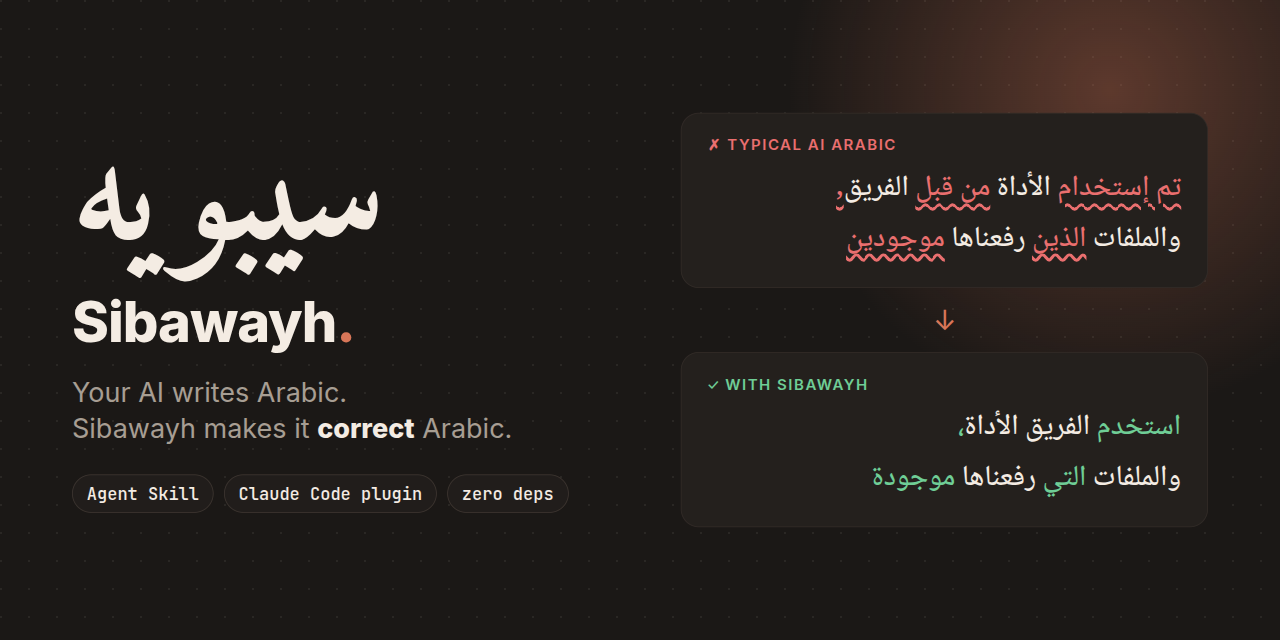
Your AI writes Arabic. Sibawayh makes it correct Arabic.
An Agent Skill that teaches AI agents to write natural Modern Standard Arabic and to check it before they answer.






Install · How it works · What it catches · Checker · Contribute
🤔 Why
Ask an AI model for Arabic and you get text that is understandable, but that a native reader spots in a second:
| What goes wrong | Looks like |
|---|---|
| English grammar in Arabic words | تم إنشاء الملف من قبل المستخدم |
| Broken agreement | الملفات الذين تم رفعهم موجودين |
| Wrong number–noun gender | ثلاث مهندسين |
| Wrong hamza | إستخدام، الى |
| English punctuation | نعم, ولكن? |
| Scrambled RTL | lines starting with an English word flip direction |
| Dialect slipping into formal text | عشان، بدي، هيك |
Sibawayh is named after سيبويه, the 8th-century scholar whose al-Kitāb is the foundational book of Arabic grammar. It gives the agent the rules, a checker and a review checklist, so that its Arabic reads as if a careful native writer wrote it.
✨ Before → after
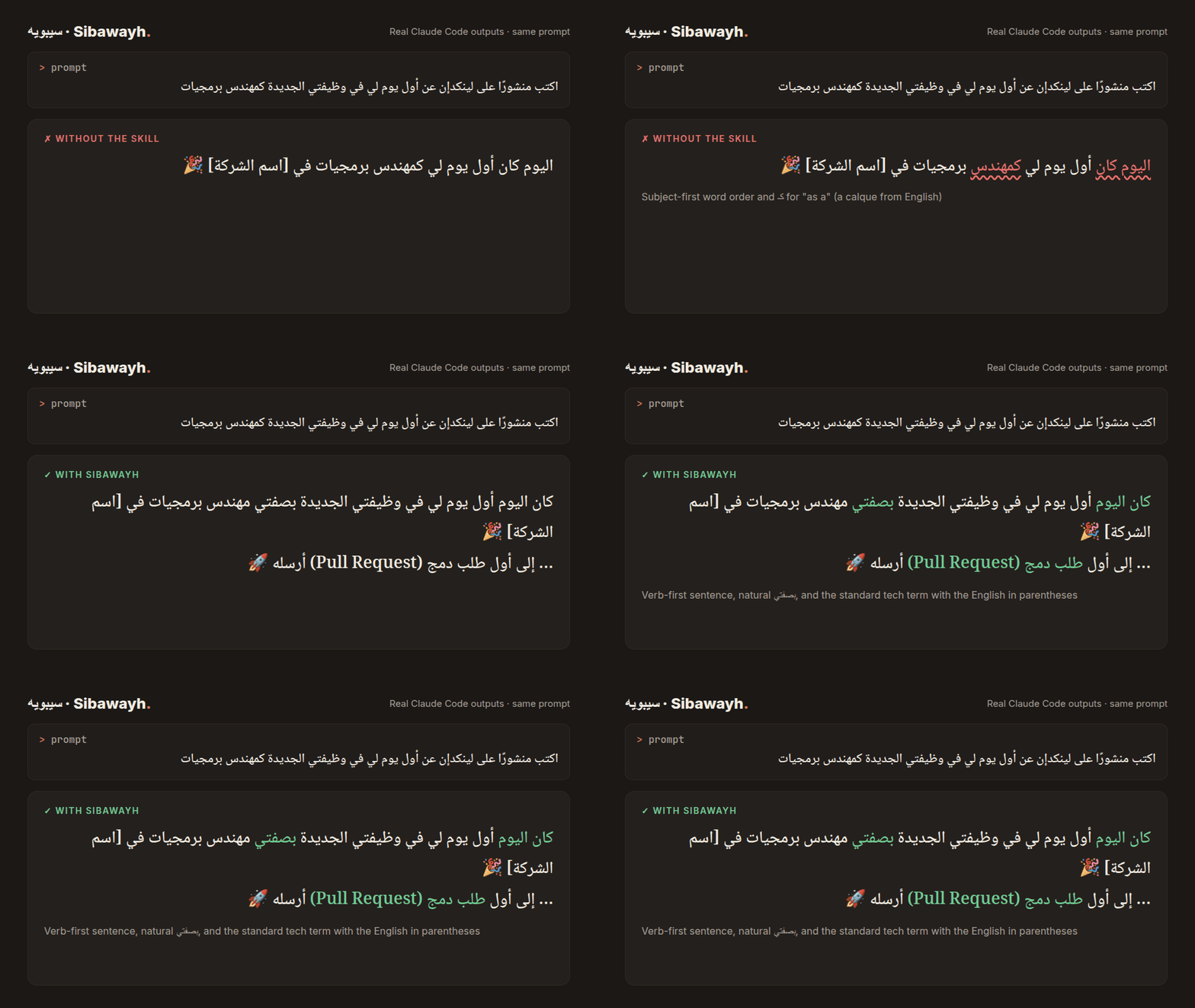
Real Claude Code outputs for the same prompt, with and without the skill.
| ✗ Typical AI output | ✓ With Sibawayh |
|---|---|
|
تم إستخدام الأداة من قبل الفريق, وهاذا ساعدنا كثيرا. |
استخدم الفريق الأداة، وهذا ساعدنا كثيرًا. |
1:1   INFO   translationese-density  Translationese density 15.8 per 100 words (تم/يتم: 2, من قبل: 1) …
1:4   ERROR  hamza-wasl    Hamzat al-wasl: write a bare alif, not إ (form X masdar)  → استخدام
1:32  FIX    punct-latin   Latin punctuation between Arabic words  → ،
1:34  ERROR  misspelling   Misspelling (no alif after ها)  → وهذا
2:16  WARN   digit-mix     Mixed digit systems; this text uses Western (0-9) digits  → 4
The script finds nothing on line 3: a regex can't reliably catch agreement with non-human plurals. That line gets fixed in the model's checklist review. This is exactly the split Sibawayh is designed around.
⚙️ How it works
flowchart LR
    A["✍️ Write<br/>with SKILL.md rules"] --> B["🔍 Check<br/>check_arabic.py --fix"]
    B --> C["📋 Review<br/>7-point checklist"]
    C --> D["✅ Answer<br/>clean Arabic only"]
- Write. The skill loads whenever the agent is about to produce Arabic: answers, docs, emails, posts, translations, summaries, UI strings and commit messages. While writing, the agent follows the rules in
SKILL.md: verb-first active sentences, correct agreement and numbers, Arabic punctuation, one digit system, and RTL-safe lines. - Check. It runs a tiny Python script with no dependencies. The script auto-fixes what is certain and flags the rest.
- Review. It works through a prioritized checklist: agreement, numbers, case endings, إنّ/أنّ, translationese, register, formatting. It changes only what is wrong.
- Answer. The user gets clean Arabic, with no checker noise.
🛡️ Golden rule: never over-correct.
Forms that purists reject but the Cairo Arabic Language Academy approved are never flagged. Examples: يعتبر، ساهم في، أكد على، في نفس الوقت، أبحاث. Contested forms are left alone, and auto-fixes run only where they can't be wrong.
🎯 What it catches
| Area | Examples | Handled by | |
|---|---|---|---|
| ✏️ | Punctuation | , ? ; → ، ؟ ؛, spacing |
🤖 checker (auto-fix) |
| 🔤 | Unicode | Persian ک/ی, presentation forms, tatweel | 🤖 checker |
| 📝 | Spelling | إستخدام, هاذا, الى, الاطفال, المدرسه, المصرى, و الكتاب, لايوجد | 🤖 checker (word lists + frequency lexicons) |
| 🔢 | Digits and RTL | mixed 3 / ٣, lines that flip direction | 🤖 checker |
| 🗣️ | Dialect leakage | عشان, بدي, هيك in formal text | 🤖 checker |
| ⚖️ | Verb endings | لم يكونون, لن يذهبون, سوف لن | 🤖 checker + 🧠 checklist |
| 🧮 | Agreement and numbers | non-human plurals, العدد والمعدود (ثلاث ملفات → ثلاثة ملفات) | 🤖 checker (numbers 3–10) + 🧠 checklist + 📚 tables |
| 🌐 | Translationese | تم + masdar, قام بـ, من قبل, كـ "as a" | 🤖 density + 🧠 checklist |
| 💻 | Tech terms | واجهة برمجة التطبيقات (API) | 📚 glossary (450+ terms) |
📦 Install
Claude Code
/plugin marketplace add anasAsh/Sibawayh
/plugin install arabic-writing@sibawayh
That's it. The skill now loads by itself whenever Claude writes Arabic.
Prefer a manual install?git clone https://github.com/anasAsh/Sibawayh.git
cd Sibawayh
ln -s "$PWD/skills/arabic-writing" ~/.claude/skills/arabic-writing
# or: cp -r skills/arabic-writing ~/.claude/skills/
From a shell, the plugin commands are claude plugin marketplace add anasAsh/Sibawayh and claude plugin install arabic-writing@sibawayh.
Cursor, GitHub Copilot and other agents
Copy skills/arabic-writing/ into your tool's skills folder; check its documentation for the path. The skill uses the standard SKILL.md format. If an agent has no shell, it falls back to the checklist alone.
🔍 Run the checker yourself
It needs Python 3.8 or later and nothing else.
python3 skills/arabic-writing/scripts/check_arabic.py file.md          # report findings
python3 skills/arabic-writing/scripts/check_arabic.py --fix file.md    # print text with safe fixes applied
python3 skills/arabic-writing/scripts/check_arabic.py --json -         # JSON findings from stdin
| Severity | Meaning |
|---|---|
fix |
certain; applied by --fix |
error |
almost always wrong |
warn |
probably wrong; check the context |
info |
style or consistency note |
--digits western|arabic|autosets the expected digit system. The default,auto, follows the majority in the text.- Exit code:
1when findings aboveinforemain, otherwise0. - Never touched: code blocks, inline code, URLs, file paths, emails, YAML front matter, Qur'an quotes in ﴿…﴾, and anything between
<!-- arabic-check: off -->and<!-- arabic-check: on -->.
🗂️ What's inside
skills/arabic-writing/
├── SKILL.md                  writing rules, workflow, checklist
├── references/
│   ├── grammar.md            agreement, numbers, case endings
│   ├── orthography.md        hamza, ة/ه, ى/ي, punctuation, digits, RTL
│   ├── style.md              translationese → natural Arabic
│   ├── common-errors.md      قل ولا تقل
│   ├── approved-forms.md     never "fix" these
│   └── glossary.md           450+ tech terms, English → Arabic
└── scripts/
    ├── check_arabic.py       the checker (stdlib only)
    ├── archeck/              rules
    └── data/                 word lists
evals/                        before/after evaluation harness
tests/                        unit tests
research/                     the research the rules are built on
📊 Evaluation
The harness in evals/ answers 50 realistic prompts with and without the skill, and a judge scores both versions blind, without knowing which is which. So far the judge is an AI model from a different family; a native-speaker round is planned. The success bar is zero over-corrections and about 50% fewer errors per 100 words, with no category getting worse. Triggering (does the skill load when it should?): 20/20 (18/20 in the first run).
- All 14 requests in Arabic, or for Arabic output, loaded the skill. That includes summarise, rewrite and proofread.
- All 4 English-only requests correctly left it unloaded.
- The 2 dialect requests load it too, for the formatting checks only. In the first run they did not.
Full evaluation (50 prompts, judged blind by an AI model from a different family; see evals/full_eval.md):
- Errors per 100 words went from 1.66 to 0.20 (−88%), and every category improved: grammar and formatting −100%, spelling and register −89%, translationese −75%.
- The Sibawayh version was preferred in 29 pairs, the baseline in 1; 20 were ties.
- 0 over-corrections. The success bar (≤50% of the baseline's errors, no category worse, no over-corrections) is met.
An AI judge is not a native reader, so a human-scored round is still to come. The answers and scores are in evals/results/ for anyone to check.
The checker against human corrections (evals/benchmarks.md): on two public corpora that people corrected word by word, it catches 52% of all errors in student essays (ZAEBUC) and 41% in native-speaker comments (QALB), up from 23% and 20% in release 0.1.2. For hamza it catches 68% and 59%; for و written apart from its word, 98% and 86%. Every flag on a word the annotators left unchanged was a real error they missed, or (in ZAEBUC) a Latin comma they chose to keep.
Over-correction check (evals/corpus_check.md): on Arabic Wikipedia featured articles, every error-level flag was a real error, including in a held-out set used for no tuning.
🤝 Contribute
Native-speaker review is the most valuable contribution. Three ways to help:
- 💻 Glossary. Suggest better or more standard terms in
glossary.md. Some terms, such as epoch, tokenization and pipeline, still have no settled Arabic equivalent. - 📝 Word lists. Add misspellings to
scripts/data/*.tsv. The rule is strict: an entry must be wrong in every context, and each entry needs a test. - 🚩 False flags. If the checker flags correct Arabic, open an issue with the sentence.
Run the tests before opening a pull request:
python3 -m unittest discover -s tests -t .
📄 License
MIT, see LICENSE. The project contains no GPL code. Any entries adapted from LanguageTool (LGPL) would live only in skills/arabic-writing/scripts/data/third_party/, with their own licence notice. The frequency lexicons (scripts/data/lexicon_*) are word counts derived from Arabic Wikipedia featured articles, whose text is licensed CC BY-SA 4.0.
Built for Arabic speakers who are tired of AI that writes almost right. 🌙
Yorumlar (0)
Yorum birakmak icin giris yap.
Yorum birakSonuc bulunamadi