burn
Health Uyari
- License — License: MIT
- Description — Repository has a description
- Active repo — Last push 0 days ago
- Low visibility — Only 5 GitHub stars
Code Basarisiz
- process.env — Environment variable access in scripts/check-ccusage.js
- os.homedir — User home directory access in src/cli/ask.js
- exec() — Shell command execution in src/lib/db.js
- os.homedir — User home directory access in src/lib/db.js
- process.env — Environment variable access in src/lib/notify.js
- os.homedir — User home directory access in src/lib/pricing.js
- process.env — Environment variable access in src/lib/pricing.js
- network request — Outbound network request in src/lib/pricing.js
- exec() — Shell command execution in src/lib/store.js
- os.homedir — User home directory access in src/lib/store.js
- process.env — Environment variable access in src/lib/store.js
Permissions Gecti
- Permissions — No dangerous permissions requested
Bu listing icin henuz AI raporu yok.
BURN — live token & cost burn-rate monitor for Claude Code, Codex and OpenCode. Web dashboard + TUI + notifications, all local.

BURN · agent monitor
Live token & cost burn-rate for your coding agents — Claude Code, Codex, OpenCode.
A web dashboard, a full-screen TUI, desktop notifications, and an always-on collector. All local. No proxy, no wrapper, no prompts ever read.
Why
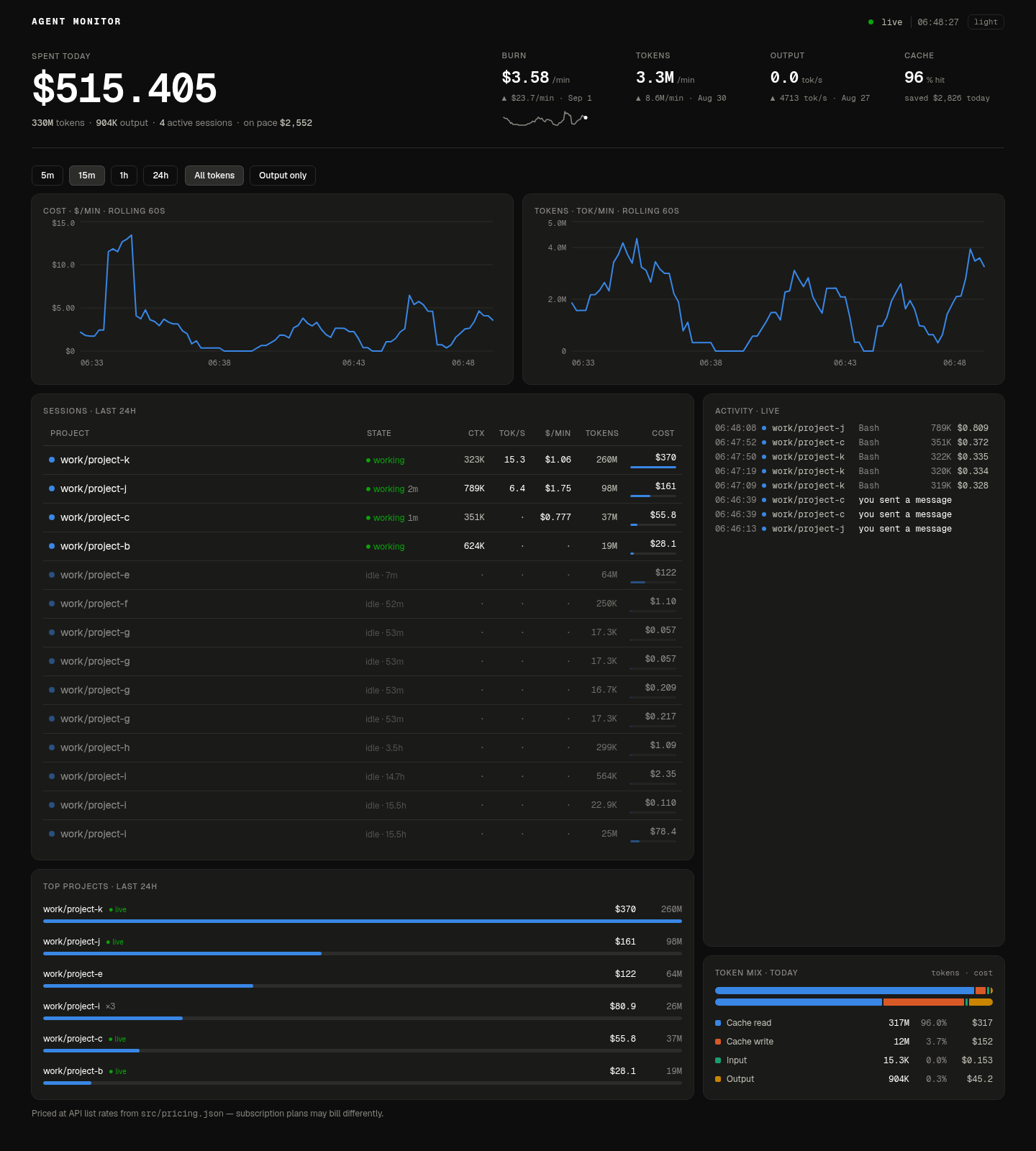
Coding agents burn tokens fast and quietly. ccusage tells you what yesterday cost; nothing tells you what this minute costs, which session is stuck, or that an agent finished twenty minutes ago and has been waiting on you since. BURN tails the session logs your agents already write and turns them into a live instrument:
- $/min · tok/min · output tok/s — rolling live rates, plus all-time records
- Session states —
working / ◉ needs you / idle, derived from transcript structure (stop reasons, tool-use blocks) — never from message content - Desktop notifications when a session finishes and is waiting on you, when one turn runs 15+ minutes, when a session looks like a runaway loop, or when you cross a budget
- Context meters per session — how close each one is to compaction
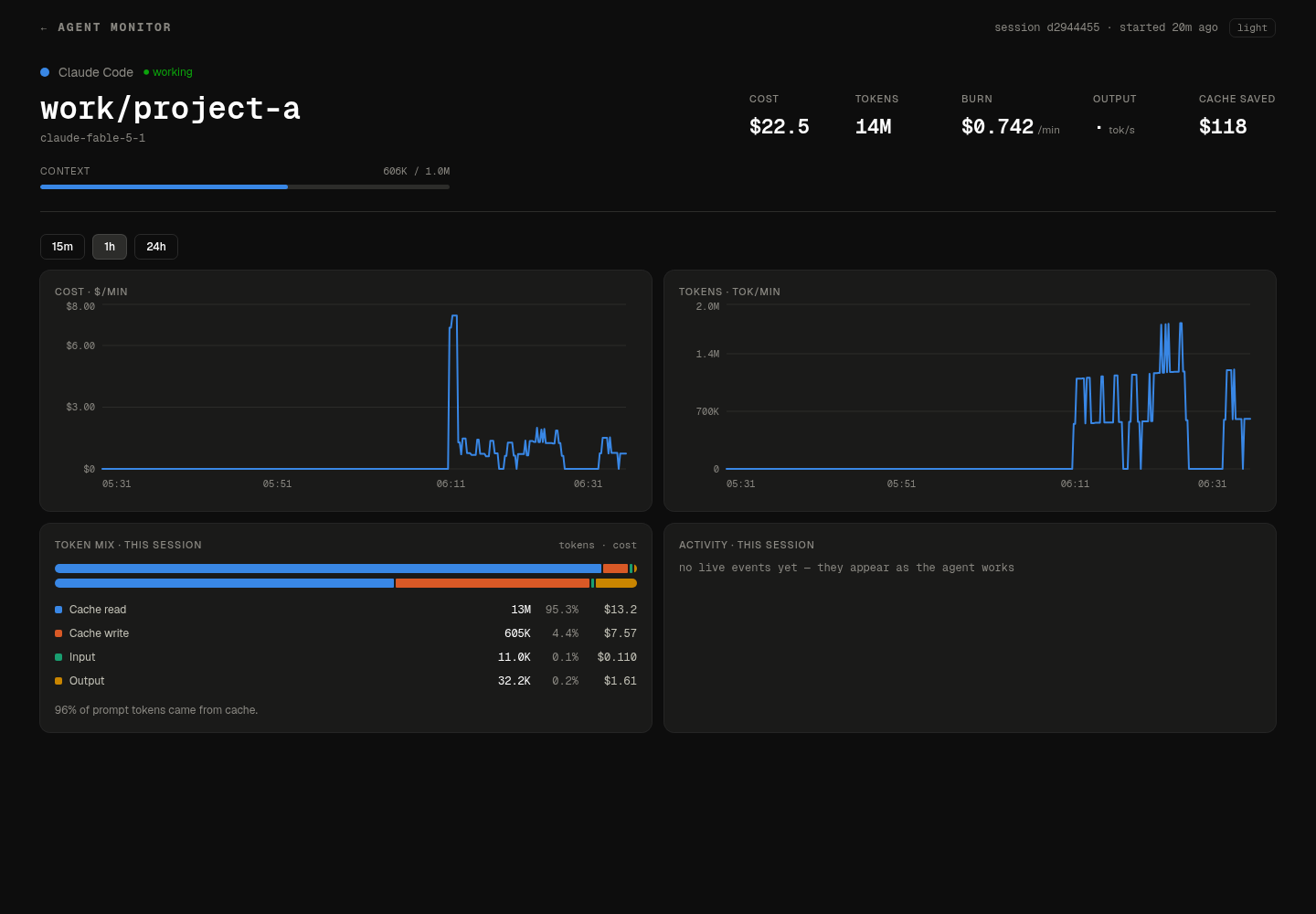
- Cache economics — hit rate, "cache saved you $X", and token-vs-cost mix (spoiler: cache reads are ~95% of tokens and output is ~10% of cost)
- Live activity ticker — tool names, turn boundaries, compactions, model switches, with the token/cost delta of each step
- Per-session pages, 5m/15m/1h/24h ranges, forecast to midnight, light & dark themes
Numbers cross-check against ccusage daily to the cent (npm run check:ccusage prints both side by side) — same LiteLLM price table, same dedupe rules, and the nested subagent transcripts (Task and Workflow agents) that a shallow directory walk misses. On a parallel-agent workload that's a 30%+ undercount.
Sources
| Agent | Reads | Notes |
|---|---|---|
| Claude Code | ~/.claude/projects/**/*.jsonl |
per-response usage, cache read / 5m / 1h write split, deduped by message.id (final usage of a streamed response wins); walks the whole tree, so <session>/subagents/*.jsonl and <session>/subagents/workflows/*/agent-*.jsonl count |
| Codex CLI | ~/.codex/sessions/YYYY/MM/DD/*.jsonl |
cumulative token_count events, diffed per rollout; forked/subagent threads skip the parent history they replay; service_tier: priority bills at the model's fast multiplier; rate-limit headroom when reported |
| OpenCode | opencode.db in $OPENCODE_DATA_DIR, ~/.local/share/opencode, and the Flatpak data dir |
read-only SQLite via node:sqlite; assistant-message tokens (reasoning billed as output) + OpenCode's own cost, diffed as rows update |
Gemini CLI isn't supported: its local chat files carry no token usage.
Install
Requires Node ≥ 22.5 (for the built-in node:sqlite). Linux desktop notifications use notify-send if present.
git clone https://github.com/Anay0305/burn.git
cd burn
npm ci && (cd web && npm ci && npm run build)
ln -s "$(pwd)/bin/burn" ~/.local/bin/burn      # or anywhere on your PATH
Run
burn              # full-screen TUI — standalone, tails logs directly
burn web          # collector + Next.js dashboard → http://localhost:3000
burn serve        # collector only (SSE/API on :4090 + a lightweight vanilla UI)
burn ask "which project cost the most this week?"   # Claude over aggregates (needs Anthropic creds)
Everything starts populated: the collector backfills the last 26h of logs (BACKFILL_HOURS to change) and, after the first run, restores from its own SQLite store in milliseconds. When an upgrade changes how logs are read or priced, the store is dropped and rebuilt from the logs automatically.
Always-on collector (recommended)
cp scripts/systemd/agent-monitor.service ~/.config/systemd/user/
# edit WorkingDirectory if the repo isn't at ~/Desktop/Projects/agent-monitor
systemctl --user enable --now agent-monitor.service
With the service running, burn web just attaches the dashboard, notifications never miss a session, and records persist. Budget alerts are opt-in via Environment= lines in the unit:
| Variable | Effect |
|---|---|
BURN_ALERT_PER_MIN=15 |
notify when burn stays above $15/min for 5 minutes |
BURN_ALERT_TODAY=2500 |
notify once when today's spend crosses $2500 |
AGENT_MONITOR_NOTIFY=0 |
disable all desktop notifications |
TUI keys
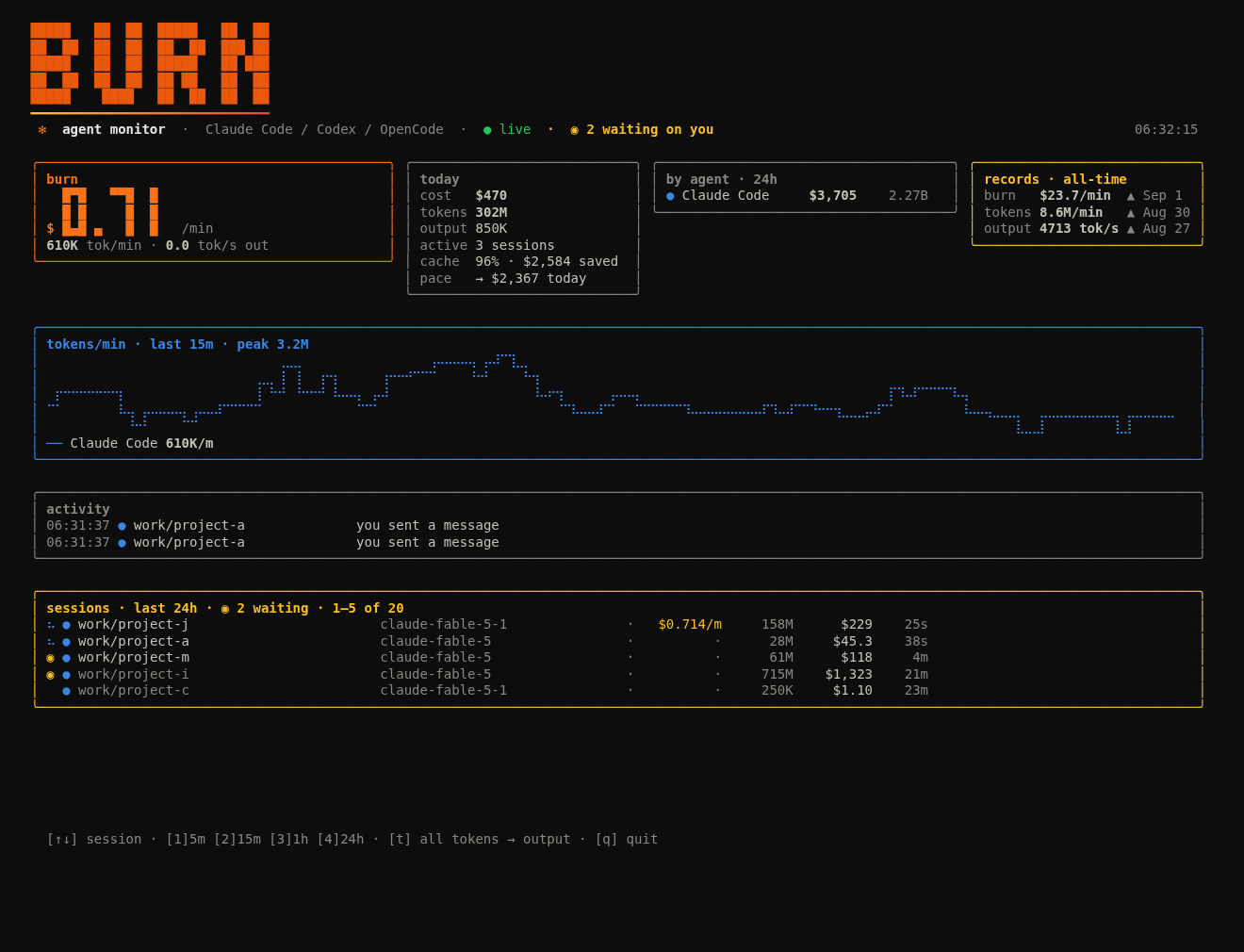
↑/↓ select a session (chart follows it) · esc back to all agents · 1/2/3/4 = 5m/15m/1h/24h · t all tokens ↔ output only · q quit
It runs in the alternate screen buffer with synchronized-output frames (no flicker), fills the terminal height, and draws braille line charts.
Pricing
Rates come from LiteLLM's model price table — the same source ccusage uses — so the two agree. The collector and TUI refresh it on start (cached 24h in ~/.local/share/agent-monitor/pricing-cache.json); set BURN_OFFLINE=1 to skip the network and use the bundled src/pricing.json, which npm run pricing:update regenerates from the same table.
- Every model carries its own cache-read / 5m-write / 1h-write rates (e.g.
claude-fable-5-1reads cache at $0.25/M, not 10% of input); the Anthropic 10% / 125% / 200% multipliers are only the fallback for models without them - Model ids resolve exact → alias → date-stripped → provider prefix stripped → boundary-aware fuzzy match, and a key never matches a longer version (
gpt-5does not pricegpt-5.6-sol;claude-fable-5does not priceclaude-fable-5-1) pricingOverridesin~/.config/claude/ccusage.json(ccusage's format) are honoured, so custom gateway models price identically in both tools- Codex priority/fast tier: 2× for gpt-5.6 (from LiteLLM / ccusage's multiplier table)
- Unknown models still count tokens; their cost is excluded and the UI says so
npm run check:ccusage [-- --since YYYY-MM-DD]replays the logs and prints BURN vsccusage dailyper day and model
Costs are API list rates. Subscription plans bill differently — treat the dollar figures as "what this would cost on the API".
Privacy
Set BURN_MASK=1 on the collector or TUI to replace every project path with a stable pseudonym (~/work/project-a, -b, …) in all output — for screenshots, screen-shares and demos. The screenshots in this README were taken that way.
BURN reads metadata: token counts, model ids, timestamps, stop reasons, tool names, and the working-directory path. It never reads or stores prompt text, tool inputs/outputs, or message content. BURN makes two kinds of network call: a once-a-day fetch of LiteLLM's public price table (a static JSON file; nothing about you is sent, and BURN_OFFLINE=1 turns it off), and burn ask, which sends per-day/per-project/per-model aggregates to the Claude API — and only when you invoke it.
Architecture
src/
  server.js          collector: tails sources, SQLite persistence, SSE + JSON API, notifications
  lib/store.js       events, sessions, rolling rates, buckets, states, peaks, cache & forecast math
  lib/tailer.js      resumable JSONL tailer (offsets + per-file state persisted)
  lib/db.js          node:sqlite (~/.local/share/agent-monitor/events.db, 14-day retention)
  lib/notify.js      notify-send: waiting-on-you, stuck turn, runaway, budget
  sources/           claude-code.js · codex.js · opencode.js  (~100 lines each; add your own)
  tui/               Ink + htm, no build step
  cli/ask.js         burn ask
web/                 Next.js + shadcn/ui + Recharts; proxies the collector same-origin
public/              zero-dependency vanilla dashboard, served by the collector itself
Adding an agent: a source provides listFiles() and an onLine(file, json) that calls store.add({...}) with per-event deltas (see codex.js for JSONL, opencode.js for SQLite polling), then gets a color slot in the UIs.
License
MIT © Anay Gupta
Yorumlar (0)
Yorum birakmak icin giris yap.
Yorum birakSonuc bulunamadi