openvidstudio
Health Gecti
- License — License: Apache-2.0
- Description — Repository has a description
- Active repo — Last push 0 days ago
- Community trust — 16 GitHub stars
Code Uyari
- process.env — Environment variable access in .agents/skills/remotion-best-practices/remotion-maps/techniques/cesium/assets/CesiumFlythrough.tsx
Permissions Gecti
- Permissions — No dangerous permissions requested
Bu listing icin henuz AI raporu yok.
Open-source MCP-driven demo videos: an AI coding agent drives a real browser over your real product and cuts a launch video from the captures. Nothing on screen is generated.





openvidstudio is an open-source demo-video add-on, built on Remotion and
Playwright, that an AI coding agent drives through MCP tools to produce
launch and demo videos for a project directly from its repo and running app.
Nothing on screen is generated: a real browser drives your real product and
every frame is a capture of it, with an optional Higgsfield AI b-roll tier
for atmosphere shots that can't be captured from a live screen.
Requirement: your frontend has to load and work in Chrome under
Playwright. Playwright-driven capture is what this tool is for and what it is
tuned around. If a human can click through your app in Chrome, this can film
it; if not, it cannot.packages/andtemplates/each get their own README as
they're built out. The site is live at
openvidstudio.vercel.app.
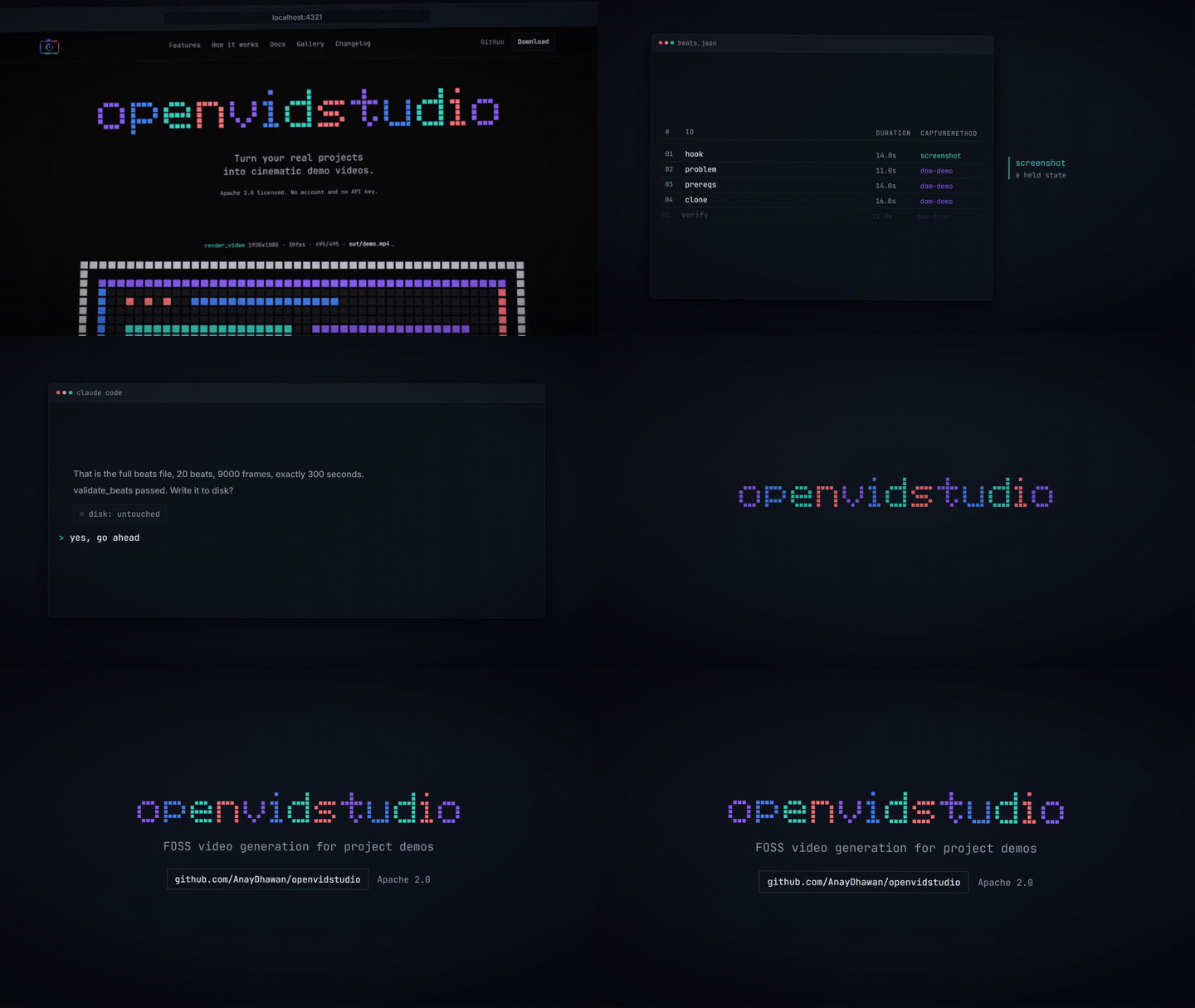
openvidstudio features
- Real product, real pixels. Every screenshot and recording comes from your
actually running app, so nothing on screen is invented: the UI, the product
text, and the layout are all ground truth. - Your agent drives. No separate app, no timeline editor, no manual
keyframing. The AI coding agent you already use (Claude Code, Cursor,
ChatGPT, or anything that speaks MCP) runs the whole pipeline through
twenty-six tools, twenty-seven with the Higgsfield tier enabled. - A directed video, not a screen recording. Push-ins, drift, shallow depth
of field, an oversized cursor, narration, and a synthesized music bed turn
plain captures into something you'd ship. - B-roll for what a screen can't show. An optional Higgsfield tier covers
atmosphere and establishing shots, never product UI, when the running app
genuinely can't produce a frame. - Not only web apps. A desktop window, an Android device or iOS Simulator,
and a terminal session are all capturable, so a CLI tool or a Linux distro
gets real footage instead of a hand-drawn panel standing in for it. - One edit costs one beat. Beats render to their own cached segments and
join under a stream copy, so fixing a caption in a five minute video
re-renders ninety frames, not nine thousand. - The same beats, other outputs. A README GIF, a docs screenshot set, store
frames at each store's exact dimensions, and a manifest-driven 9:16 cut all
come out of the finished render.
Quick Start
{
  "mcpServers": {
    "openvidstudio": {
      "command": "npx",
      "args": ["-y", "@openvidstudio/mcp-server"]
    }
  }
}
Drop that into your MCP client's config, which for Claude Code is .mcp.json, and
restart the client. Twenty-six tools should appear.
Then paste this to your agent, from inside the repo you want a video of:
make a demo video of this project with openvidstudio.

handle it end to end. work out what this project is and how to start it, get it
running, and use its own brand rather than your defaults. ask me anything you
need along the way, one question at a time, and show me the result when it is
done.
That is the whole thing. You do not have to know the port, read the tool list, or
put the steps in order: the agent works out how to start the app from your scripts,
checks the machine with preflight, reads your palette and fonts withextract_brand, asks what the video should cover, and shows you the full plan before
writing anything to disk. Say yes and it captures, renders, and hands you the mp4.
Working from a clone instead:
git clone https://github.com/AnayDhawan/openvidstudio.git
cd openvidstudio && pnpm install
pnpm --filter @openvidstudio/mcp-server build
# then point the config at packages/mcp-server/dist/stdio.js with "command": "node"
Prerequisites
| What | Minimum | Needed for | Blocking |
|---|---|---|---|
| Node.js | 18 | Runs the server. npx ships with it, and npx is the install |
yes |
| ffmpeg | 4.0 | Sound effects and pulling QC frames back out of a render | yes |
| Playwright | 1.48 | Resolvable inside the project the video is built in | yes |
| Chromium | whatever playwright install pulls |
The browser capture actually drives | yes |
| Your app | running, reachable | Capture points at a real URL. Nothing serving means nothing to film | yes |
| edge-tts | any current, Python 3.8+ | Narration | no |
preflight checks every row and names the fix for your platform. Only the Node
version is enforced numerically; the rest are presence checks.
# Windows. Reopen the terminal after installing ffmpeg, winget only puts it on
# PATH for new shells.
winget install --id Gyan.FFmpeg -e
npm install playwright && npx playwright install chromium
pip install edge-tts

# macOS
brew install ffmpeg
npm install playwright && npx playwright install chromium
pip install edge-tts

# Debian or Ubuntu
sudo apt update && sudo apt install -y ffmpeg
npm install playwright && npx playwright install chromium
pip install edge-tts
pnpm is not needed to use openvidstudio. It is only for building this repo from a
clone, which is covered under Quick Start.
Docs
Read packages/docs/PLANNING.md first for the guided intake flow, thenpackages/docs/OVERVIEW.md for the full pipeline shape. PIPELINE.md,STYLE.md, CAPTURE.md and SCRIPT.md cover the individual steps and the rules
that are enforced rather than suggested.
Agent skills
Both this repo and every scaffolded project ship the official Remotion
agent-skills bundle (markup, captions, rendering, SaaS, maps, and more) for
Claude Code, Cursor, Windsurf, OpenCode, and GitHub Copilot, so whichever
coding agent writes your scenes has real Remotion knowledge to work from,
not just this project's own PIPELINE.md/STYLE.md rules.
What the tools do
| Tool | |
|---|---|
init_project |
Scaffolds the project shell: package.json, Remotion config, the SFX pack, docs |
preflight |
Checks node, ffmpeg, Playwright, Chromium, and whether your app is responding. Every failure names its fix |
plan_beats |
A beat skeleton with a narration word budget per beat |
validate_beats |
Schema and pacing, before anything is written |
write_beats_file |
Commits the approved beats |
capture_screenshot |
Zoom compensated capture of the real running app |
capture_screen_recording |
Full viewport recording |
capture_desktop |
A native window, a region, or a whole screen, through ffmpeg. Wayland goes through pipewire |
capture_mobile |
An Android device or an iOS Simulator |
capture_terminal |
A real command run, recorded as timed text rather than pixels, with a pty when one is available |
plan_shots |
Ranks what the video should show from the repo's own emphasis, with the evidence for each |
scaffold_scene |
A scene that renders, from one of ten templates, using that beat's own copy |
validate_scenes |
Catches what renders successfully and is wrong, chiefly content cropped outside the camera |
generate_narration |
One clip per beat, paced to fit without sounding stretched |
stitch_composition |
Sequences scenes and audio |
contact_sheet |
Every beat in one image, in a fraction of a render |
render_video |
Draft or full quality, and incrementally: only the beats whose inputs changed |
qc_extract_frames |
Frames back out for review |
diff_beats |
What changed between two manifests, and what that costs to fix |
visual_regression |
This render against the last accepted one, per beat, with a PR comment |
docs_drift |
Which clips no longer match the pages they document |
release_diff |
Two refs in, a before/after manifest for a what's-new clip out |
export_rendition |
A README GIF, a docs screenshot set, or store frames from the same render |
reformat_vertical |
A 9:16 cut with the crop chosen per beat from the manifest |
plan_sound_effects |
Works out which sounds the synthesized pack already covers, and where to get the rest |
extract_brand |
Reads your repo's palette, fonts and logo so the video looks like your product |
import_higgsfield_clip |
Optional AI b roll, gated on config |
The capture engine on its own
@openvidstudio/capture is published separately: zoom
compensated browser capture, interaction replay, and the desktop, mobile and
terminal backends, with no dependency on Remotion, React, or the video pipeline.
If you want trustworthy captures of your app and you are not making a video,
take that package and ignore the rest.
Status
The pipeline runs end to end and scaffold_scene emits scenes that render, so an
agent can go from a brief to a narrated mp4 without hand writing Remotion. The
templates are structurally correct but plain: a first render looks right rather than
good, and making it look good is still your job.
Yorumlar (0)
Yorum birakmak icin giris yap.
Yorum birakSonuc bulunamadi