sketchling
Health Gecti
- License — License: MIT
- Description — Repository has a description
- Active repo — Last push 0 days ago
- Community trust — 12 GitHub stars
Code Gecti
- Code scan — Scanned 12 files during light audit, no dangerous patterns found
Permissions Gecti
- Permissions — No dangerous permissions requested
Bu listing icin henuz AI raporu yok.
A hand-drawn illustration and animation language for LLMs
sketchling


A hand drawn illustration and animation language for LLMs. Manim gave language models a way to express math visually in code. Sketchling does the same for expressive, hand drawn illustration and motion — not a diagramming DSL, not a general 3D engine, a vocabulary for drawing and moving things by hand.
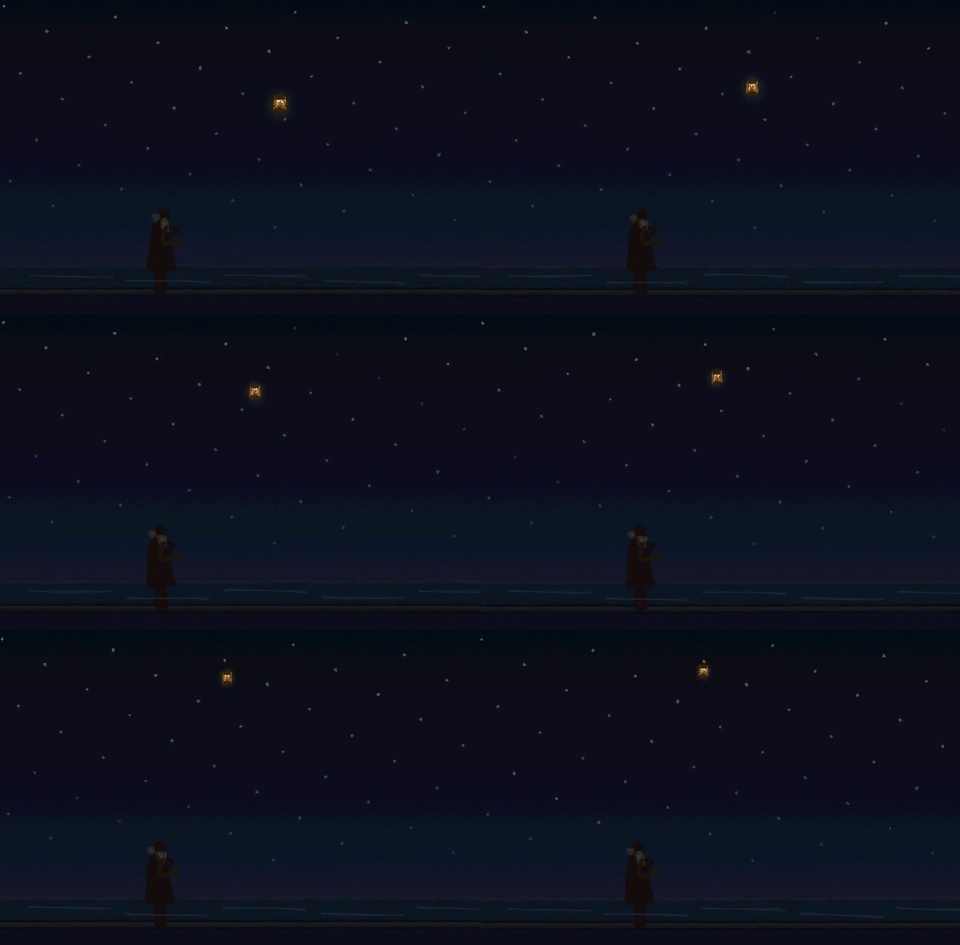
This is the closing shot of The Lantern Maker, a nine scene, three minute short film. An artisan crafts a paper lantern by lamplight, then carries it through a darkening town to release it from a bridge at night. Watch the full thing at docs/story-lantern-maker.mp4.
Nobody hand animated this. Devin built it cold, working from nothing but this repository's own docs, the same way every example in examples/ was built: an LLM writing TypeScript against a vocabulary, not a human hand authoring vector art. That is the actual point of sketchling. If a coding agent can read a README and come out the other side with a real hand drawn film, the vocabulary is doing its job.
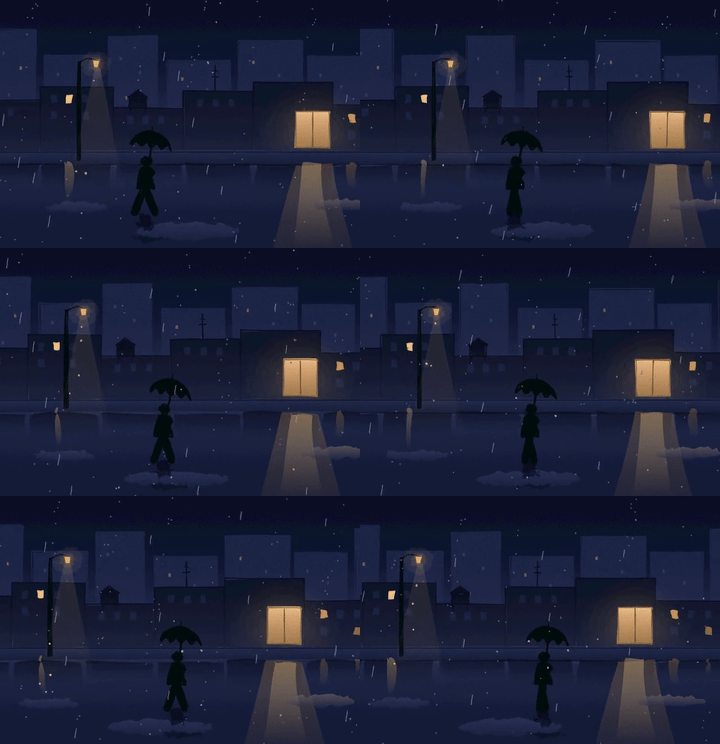
A few more scenes from the same batch, also built cold, also unedited:
 |
 |
More stills from the same set: lighthouse watch, campfire story, market street, summit sunrise, snow village, moonlit sail. Full videos for all of these live in docs/, source in examples/showcase/.
Everything above shares one register — hand-drawn ink, restrained and muted — because it's one batch, not a ceiling. Same library, same primitives, different look/texture, three more coding agents building cold on three unrelated subjects:
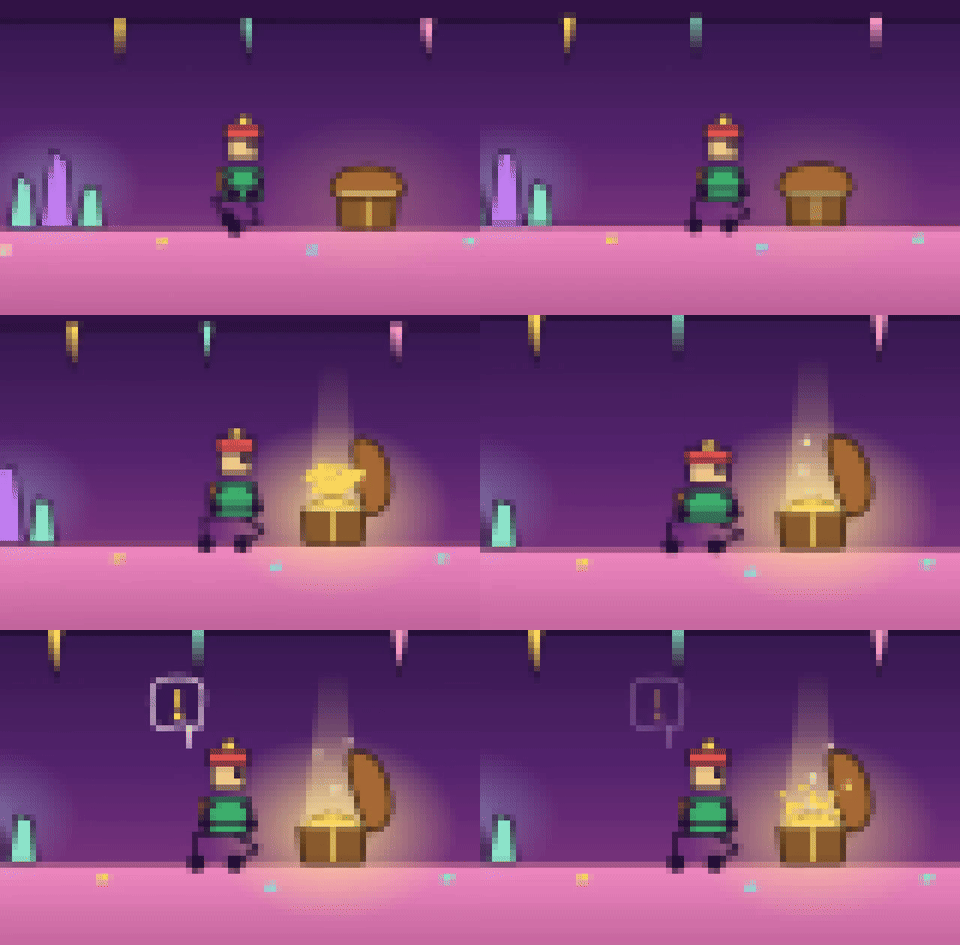 texture: "pixel" — candy-cave.ts |
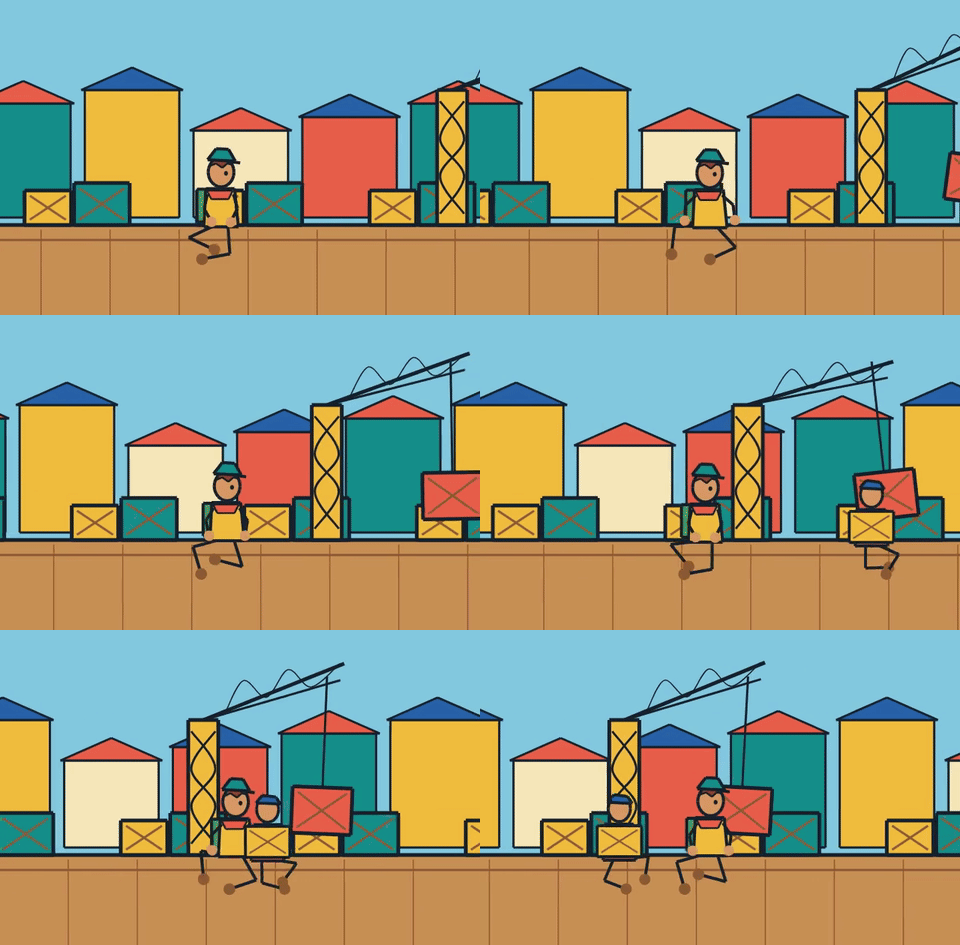 look: "flat" — harbor-explorer.ts |
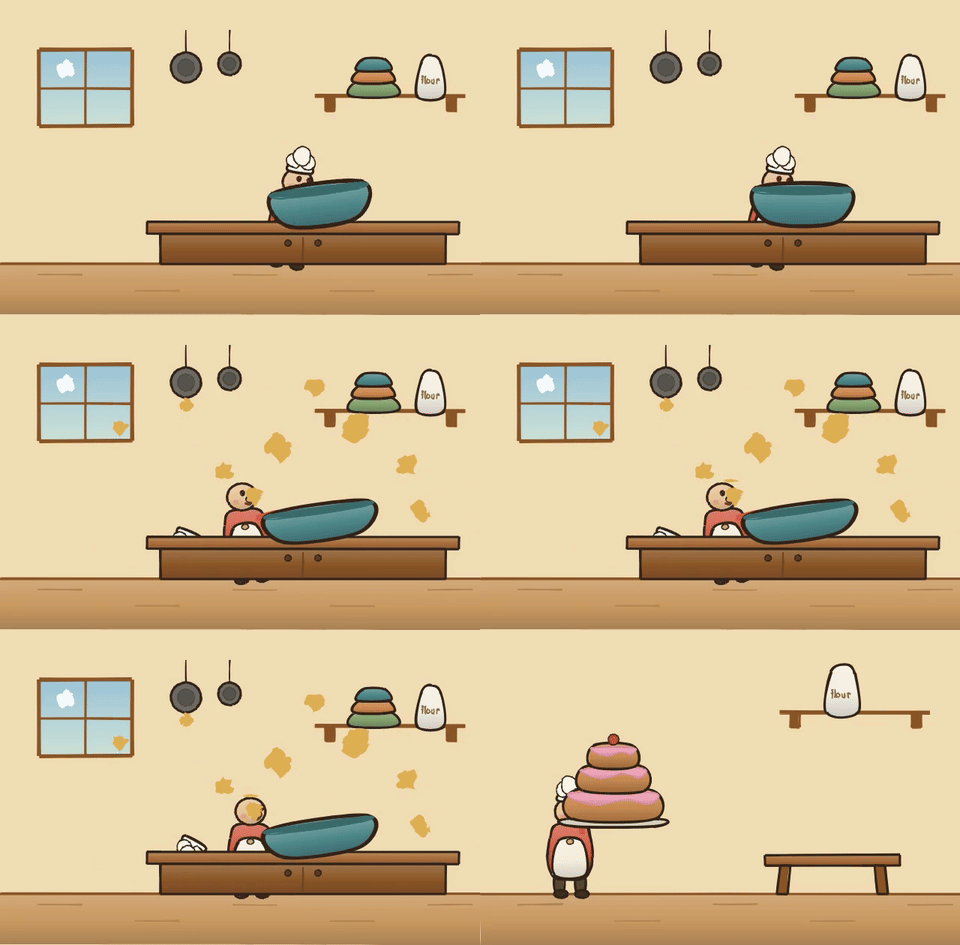 look: "clay" — clay-baker.ts |
Also real: a toon-shaded 3D toy robot (nursery-blocks.ts, look: "toon3d") and a film-grain jazz club with a synthesized score (late-set.ts, texture: "grain"). |
Playground
anaygarodia.github.io/sketchling runs the whole
vocabulary in a browser tab: write a scene, watch it draw itself, scrub the timeline, share a
render as a link. It is the same renderer the CLI drives, not a cut down demo — source and notes
in site/.
The loop, end to end
marketing/magic-moment.mp4 is thirty seconds of the whole idea:
a prompt asking for an illustration, the TypeScript an agent writes for it, and the animation
that code renders. The code in the clip is the code that produced the animation, andmarketing/build.sh rebuilds the whole thing from source.
Gallery
gallery/ is twelve short loops — a record player, a pendulum clock, wind moving
through wheat, a crab sidestepping — picked from forty eight scenes by rendering all of them and
keeping the ones that hold up. Every clip has its scene file beside it ingallery/scenes/, and gallery/build.sh regenerates the lot.
Install
npm install -g sketchling
npx playwright install chromium
The second line is a one time step. Rendering runs through a real headless Chromium browser (via Playwright), not a canvas library, so the first install pulls down a Chromium binary, a couple hundred MB. Video export also needs ffmpeg on your PATH. A still only workflow does not.
Quick start
import { sketch } from "sketchling";

const scene = sketch.scene({ width: 480, height: 420, background: "#7096c6" });

const lid = sketch.loop(
  [[70, 55], [330, 55], [330, 245], [70, 245]],
  { color: "#15130f", weight: "bold", looseness: 0.22, smooth: false }
);
scene.add(lid).drawOn({ at: 0, duration: 0.5 });

export default scene;
sketchling render scene.ts --out preview.png
sketchling render scene.ts --video preview.mp4 --fps 24
sketchling render scene.ts --serve
Working inside a clone of this repo instead of a published install? Import from ../src/index.js in place of "sketchling", or run npm link once you have built.
For coding agents
Every film in this README, including The Lantern Maker at the top, was built by handing an agent a prompt like this and nothing else:
Using the sketchling npm package, build a short hand-drawn animated film about
[subject]. Read AGENTS.md in the package for the full API. Pick a look/texture
on purpose instead of defaulting to look: "ink". Render it, run
`sketchling validate`, and fix anything it flags before calling it done.
AGENTS.md is the actual reference — every primitive, every animation, every gotcha found the hard way, written for an agent to read cold and act on, not summarized marketing copy. It's also installed as .claude/skills/sketchling/ and .agents/skills/sketchling/ so it loads automatically in repos that use those conventions.
Why this exists
Ask an LLM to hand code an SVG path for a person or a tree and you get something crude. Two choices make hand drawn illustration tractable for a model instead:
- The vocabulary is expressive, not geometric. There is no
Circle()orArc(). Primitives take character parameters likeweight,looseness, andenergy, not just coordinates. A loose stroke hides imprecision by design instead of exposing it. - The renderer is forgiving by default. Every shape draws through a rough.js based sketchy engine: jittered strokes, imperfect closure, variable width. Slightly off geometry reads as style, not as a mistake, the same slack that lets a hand drawn line hide a shaky hand.
Core capabilities
Hand drawn primitives. stroke, loop, blob, group, text, plus small compositions like arrow and speechBubble. Style knobs (weight, looseness, energy, fill) control how imperfect and how expressive a shape reads, not just its geometry.
Real animation, not just tweening. drawOn reveals a shape the way a hand actually draws it, tracing the outline first and filling in after, with a pen tip riding the leading edge. Line boil keeps a finished stroke subtly alive rather than looking frozen the instant it lands.
Labeled, relative scheduling. Every animation lives on one timeline, but you don't have to hand-compute absolute seconds for it: scene.label("liftoff", 4.2) names a moment, and any later at can reference it ("liftoff+0.4"), with node.endAt chaining a sequence off whatever just finished — instead of a wall of hand-tallied literals.
IK rigging and procedural gait. sketch.limb gives you a two bone chain solved from a target position. sketch.walk turns two of those into a full bipedal gait, feet planting without sliding, arms counter swinging with the legs, generated from step count and stride length rather than hand tuned per pose.
Camera and film. Pan and zoom through a world bigger than one screen, follow a moving character, or cut several independent scenes together into one continuous piece with sketch.film(), the tool The Lantern Maker itself is built with.
Secondary motion. springTo and sketch.connector give you damped spring lag and a bendable line that tracks a live target, the difference between an ear that snaps to a new angle and one that actually flops.
Real shading. sketch.shade(baseColor, options) derives a full highlight to shadow gradient from one color and a light direction, instead of hand picking two or three hex values per shape.
Particles and sound. A closed form particle emitter (sparks, snow, confetti, dust) with no simulation step, and sketch.sound() for scheduled notes and hits synthesized directly into the exported video's audio track.
Five looks, three textures. "ink", "flat", "clay", "lit3d", and "toon3d" change how geometry itself renders. "watercolor", "grain", and "pixel" are an independent whole frame texture layered on top of any of them.
The complete reference for all of this, including every gotcha found the hard way, lives in AGENTS.md — see "For coding agents" above.
How it works
A scene graph is built by running your scene.ts in plain Node, no DOM involved, which is cheap enough to lint before a single pixel exists. That serialized scene is then handed to a headless Chromium page, where rough.js draws it as SVG and GSAP drives the timeline. Renders are deterministic: the same scene at the same timestamp produces byte identical output, which makes cmp a real verification tool, not just an eyeball check.
Status
Early and opinionated by design. The bet is a small, well designed vocabulary — primitives with character, not a Circle()/Arc() geometry API — beats a sprawling one that does everything adequately. Five looks and three textures exist today ("ink", "flat", "clay", "lit3d", "toon3d", "watercolor", "grain", "pixel"), because "opinionated" means a small deliberate vocabulary, not one fixed aesthetic — the gallery above is five of them on five unrelated subjects, not one register wearing different clothes.
Contributing
Issues and PRs are welcome. See CONTRIBUTING.md for setup, how to verify a change by actually rendering it, and what a good PR looks like. CHANGELOG.md tracks what shipped in each version.
License
MIT. See LICENSE.
Yorumlar (0)
Yorum birakmak icin giris yap.
Yorum birakSonuc bulunamadi