abliterate
Health Uyari
- License — License: MIT
- Description — Repository has a description
- Active repo — Last push 0 days ago
- Low visibility — Only 5 GitHub stars
Code Gecti
- Code scan — Scanned 12 files during light audit, no dangerous patterns found
Permissions Gecti
- Permissions — No dangerous permissions requested
Bu listing icin henuz AI raporu yok.
Security review of source changes before the push: a skill for Claude Code and Codex, a read-only engine (sinks, attack surface, OSV/KEV/EPSS reachability, variants), a pre-push hook and a GitHub Action with SARIF.
Catch the vulnerability before the push.
abliterate helps a team check its own source changes before a push or merge. Which product rule does this change break, and which test would catch it? The reviewer reads the supplied checkout, traces the changed path and reports what the evidence supports. An application URL can identify the route to look up in code. The running application stays outside the review.
It has three parts that work together:
- A skill for Claude Code and Codex. It traces attacker-controlled data from the entry point to the sink, finds the guard on that exact path, and tries to disprove every suspicion before reporting it.
- An engine, the
abliterateCLI. It collects evidence the agent can trust: which states changed, attack surface, candidate sinks, vulnerable dependencies with reachability, and variants of past fixes. - A git integration: a pre-push hook and a GitHub Action that report every pull request to code scanning and in one PR comment.
There is no abliterate model or service. The reasoning runs in your agent, with its permissions. The engine runs locally and is read-only.
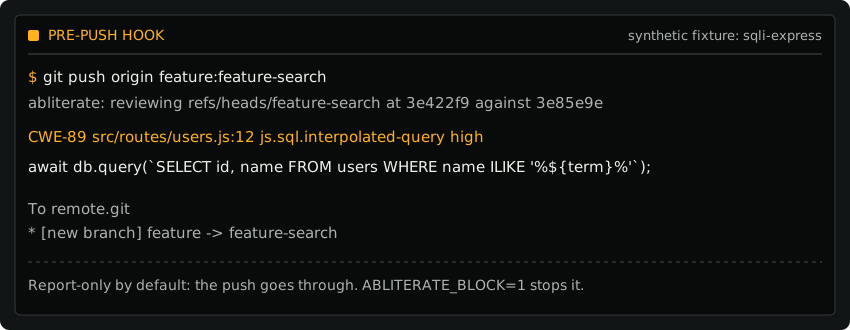
Real output of the pre-push hook on the synthetic sqli-express fixture (evals/make_fixtures.py), trimmed to the essential lines.
Install
Claude Code (plugin: both skills and a read-only reviewer agent)
/plugin marketplace add andreaborio/abliterate
/plugin install abliterate@abliterate
Codex
codex plugin marketplace add andreaborio/abliterate
Any agent with Agent Skills
npx skills add andreaborio/abliterate --skill abliterate-review --skill abliterate-variants
The engine needs no install: npx -y abliterate@latest --help.
Try a review
Review the changes our team would push against main. Use the local diff, callers and tests to check our product's security rules. Report confirmed regressions and suggest a test with synthetic data for each. Leave files unchanged.
The skill runs the engine, traces each lead, and reports only what it could demonstrate. Each confirmed finding comes with:
- the
file:line; - the actor;
- the broken rule;
- the effect;
- a fix;
- the test that fails before the fix.
Suspicions it could not settle are listed separately, with the one fact that would decide them.
Other requests:
- Check whether a fix was complete: "Is CVE-2021-23337 reachable here?" or "Did the XSS fix in a1b2c3 miss similar code?"
- Design mode: "Design the access rules for a shared invoice before I write the endpoint."
- Fix mode: "Fix the confirmed IDOR and add the regression test."
The engine
npx -y abliterate@latest <command>
| Command | Output |
|---|---|
scope --base main |
Verified review states: commits since the merge-base, staged, unstaged, untracked |
surface --changed |
Routes, server actions, jobs, webhooks and CI triggers in changed files, with the auth names on each |
sinks --changed |
Candidate vulnerable lines by CWE, marked with the snapshot that introduced them |
deps --changed |
New or updated dependencies, OSV advisories, CISA KEV and EPSS data, and imports or calls observed in the inspected source |
variants --history |
Patterns that past security fixes in the repo removed, still present elsewhere |
variants --from CVE-… |
The same, seeded from an advisory, a fixing commit or a GitHub commit URL |
report --in findings.json |
Validates the agent's findings and writes SARIF 2.1.0 and markdown |
hook install |
A pre-push hook with the fast checks; non-blocking unless ABLITERATE_BLOCK=1 |
Candidates are leads, not findings. The rules recognise common guards (parameterised queries, allowlists, safe_join, sanitisers) and stay quiet when one sits on the same path. Secrets are never printed.
What leaves your machine
depssends package names and versions toapi.osv.dev, and CVE ids toapi.first.org(EPSS). It downloads the CISA KEV feed.variants --fromfetches a public advisory or GitHub patch.- Nothing else contacts the network. Source code, file paths and repository names are never sent.
- Offline use:
--offlineuses only the local cache (~/.cache/abliterate), anddeps --inventorylists packages with no network at all.
Pre-push hook
Run abliterate hook install in the repository with Git 2.41 or newer. To replace a hook generated by 0.2.0 after upgrading, run npx -y [email protected] hook install. Each ref in a push is reviewed using the commit Git is sending. The engine reads code, attributes and dependencies from that commit. An optional agent gets a temporary repository with that commit as HEAD and no project files checked out.
For an existing ref, the comparison starts at the remote tip advertised by Git, including for forced updates. For a new ref, the hook looks for a common ancestor with the outgoing branch’s upstream on that remote, the locally known remote default or main/master, then a local main/master. The hook reports an incomplete comparison when it lacks a base. Deletions and tags pointing at a tree or blob have no commit to review.
By default the hook reports and allows the push. Set ABLITERATE_BLOCK=1 to stop on a high-confidence candidate or an unavailable commit comparison. Set ABLITERATE_DEPS=0 to skip advisory lookups.
PHP and Ruby path candidates
The php.path.request-path and rb.path.request-path engine rules trace request
values into PHP file reads/includes and Ruby file reads/send_file. They follow
local assignments and interpolation, recognise basename on the actual path,
and report separator-bounded confinement checks as guarded only when they precede
the sink and apply to that resolved path. Use sinks --include-guarded to inspect
the guard evidence. These bounded, same-function heuristics are review leads;
dynamic dispatch, helper functions, aliases across calls, filesystem symlinks and
more complex control flow still require tracing. A plain realpath orRails.root.join without confinement does not suppress a candidate.
GitHub Action
name: abliterate
on: pull_request
permissions:
  contents: read
  pull-requests: write     # the PR comment
  security-events: write   # code scanning upload
jobs:
  review:
    runs-on: ubuntu-latest
    steps:
      - uses: actions/checkout@v4
        with:
          fetch-depth: 0
      - uses: andreaborio/[email protected]
        with:
          agent: claude                       # none | claude | codex
          anthropic-api-key: ${{ secrets.ANTHROPIC_API_KEY }}
          fail-on: high
What the job does:
- Engine evidence is collected on every PR, with no key.
- With an
agent, Claude Code or Codex reviews the PR read-only, following the skill, and writes findings that the engine validates. - Results go to code scanning as SARIF, and one PR comment is created and then updated.
- Each run stores its evidence and report under
RUNNER_TEMP. Thefindingsandsarifaction outputs give their paths. When an agent step is skipped, fails or returns an invalid report, the action uses the current run's engine evidence.
When the check fails:
fail-onfails the check only on confirmed findings introduced by the PR.- Without an agent nothing is confirmed. Engine candidates appear as notes, and
block-on-candidates: trueturns high-confidence candidates into a failing check.
Safety:
- The workflow uses
pull_request, neverpull_request_target. - The agent step is skipped for forks, which have no secrets.
- The agent may not run the PR's code.
How it is verified
engine/tests (npm test) run every rule against 14 synthetic repositories (evals/make_fixtures.py). Each repository seeds one vulnerability next to a guarded twin that must not be flagged. The tests also check that:- SARIF validates against the official OASIS schema;
- OSV, KEV and EPSS lookups replay recorded responses.
- Release check (
python3 build.py && python3 verification/check_release.py): installs the built npm and PyPI packages and checks that they behave identically. - Agent evals (
claude plugin eval .): run the plugin on cases underevals/cases/, against a no-plugin baseline.
Engine results are deterministic. Agent results are measured, not guaranteed.
Development
The skills in skills/ are the source of truth, shared by the plugin, the npm package and the PyPI package. The engine is TypeScript in engine/src, bundled into one dependency-free file. See CONTRIBUTING and the security policy.
MIT license.
Yorumlar (0)
Yorum birakmak icin giris yap.
Yorum birakSonuc bulunamadi