claude-burst
Health Warn
- License — License: MIT
- Description — Repository has a description
- Active repo — Last push 0 days ago
- Low visibility — Only 5 GitHub stars
Code Fail
- rm -rf — Recursive force deletion command in install.sh
Permissions Pass
- Permissions — No dangerous permissions requested
No AI report is available for this listing yet.
Local gateway for Claude Code: your Claude subscription first, overflow to Together AI (GLM), OpenRouter, any OpenAI-compatible endpoint or Amazon Bedrock, or a metered Anthropic API key. Pauseless compaction for long sessions. Keeps Remote Control working.
Claude Burst
Your Claude subscription as the engine. Together AI's GLM as cheap overflow, with the overflow trimmed before it is paid for.
Claude Burst is a Mac-only local gateway for Claude Code:
Overflow. It keeps your normal Claude Pro/Max login as the primary credential, watches Anthropic's own subscription rate-limit headers, and only when Anthropic says a model's allowance is actually exhausted does it send that model's requests to a secondary, this README works through Together AI serving GLM, then returns to the subscription when the reset timestamp arrives.
Overflow pruning. Every overflow request resends the whole conversation to a metered provider, and most of it is old tool output. Before it is sent, tool results older than the most recent 10 are replaced with a one-line note, and any single result over 40 KB keeps only its start and end. The subscription is never pruned: Anthropic caches its context, and rewriting it on every request would break the cache (pauseless compaction, below, rewrites it once, on purpose). The dashboard's Context & cache panel has the switches, what was not sent, the cache hit rate per route, and a verdict that turns red if pruned requests fail more often than unpruned ones.
Pauseless compaction (experimental, off by default). Long subscription sessions are compacted in the background, with no pause. When a session's context passes a threshold (default 400k), Burst has the same model summarise the older history while you keep working, and swaps the summary in on your next prompt. See Pauseless compaction.
Token shunting, an earlier second job for the secondary, was switched off on 2026-09-21 because it saved nothing, and has been removed from the dashboard; see Token shunting.
The secondary is a pluggable slot. Together AI and OpenRouter (or any other OpenAI-compatible chat-completions endpoint) can do both jobs. Amazon Bedrock is supported for overflow only and cannot be a shunt worker. A direct Anthropic API key is available if you would rather stay on Anthropic's own billing. See Together AI, OpenRouter or any OpenAI-compatible secondary.
This is an experimental MVP. Test it on a non-critical development account before any broader rollout.
No Claude subscription? Claude Burst also supports a direct, metered Anthropic API key as the primary route instead of subscription passthrough (see No-subscription setup below). In that mode there's no included allowance to burst from, so failover to the secondary is triggered by sustained failures instead of subscription-exhaustion headers, both routes are metered, so a single transient error doesn't flip traffic to a second paid provider.
Dashboard
Claude Burst runs a local dashboard beside the gateway, on port 7788:
open http://127.0.0.1:7788
It binds loopback only and needs no login (see the admin UI for how it is protected). Change the address with claude-burst configure --admin-listen 127.0.0.1:PORT, turn it off with --admin-listen off, or give it a friendlier name with a friendlier admin URL.
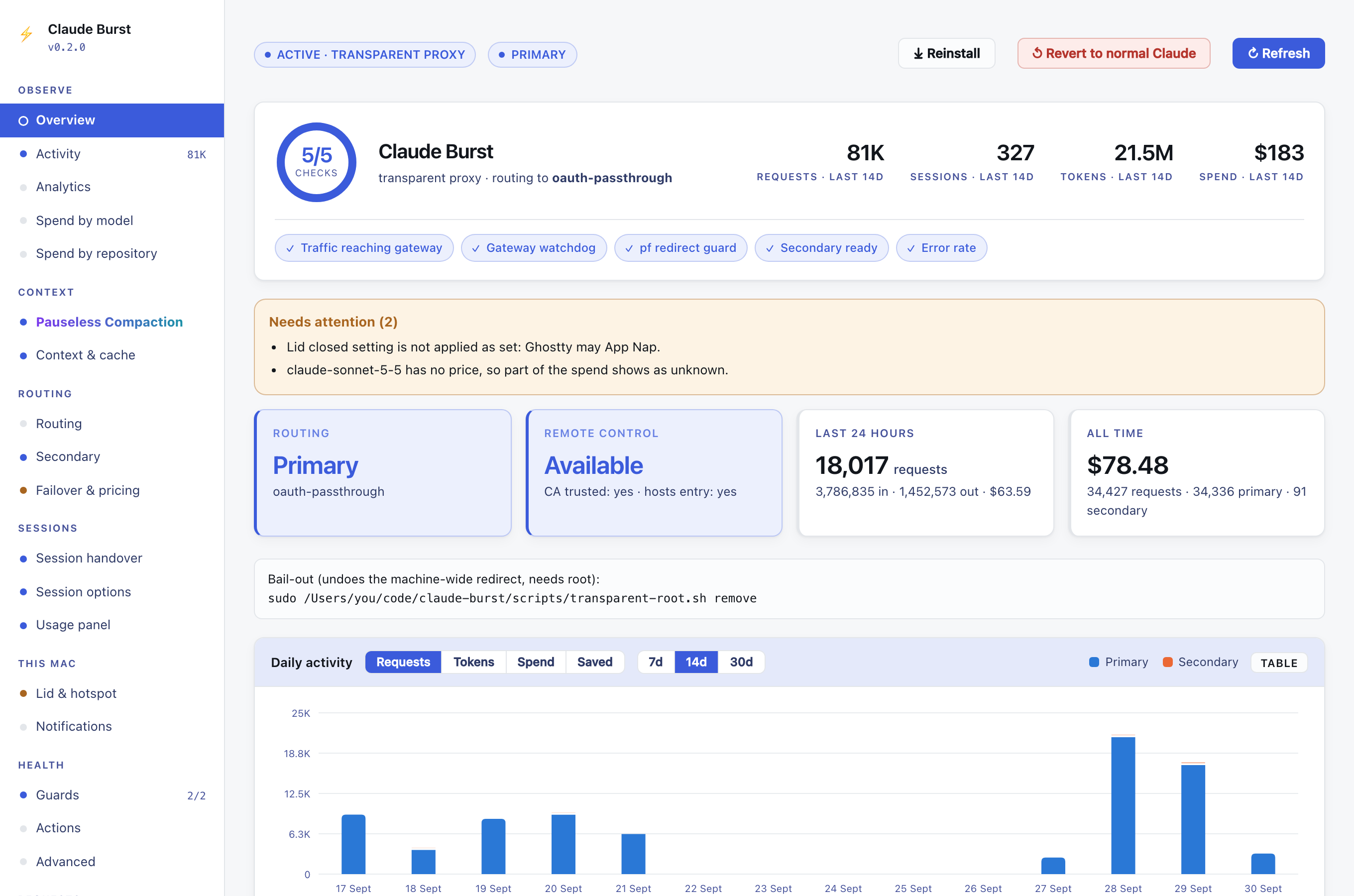
The menu down the left follows you as you scroll, grouped by job:
- Observe: Overview, Activity, Analytics (latency, error rate, spend per model, and spend per repository, each session filed under the repository its Claude Code transcript says it ran in), Responses, Requests.
- Context: Pauseless Compaction, Context & cache.
- Routing: failover strategy and intercept mode, Secondary, Failover & pricing.
- Sessions: Session handover, Session options, Usage panel.
- This Mac: lid closed and hotspot, Notifications.
- Health: Guards, Actions.
- Setup: Install, Advanced (timeouts and limits).
Every control section says where it is saved and when it applies, as a chip beside its title: applies at once, applies to the next session, or applies after a restart. Settings the gateway only reads at startup (pricing, fallback models, failover thresholds and strategy, intercept mode, the secondary, timeouts and limits) are compared with the running gateway, and a banner at the top lists any that are saved but not yet in use, with a Restart the gateway now button.
A Needs attention list above the overview collects everything not doing what it is set to do, each linking to its section: a guard not running, handover hooks half installed, the lid setting not applied as set, another program keeping the Mac awake, a failed usage panel install or removal, and models served without a price.
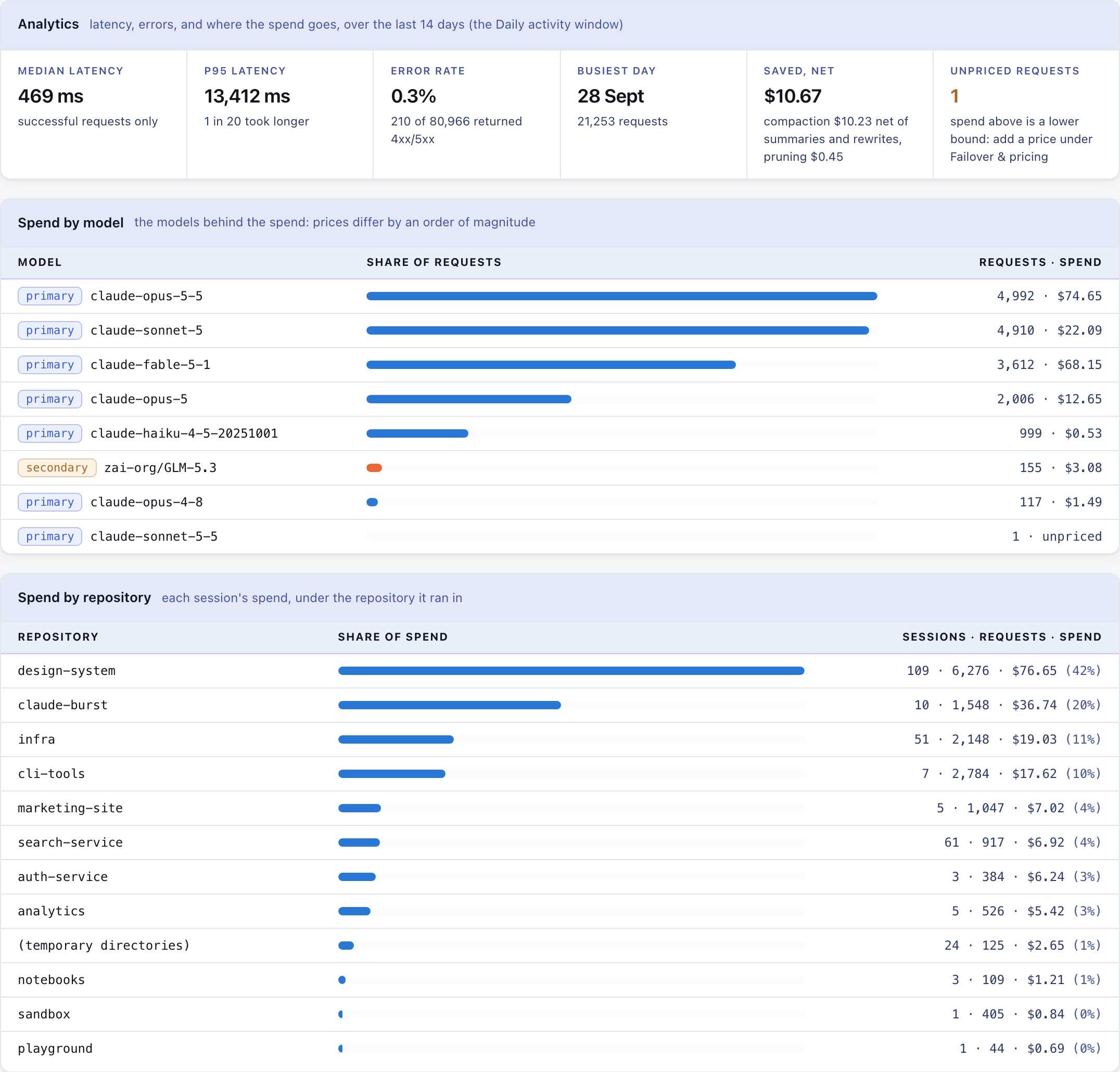
Screenshots are of a real dashboard with session ids, repository names and dollar figures replaced.
Supported providers
Primary and secondary are independent, pluggable slots (internal/router/provider.go), nothing here is tied to one vendor:
| Slot | Options |
|---|---|
| Primary | oauth-passthrough - your existing Claude Pro/Max subscription login (the default, and the setup this whole README describes first) · anthropic-api-key - a direct, metered Anthropic API key, for accounts with no subscription |
| Secondary | openai-compatible - Together AI (the worked example, serving GLM), OpenRouter, or any other OpenAI-compatible chat-completions endpoint · bedrock - Amazon Bedrock · none - disable overflow entirely |
What each secondary can do:
| Secondary | Overflow | Token-shunting worker |
|---|---|---|
| Together AI, OpenRouter, any OpenAI-compatible endpoint | yes | yes |
| Amazon Bedrock | yes | no |
Bedrock speaks Anthropic's Messages format natively and is relayed byte-for-byte. The OpenAI-compatible providers go through a translator in both directions. The shunt worker makes one plain chat-completions call, which is why only that family can serve it.
See Together AI, OpenRouter or any OpenAI-compatible secondary for the worked examples, and Configuration for every field.
Keeping Remote Control. Pointing Claude Code at any local gateway normally costs you its Remote Control feature, Claude Code disables Remote Control the moment ANTHROPIC_BASE_URL names anything other than api.anthropic.com, and the default setup below sets exactly that variable. Claude Burst's transparent intercept mode solves this by never touching ANTHROPIC_BASE_URL at all: instead of using that config mechanism, it gets into the path a level lower, at DNS, so Claude Code's own settings never change and it believes it is still talking to api.anthropic.com directly. See Keeping Remote Control: transparent intercept mode below.
Pauseless compaction: long sessions without the pause (experimental)
Claude Code's /compact stops the session while it summarises. Burst's compaction never does.
On the subscription every turn re-reads the whole conversation, so a turn at 400k tokens costs about four times one at 100k and uses up your limits four times as fast. Claude Code only compacts near the end of its 1M window. With pauseless compaction on:
- When a session's context passes Compact at (default 400k), Burst sends one background request, on your subscription with the session's own login, asking the same model to summarise everything before your latest prompt. It takes about 40 seconds and you keep working.
- The summary request resends the history exactly as Claude Code last sent it, so it reads from cache rather than paying for the whole context again.
- From your next prompt, Burst sends the summary in place of those messages. Claude Code keeps its full local history and sees no difference. CLAUDE.md and other session context are carried over word for word. Thinking from before the summary is dropped, as Anthropic requires when history changes.
/clear,/compactor a rewind make the summary stop fitting, and requests then go through untouched.- A session is compacted at most once per window (default 60 minutes), a warning is logged at Warn at (default 300k), and state survives a gateway restart.
What it did in its first day (one long Opus 5.5 session, 2026-09-29 to 30): three summaries, the biggest drop 611k tokens to 49k with recall intact. Over 306 requests that is $25.12 saved net: $30.57 of context not resent, less $5.27 for the summaries and $0.19 for cache rewrites. The first two summaries cost $2.10 and $2.96 because they did not read the session from cache; the fix brought the third down to $0.21.
How the savings are calculated
A compacted request does not record what it would have sent without Burst, so the dashboard works it out by replaying each session from metrics.jsonl, request by request, beside a "without Burst" twin:
- The twin grows as the session grows. On every request the twin's context changes by exactly as much as the real one, except that it never takes Burst's drops.
- Claude Code compacts the twin. Without Burst the session would not grow past the 1M window: Claude Code compacts on its own near the end of it. When the twin reaches 950k (95% of the window; Claude Code does not publish its exact threshold), it is compacted back down to the size of one of Burst's summaries. So fifteen compactions never claim fifteen windows of saving, and just after the twin has been compacted it can be smaller than the real session; those requests count against Burst.
- Saving per request = twin context minus real context, priced at the model's cache-read rate (in a long session every resent token is a cache read).
- Net saving = the sum of those, less every summary call, less the extra cost of writing each shortened history to cache on the request after a swap (where the twin would only have read). The twin's own compactions by Claude Code are not credited back, so the net figure errs low.
- All figures are API-equivalent: on a subscription the real effect is using your limits more slowly, not a smaller bill.
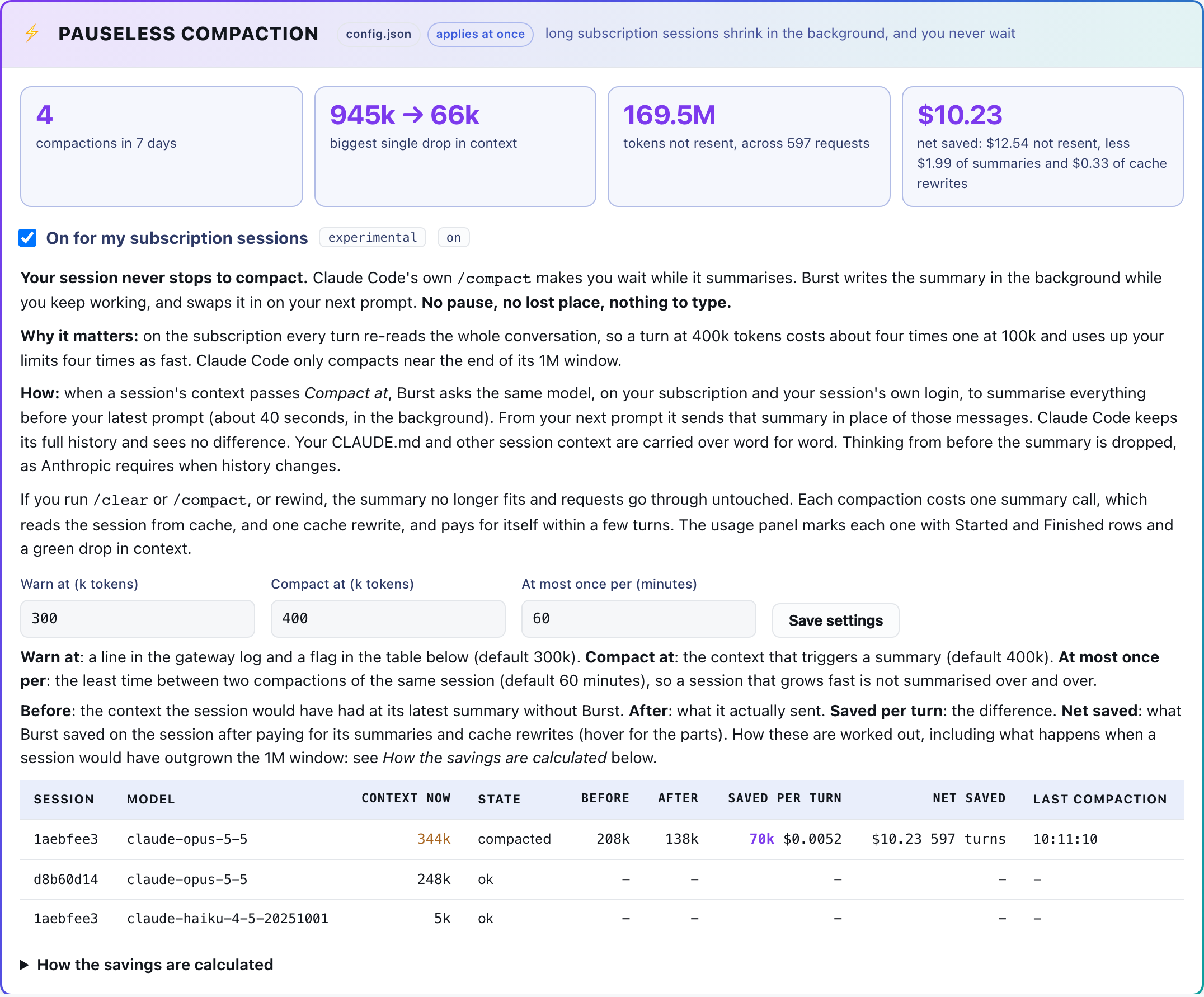
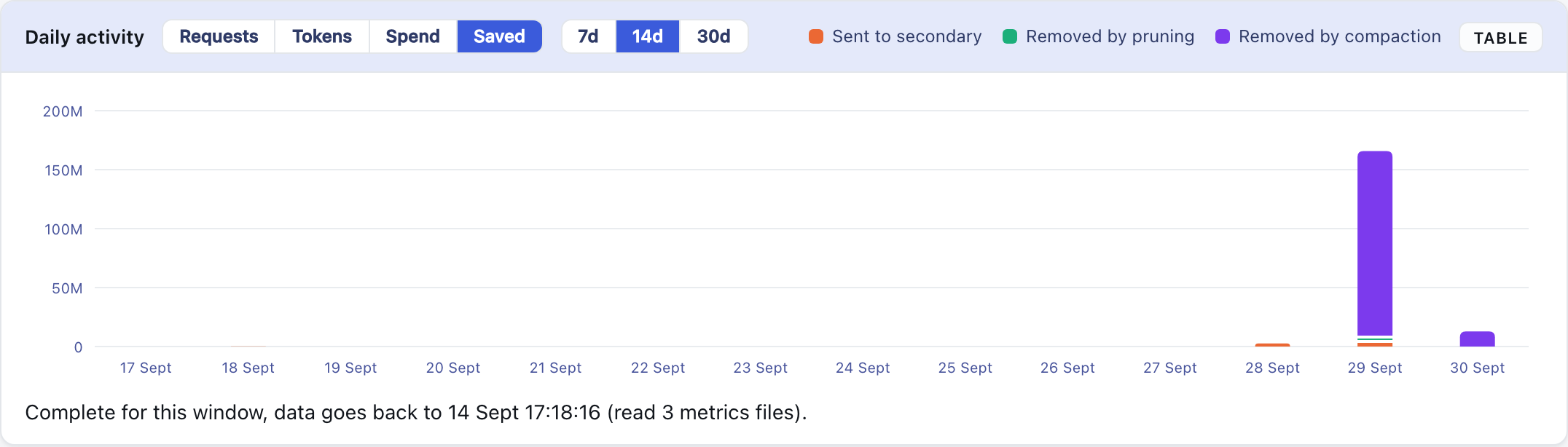
The dashboard shows the net figure in the Pauseless Compaction section (per session, with the parts on hover), in the Saved, net tile under Analytics, and per day in the Saved chart's tooltip. The same explanation is on the page under How the savings are calculated.
Where to see it:
- Dashboard, Pauseless Compaction (its own entry in the menu): the on/off switch and thresholds, headline figures for the last 7 days, and a table of sessions with context before and after the latest summary, the saving per turn, and the net saving after summaries and cache rewrites.
- Dashboard, Daily activity, Saved: compaction's tokens not resent, stacked with what overflow pruning removed, per day. The tooltip shows what each saved and what the summaries cost.
- Usage panel: Started and Finished rows in the turn table, a green negative context delta on the turn where the summary landed, and the summary's cost in the session total.
Keeping Claude Code working with the lid shut (optional)
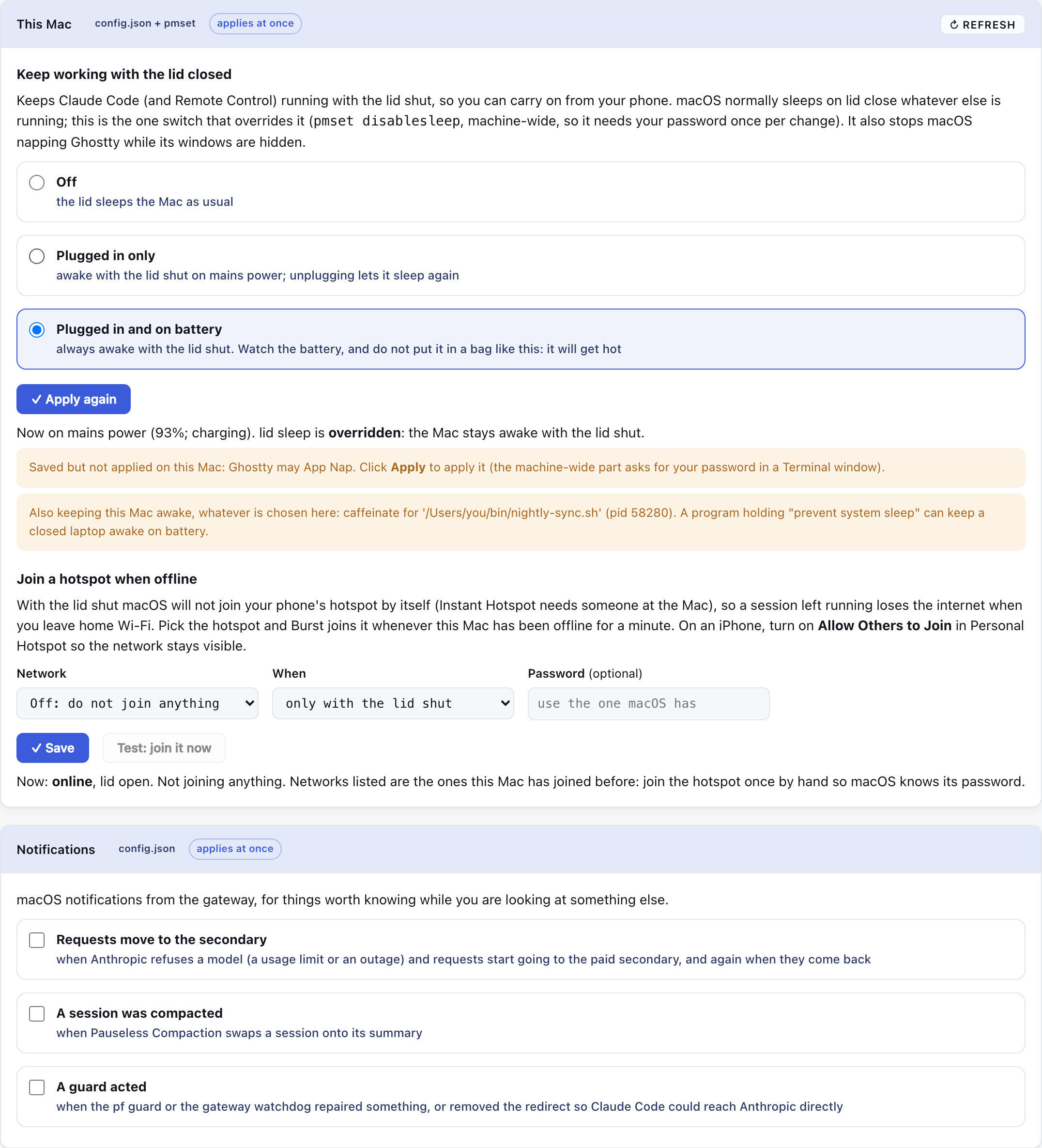
Off by default. keep_awake_lid_closed in config.json keeps a Claude Code session in Ghostty running, and Remote Control reachable, after you close the lid. keep_awake_lid_closed_power picks when:
keep_awake_lid_closed_power |
Lid shut, plugged in | Lid shut, on battery |
|---|---|---|
ac (default) |
stays awake | sleeps as normal |
always |
stays awake | stays awake |
claude-burst configure --keep-awake-lid-closed true                 # mode ac
claude-burst configure --keep-awake-power always                    # switch mode
claude-burst configure --keep-awake-lid-closed false                # undo
sudo scripts/lid-awake-root.sh apply ac                             # printed for you if sudo is not cached; ./install.sh re-applies it from config.json
pmset -a disablesleep 1(root), the only switch that overrides clamshell sleep;caffeinateandpmset sleep 0do not. The prior value is recorded and restored byremove.- Mode
acneeds a root LaunchDaemon (ninja.andrewbaker.claude-burst-lidawake): SleepDisabled is one global value with no per-power-source form, so the daemon followspmset -g pslogand sets it on plug-in and unplug. It runs a root-owned copy in/usr/local/libexec/claude-burst; re-runapplyafter editing the script. Log:/var/log/claude-burst-lidawake.log. - Ghostty App Nap off (
NSAppSleepDisabled, no root), with the lid shut every window is occluded, which is when macOS throttles the app. Takes effect on Ghostty's next launch. claude-burst statusshows the flag, the mode, the power source and the machine's actual state, and flags drift either way.
With always, a closed laptop never sleeps: on battery in a bag that means heat and a flat battery. That is why ac is the default.
./install.sh applies whatever config.json says (nothing at all when false), and ./install.sh uninstall removes the daemon and restores the prior sleep setting. Check it is live with claude-burst status:
keep awake lid closed: on, mode ac (now on AC: SleepDisabled on, Ghostty App Nap disabled on)
Any line starting -> beneath it is drift, with the command that fixes it.
From the dashboard (This Mac, Lid & hotspot): pick Off, Plugged in only (ac) or Plugged in and on battery (always, asks you to confirm). It saves config.json, sets Ghostty's App Nap, and applies the root half with cached sudo or in a Terminal window that asks for your password. It shows the live state (power source, battery, whether lid sleep is overridden) and anything not applied as set.
It also lists other programs keeping this Mac awake: any process holding a PreventSystemSleep assertion (for example caffeinate -s) keeps a closed laptop awake on battery whatever this setting says. The idle assertions caffeinate -i takes, which Claude Code holds, do not, so they are not listed.
Join a hotspot when offline
With the lid shut macOS does not join a phone's hotspot by itself (Instant Hotspot is driven from the Wi-Fi menu while someone is at the Mac), so a session left running loses the internet when you leave home Wi-Fi. Off by default.
- Pick the network from a dropdown of the networks this Mac has joined before (
networksetup -listpreferredwirelessnetworks). Join the hotspot once by hand first, so macOS has its password. - When: only with the lid shut (default), or any time this Mac is offline.
- Offline means unreachable, not "on the wrong network": a TCP connect to
1.1.1.1:443and8.8.8.8:443, by address, so the/etc/hostsredirect does not affect it. The SSID is not checked because since macOS 14.4networksetup -getairportnetworkreports "not associated" to processes without Location access even while connected. - Checks every 30s; joins after two failed checks in a row, and retries at most every 2 minutes. The gateway runs the watcher and re-reads
config.jsoneach check, so changes need no restart. - Password: optional, stored in the login Keychain as service
claude-burst-hotspot. Without one,networksetupuses the password macOS already has. - On an iPhone, turn on Allow Others to Join in Personal Hotspot, or the network is not visible to a Mac nobody is using.
- Test: join it now joins immediately (leaving the current Wi-Fi) and reports whether the Mac is online afterwards.
- Log:
~/.config/claude-burst/hotspot.log, also shown on the page.
Notifications
macOS notifications (through osascript) for events worth knowing while you look elsewhere, each switched on separately in This Mac, Notifications:
- Failover: requests move to the paid secondary, and again when they come back.
- Compaction: Pauseless Compaction swapped a session onto its summary.
- Guards: the pf guard or the gateway watchdog repaired something, or removed the redirect.
Starting the gateway announces nothing already true. config.json is read live, so no restart.
Session handover: HANDOFF.md read at start, written at close (optional)
Two Claude Code hooks, installed and adapted from the dashboard's Session handover section. They only act in a repo whose git root has a HANDOFF.md: create one (even empty) to opt a repo in.
- SessionStart (new session or
/clear): Claude is given a briefing, the newest handover section, the commits sinceHANDOFF.mdlast changed,git statusand the repo's layout, and told to skim the code it names before answering. - SessionEnd (
/exit, Ctrl-D,/clear, or closing the Ghostty window, which Claude Code reports as reasonother): a detached job (setsid, so the window's SIGHUP cannot kill it) resumes a fork of the finished session with the writer model, has it prepend a dated section toHANDOFF.md, and commits that one file locally. It never pushes. Sessions with fewer typed prompts than the minimum are skipped, and so is a session with nothing worth handing over. A macOS notification says when it is done.
The dashboard edits the briefing text, the writer's instructions, the writer model, the minimum prompts and whether to commit, and shows the log. Settings: ~/.config/claude-burst/handover.json (defaults stored as empty, so they follow new defaults). Scripts, the settings they read, the log and the writer's last reply: ~/.config/claude-burst/handover/. The scripts are embedded in the binary and rewritten when they differ, so edit internal/handover/scripts/, not the installed copies.
Cost: the writer re-reads the whole session, so a long session costs about one more turn of it. Pick a cheaper writer model to spend less.
Session options and the usage panel
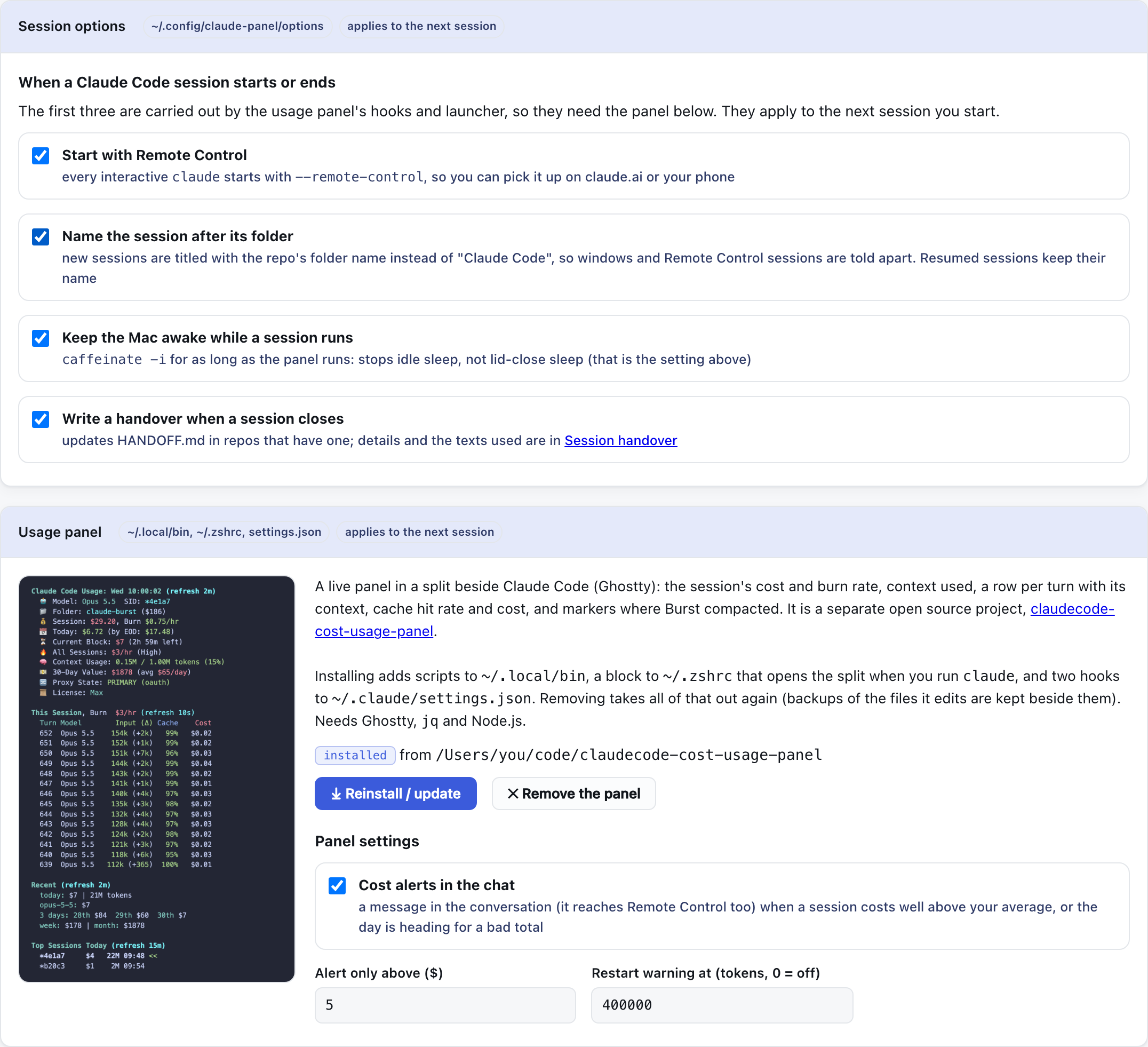
Session options (Sessions menu) apply to the next session you start. The first three are carried out by the usage panel's hooks and launcher, so they need it installed, and are saved in ~/.config/claude-panel/options:
- Start with Remote Control: every interactive
claudestarts with--remote-control. - Name the session after its folder: new sessions are titled with the repo's folder name instead of "Claude Code". Resumed sessions keep their name.
- Keep the Mac awake while a session runs:
caffeinate -iwhile the panel runs. Stops idle sleep, not lid-close sleep. - Write a handover when a session closes: the same switch as in Session handover.
Usage panel (Sessions menu): a live panel in a Ghostty split beside Claude Code, showing the session's cost and burn rate, context used, a row per turn with its context, cache hit rate and cost, and where Burst compacted. The section explains what it installs and shows a masked screenshot.
- Install runs the panel's
claude-panel-setup.shfrom a checkout beside this repo, cloning it first if there is none. It adds scripts to~/.local/bin, a block to~/.zshrc, and two hooks to~/.claude/settings.json. - Remove (click twice to confirm) runs the panel's
claude-panel-uninstall.sh, which takes all of that out and keeps backups of the files it edits. Removing it also turns off the three session options above. - One install or removal at a time; its output is shown on the page.
- Panel settings: cost alerts in the chat (on or off), the minimum dollar amount before a session alert fires, and the context size that shows a red restart warning (0 turns it off).
Failover & pricing
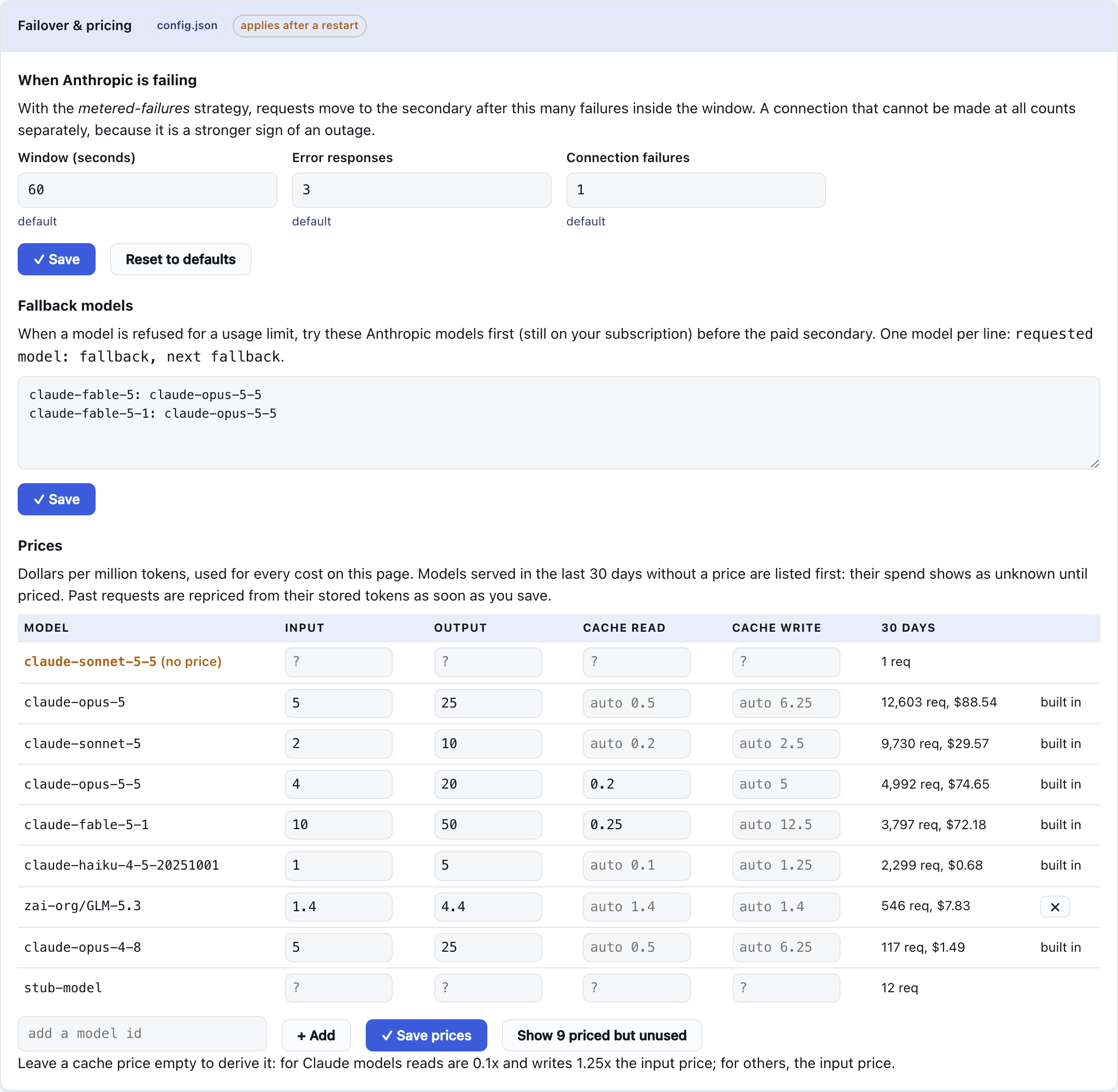
Routing menu, saved in config.json, applies after a restart (the banner offers it):
- When Anthropic is failing: the
metered_failoverwindow, error responses and connection failures, each marked when changed from its default, with Reset to defaults. - Fallback models:
fallback_chain, one line per model (requested model: fallback, next fallback), tried on your subscription before the paid secondary. - Prices: every model with a price, plus every model served in the last 30 days, unpriced models first, with requests and spend per model. Add, edit or remove a price (a built-in price can only be reset to its built-in value, since built-ins are merged into every load; an empty cache price is derived from the input price); past requests recorded as unpriced are repriced from their stored tokens once saved.
Advanced (Setup menu, collapsed): reset_grace_seconds, unknown_reset_seconds, response_header_timeout_seconds and max_request_mb, each marked when changed from its default. The gateway and dashboard addresses and TLS peer logging are shown read only: they change what Claude Code connects to, so they are set with claude-burst configure and a reinstall.
Why this exists
Anthropic exposes materially different commercial models for access to the same Claude model families:
- Claude Max is a fixed monthly subscription with rolling usage limits.
- Claude API is metered by token.
- Together AI, OpenRouter and Amazon Bedrock all offer metered access to Claude-family or comparable models outside Anthropic's own billing.
Anthropic's Claude Code gateway documentation explicitly supports ANTHROPIC_BASE_URL with an existing claude.ai subscription login. Setting only the base URL keeps the subscription credential active and the subscription's usage limits and billing continue to apply. Claude Burst uses that supported gateway mechanism and respects the subscription limit rather than trying to evade it.
Token shunting: keep the boring work out of Claude's context
Switched off on 2026-09-21, and not recommended. In its first day it blocked 12 direct
reads in real plugin projects and delegated none of them: Claude read the files in windows
instead, which the guard deliberately allows. Full reasoning and the evidence:
DECISION-token-shunting-off.md, including how it compares
with the article it was built from (the design matches; the workload and the test did not).
It has been removed from the dashboard; theclaude-burst shuntcommands remain so an
old install's hook and skill can still be removed (./install.sh uninstalldoes this).
What follows documents how it works, for anyone re-enabling it from the command line.
Most of what a coding agent does is I/O, not judgment: reading 25,000 tokens of source to produce 300 tokens of understanding. claude-burst shunt hands that to your configured openai-compatible secondary, Together AI serving GLM in the worked example, so Opus/Fable never carry it. It is the Spotify technique built into the gateway you already run, reusing the secondary's Keychain key and base URL.
Prerequisite: an openai-compatible secondary (Bedrock cannot be a worker). With Together AI:
claude-burst configure --secondary openai-compatible \
  --secondary-base-url https://api.together.xyz/v1 \
  --secondary-model zai-org/GLM-5.3
TOGETHER_API_KEY='your-key' claude-burst keychain-set --provider together
Then:
claude-burst shunt enable            # both parts; or --read / --write for one
claude-burst shunt doctor            # proves the worker sees a whole prompt
claude-burst shunt status            # what is on, and what it has saved
claude-burst shunt disable --write   # switch one part off; disable alone removes everything
Restart Claude Code after enabling. Four parts, installed for you:
| Part | What it does |
|---|---|
Guard (PreToolUse hook, Read|Bash; installed only while read is on) |
Refuses a whole-file Read, or a plain cat/head/tail/less/more, on a file of 350+ lines (shunt.min_lines) and tells Claude to use the worker instead. Windowed reads (offset/limit) always pass, they are the escape hatch. |
shunt read |
--question Q file... → a terse answer with path:line citations. Files over 6,000 lines are chunked and read concurrently. Needs read on. |
shunt write |
--spec S --ref example --out path → generates a file straight to disk, never through Claude's context. Keeps the previous file as .bak, refuses truncated, empty, null or refusal output, writes atomically. Needs write on. |
Skill (~/.claude/skills/claude-burst-shunt) |
Tells Claude when to delegate and when not to (edits, debugging, concurrency, security review). Describes only what is switched on. |
Why a hook and not just instructions: an agent under pressure reads the file directly unless something refuses it. The guard is that something.
What it will not do
- Never sends credential-looking files (
.env,*.pem,*.key,id_rsa*,.aws/,.ssh/,*.tfstate, …) to the worker, and refuses to write them. A direct read is allowed for those, as before. - Fails open. If the guard cannot decide (bad input, unreadable config) it allows the read. A wrongly allowed read only costs tokens; a wrongly refused one would leave Claude unable to look at a file.
- Leaves
.claude/alone and will not write inside it or.git/. - Needs an openai-compatible secondary. Bedrock is a different wire protocol and is not a worker.
- Your files go to that provider whenever a read is delegated. That is the trade; use
shunt.model/a self-hostedsecondary.base_urlif it matters.
Honest numbers. Spotify's ~90% is the reduction in frontier tokens on bulk-read work, not on a whole session; an independent rebuild measured ~60% fewer frontier tokens, ~33% lower total cost and ~65% more elapsed time (a delegated read costs 10-30 s). Below the threshold a delegation costs more than it saves, that is why the default is 350 lines. claude-burst stats and status report reads, writes, refused direct reads, an estimated tokens-kept-out figure (~4 bytes/token) and the worker's own cost. A worker model with no pricing entry is reported as unpriced rather than free. Measure over a couple of weeks before quoting it.
"shunt": { "read": true, "write": true, "min_lines": 350, "chunk_lines": 6000, "timeout_seconds": 120, "model": "" }
Seeing what is going on. Every refusal, delegation and failure is recorded in ~/.config/claude-burst/shunt.jsonl with the Claude Code session id, the project directory, the file and the tool (Read, Bash cat, ...), and no file contents, questions, specs or answers.
claude-burst shunt log                  # plain text, oldest first: time, TAG, what happened, [project · session]
claude-burst shunt log --problems       # only what needs a look
claude-burst shunt log --session aaaa1  # one session (id or prefix)
claude-burst shunt log --json           # raw events
claude-burst shunt status               # totals, plus the last problems
One shunt is one row. The guard hook and shunt read are separate processes that log separately, a redirect when a direct read is blocked, and the delegated read a few seconds later, and shunt log folds the pair into a single SHUNTED row (raw events stay in shunt.jsonl, and shunt log --json prints them unfolded). Tags: SHUNTED (the read went to the worker instead of Claude; if Claude tried a direct read first the row says how many times), WRITE (generated straight to disk), REDIRECTED (a direct read was blocked and Claude has not yet followed up, grey, and turns into SHUNTED or NO-SHUNT), NO-SHUNT (a direct read was blocked but no delegated read followed: usually Claude read a window of the file or moved on, amber, not a failure), LOOP (the same session was blocked three or more times with no answer in between: it is retrying instead of running shunt read; the third and later attempts also tell the model so), SHUNT-FAIL / WRITE-FAIL (with the stage it failed at: disabled, args, worker_init, worker_call, validate, write_file), and GUARD-ERR (the guard could not decide and allowed the call; it fails open, and says so). Only the last three kinds and LOOP are red. Every exit path logs, including the ones that used to leave no trace: the feature being off, no worker key, bad arguments.
How it is tested. Each piece has unit tests (the guard's rules, the worker, code-write validation, the settings.json hook editor, the dashboard endpoints). On top of those, internal/integration/shunt_e2e_test.go builds the real binary and drives it the way Claude Code does, the hook's stdin/exit-code protocol, a settings.json that already holds someone else's hook, and a fake openai-compatible worker, through enable, blocking and passing the right calls, a delegated read (a credentials file never reaches the worker), a generated file, the log, and disable restoring settings.json exactly. It also checks that enabling refuses without a worker, that a failing worker is reported and logged, and that the guard fails open on a broken config. Breaking the guard, or skipping the worker check on enable, makes it fail.
Live proof on your machine. Those tests fake Claude Code. internal/integration/shunt_live_test.go uses the real thing: it runs claude -p on a small model against a 600-line file, then reads shunt.jsonl for that session's own events. It checks that a real whole-file Read is blocked, that the refusal reaches the model, that the log names the session, project and file, that the delegated shunt read runs with the same session id (so CLAUDE_CODE_SESSION_ID really is in Claude's Bash environment), that a real call to your worker is billed and recorded, that nothing loops, and that the answer is right. It uses the installed binary and your real config, so it answers "is what I have deployed working?", and it costs a few cents, so it is opt-in:
CLAUDE_BURST_LIVE_SHUNT=1 go test ./internal/integration/ -run TestLiveShunt -v -timeout 10m
Its events appear in your real log under a project named shunt-live-check-*. It refuses to pass on a machine where shunting is not fully enabled. A model that is blocked is free to answer another way (it sometimes uses grep), so one test lets the model choose and asserts only what holds either way, and the other tells it to follow the refusal's instructions and proves the whole redirect.
Routing behaviour
- Claude Code sends
/v1/messagestohttp://127.0.0.1:7777. - Claude Burst forwards the request to
https://api.anthropic.comunchanged, including the user's saved Claude subscription OAuth credential and required beta headers. - Successful responses stream straight back to Claude Code.
- Generic
429responses do not trigger overflow. - Overflow activates only when Anthropic's subscription headers indicate a rejected unified limit, for example
anthropic-ratelimit-unified-status: rejected, or when an explicit subscription-limit error is returned. - Claude Burst reads Anthropic's reset timestamp and persists it against the model that was refused, not the account.
- The rejected request is replayed down that model's
fallback_chainfirst, another Claude model, still on the subscription, still free. - Only when every rung has a rejection window of its own does the request go to the configured secondary, Together AI, OpenRouter, any other OpenAI-compatible endpoint, or Amazon Bedrock, using a credential stored in macOS Keychain.
- Later requests for that model skip straight to the rung (or the secondary) until the reset time plus a small safety grace period; other models are untouched.
- The first request after that time goes back to Anthropic Max automatically.
When the network itself is the problem
A laptop changing WiFi looks like an Anthropic outage from the inside, and failing over does
not help: the secondary is behind the same network. Three rules keep it from being treated as
one (all from the 2026-09-21 evening, when a hotspot-to-LAN switch put a healthy primary's
traffic behind a secondary that could not answer for five minutes):
- A dead pooled connection is retried once, on a fresh one. A
write: broken pipemeans
the kept-alive connection died and the server never saw the request, so it is safe to resend
and is not counted as a failure. Read-side resets are not retried: the server may already
have run the request. - Silence while DNS is down does not fail over. If the far side did not answer (a timeout,
not a refused or reset connection) and the control lookup ofwww.apple.comfails, the
request gets a fast, explicit 502 instead of waiting on a second dead host. - An outage window is short and releases itself. A window armed by failures (as opposed to
a rate limit) lastsmetered_failover.window_seconds(60 s), not the 5-minute unknown-reset
default, and ends the moment the secondary also fails at the transport level.
Limits are per model, and are never inferred
Anthropic's claim headers name the bucket that was exhausted (five_hour,seven_day_opus, seven_day_overage_included, …) but nothing in the response states which
models that bucket covers. Claude Burst does not guess: only the model that was actually
refused gets a window. If a limit really is account-wide, the next model discovers that for
itself on its first request, one rejection, which bills nothing.
Guessing the other way is what cost real money. Until 2026-09-20 any reported limit armed
one account-wide window, so a single refused Fable request sent every model to the paid
secondary for the next two days while Opus was answering normally.
fallback_chain in config.json is the ordered list of models to try on the subscription
before spending anything:
"fallback_chain": {
  "claude-fable-5-1": ["claude-opus-5-5"],
  "claude-fable-5":   ["claude-opus-5-5"]
}
Those two are the shipped default. claude-opus-5 → claude-sonnet-5 works the same way
but is left for you to add deliberately, it is a much larger capability drop than a cost
saving justifies by default. A rung is skipped when it is inside a window of its own, and a
chain that names its own key is ignored rather than retrying the model that was just refused.
The dashboard's Actions section has a Try another Claude model before the secondary
toggle that turns the whole thing off live, without a config edit or a restart, and shows
which models are currently refused and where their traffic is actually going. claude-burst status prints the same thing as refused: lines.
The forced window (claude-burst force-secondary, or Force → secondary on the
dashboard) is still account-wide and deliberately bypasses the chain: its only purpose is to
exercise the secondary, and quietly serving a different Claude model instead would defeat
the only test that path ever gets.
Only /v1/messages participates in any of this. Everything else, count_tokens, and
Claude Code's control-plane traffic such as Remote Control's long-poll and settings fetch -
always goes to the primary, never fails over, and does not feed the failover detector in
either direction. There is nowhere correct to send those: an OpenAI-compatible endpoint has
no equivalent of a Remote Control long-poll, and translating a count_tokens body would
bill a full generation to answer "how many tokens is this". Just as importantly, a dropped
long-poll is not evidence that inference is failing and must not be able to open a paid
overflow window, and a healthy long-poll is not evidence that it has recovered.
Claude Burst does not rotate Max accounts, suppress quota signals, fabricate headers, or attempt to extend the Max allowance. The subscription limit remains authoritative.
What is logged
Claude Burst writes to two files under ~/.config/claude-burst/ - both rotate, so the pair is really up to 20 claude-burst.log[.N] files and 6 metrics.jsonl[.N] files, and both are metadata-only: prompts, source code, tool inputs and model outputs are never written to disk. The proxy necessarily handles the request body in memory so it can replay a rejected request to the secondary, but it does not persist it.
metrics.jsonl - structured, one line per request
(Also note the model fields: model is what served the request and drives cost;requested_model is what Claude Code asked for. They differ exactly when a remapping
provider, Bedrock's modelMap, or openai-compatible fixed/consistent failover, was
involved. Pricing uses the served model, so a request GLM served is never costed at
Claude Opus rates.)
- timestamp and a short request id (also present in
claude-burst.log, so a line in one file can always be matched to the other) - Claude Code session and agent identifiers
- the slot (
primaryorsecondary) and the route that served it,anthropicfor oauth-passthrough,anthropic-api-key,bedrock, or an openai-compatible secondary's vendor label (together,openrouter, whateverkeychain_servicenames) destination: the actual outbound URL (scheme, host and path; no query). The slot label says which slot was chosen; this says where the request physically went, which is what settles "did that really go to the secondary?"- model
- HTTP status
- latency
- input/output token usage where exposed in the SSE stream
- estimated API-equivalent cost using the prices in
config.json. A model with nopricingentry costs0- so the event also carriespricing_unknown: true, andstatscounts it separately, because a zero meaning "not priced" must not read as a zero meaning "free". Third-party secondary models are not in the default pricing table: add yours topricingor its spend will not be counted - subscription limit claim and reset timestamp when failover occurs
- a short note on what happened (e.g. "subscription limit detected; request replayed to secondary", "keychain load failed: ...")
claude-burst.log - plain text, for debugging
Every request gets a start line and a matching done line (same request id, final HTTP status, duration), so you can always see what the gateway did even for requests that never made it into metrics.jsonl. In addition, every failure path logs which stage it failed at and why:
- reading or size-limiting the request body
- building the outbound request to Anthropic or the secondary
- the upstream HTTP call itself (network errors)
- loading the secondary's key from the environment/Keychain
- mapping a model name for the secondary (Bedrock
model_map, or the openai-compatible target) - reading or writing the local overflow-state file
- writing a metrics event
- a panic anywhere in the request path, recovered, logged with a stack trace, and turned into a
500instead of crashing the gateway or hanging Claude Code's connection
A metrics-write failure (disk full, permissions, etc.) is logged but never fails the request itself, by the time metrics would be written, Claude Code has already been served.
Requirements
- macOS on Apple Silicon or Intel
- Go 1.23+ (there's no prebuilt binary in the repo;
install.shbuilds one locally) - Either: Claude Code already installed and logged into the intended Pro/Max account (subscription mode), or a metered Anthropic API key (no-subscription mode)
- A credential for whichever secondary you pick, one of:
| Secondary | Credential | Provider setting | Overflow | Shunt worker |
|---|---|---|---|---|
| Together AI (worked example) | a Together API key | --secondary openai-compatible |
yes | yes |
| OpenRouter | an OpenRouter API key | --secondary openai-compatible |
yes | yes |
| Amazon Bedrock | Bedrock access + an API key in AWS_BEARER_TOKEN_BEDROCK |
--secondary bedrock |
yes | no |
| (none) | - | --secondary none |
no | no |
The secondary is a pluggable slot (internal/router/provider.go), not a hardcoded vendor. The two families differ in two ways worth knowing up front. Bedrock speaks Anthropic's Messages wire format natively, so its responses are relayed byte-for-byte, while Together AI and OpenRouter go through the OpenAI-compatible translator (internal/router/provider_openai.go) in both directions, streaming included, both paths are tested. And only the OpenAI-compatible family can be a token-shunting worker. Pick on price, model availability and who you would rather have a billing relationship with.
Install
git clone https://github.com/andrewbakercloudscale/claude-burst.git
cd claude-burst
At the end, ./install.sh offers to install the usage panel too: a live split beside Claude Code with each turn's context and cost, which also marks when Burst compacts a session. It uses a checkout beside this one if there is one, otherwise clones its own. Set CLAUDE_BURST_PANEL=yes or no to answer without the prompt (a non-interactive run skips it and says how to get it). The two stay separate repos and neither needs the other.
Run ./install.sh, then point the secondary at your provider. Together AI is the recommended path, it does overflow and can also be the shunt worker:
# Together AI (recommended)
./install.sh
claude-burst configure --secondary openai-compatible \
  --secondary-base-url https://api.together.xyz/v1 \
  --secondary-model zai-org/GLM-5.3
TOGETHER_API_KEY='your-key' claude-burst keychain-set --provider together
claude-burst shunt enable          # optional: token shunting, see above
# OpenRouter
./install.sh
claude-burst configure --secondary openai-compatible \
  --secondary-base-url https://openrouter.ai/api/v1 \
  --secondary-model anthropic/claude-sonnet-4.5
OPENROUTER_API_KEY='your-key' claude-burst keychain-set --provider openrouter
# Amazon Bedrock (overflow only, cannot be a shunt worker)
export AWS_REGION=us-east-1
export AWS_BEARER_TOKEN_BEDROCK='your-bedrock-api-key'
./install.sh
Why the Together and OpenRouter blocks run configure after the installer. install.sh itself only knows Bedrock: it runs configure --region and stores AWS_BEARER_TOKEN_BEDROCK if that is set. That is its historical default, not a recommendation. Until you run configure --secondary openai-compatible the secondary is a Bedrock slot with no key behind it, so overflow would have nowhere to go.
See Together AI, OpenRouter or any OpenAI-compatible secondary for the full detail, including what the translator does.
The installer:
- builds
claude-burstlocally (go build) and installs it into~/.local/bin/claude-burst - stores a Bedrock key in macOS Keychain if
AWS_BEARER_TOKEN_BEDROCKis set; for Together AI, OpenRouter or any other endpoint useclaude-burst keychain-set --provider <name>as shown above (see Commands) - writes the initial configuration
- updates
~/.claude/settings.jsonwith onlyANTHROPIC_BASE_URL=http://127.0.0.1:7777 - does not add an Anthropic credential of its own, in subscription mode this keeps the saved Max login active; in no-subscription mode, Claude Code's own
ANTHROPIC_API_KEY(set separately, see below) is what gets forwarded - creates and starts a macOS LaunchAgent
- adds
~/.local/binto~/.zprofileif required
Restart Claude Code after installation.
No-subscription setup (metered API key primary)
If you don't have a Claude Pro/Max subscription, use a direct Anthropic API key as the primary route instead of subscription passthrough:
./install.sh
claude-burst configure --primary anthropic-api-key \
  --secondary openai-compatible \
  --secondary-base-url https://api.together.xyz/v1 \
  --secondary-model zai-org/GLM-5.3
TOGETHER_API_KEY='your-key' claude-burst keychain-set --provider together
claude-burst enable
Then set ANTHROPIC_API_KEY in Claude Code's own settings env (e.g. the env block in ~/.claude/settings.json, alongside ANTHROPIC_BASE_URL), not in claude-burst's config. The gateway never stores or injects an Anthropic credential itself; it only forwards whatever auth header Claude Code already sent, exactly like subscription mode does with the OAuth header.
In this mode, both the primary (metered Anthropic API) and the secondary (Together AI) cost money per token, so failover isn't triggered by a single rate-limit response, see metered_failover below. (Amazon Bedrock works here too: --secondary bedrock --region us-east-1 with AWS_BEARER_TOKEN_BEDROCK stored via claude-burst keychain-set.)
Verify
claude-burst status
curl -s http://127.0.0.1:7777/healthz          # base-url mode only, see below
claude-burst stats --days 30
In transparent mode that curl will almost certainly time out, and that is expected.
While the pf redirect is installed, direct connections to the gateway's own port nearly
always fail, the rule makes its own target port unreachable, whichever port it targets.
Measured at 0/20 and 1/15 in separate runs, so roughly one attempt in twenty does get
through: enough that a single lucky probe can convince you the port is fine, not enough to
build a health check on (issue #1, and INVESTIGATION-TLS-STORM.md for the measurements).
Probe the real path instead, which is what the gateway's own health checks do:
curl -sk https://api.anthropic.com/healthz # answers from the gateway, not Anthropic
A JSON body containing "overflow" means it came from Claude Burst. Anthropic's real/healthz does not return that, so this cannot produce a false positive.
You can also check Claude Code's own /status and /usage views to confirm that it is still using the intended subscription before a failover occurs.
Commands
claude-burst serve
claude-burst configure --secondary openai-compatible \
  --secondary-base-url https://api.together.xyz/v1 --secondary-model zai-org/GLM-5.3
claude-burst configure --secondary none
claude-burst keychain-set --provider together   # reads TOGETHER_API_KEY into the Keychain
claude-burst keychain-set --provider together --service my-service   # store under a custom service name
claude-burst enable
claude-burst disable
claude-burst status
claude-burst reset                           # back to primary now
claude-burst force-secondary --minutes 15    # route to the secondary on purpose (testing)
claude-burst stats --days 30
claude-burst version

claude-burst configure --keep-awake-lid-closed true|false   # lid shut: keep Claude Code + Remote Control running
claude-burst configure --keep-awake-power ac|always         # ac (default): only while plugged in
sudo scripts/lid-awake-root.sh apply ac|always              # the root half; configure prints this
sudo scripts/lid-awake-root.sh remove
scripts/lid-awake-root.sh status

claude-burst shunt enable [--read] [--write] # token shunting: default both
claude-burst shunt disable [--read] [--write]
claude-burst shunt status
claude-burst shunt doctor [--quick]          # does the worker see a whole prompt?
claude-burst shunt log [--problems]          # what happened, with project and session

# Amazon Bedrock secondary (overflow only)
claude-burst configure --secondary bedrock --region us-east-1
claude-burst keychain-set                    # reads AWS_BEARER_TOKEN_BEDROCK
claude-burst configure --primary anthropic-api-key --secondary bedrock
shunt guard, shunt read and shunt write also exist, but they are what the hook and Claude run, not commands you type.
Configuration
Configuration lives at ~/.config/claude-burst/config.json. Legacy flat fields (anthropic_base_url, bedrock_base_url, model_map, keychain_service) are still read and still work unchanged, they're synthesized into primary/secondary automatically. New setups can also configure primary/secondary directly:
{
  "listen": "127.0.0.1:7777",
  "reset_grace_seconds": 10,
  "unknown_reset_seconds": 300,
  "response_header_timeout_seconds": 60,
  "max_request_mb": 128,
  "keep_awake_lid_closed": false,
  "keep_awake_lid_closed_power": "ac",
  "notify": { "failover": true, "compaction": false, "guards": true },
  "hotspot": { "ssid": "My Phone", "when": "lid-closed" },
  "primary": {
    "provider": "oauth-passthrough",
    "base_url": "https://api.anthropic.com",
    "failover_strategy": "subscription-limit"
  },
  "secondary": {
    "provider": "openai-compatible",
    "base_url": "https://api.together.xyz/v1",
    "model": "zai-org/GLM-5.3",
    "keychain_service": "claude-burst-together"
  },
  "pricing": {
    "zai-org/GLM-5.3": { "input_per_mtok": 1.4, "output_per_mtok": 4.4 }
  },
  "shunt": {
    "read": true,
    "write": true,
    "min_lines": 350
  },
  "metered_failover": {
    "window_seconds": 60,
    "min_failures": 3
  }
}
An Amazon Bedrock secondary instead has "provider": "bedrock", the bedrock-runtime base_url, "keychain_service": "claude-burst-bedrock" and a required model_map from every Claude model to its Bedrock id, see Amazon Bedrock notes.
primary.provider/secondary.provider:oauth-passthrough(subscription OAuth passthrough),anthropic-api-key(metered, no-subscription),openai-compatible(Together AI, OpenRouter, ...), orbedrock. Neither slot is tied to a specific vendor, either can hold any of them, thoughconfigure --primaryonly accepts the first three, so a non-Anthropic primary means editingconfig.json.noneis valid for the secondary only.primary.failover_strategy:subscription-limit(only Anthropic's own subscription-exhaustion headers trigger failover, a bare 429 never does),metered-failures(a sliding-window failure count triggers failover, since every route is metered and a single blip shouldn't move traffic),subscription-limit+metered-failures(both: genuine subscription exhaustion fails over immediately as above, and a sustained run of 429/5xx responses or transport errors/timeouts, an Anthropic outage, not plan exhaustion, fails over once the relevantmetered_failoverthreshold is reached, which is a different number for HTTP failures than for transport failures; see below), ornone(never fail over). A subscription (oauth-passthrough) primary defaults tosubscription-limitalone, which by design does not react to a bare 500 or a timeout, setsubscription-limit+metered-failures(claude-burst configure --failover-strategy subscription-limit+metered-failures) if you also want overflow on an Anthropic outage.metered_failover.window_seconds/min_failures/transport_error_min_failures: for the metered strategies, how many upstream failures inside a trailing window before failing over. Two counters, not one, because the two signals differ in strength. An HTTP failure (429 or 5xx) means Anthropic answered and could be a passing blip, so it takesmin_failures(default 3) withinwindow_seconds(default 60). A transport failure, Anthropic could not be reached at all, takestransport_error_min_failures, which defaults to 1, so a real outage does not sit retrying against a dead primary. Any success resets both. Other 4xx errors (bad key, malformed request) never count, since routing to the secondary wouldn't fix them; neither do failures that are unambiguously this machine's fault, DNS resolution failure, "network unreachable", "no route to host" - because the secondary is equally unreachable through a dead local network, and counting them turns walking out of WiFi range into a paid overflow window. Nor does a request the client cancelled: the outbound call carries Claude Code's own request context, so interrupting a turn cancels the upstream call too, and withtransport_error_min_failuresat 1 a single Esc used to arm a 300-second overflow window and bill the next few minutes of inference to the paid secondary (observed live 2026-09-08). Cancellation is excluded, and a cancelled request is never replayed to the secondary, nobody is waiting for the answer. A deadline that expires still counts, since that is a genuinely stalled upstream.pricing: per-million-token rates, keyed by the model that actually served the request. A third-party model is not in the defaults (the same GLM id costs different amounts through Together, OpenRouter and Z.ai), so add yours or its spend is reported as unpriced rather than free. This also prices token-shunt worker calls.shunt.read/shunt.write/shunt.min_lines/shunt.chunk_lines/shunt.timeout_seconds/shunt.model: token shunting, see Token shunting.shunt.modeloverrides the worker model; empty means the secondary's own model.keep_awake_lid_closed(defaultfalse) /keep_awake_lid_closed_power(acdefault, oralways): keep the Mac, and so Claude Code in Ghostty and Remote Control, running with the lid shut, plugged in only, or on battery too. Changing the file alone does nothing to the machine: apply withconfigure --keep-awake-lid-closedor./install.sh, andclaude-burst statusreports any drift. See Keeping Claude Code working with the lid shut.notify.failover/notify.compaction/notify.guards(all defaultfalse): macOS notifications, see Notifications. Read live.hotspot.ssid(empty: off) /hotspot.when(lid-closeddefault, oralways): join that network when this Mac is offline, see Join a hotspot when offline. Read live.response_header_timeout_seconds: bounds how long the gateway waits for a response to start before treating the upstream as failed (doesn't affect how long an already-started stream can run).
./install.sh re-applies keep_awake_lid_closed from config.json on every run. When it is false (the default) the installer touches no power settings and asks for no password; when true it asks for sudo once to apply the chosen power mode.
Model IDs change over time. With Together AI or OpenRouter keep secondary.model (and any model_map) aligned with a model the endpoint actually serves; with Bedrock keep model_map aligned with the Claude models enabled in your account.
Important limitations
1. No failover on ordinary throttling
Anthropic uses HTTP 429 for several different conditions. Claude Burst deliberately refuses to interpret a bare 429 as Max exhaustion. This avoids turning a temporary capacity throttle into unexpected spend on the secondary.
2. API-equivalent cost is not Anthropic's internal cost
The metrics estimate answers: "What would these observed input/output tokens cost at the configured public API rates?" It does not estimate Anthropic's marginal inference cost, gross margin, internal transfer pricing, or the economic value of prompt caching unless you extend the metric model to account for cache buckets.
3. Consumer versus commercial governance remains different
A local data-loss-prevention layer can reduce what leaves the machine, but it does not make a consumer Max account contractually or operationally identical to Claude for Work, the Claude API, or Bedrock. Review your organization's legal, procurement, retention, audit and account-management requirements before rolling consumer subscriptions out to employees.
4. No caller authentication on the local gateway
Any local process, including a browser tab, since POST /v1/messages with a simple content type needs no CORS preflight, can send the gateway a request. It cannot force an overflow window open (only genuine subscription-limit/sustained-failure signals do that), but it can ride an already-open one, and it can drive ordinary (non-overflow) traffic through your credential. Don't bind listen to anything but 127.0.0.1.
5. Upstream error text (including the request path/query) is logged and metered failure detail is not size-bounded
Transport-error and non-failover-error log lines include the upstream error.Error() string, which can contain the request URL (path and query, not host credentials, Go's url.Error redacts userinfo). Prompts and response bodies are never included per the metadata-only design, but treat claude-burst.log as containing request metadata, not as fully opaque.
6. Transparent intercept mode is machine-wide, and TLS interception is assumed benign
The /etc/hosts entry transparent mode installs affects every process on the Mac, not just
Claude Code, see the trade-off table above. Separately, the design assumes that TLS
interception does not itself break Remote Control. That is well supported (Claude Code is
widely run behind corporate inspecting proxies, and documents NODE_EXTRA_CA_CERTS for
exactly that) but is not something this project can prove. scripts/check-interception.sh
settles it on a network that actually inspects TLS: it distinguishes intercepted from
bypassed from not enrolled, which a bare certificate-issuer check cannot.
7. Token shunting sends file contents to the secondary provider
Whenever a read is delegated the whole file goes to the secondary (Together AI in the worked example), a third party with its own retention terms. Credential-looking files (.env, *.pem, *.key, id_rsa*, .aws/, .ssh/, *.tfstate, ...) are never sent, by a name-based heuristic that errs toward refusing; it is a safety net, not a data-loss-prevention control. A worker's answer is derived from file contents, which can contain text that looks like instructions, so the installed skill tells Claude to treat it as data. Turn it off from the dashboard's master switch or with claude-burst shunt disable; the guard reads config.json on every call, so off takes effect immediately.
8. Lid-closed keep-awake changes a machine-wide power setting
keep_awake_lid_closed sets pmset SleepDisabled, which applies to the whole Mac, not just Claude Code. In the default ac mode a root LaunchDaemon turns it off when you unplug; if that daemon is stopped, the last value stays, so a Mac unplugged while it is down will not sleep with the lid shut. claude-burst status and scripts/lid-awake-root.sh status show the daemon and the live value. In always mode a closed laptop on battery never sleeps: heat and a flat battery in a bag. Unplugging while the lid is already shut has not been verified to sleep the Mac immediately rather than at its next wake check.
Together AI, OpenRouter or any OpenAI-compatible secondary
A secondary can be any OpenAI-compatible chat-completions endpoint, not one named vendor. Together AI serving GLM 5.3 is the one this project runs and has verified live, including a genuine streaming tool call. provider: "openai-compatible" plus a base_url and model is the entire integration surface; nothing about the vendor is hardcoded anywhere in the request path. This is also the only family that can be a token-shunting worker. Together AI and OpenRouter (which fronts many different model providers behind one OpenAI-compatible API) are shown below, but the same base_url/model shape works for any other OpenAI-compatible endpoint. Unlike bedrock and the two Anthropic-passthrough providers, which all speak Anthropic's Messages wire format natively and only need Server.relay to stream the response back byte-for-byte, this provider (internal/router/provider_openai.go) does real bidirectional translation: request body shape (system/messages/tools, including splitting Anthropic's nested tool_result blocks into OpenAI's sibling tool messages), non-streaming and streaming response shape (OpenAI's delta-based SSE chunks translated live into Anthropic's message_start/content_block_start/content_block_delta/content_block_stop/message_delta/message_stop event sequence, including parallel tool calls), and tool-call schema (tool_use blocks ↔ tool_calls).
Not translated (dropped, not an error): Anthropic's server-side tools (web_search_20250305 and friends, declared with a name and a type but no input_schema, because Anthropic's own API runs them; a logged line names any that were dropped), images/documents in message content, Anthropic extended-thinking (thinking/redacted_thinking) blocks in history, and prompt-caching cache_control hints, none have a meaningful equivalent on a generic OpenAI-compatible endpoint, and Claude Code's ordinary coding-agent traffic is overwhelmingly text + tool-use.
Configure it as secondary in config.json. Two failover modes, chosen just by whether model_map is present:
Fixed failover, every Claude model (sonnet, opus, haiku) fails over to the same target model:
{
  "secondary": {
    "provider": "openai-compatible",
    "base_url": "https://api.together.xyz/v1",
    "model": "zai-org/GLM-5.3"
  }
}
Consistent failover, each Claude model can fail over to a different target (e.g. opus to a stronger/pricier model, sonnet/haiku to a cheaper one), via model_map. model is still required as the fallback target for any Claude model with no explicit entry:
{
  "secondary": {
    "provider": "openai-compatible",
    "base_url": "https://api.together.xyz/v1",
    "model": "zai-org/GLM-5.3",
    "model_map": {
      "claude-opus-5": "zai-org/GLM-5.3-Big"
    }
  }
}
Unlike Bedrock's model_map (which errors on a Claude model with no entry), an unmapped model here silently falls back to model rather than failing the request, there's always a usable target.
Worked example: OpenRouter instead of Together AI
Same shape, different endpoint and model:
{
  "secondary": {
    "provider": "openai-compatible",
    "base_url": "https://openrouter.ai/api/v1",
    "model": "z-ai/glm-5.3"
  }
}
claude-burst configure --secondary openai-compatible \
  --secondary-base-url https://openrouter.ai/api/v1 \
  --secondary-model z-ai/glm-5.3 \
  --secondary-keychain-service claude-burst-openrouter
claude-burst keychain-set --provider openrouter   # reads OPENROUTER_API_KEY
Credential storage and naming
claude-burst keychain-set --provider <label> stores whatever <label>_API_KEY is set in the environment (uppercased, hyphens become underscores) into a macOS Keychain service named claude-burst-<label> by default, --provider together reads TOGETHER_API_KEY into claude-burst-together, --provider openrouter reads OPENROUTER_API_KEY into claude-burst-openrouter, and so on for any other vendor. Nothing here is a hardcoded allowlist; <label> can be anything. At request time, the gateway derives the same identity back out of whichever keychain service secondary.keychain_service actually names, so the two directions always agree without a second place to keep in sync (internal/router.EnvVarForProvider / openAICompatibleIdentity). Use --secondary-keychain-service on configure if you want a service name other than the claude-burst-<label> default (for example, to run two different OpenAI-compatible secondaries side by side under distinct names), and the matching --service on keychain-set to store the key under that same name. keychain-set never infers the service from whichever secondary happens to be configured: it used to, and the first time two OpenAI-compatible providers existed side by side it overwrote one provider's stored key with the other's. Storing several providers' keys and swapping which is active is now just independent config edits.
Dual-account (/login personal + work) OAuth failover was investigated and explicitly rejected, in favor of the above. It would have required reading and independently refreshing a live Claude Code OAuth credential via an undocumented endpoint (https://platform.claude.com/v1/oauth/token), exactly the pattern this README's design principles (and the source blog post) call out as why other third-party tools have been blocked by Anthropic. Not planned.
Amazon Bedrock notes
Bedrock is supported as an overflow secondary (--secondary bedrock), not as a token-shunting worker. Its model_map is required: every Claude model needs an entry, and one without it fails the request rather than falling back. What is specific to it:
Bedrock feature compatibility
Claude Code's Anthropic endpoint can send beta features that a third-party/cloud endpoint may not support. Claude Burst strips only the OAuth-specific oauth-* beta value before Bedrock and leaves the remaining Claude Code beta capabilities intact. If Bedrock rejects a feature that Anthropic accepts, the response is returned to Claude Code rather than silently weakening the request.
Bedrock API key authentication only (as of v0.2.0)
The gateway reads AWS_BEARER_TOKEN_BEDROCK and stores it in macOS Keychain. It does not yet implement AWS SSO, role assumption, awsAuthRefresh, or SigV4 signing. Those should be added before a large enterprise rollout.
The Bedrock key is briefly visible in local process listings
claude-burst keychain-set passes the key to /usr/bin/security as a command-line argument, so it's visible in ps output to other local processes for the duration of that one call. Reading it from stdin instead would close this, but security's interactive password prompt doesn't reliably accept piped stdin in non-terminal contexts, so this hasn't been changed yet.
Keeping Remote Control: transparent intercept mode (optional)
Claude Code disables Remote Control whenever ANTHROPIC_BASE_URL names a host other
than api.anthropic.com - a check on the literal variable value, not on where the traffic
ends up (docs). The default base-url
mode sets exactly that variable, so enabling the gateway costs you that feature.
transparent mode leaves the variable unset and gets into the path at the DNS layer
instead: /etc/hosts points the hostname at the gateway, which terminates TLS with a
locally generated CA. Claude Code believes it reached Anthropic directly, so Remote Control
keeps working.
claude-burst configure --intercept-mode transparent
claude-burst enable        # generates the CA, trusts it, prints the one sudo step left
sudo scripts/transparent-root.sh install
Undo, at any time, idempotent, safe even if nothing was installed:
sudo scripts/transparent-root.sh remove
What it costs
transparent is the recommended mode and base-url is the fallback. The reason is the first row:
Claude Code turns Remote Control off whenever ANTHROPIC_BASE_URL names a non-Anthropic host, so
base-url mode buys its simplicity by disabling the feature transparent mode exists to preserve. Choose
base-url when you cannot or would rather not touch system files.
transparent - recommended |
base-url - fallback |
|
|---|---|---|
| Remote Control | works | disabled |
| root required | once, for /etc/hosts + pf |
no |
| certificates | local CA, added to NODE_EXTRA_CA_CERTS |
none |
| blast radius | every process on the machine | this user's Claude Code |
| guards needed | gateway watchdog + pf redirect guard | gateway watchdog |
Note that the code's own default is still base-url: it is what an unconfigured install falls back to,
because it is the only mode that needs no privileges and cannot half-install. That is a safe starting
point, not a recommendation, pick transparent deliberately, from the dashboard or withclaude-burst configure --intercept-mode transparent.
The last row is the real trade. While the /etc/hosts entry exists, everything on the
Mac that talks to that hostname goes through the gateway, so if the gateway is down,
Anthropic is unreachable machine-wide, not just in one session. transparent-root.sh install therefore refuses to run unless /healthz answers, and verifies the pf redirect
works before touching /etc/hosts; remove undoes /etc/hosts first.
How it avoids calling itself
Once /etc/hosts maps the hostname to the gateway, that mapping applies to the gateway's
own upstream requests too, it would call itself, forever. Go consults /etc/hosts in both
its cgo and pure-Go resolver modes, so PreferGo does not avoid this. The gateway resolves
the intercepted hostname over DNS-over-HTTPS instead (intercept.resolver_doh), which never
consults /etc/hosts, and dials the returned address while leaving TLS ServerName as the
real hostname so certificate verification is unchanged. Only the intercepted hostname is
treated this way. A DoH answer pointing at loopback is rejected outright, that is the
loop's exact shape. Set intercept.upstream_addr to pin an IP where DoH is blocked.
Checking whether it is working
claude-burst status                          # CA trusted? hosts entry? certificate?
sudo scripts/transparent-root.sh status      # pf rule actually loaded?
curl -sk https://api.anthropic.com/healthz   # does the REAL path answer from the gateway?
Use the last one rather than a direct probe of the gateway port: while the redirect is
installed the gateway port very nearly never accepts direct connections (see Verify above).
The admin dashboard's Test connection button runs exactly this check.
If you want to see why for yourself, scripts/diagnose-direct-port.sh snapshots pf's
loaded rules, states and drop counters around a burst of failing probes and names the
counter that moved. It is read-only, every pfctl call is a -s show, so it is safe to
run mid-incident:
sudo scripts/diagnose-direct-port.sh # writes a timestamped log you can attach to a bug
On this machine it shows state-insert climbing by ~14 per probe while every filter and
block counter stays at zero: pf is failing to insert state for these connections, not
filtering them. See INVESTIGATION-TLS-STORM.md.
Watch for live rdr rule : MISSING while the hosts entry is present. That is the bad
state, DNS redirects but nothing listens, and the fix is remove.
Guards
Two background jobs keep this working while nobody is watching, and the dashboard shows whether each
is armed, when it last checked and what it has caught, with a button to install either:
| Guard | Runs as | Covers |
|---|---|---|
Gateway watchdog (install-selfheal-watchdog.sh) |
you | the gateway's process dying. Checks it has a pid, not merely that launchd still has the job registered, launchd goes on answering for a job whose process has exited |
pf redirect guard (install-pf-heal.sh) |
root | traffic not reaching the gateway, whatever the cause. Probes the real path end to end rather than any one component |
Both are needed in transparent mode; base-url mode needs only the watchdog.
Guarding the pf rule
The rdr rule is the one part of this that something else on your Mac can take away.
On 2026-09-07 it vanished from the loaded ruleset while /etc/hosts stayed, and every
process on the machine got connection refused for api.anthropic.com for hours. The
anchor file and the pf.conf reference were both still perfectly intact, only the
loaded ruleset had lost the rule, so every check that read configuration said OK.
Other pf-owning software (VPN and endpoint-security clients, in this case Zscaler and
CrowdStrike) reloads pf on network change and on wake; a load anchor line does not
guarantee the rule stays loaded.
So arm the healer. The dashboard's pf redirect guard panel says whether it is armed,
when it last checked, and what it has caught, and arms it for you. install-proxy.sh
also does it during a transparent install. By hand:
sudo scripts/install-pf-heal.sh          # root LaunchDaemon, every 30s + on network change
scripts/install-pf-heal.sh status        # armed? what has it caught?
tail -f /var/log/claude-burst-pf.log     # world-readable, no sudo needed
Each cycle it does nothing at all unless the hosts block is present and the rdr rule
is gone. Then it logs the outage, runs transparent-root.sh reload-anchor, and
notifies you. If four consecutive repairs fail it removes the redirect and says so:
with it gone, everything reaches Anthropic directly and burst is merely out of the path,
which beats a Mac that cannot reach Anthropic at all.
It needs root, reloading a pf anchor does, which is why it is a LaunchDaemon rather
than part of the existing user-level self-heal-watchdog.sh. That watchdog detected this
exact failure three times and could only post a notification.
Drive every branch of its decision tree without root, and without breaking anything:
scripts/pf-heal.sh --self-test
See ROLLBACK.md for undoing every part of this independently.
Emergency recovery, without this machine's help
Everything the dashboard offers goes through a gateway that is running. When it is
not, the gateway is dead, 127.0.0.1:7788 refuses to connect, and transparent mode's/etc/hosts redirect is still pointing every process on the Mac at nothing, the
dashboard cannot help you, and neither can any button on it.
That case is why the whole recovery chain is committed here and nothing in it needs
this project to be installed, built, or working:
git clone https://github.com/andrewbakercloudscale/claude-burst.git
cd claude-burst
./scripts/rollback.sh          # asks for sudo; undoes every part, verifies the result
rollback.sh removes the /etc/hosts redirect and pf rule first (widest blast radius
first), then the System-keychain CA trust, then restores settings.json, config.json
and the CA bundle from the latest backup, stops the gateway, and verifiesapi.anthropic.com resolves off-box before it claims success. It is idempotent: safe
when nothing was installed, when half an install succeeded, and twice in a row.
If you cannot even clone, the two commands that matter are short enough to type:
sudo sed -i '' '/# BEGIN claude-burst hosts/,/# END claude-burst hosts/d' /etc/hosts
sudo dscacheutil -flushcache
That alone restores Anthropic access machine-wide; everything else is tidy-up.
Forcing the secondary, and the admin UI
A subscription primary only fails over on genuine exhaustion signals, which cannot be
provoked on demand, so the secondary path stays unexercised until the day it is needed,
which is the worst possible moment to find out it is misconfigured. To exercise it:
claude-burst force-secondary --minutes 15   # inference goes to the secondary
claude-burst reset                          # back to the primary immediately
The forced state is recorded with limit_claim: "forced", so neither the metrics norstatus ever imply Anthropic reported a limit it did not.
The local admin UI
A local control panel runs alongside the gateway on 127.0.0.1:7788 (disable withclaude-burst configure --admin-listen off). It shows routing state, usage, the last 50
requests, and the last 20 upstream responses with their headers, theanthropic-ratelimit-* ones are what actually decide failover, so overflow behaviour
becomes debuggable rather than mysterious. It also says whether burst is in the path at
all, and Test connection proves it live rather than reading config off disk, which is
not the same question.
What the buttons do: force or clear overflow; change the secondary model, failover strategy
and intercept mode; edit failover thresholds, fallback models, prices and timeouts; set the
lid-closed mode, the hotspot and notifications; install or remove the usage panel and set
its options; restart the gateway (routing config is only read at startup); install either
mode; arm either guard and read its log; read the gateway's own log. Anything needing root
or affecting the whole machine is not done in-process, the button writes a script and
opens it in Terminal, where you answer the sudo prompt and watch every command. That
includes Revert, which runs scripts/rollback.sh: it undoes the machine-wide redirect
too, not just Claude Code's endpoint, because a revert button that cannot undo the widest
change it is offered for is not a revert button.
It binds loopback and has no login, which is not by itself safe: a malicious page can point
a hostname it controls at 127.0.0.1 and drive the UI from your own browser. Two defences
apply to every request, the Host header must name loopback, and mutating requests must
carry a custom header, which forces a CORS preflight the server never answers. Response
headers are held in memory only and filtered through an allowlist; request rows are
metadata only, never prompt or response content.
A friendlier admin URL
sudo scripts/transparent-root.sh admin-host cloudscale-claudeburst.test
claude-burst configure --admin-hostname cloudscale-claudeburst.test
launchctl kickstart -k gui/$UID/ninja.andrewbaker.claude-burst
Then the panel is at http://cloudscale-claudeburst.test:7788. Use a dotted name -
browsers treat a single-label name as a search term, and .test is reserved by RFC 6761 so
it can never collide with a real domain. Undo withsudo scripts/transparent-root.sh admin-host-remove andclaude-burst configure --admin-hostname off.
This is a separate /etc/hosts block from transparent mode's, so removing one never
disturbs the other.
Be aware of the trade. The Host header check is a DNS-rebinding defence, and a hostname a
hostile page can guess and navigate to weakens it. What still holds: mutating requests
require a custom header, so a cross-origin page needs a preflight this server never answers,
and no CORS headers are ever returned, so responses cannot be read cross-origin. A hostile
page could therefore fire read-only requests but not see the answers.
Testing
go test ./... -race
go vet ./...
CI runs both on every push and pull request (see .github/workflows/test.yml).
The tests include a simulated Anthropic subscription rejection that verifies the same request is replayed to the secondary, the model is remapped, the OAuth beta is removed from a Bedrock call, and the overflow reset state is persisted (the suite covers both Bedrock and the OpenAI-compatible translator), plus an equivalent suite for the metered-failures strategy (sustained-failure threshold, window expiry, success reset, and the no-subscription primary forwarding its own auth header unchanged).
Token shunting has its own tests, including an end-to-end one that builds the binary and drives it through the hook protocol, see How it is tested.
Uninstall
./install.sh uninstall
This removes the LaunchAgent and the binary. If keep_awake_lid_closed was applied it also removes the root power-source LaunchDaemon and restores SleepDisabled to its prior value (one sudo prompt), so an uninstall never leaves a Mac that will not sleep. It intentionally keeps metrics, configuration and the Keychain secret so a rerun of the installer does not silently wipe them.
Terms and design notes
Anthropic's current Consumer Terms prohibit account sharing and prohibit bypassing protective measures. This project is designed around one subscription account per user and treats Anthropic's quota rejection as final for that subscription window. It then makes a separate, paid request through Amazon Bedrock rather than trying to defeat the Max limit.
Anthropic also documents the concept of switching Max users to metered API credits after included usage is exhausted. Claude Burst applies the same base-plus-overflow idea to an AWS Bedrock channel controlled by the organization. This is a technical interpretation, not legal advice, and an enterprise deployment should still be reviewed against the contracts your organization has actually signed.
Official references
- Anthropic Max plan: https://support.claude.com/en/articles/11049741-what-is-the-max-plan
- Claude Code with Pro/Max: https://support.claude.com/en/articles/11145838-use-claude-code-with-your-pro-or-max-plan
- Claude pricing: https://claude.com/pricing
- Claude Code LLM gateways: https://code.claude.com/docs/en/llm-gateway
- Gateway protocol: https://code.claude.com/docs/en/llm-gateway-protocol
- Claude Code errors and usage limits: https://code.claude.com/docs/en/errors
- Anthropic Consumer Terms: https://www.anthropic.com/legal/consumer-terms
- Claude Code on Amazon Bedrock: https://code.claude.com/docs/en/amazon-bedrock
- Amazon Bedrock Anthropic Messages API: https://docs.aws.amazon.com/bedrock/latest/userguide/inference-messages-api.html
- Amazon Bedrock API keys: https://docs.aws.amazon.com/bedrock/latest/userguide/api-keys.html
License
MIT. See LICENSE.
Reviews (0)
Sign in to leave a review.
Leave a reviewNo results found