session-cartographer
Health Uyari
- License — License: NOASSERTION
- Description — Repository has a description
- Active repo — Last push 0 days ago
- Low visibility — Only 5 GitHub stars
Code Uyari
- process.env — Environment variable access in explorer/server/index.js
- network request — Outbound network request in explorer/server/index.js
- process.env — Environment variable access in explorer/server/jsonl.js
Permissions Gecti
- Permissions — No dangerous permissions requested
Bu listing icin henuz AI raporu yok.
Map and search Claude Code session history. BM25, semantic search and rank fusion via awk. And faceting.
Session Cartographer
Searchable memory for Claude Code and Codex. Hooks capture URLs, file edits,
git commits, and lifecycle events into one provider-neutral JSONL history.
Search fuses BM25 keyword scoring with vector similarity via Reciprocal Rank
Fusion — then facets the results by project, event type, source, and time.
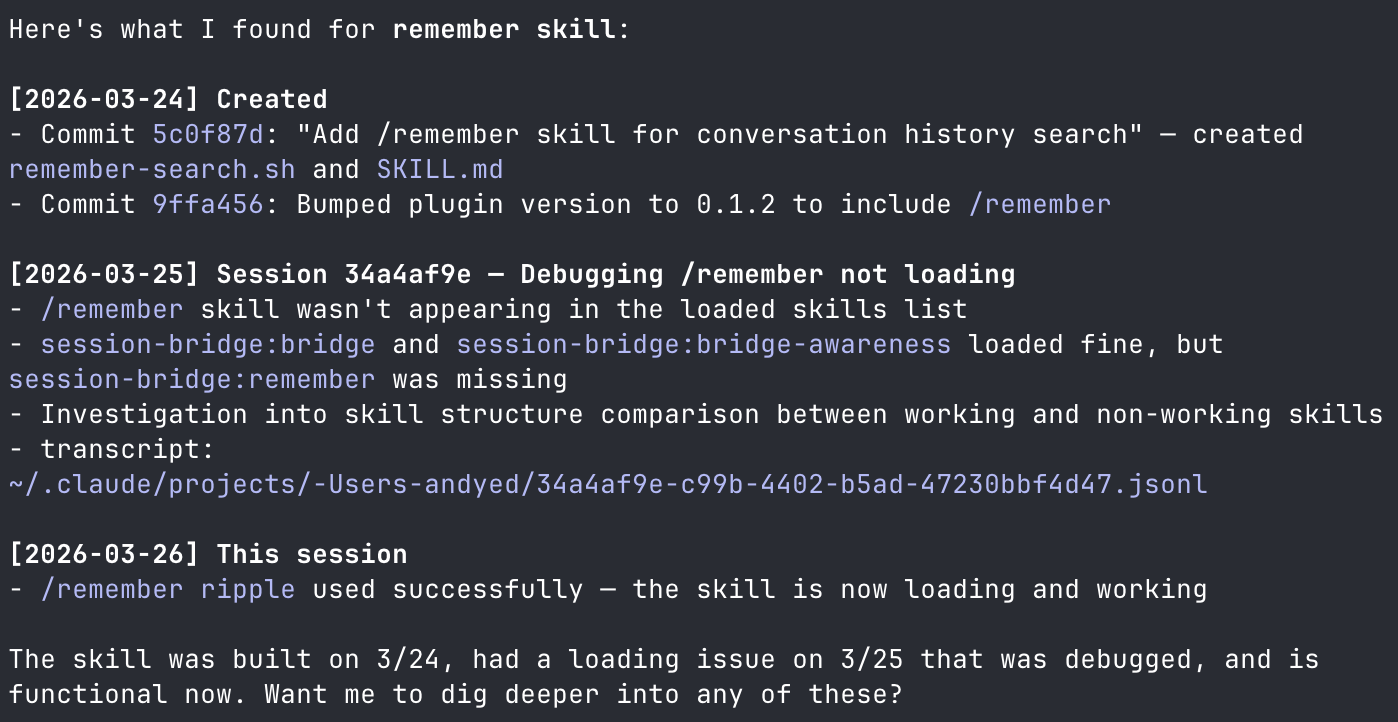
Live demo → — Explorer running against a test set from building Session Cartographer with Claude Code. Try the example queries.
What you get
/remember— Ask Claude or Codex to recall past decisions, research, and fixes from either agent. Runs BM25 + RRF search across event logs and transcripts. Zero dependencies (bash + awk)./focus— Orient on a project before diving in: recent milestones and commits, plus cross-project research threads and recurring maneuvers from the co-occurrence graph./carto— Visual Explorer with timeline, faceted search, and transcript viewer. Click a facet pill to narrow by project or event type. Click a timeline dot to jump to that result./wrapup— End-of-session synthesis. Captures decisions, discoveries, and unfinished threads as a searchable milestone event. Invoke before ending a productive session./investigate— Diagnosis gate for bug work. Forces a written root-cause hypothesis (cause + mechanism + disproof) before any fix code, and logs it as a searchable event for later recall.- Faceted search — Server computes distributions over the top 500 fused results. Filter by project, event type (fetch/search/commit/edit/bash), and match source (keyword/semantic). Client-side filtering, URL-persisted state.
- Hybrid ranking — BM25 keyword scoring + Qdrant semantic similarity, merged via RRF (k=60). Graceful degradation — keyword-only if Qdrant isn't running.
Co-occurrence graph & maneuver map
scripts/cooccurrence-graph.js builds a significance-weighted co-occurrence graph over the structured fields in your event logs (projects, detected tech-signals) — never tokenized prose. One scoring engine, two graphs. Zero external dependencies (Node fs/path/os only). It's wired into /focus (related threads + maneuvers) and /remember (--signal procedural recall), with an opt-in SessionStart hook that surfaces orientation automatically — not yet a lens in the Explorer UI. Method doc: docs/COOCCURRENCE.md.
- Project co-activity —
--related <project>surfaces cross-project research threads. The document is a calendar day, not a session: 97% of sessions touch a single project, so the cross-thread signal lives in same-day co-activity, not same-session. - Maneuver map —
--maneuvers <project>shows a project's procedure profile (detected signals likeff-merge,gh-release,cloudflare-pages,netlify,overleaf-sync) and which other projects share it. Two views: composition (signal × signal, which markers compose one maneuver) and transfer (project × project, which projects share a procedure).
# Cross-project threads co-active with a project (shared days · G²)
node scripts/cooccurrence-graph.js --related approach-retreat

# A project's maneuver profile + the projects that share it (shared signals · G²)
node scripts/cooccurrence-graph.js --maneuvers psychodeli

# Which projects run a maneuver, and what it composes with (powers /remember "how do I deploy X")
node scripts/cooccurrence-graph.js --signal cloudflare

# Build the full graph, write JSON, print top edges
node scripts/cooccurrence-graph.js --show both
Edges are ranked by Dunning's log-likelihood ratio (G², Dunning 1993) — observed-vs-expected co-occurrence that scales with the evidence. See Inspiration for the lineage.
Auto-focus (opt-in). Set CARTOGRAPHER_FOCUS_ON_START=1 and a SessionStart hook injects the related-threads + maneuver lenses as context when you enter a project — dormant by default, abstains on home-dir launches, and surfaces once per project per day. The --related lens is gated by a G² stability heuristic so solo-project coincidence never reaches you.
Install
The GitHub release ships one unified bundle for both agents—there are no
separate Claude and Codex packages. Download and extractsession-cartographer-<version>.tar.gz, then run one of these from the
extracted directory:
# Codex
codex plugin marketplace add "$PWD"
codex plugin add session-cartographer@session-cartographer

# Claude Code
claude plugin marketplace add "$PWD"
claude plugin install session-cartographer@session-cartographer
Start a new task/session after installation. Hooks auto-register and start
logging immediately; /remember works with keyword search out of the box.
For development, clone the repository and register the checkout itself as the
marketplace. Release archives are self-contained: installed skills, hooks,
search scripts, and the Explorer do not reach back into a source checkout.
Explorer (web UI)
cd session-cartographer/explorer && npm install && npm run dev
# API on :2526, UI on :2527
Then use /carto to open it in your browser.
Semantic search (optional)
Adds vector similarity to the keyword pipeline. Both always run, results fuse via RRF. No Docker — two binaries, under 1GB total. See docs/SETUP.md.
Add to your CLAUDE.md
After installing, add this so the agent knows to use cartographer:
## Session History

Session Cartographer is installed. Skills:
- `/remember <query>` — search past session history (decisions, research, fixes)
- `/focus <project>` — orient on a project before diving in
- `/carto` — open the Explorer web app for visual browsing
- `/wrapup` — end-of-session synthesis (decisions, discoveries, next steps)
- `/investigate <bug>` — root-cause diagnosis gate before writing fix code

When you need context from a previous conversation, use `/remember`. The skill
runs BM25 + RRF search across event logs and transcripts. Read the transcript
path from results to recover full conversation context.
Cold start
Hooks only capture events going forward. On a fresh install your event logs are empty — that's expected. You'll start seeing results after a few sessions of normal Claude Code use.
To backfill existing history:
# Git commits across your repos (fast, no Qdrant needed)
bash scripts/backfill-git-history.sh --since 2026-01-01

# Claude Code memory files (feedback, project notes)
bash scripts/backfill-memories.sh

# Historical transcripts into Qdrant (requires Qdrant + embedding server)
bash scripts/retro-index.sh --limit-days 30

# Deep reconstruction — extracts tool_use blocks, synthesizes research events
node scripts/reconstruct-history.js

# Tag indexed transcript turns with a prompt-intent (run after the Qdrant
# backfills above) — enables `cartographer-search.sh --intent KEY` and the
# intents facet. reconstruct-history.js already tags turns it indexes itself;
# this catches turns indexed before intent classification was added.
node scripts/backfill-prompt-intents.js
Footprint
  Disk footprint (1,839 sessions, 40+ projects)

  Claude Code transcripts  ████████████████████████████████████  2,900 MB
    Cartographer log data  ▏                                      1.5 MB
      Cartographer source  ▏                                        2 MB

  Cartographer adds ~1 MB per 2 GB of transcripts (1:2000)
grep vs. cartographer
Measured on 2.9 GB of transcripts, 4,400 indexed events, 186 sessions. Metric is unique sessions surfaced — the unit that matters for recovering context.
                            ── grep ──         ── cartographer ──
Query                       sessions    sec    sessions    sec
──────────────────────────  ────────  ──────   ────────  ──────
"BM25"                           73    18.3         11     1.5
"facets"                         45    24.5         19     1.5
"transcript viewer"              21    20.5         14     1.6
"backfill"                       49    25.2         17     1.5
"concurrent timeline"            10    26.2         15     1.5
"diff shape"                     14    26.0         27     1.5
"session milestones"             27    21.2         42     1.6
"fisheye autocomplete"            7    25.5         12     1.5
──────────────────────────  ────────  ──────   ────────  ──────
MEAN                             31    23.4         20     1.5
Cartographer is 15× faster on average. grep session counts are inflated by CLAUDE.md content echoed in every session and compaction summaries that parrot parent conversations. Cartographer deduplicates through event-level indexing: each git commit, URL fetch, and milestone is one event with a session_id linking back to the source transcript.
For queries that only appear in conversation text (not in indexed events), cartographer falls back to transcript search via ripgrep + BM25 — slower but still ranked.
Where grep still wins
The speed numbers above compare the wrong things. grep searches raw conversation text across 2.9 GB of transcripts. Cartographer searches a 1.5 MB event index. They have different recall surfaces: grep finds anything ever said in a session; cartographer only finds what hooks captured (commits, fetches, milestones, file edits). For terms like "facets" that never appear in event logs — only in conversation — cartographer's keyword path returns nothing until the transcript fallback kicks in, which is slower than grep.
Cartographer's real advantage is ranking and deduplication, not coverage. grep returns 73 sessions for "BM25" because the term appears in echoed CLAUDE.md content in every session — that's noise, not recall. Cartographer returns 11 sessions with ranked, deduplicated events linked to source transcripts. The hybrid path (BM25 + Qdrant semantic) adds phrase-level understanding that bag-of-words keyword search can't match: "diff shape" as a concept vs. "diff" and "shape" as independent words. Evaluation results and phrase matching roadmap →
Precision evaluation (4 labeled queries)
          P@5    P@10   Recall   Speed
grep       —      —      75%    28.1s
BM25      0.40   0.33    79%    29.3s
hybrid    0.45   0.40    79%    28.6s
Hybrid (BM25 + semantic) outperforms keyword-only at every k. grep has no ranking so precision isn't measurable, but its recall is competitive. The main precision gap is multi-word queries like "diff shape" (P@5=0.0) where BM25 matches each word independently. Phrase matching via ordered bigrams or positional indexing would fix this — see the search roadmap.
Architecture
Hooks are the foundation. Everything else is a lens.
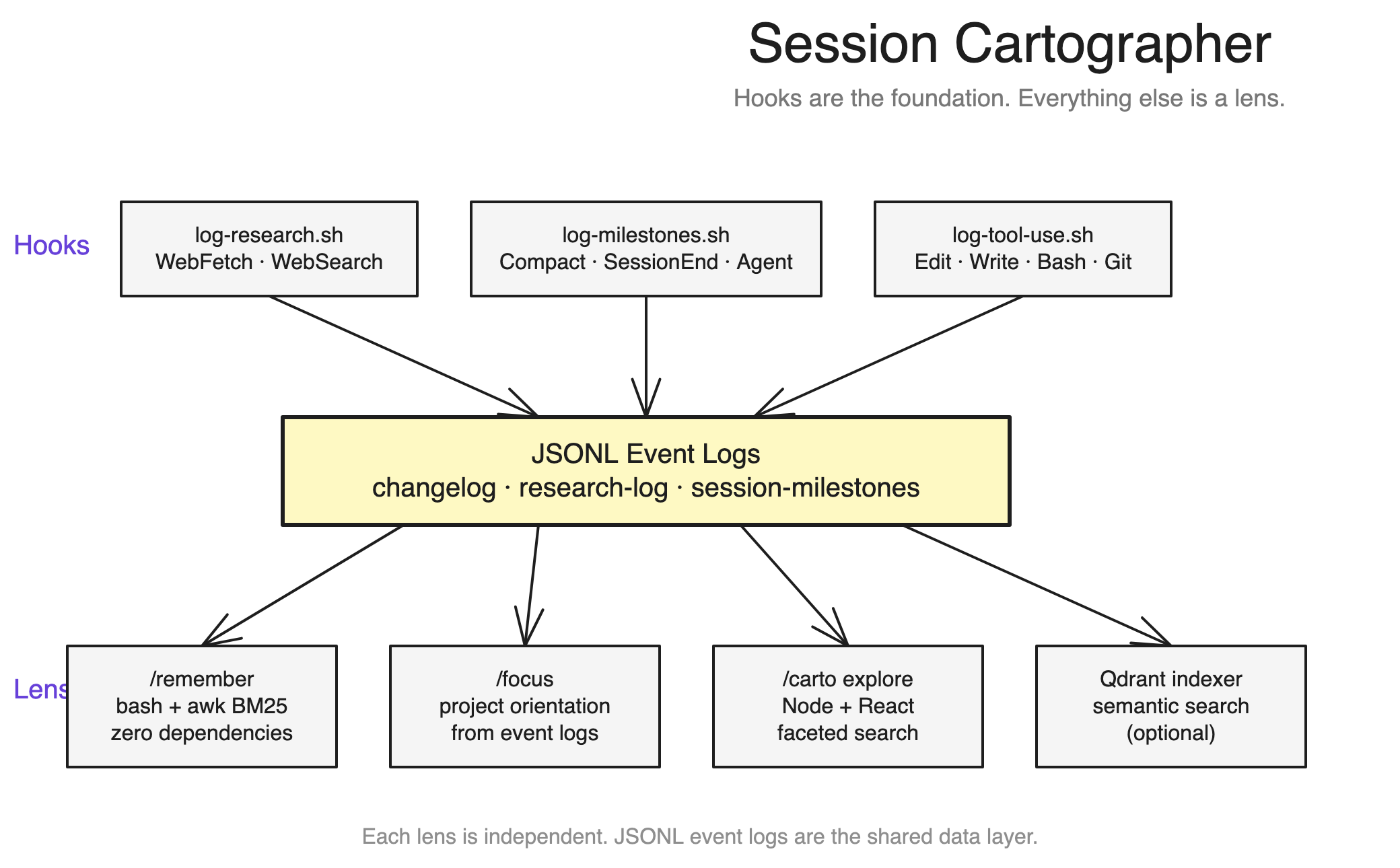
Each layer is independent. You can use /remember without the Explorer, /focus without /remember, or just the hooks with your own tooling. The JSONL event logs (schema) are the shared data layer.
There is no global Claude/Codex mode. Each hook invocation and normalized turn
carries provider provenance, while both agents search the same logs and Qdrant
collection by default. Claude can therefore recall a Codex session and Codex
can recall a Claude session. Raw provider formats are isolated behind separate
transcript adapters. See Provider Architecture.
What gets logged
| Hook | Triggers on | Captures |
|---|---|---|
log-research.sh |
Claude web tools, Codex web/MCP tools | URLs, search queries, auto-categorization |
log-session-milestones.sh |
PreCompact, SessionEnd/Stop, SubagentStop | Provider-aware lifecycle events with transcript links |
log-tool-use.sh |
Edit, Write, apply_patch, Bash | File modifications, git commits, commands (opt-in: CARTOGRAPHER_LOG_TOOL_USE=true) |
Event types are dynamic — they depend on which hooks you enable and how you use Claude Code and Codex. Run jq -r '.type' ~/Documents/dev/changelog.jsonl | sort | uniq -c | sort -rn to see your actual type distribution.
Configuration
All paths and endpoints are configurable via environment variables. See docs/SETUP.md for the full table.
Extend session transcript retention
Claude Code deletes transcripts after 30 days by default. Extend in ~/.claude/settings.json:
{
  "cleanupPeriodDays": 365
}
A year of event logs is ~8 MB. Your session history is the training data for your future workflow — keep it.
Tradeoffs
Speed vs. recall: grep scans everything (30-50s). Cartographer searches a 1.5MB index (sub-second, ranked) but only finds what hooks captured. Mitigations: CARTOGRAPHER_LOG_TOOL_USE=true, transcript grep fallback, Qdrant backfill.
BM25 handles Latin scripts only. Accented characters normalized (résumé → resume). CJK/RTL needs semantic search, which is multilingual natively.
No phrase matching. "diff shape" is treated as diff OR shape, not a phrase. Semantic search (Qdrant) handles this implicitly — the embedding captures the concept. The keyword path doesn't. Ordered bigram injection (SDM-lite) was attempted and reverted after measuring zero P@5 delta on 9 truth queries with a 33% indexing-cost regression — the motivating diff shape case is dominated by events that already win on filename tokenization (e.g. diff-shape.sh), so bigrams don't shift rank. See phrase matching TODO for the revised plan.
No stemming. shader* for prefix matching. See query rewrite roadmap.
Deep linking
Hooks write claude-history:// URIs into every event — stable references into Claude Code session transcripts. The Explorer resolves these natively. Fragment references for anchoring into specific conversation moments are on the roadmap.
Evaluation
Search quality is measured against labeled ground truth — graded relevance judgments for each result across 4 test queries. Truth data is checked in at explorer/public/demo/demo/truth/.
Each truth file records:
- Query intent — what the user is actually trying to find
- Session relevance — which sessions are primary/secondary sources
- Per-result grades — 0 (noise) to 3 (exact match), with noise classification (
single_word_match,compaction_echo, etc.)
The same data powers the live demo and the precision/recall benchmarks above. Run the full test suite:
bash tests/private/run-tests.sh        # 11 tests against live data
bash tests/private/run-fixture-tests.sh # 14 tests against fixtures
bash tests/private/benchmark.sh         # 8-query speed comparison
See also
- docs/SETUP.md — Full setup, Qdrant, environment variables, disk usage
- docs/MIGRATION_TURNS.md — Existing-user migration to turn-based transcript indexing
- docs/RANK_FUSION.md — BM25 + RRF scoring architecture
- docs/SCORING.md — What scores mean, when to chase a result
- docs/CUSTOM_HOOKS.md — Log your own events to the index
- docs/LOG_SCHEMAS.md — JSONL schemas for all event types
- docs/CHANGELOG_SPEC.md — Event envelope format
- docs/EXPLORER_SPEC.md — Explorer implementation architecture
- docs/PERMALINK_SPEC.md —
claude-history://URI scheme - docs/landscape-survey.md — 30+ Claude Code memory projects compared
- docs/GHPAGES_DEMO_SPEC.md — Demo site architecture + ground truth evaluation spec
- Live demo — Try the Explorer against real test data
Uninstall
claude uninstall session-cartographer                    # remove plugin + hooks
# or: codex plugin remove session-cartographer@session-cartographer
# Optionally delete event logs:
rm ~/Documents/dev/changelog.jsonl ~/Documents/dev/research-log.jsonl ~/Documents/dev/session-milestones.jsonl
rm -rf ~/Documents/dev/session-cartographer              # the repo
Inspiration
The co-occurrence graph above is a direct response to lume by DeepBlueDynamics — its Rust hybrid-search engine carries a Semantic Knowledge Graph layer (entity co-occurrence with significance weighting) that prompted us to ask what the same idea would surface over session entities instead of documents.
We adapted it in two ways. First, the entities: lume scores co-occurrence across a corpus of documents; we score it over structured session entities (projects, detected tech-signals), never tokenized prose. Second, the statistic: lume ranks by a z-score passed through tanh, which saturates — for a perfectly-correlated pair (a = b = k) the z-score collapses to √N regardless of count, so a 3-session fluke and a 30-session pattern score identically. We rank by Dunning's log-likelihood ratio (G², Dunning 1993) instead, which scales with the evidence.
Credit also to the deeper lineage lume itself cites: the Semantic Knowledge Graph work of Trey Grainger and Erik Hatcher, which framed entity co-occurrence as a significance-weighted graph in the first place.
Attribution
Search concept originated in a fork of claude-code-session-bridge by Shreyas Patil (MIT License).
License
MIT
Yorumlar (0)
Yorum birakmak icin giris yap.
Yorum birakSonuc bulunamadi