compounded
Health Uyari
- License — License: MIT
- Description — Repository has a description
- Active repo — Last push 0 days ago
- Low visibility — Only 5 GitHub stars
Code Basarisiz
- rm -rf — Recursive force deletion command in docs/demo.sh
Permissions Gecti
- Permissions — No dangerous permissions requested
Bu listing icin henuz AI raporu yok.
Claude Code plugin that learns from your corrections — approved lessons become rules that earn autonomy through real use: verified → trusted → autonomous. One mistake = one level down. No daemon, no cloud, 100% local.

Your AI agent gets better at you the longer you use it.
Correct Claude once — it asks to remember the lesson, then never makes that mistake again. Your approval is the only gate: saved rules are active immediately at .verified, build a track record to reach .trusted, and graduate to .autonomous. One correction sends them back down. No daemon. No cloud. No re-explaining.





Install · How it works · Manifesto · Philosophy · Docs · Compare
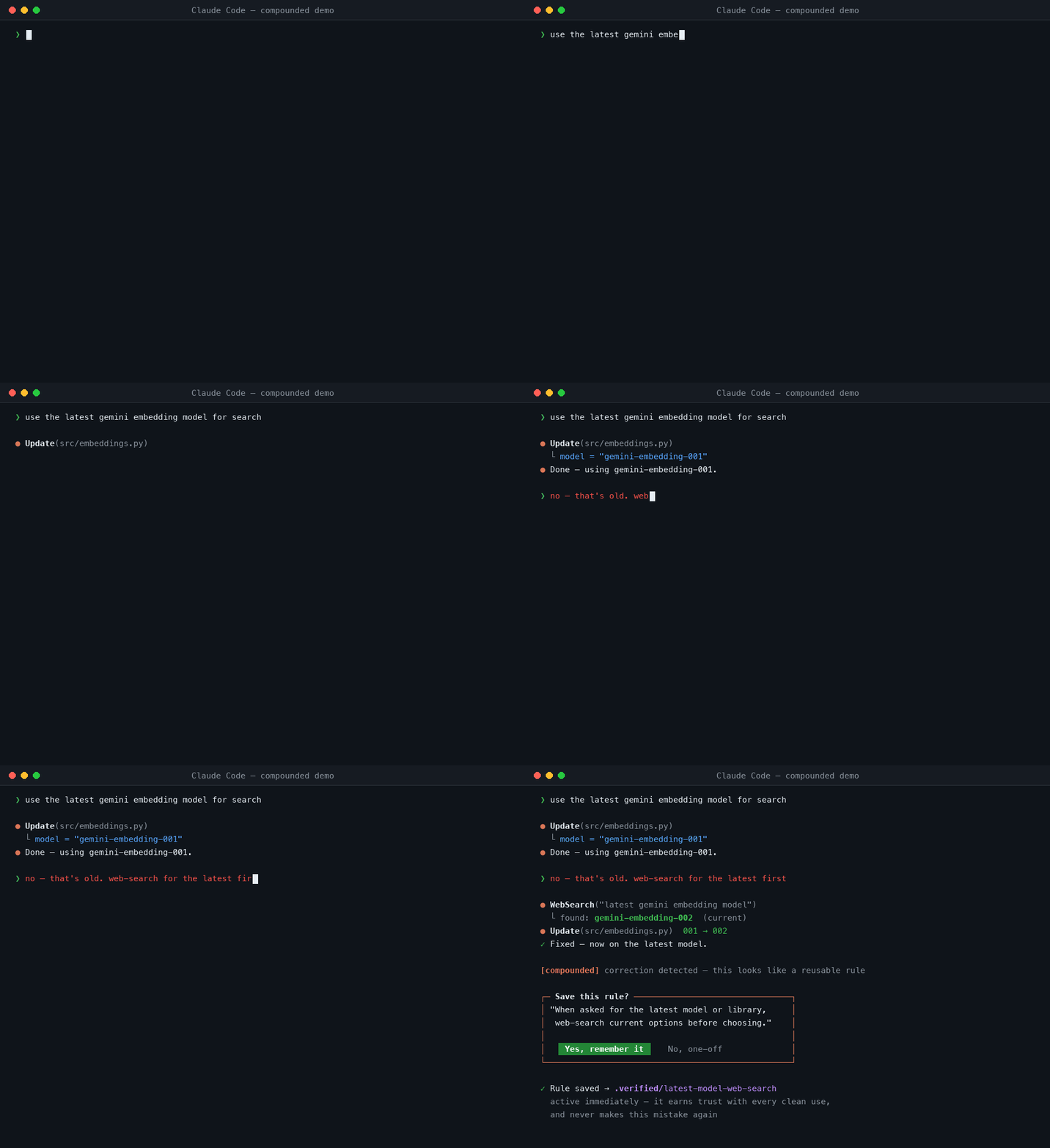
Correct it once. Approve the lesson. Never repeat yourself.
What is this? (the no-jargon version)
Think of Claude as a smart new employee with amnesia — brilliant, but every morning it forgets everything you taught it yesterday. You end up correcting the same mistakes over and over.
compounded fixes that, the same way you'd train a real new hire:
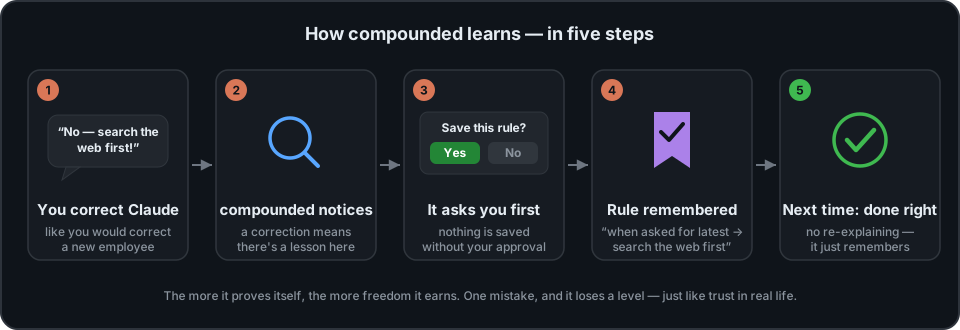
A real example. You ask Claude to use the latest Gemini embedding model. It picks an old one from memory. You say: "No — search the web first, then pick the latest." compounded catches that correction and asks: "Save this rule?" You tap Yes. From now on, whenever you ask for the latest anything, Claude searches the web first — without being told.
And it's not blind trust: every saved lesson starts on probation and earns more freedom each time it works — or loses it the moment it doesn't.
Why compounded?
Claude Code's AutoMemory writes notes. AutoDream cleans them.
compounded verifies them — and lets them earn the right to act.
When compounded captures a lesson, you approve it once and it's live — .verified, injected into every session. Three clean uses → .trusted. Ten with no recent corrections → .autonomous. One correction sends it back a step. Unapproved captures and demoted skills wait in .proposed/ for a verifier replay before re-entering.
It's how you train a junior. It's how you should train your agent.
Install
# In Claude Code:
/plugin marketplace add ankitkr3/compounded-marketplace
/plugin install compounded@compounded-marketplace
Restart Claude Code. That's it.
First-time approval prompts: hooks fire silently, but the first time you run any
/compounded:*slash command you'll see a Claude Code permission prompt. Either click "always allow" in the prompt (per-command, easiest) or pre-allowlist everything by adding"Bash(python3 ~/.claude/plugins/cache/compounded-marketplace/compounded/**:*)"topermissions.allowin~/.claude/settings.json. See INSTALL.md for details.
| ✅ No daemon to run | ✅ No cloud account | ✅ No telemetry | ✅ 100% local |
| ✅ Python stdlib only | ✅ SQLite + flat files | ✅ Portable archive | ✅ MIT licensed |
The trust ladder
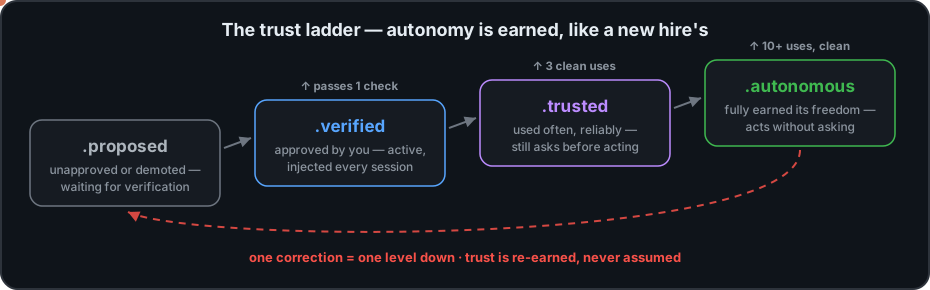
| Tier | Behavior | Activation |
|---|---|---|
.proposed |
Unapproved: demoted skills and imports, awaiting verification | Never auto-loads |
.verified |
User-approved at capture, or verified on a real task | Rules inject at session start |
.trusted |
3+ clean uses on real follow-ups | Auto-loads, asks before applying |
.autonomous |
10+ uses, last 5 clean, no recent corrections | Runs without asking |
Demotions happen automatically: one correction = one tier down. Three corrections in 30 days = back to .proposed. Pin a skill with /compounded:pin <skill> to lock it at its current tier.
Run /compounded:trust-status to see where every skill sits and what's about to promote or demote.
What compounded actually does
Three things. That's the whole pitch.
🧠 Cross-project memoryA user-global AutoMemory writes per-project notes — compounded writes the preferences and facts that follow you across all of them. Hard-bounded at 1500 characters by design, so it stays readable and useful. |
✓ Verified skillsApprove a lesson once and it's The verifier subagent guards the unapproved path (imports, demotions): replay against a real task, PASS or FAIL with the reason logged. Failures land in |
📦 Portable archive
|
Learns from your corrections (v1.2)
Corrections are the highest-signal teaching moments — so compounded treats them as the primary learning trigger, not noise:
- You correct Claude ("no — web-search for the latest model first") and Claude does the corrective work
- The Stop hook spots the correction and nudges Claude: the delta between what you asked, what it did, and how you corrected it is a lesson
- Claude extracts the generalizable rule and asks you to approve it — your approval is the only gate
- Approved rules save straight to
.verified/and are injected at the start of every session — "when the user asks for the latest X, web-search first" — active immediately, climbing the trust ladder with each clean use, demoted the moment they steer a task wrong
One-off corrections ("use port 3001 here") are deliberately ignored — only rules with a clear, general trigger get proposed. .proposed/ still exists for the unapproved path: demoted skills and imports wait there for verification.
Auto-propose (v1.1)
You don't have to remember to save things. After every turn, the Stop hook scores what just happened — tool calls, distinct files edited, shell commands, recovery from failure, planned execution. When the score crosses the threshold, the agent gets a nudge to consider authoring a skill. The agent still decides whether to propose (one-off chores get ignored), but the prompt to consider is automatic.
Quiet by design: routine turns produce zero output. You only see anything when there's real signal. Check ~/.claude/compounded/logs/auto_propose.jsonl to see what fired and what didn't — each entry now records a capture_kind (procedure or rule) — useful for tuning if you want to.
Demo
Run the included lifecycle demo to see propose → verify → use × 3 → trust → use × 7 → autonomous → correction → demote in 30 seconds:
bash docs/demo.sh
[1/8] proposing skill 'typo-fixer' ......................... .proposed/
[2/8] running verifier subagent (claude-haiku-4-5) ......... PASS
[3/8] moved to .verified/, ready for use
[4/8] used 3× on real follow-ups ........................... promoted → .trusted
[5/8] used 7× more, last 5 clean ........................... promoted → .autonomous
[6/8] one correction on use #11 ............................ demoted → .trusted
[7/8] exported archive ..................................... compounded.tar.gz (12KB)
[8/8] imported on a fresh install .......................... ✓ same state
How compounded composes
compounded does not replace anything. It is the verification + portability layer of a stack:
| Tool | What it does | What compounded adds |
|---|---|---|
| AutoMemory (native) | Per-project notes, MEMORY.md | Cross-project USER.md |
| AutoDream (native) | Consolidates project memory between sessions | Verifies skills, not notes |
| skill-creator (native) | Eval-based testing of hand-authored skills | Replay-based verification of agent-authored skills |
| superpowers | TDD / brainstorm / plan methodology | Memory + earned trust gradient |
| claude-mem | Daemon-based observation capture | No daemon, different model |
| Karpathy CLAUDE.md | Behavioral principles | Composable — drop both into your project |
Each layer does one thing well. None of them does what compounded does.
Commands
| Command | What it does |
|---|---|
/compounded:status |
USER.md size, skill counts by tier, recent transitions |
/compounded:trust-status |
The full trust ladder, with promotion/demotion candidates highlighted |
/compounded:export <path> |
Bundle USER.md + verified skills into a portable archive |
/compounded:import <path> |
Merge an archive on this machine |
/compounded:verify <skill> |
Manually run the verifier on a .proposed/ skill |
/compounded:trust <skill> --to <tier> |
Manual promotion (skip the gradient) |
/compounded:demote <skill> |
Drop a skill one tier |
/compounded:pin <skill> |
Lock a skill at its current tier (no auto-demotion) |
/compounded:unpin <skill> |
Remove a pin |
What's stored where
~/.claude/compounded/
├── USER.md                   ← user-global preferences (loaded every session)
├── trust.db                  ← SQLite: skill state, events, sessions
├── config.json               ← per-user config
├── skills/
│   ├── .proposed/<name>/     ← awaiting verification
│   ├── .verified/<name>/     ← passed verification
│   ├── .trusted/<name>/      ← 3+ clean uses
│   ├── .autonomous/<name>/   ← 10+ uses, recent run clean
│   ├── .rejected/<name>/     ← failed verification (recoverable)
│   └── .pinned               ← list of pinned skill names
└── logs/
    └── verifier_dispatches.jsonl
All local. All inspectable. All editable if something goes wrong.
What it doesn't do
| Won't do | Why |
|---|---|
| ❌ No daemon | Zero install friction. Hooks fire when Claude Code fires them. |
| ❌ No cloud / telemetry / account | Your skills are yours. |
| ❌ No vector index / embeddings / GPU | Keyword overlap + replay is enough. |
| ❌ No transcript capture | claude-mem does that — use both if you want both. |
| ❌ No project memory cleanup | AutoDream does that. |
| ❌ No eval framework | skill-creator does that. |
Every "no" is deliberate. compounded does three things and stops.
Cost
The verifier subagent runs on Claude Haiku 4.5 by default. Each verification is roughly 1500 input tokens + a small JSON response.
Expected cost at typical usage: under $0.20/month.
The verifier only runs when a .proposed/ skill matches the just-finished task, which for most users is a handful of times per week.
To switch to Sonnet for higher-accuracy verification (~5× the cost), edit ~/.claude/compounded/config.json:
{
  "skills": {
    "verifier_model": "claude-sonnet-4-6"
  }
}
Tested
55 unit tests covering memory injection, skill proposal, correction-driven rule capture, transcript-schema parsing, security scanning, trust-ladder transitions in all directions, pin behavior, stale-sweep exemptions, archive roundtrip, and verdict finalization.
git clone https://github.com/ankitkr3/compounded
cd compounded
python3 -m unittest discover tests/ -v
CI runs the suite on Linux + macOS across Python 3.9–3.12 on every PR.
The four principles
Read the manifesto. Four principles, one page, copy-pasteable.
- Bounded over Unbounded — memory should be small enough to read in one breath.
- Verified over Recalled — a skill that replayed successfully is a fact; one that was merely saved is a hypothesis.
- Earned over Granted — authority is earned, not assumed.
- Composable over Comprehensive — small tool, sharp wedge, plays well with everything else.
Contributing
PRs welcome. New built-in skills, bug fixes, doc improvements.
python3 -m unittest discover tests/ -v
For new built-in skills (skills that ship with compounded itself, not user-authored skills), follow the format of skills/compounded-typo-fixer/SKILL.md and include the criteria the skill is meant to demonstrate.
See CLAUDE.md for codebase conventions.
License
MIT. Fork, ship, sell. Just include the notice.
Why "compounded"
Capability that compounds is the whole point. Every verified skill compounds the agent's toolkit. Every clean use compounds the trust in that skill. Every correction compounds back — trust isn't given once, it's earned and re-earned. The trust ladder is compound interest applied to demonstrated reliability: small reliable acts that, over time, become the foundation for larger autonomous ones.
"The most powerful force in the universe is compound interest." — Albert Einstein (apocryphal)
The product is named for what it does to your agent.
Manifesto · Philosophy · Install Guide · Architecture · Memory Guide · Skill Authoring · Privacy
Built for Claude Code · Made with discipline by @ankitkr3
Yorumlar (0)
Yorum birakmak icin giris yap.
Yorum birakSonuc bulunamadi