anomalia
Health Warn
- License — License: Apache-2.0
- Description — Repository has a description
- Active repo — Last push 0 days ago
- Low visibility — Only 5 GitHub stars
Code Warn
- process.env — Environment variable access in .agents/skills/remotion-best-practices/remotion-maps/techniques/cesium/assets/CesiumFlythrough.tsx
Permissions Pass
- Permissions — No dangerous permissions requested
No AI report is available for this listing yet.
Your marketing department, automated. Open-source Grok Bot alternative specialized in marketing, distribution, and sales.

Anomalia




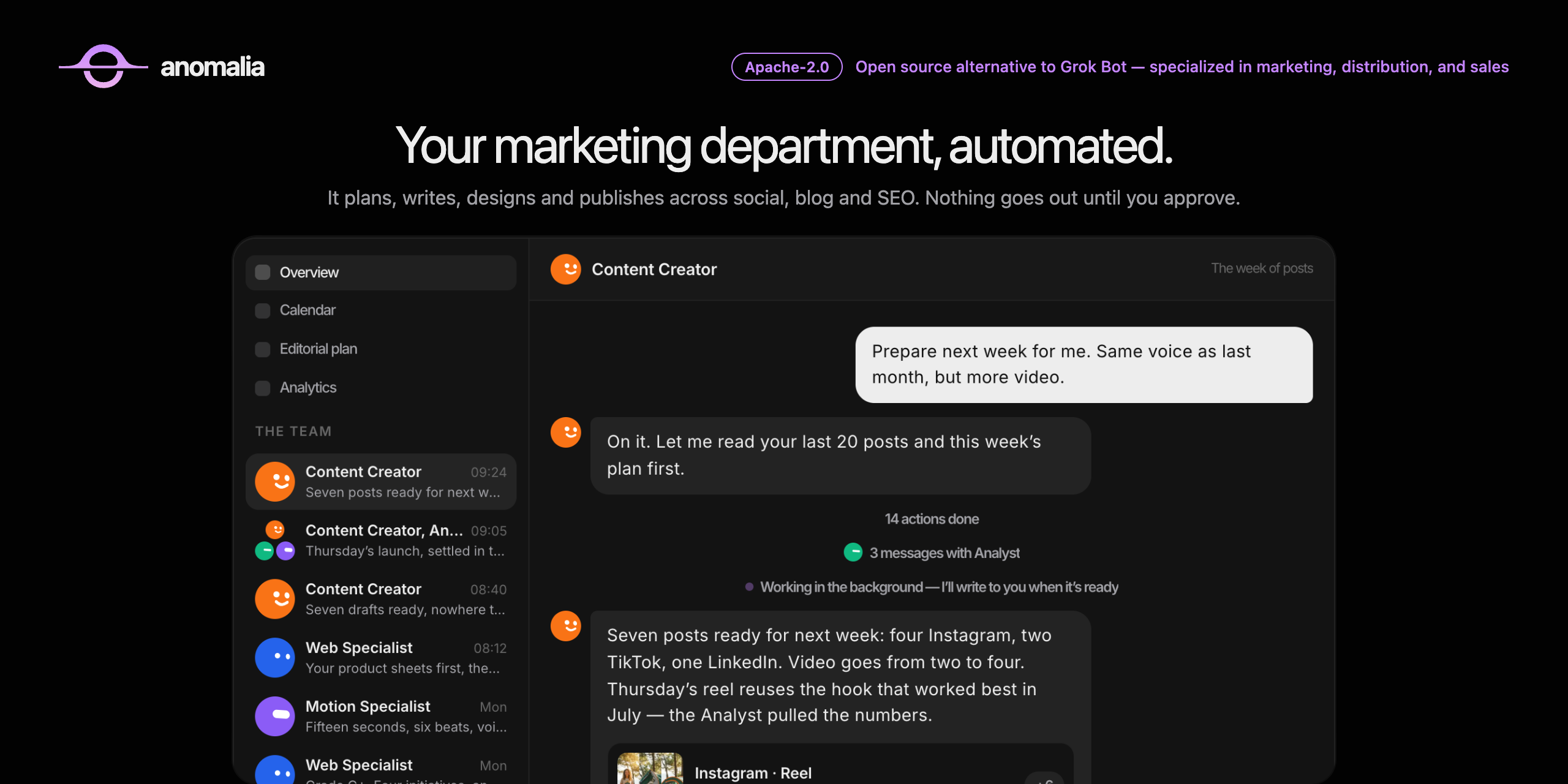
Your marketing department, automated. Anomalia is an open-source Grok Bot
alternative specialized in marketing, distribution, and sales. It plans, writes,
designs, and publishes across social, blog, and SEO — nothing goes out until you
approve. Use it hosted at anomalia.so, or run the complete
stack yourself.
Features
- Weekly editorial plan, then on-brand posts, carousels, and video
- Calendar and one-tap approve — from the app, email, or
CLI / MCP - Studio: brand kit, products, people, competitors, and voice
- Radar: news and conversations turned into drafts and lead replies
- Blog, SEO, and GEO — rank on Google and get cited by AI assistants
- Multi-brand workspaces (one account, many brands)
- Propose-approve throughout: the AI never publishes silently
- Drive it from Cursor or Claude via MCP, or from the
anomaliaCLI
Stack
- TypeScript and SvelteKit
- Supabase (Postgres, Auth, Storage)
- Node.js 22 and Docker Compose
- MCP server and CLI in anomalia-cli
Quick start
You need Node.js 22+, Docker with Compose, and openssl.
cp infra/compose/.env.example infra/compose/.env   # fill POSTGRES_PASSWORD, DASHBOARD_PASSWORD, SECRET_KEY_BASE
cp .env.example .env                               # set PUBLIC_SUPABASE_URL=http://localhost:8000 and copy ANON_KEY / SERVICE_ROLE_KEY from infra/compose/.env into PUBLIC_SUPABASE_ANON_KEY / SUPABASE_SERVICE_ROLE_KEY
(cd infra/compose && docker compose up -d --wait)
npm install

export DATABASE_URL="postgres://postgres:<POSTGRES_PASSWORD>@localhost:5432/postgres"
npm run db:migrate
npm run db:seed
npm run dev          # http://localhost:5173 — login with the seeded [email protected] / change-me-now-12345
--wait is required: migrate needs tables that storage and realtime create on
startup. If it stops on a missing storage.buckets relation, runnpm run db:migrate again.
db:seed prints the TENANT_BRAND_ID line to paste into .env for a
single-brand install. The demo login comes from SEED_DEMO_EMAIL /SEED_DEMO_PASSWORD if you want different ones. Skip the compose step if you
already have a hosted Supabase project — point the same keys at it.
Production: npm run build:node && npm start (port 3000), or frominfra/compose/: docker compose up -d --build app.
Read docs/SELF_HOSTING.md for the complete guide.
Contributing
Contributions are welcome. Please read CONTRIBUTING.md
before opening a pull request. For security vulnerabilities, follow
SECURITY.md instead of filing a public issue.
Anomalia is licensed under the Apache License 2.0.
Questions and ideas are welcome in the
Discord community.
Reviews (0)
Sign in to leave a review.
Leave a reviewNo results found