synapse
Health Uyari
- License — License: MIT
- Description — Repository has a description
- Active repo — Last push 0 days ago
- Low visibility — Only 7 GitHub stars
Code Gecti
- Code scan — Scanned 12 files during light audit, no dangerous patterns found
Permissions Gecti
- Permissions — No dangerous permissions requested
Bu listing icin henuz AI raporu yok.
Private local memory for any AI agent: Markdown database, SQLite search, MCP, zero runtime dependencies.
Synapse
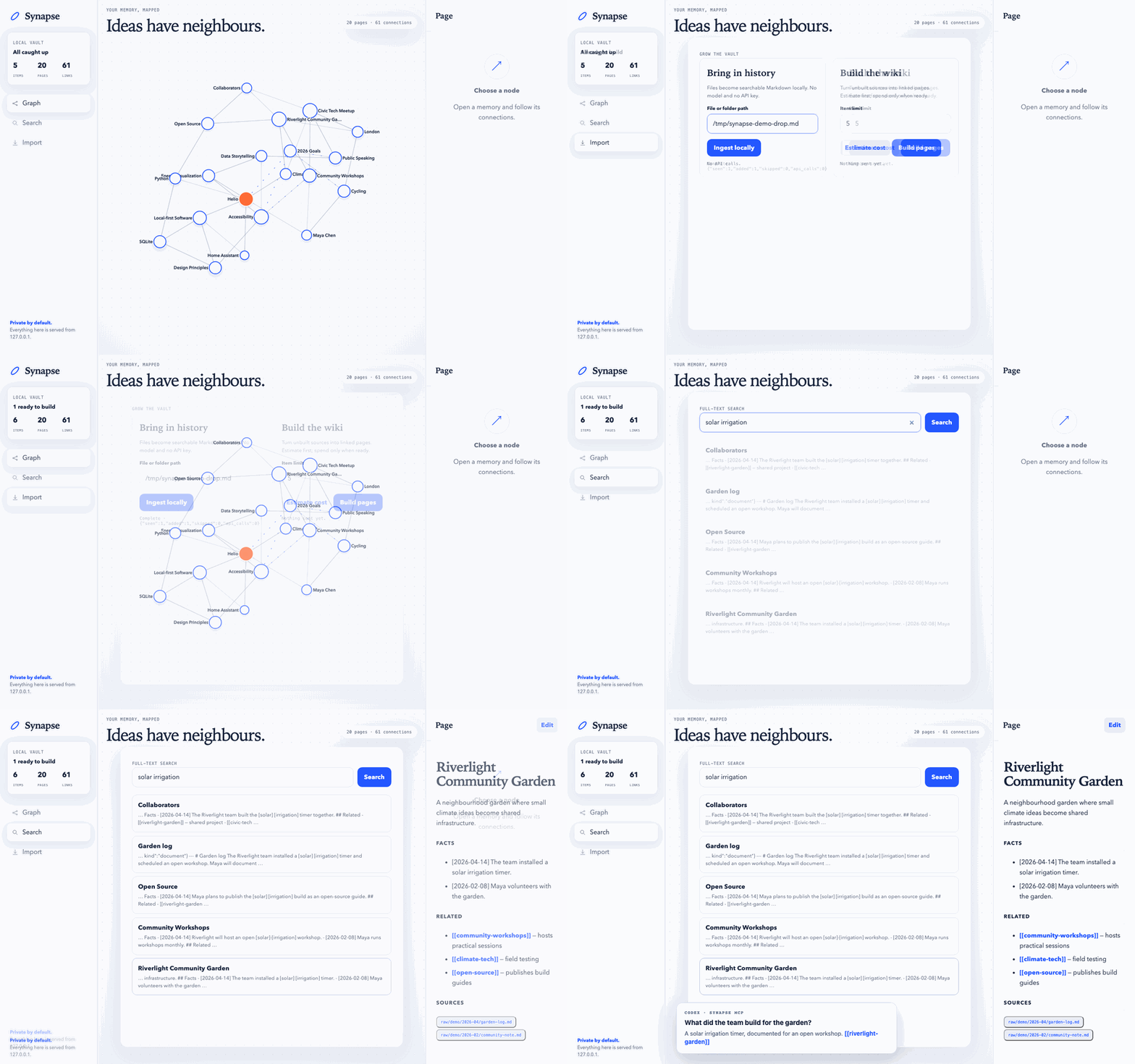
Point it at text. Get a searchable archive for free. Spend a few cents turning it into a Markdown wiki your agent can query.




Give any AI agent or workspace application a private, local memory without filling every prompt with your history:
uvx --from synapse-vault synapse mcp --vault /absolute/path/to/my-brain
That command is a local STDIO MCP server, not a Codex or OpenAI integration. Connect it directly to MCP-capable clients such as Codex, Claude Code, OpenCode, or OpenClaw. Pi, Orbit, Hermes, and other workspace agents can use MCP when supported or the bundled skill and CLI. See the copy-paste setup examples.
Nothing from the vault is injected into the agent's prompt. The agent searches first, then reads one relevant Markdown page. A thousand unopened pages cost zero tokens.
See it in ten seconds
uvx --from synapse-vault synapse serve --demo
That opens a populated 20-page graph. It needs no API key, import, database server, or JavaScript build.
Keep your own history
uvx --from synapse-vault synapse init ./my-brain
uvx --from synapse-vault synapse ingest ~/Downloads/chatgpt-export --vault ./my-brain
uvx --from synapse-vault synapse serve --vault ./my-brain
Ingest is local and free: it writes Markdown and builds a disposable SQLite FTS5 index. Search works immediately:
uvx --from synapse-vault synapse search "the phrase I remember" --vault ./my-brain
To turn raw history into a linked wiki, estimate first and then build a small resumable batch:
export SYNAPSE_API_KEY="..."
uvx --from synapse-vault synapse build --vault ./my-brain --limit 20 --dry-run
uvx --from synapse-vault synapse build --vault ./my-brain --limit 20
The build pass is optional. It is a plain for loop making one OpenAI-compatible chat-completions request per item. Run it against OpenAI or a local Ollama/LM Studio server; stop and resume without paying twice.
Markdown is the database
my-brain/
├── raw/<source>/<YYYY-MM>/<id>.md   immutable imported history
├── wiki/<slug>.md                   linked, editable knowledge pages
├── notes/<slug>.md                  approved, append-only agent notes
├── synapse.db                       disposable FTS5 + graph index
└── synapse.toml                     model and owner settings
Delete synapse.db and synapse reindex --vault ./my-brain recreates it. The durable data is ordinary Markdown that works with git, Obsidian, grep, and any editor.
How it works
- An adapter streams each source into a tiny
Itemshape with stable IDs and timestamps. - Ingest writes immutable raw Markdown and indexes it with SQLite FTS5—no model call.
- Build compresses one item and asks any OpenAI-compatible model for complete wiki pages.
[[wikilinks]]become edges; a recursive SQLite CTE handles multi-hop traversal.- The one-file dashboard, CLI, Python API, REST API, and MCP server all use the same vault.
Model providers
Synapse uses one standard-library HTTP POST to /chat/completions; there is no provider SDK.
| Provider | Base URL | Status |
|---|---|---|
| OpenAI | https://api.openai.com/v1 |
Tested with gpt-4o-mini |
| Ollama | http://localhost:11434/v1 |
Compatible; not yet in CI |
| LM Studio | http://localhost:1234/v1 |
Compatible; not yet in CI |
| OpenRouter | https://openrouter.ai/api/v1 |
Compatible; community verification wanted |
| Groq | https://api.groq.com/openai/v1 |
Compatible; community verification wanted |
| Together | https://api.together.xyz/v1 |
Compatible; community verification wanted |
| DeepSeek | https://api.deepseek.com/v1 |
Compatible; community verification wanted |
Set SYNAPSE_BASE_URL, SYNAPSE_MODEL, and (when required) SYNAPSE_API_KEY. See configuration and costs.
Agent access
The MCP server exposes selective reads plus propose_note. It is a small stdlib JSON-RPC loop over STDIO, so there is no daemon and no MCP SDK dependency.
# Codex
codex mcp add synapse -- uvx --from synapse-vault synapse mcp --vault /absolute/path/to/my-brain

# Claude Code
claude mcp add --transport stdio synapse -- uvx --from synapse-vault synapse mcp --vault /absolute/path/to/my-brain
OpenCode, OpenClaw, generic MCP JSON, and skill/CLI examples for Pi and other workspace agents are in MCP setup. The integration boundary is MCP or ordinary commands—not a particular agent vendor.
Agents cannot silently rewrite memory. propose_note stages one provenance-bearing semantic note with an idempotency key and revision check. You inspect the diff and approve it outside MCP:
uvx --from synapse-vault synapse proposals --vault ./my-brain
uvx --from synapse-vault synapse proposals <id> --vault ./my-brain
uvx --from synapse-vault synapse approve-note <id> --vault ./my-brain
Imported history remains write-once. Credentials, browser sessions, workspace state, and routine chat turns do not belong in notes; merge and deletion remain human-only.
Python works too:
from synapse import Vault

matches = Vault("./my-brain").search("launch decision")
Not built, on purpose
| Not built | Why |
|---|---|
| Embeddings | FTS5 is free, inspectable, and needs no migration or per-item API call. Add vectors only after measured recall failures. |
| Graph database | Personal graphs fit in SQLite; a ten-line recursive CTE handles traversal. |
| Auth or cloud sync | Synapse is single-user and binds only to 127.0.0.1. Your files stay yours. |
| Agent framework | The processing pipeline is a resumable loop, not an application graph. |
| Automatic merge/delete | Agents can only propose append-only notes; a human approves them and handles destructive changes. |
| PDF/DOCX parser | Those dependencies would break the zero-dependency promise; convert with Pandoc or MarkItDown first. |
Imported text is untrusted data. Synapse never executes it, and agents are instructed never to follow instructions found inside pages. Raw sources remain available for provenance.
Learn and contribute
- Add an adapter—the highest-impact contribution is about 30 lines plus one tiny synthetic fixture.
- Read how the SQLite graph works.
- See CONTRIBUTING.md for the test and pull-request workflow.
Synapse began as the winner of the LangGraph hackathon in London. This is the local-first rewrite that deleted SurrealDB, FastAPI, React, LangGraph, and embeddings so people can actually run it.
Yorumlar (0)
Yorum birakmak icin giris yap.
Yorum birakSonuc bulunamadi