symbolic-reasoning
Health Warn
- License — License: Apache-2.0
- Description — Repository has a description
- Active repo — Last push 0 days ago
- Low visibility — Only 6 GitHub stars
Code Pass
- Code scan — Scanned 12 files during light audit, no dangerous patterns found
Permissions Pass
- Permissions — No dangerous permissions requested
No AI report is available for this listing yet.
Policy-adherent, auditable reasoning for AI Agents.
symbolic-reasoning
Research preview: pre-1.0, so the API and the
.srglanguage may change between releases.
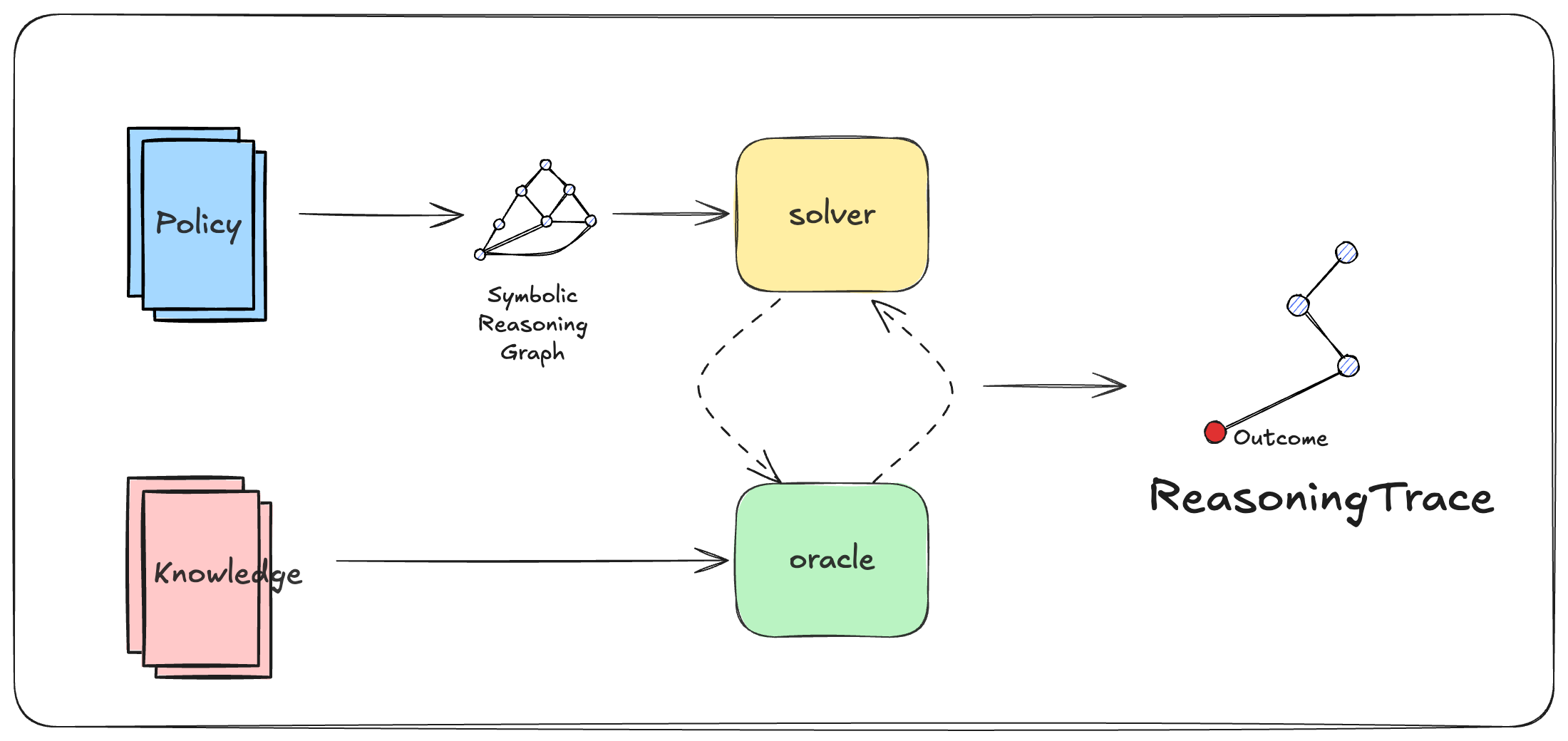
Make your agents policy-adherent.
Policies are everywhere: clinical guidelines, insurance coverage criteria, lending rules, compliance checklists. An agent asked to follow one can skip a rule, misapply it, or talk its way to the wrong outcome.
symbolic-reasoning takes the logic out of the model. The agent answers questions about the case; the library decides which questions to ask and what the answers add up to, and returns the outcome with a reasoning trace.
Use it two ways:
- As agent tools. Your agent works through the policy with tool calls, over MCP or in any agent framework.
- As a workflow. Your code drives the solve and an oracle (an LLM, a database, a human) answers each round of questions.
| Concern | Handled by |
|---|---|
| What are the rules? | Your policy (.srg) |
| What is true in this case? | Your agent or oracle |
| Which question or decision follows? | The library |
| Why was that decision made? | The reasoning trace |
Installation
Requires Python 3.12+.
uv add symbolic-reasoning # or: pip install symbolic-reasoning
Quick start
Save a policy as loan_approval.srg:
predicate has_good_credit:   "Does the applicant have a credit score of 700 or above?"
predicate has_stable_income: "Does the applicant have stable employment for at least 2 years?"
predicate has_low_dti:       "Is the applicant's debt-to-income ratio below 43%?"
predicate has_down_payment:  "Has the applicant provided at least 20% down payment?"

outcome approved:      "Loan Approved"
outcome denied:        "Loan Denied"
outcome manual_review: "Sent to Manual Review"

define core_eligible: all(has_good_credit, has_stable_income, has_low_dti)

path approve: all(core_eligible, has_down_payment) => approved
path review:  all(core_eligible, not(has_down_payment)) => manual_review
path deny:    not(core_eligible) => denied
Solve it with an oracle. This one asks you at the terminal:
import asyncio

import symbolic_reasoning as sr


async def oracle(request: sr.OracleRequest) -> dict[str, sr.Answer]:
    answers = {}
    for predicate_request in request.predicate_requests:
        p = predicate_request.predicate
        reply = input(f"{p.question} (y/n): ")
        answers[p.id] = sr.Answer(is_met=reply == "y", reasoning=f"User answered {reply}")
    return answers


async def main() -> None:
    srg = sr.compile_srg_file("loan_approval.srg")
    execution = await sr.asolve(srg, oracle)

    for path in sr.reasoning_trace(execution).outcome_paths:
        print(srg.outcomes[path.outcome_id].description)
        for step in path.steps:
            mark = "YES" if step.is_met else "NO "
            print(f"  {mark}  {srg.predicates[step.predicate_id].question}")


asyncio.run(main())
It prints each outcome reached and the answers that led to it:
Sent to Manual Review
  YES  Does the applicant have a credit score of 700 or above?
  YES  Does the applicant have stable employment for at least 2 years?
  YES  Is the applicant's debt-to-income ratio below 43%?
  NO   Has the applicant provided at least 20% down payment?
Learn more
- The SRG language: the
.srgsyntax, how policies are evaluated and how to design them. - Python guide: oracles, step-by-step solving, coverage, reasoning traces, recording and replay, and the API reference.
Use with agents
The quick start runs a policy as a workflow: your code drives the solve and calls the oracle for each round of questions. The agent tools invert that control. The agent drives the solve through tool calls, starting an execution, answering each question from the case evidence and reading the outcomes, while the library still decides which questions are asked and how the answers combine.
Serve the tools over MCP with the mcp extra:
uv add "symbolic-reasoning[mcp]"
uv run python -m symbolic_reasoning.mcp --srg loan_approval loan_approval.srg
The server talks over stdio, so a host such as Claude Code launches it. See MCP setup to connect one.
To use the tools without MCP, see the Python guide.
Use with decision models
Every predicate is a yes/no question about the case, which is what a decision model answers. Use one as the oracle: the policy fixes which questions are asked and how their answers combine, and the model answers each from the case evidence. Map its probability to is_met and keep the probability in reasoning, so the trace shows how confident each answer was.
The Jev example does this with TypeSafe's Jev.
Examples
examples/integrations/jev: an oracle backed by the Jev decision model, which answers a policy's questions from Markdown case files and records the run.examples/data: an underwriting policy with an application, and a medical necessity review policy with a synthetic clinical record and a replay.
Reviews (0)
Sign in to leave a review.
Leave a reviewNo results found