piper
Health Uyari
- License — License: Apache-2.0
- Description — Repository has a description
- Active repo — Last push 0 days ago
- Low visibility — Only 6 GitHub stars
Code Gecti
- Code scan — Scanned 12 files during light audit, no dangerous patterns found
Permissions Gecti
- Permissions — No dangerous permissions requested
Bu listing icin henuz AI raporu yok.
Pipeline Intelligence, Provisioning, Error-handling & Releases — terminal-first LLM-driven DevOps copilot

PIPER
An AI DevOps copilot that cannot invent a command.
It reads your servers, finds what is broken, and cites the output behind every
claim — driving ssh, docker, kubectl and friends from a typed catalog it
is not allowed to step outside of. Runs on a 4B model on your laptop, with no
API key and nothing leaving the machine.






[!IMPORTANT]
The LLM never executes anything. It only picks an action from a fixed
catalog. PIPER then validates the choice and runs the command on your
own machine through a single audited executor. The LLM is a planner, not a
shell. This is the entire product.
Demo
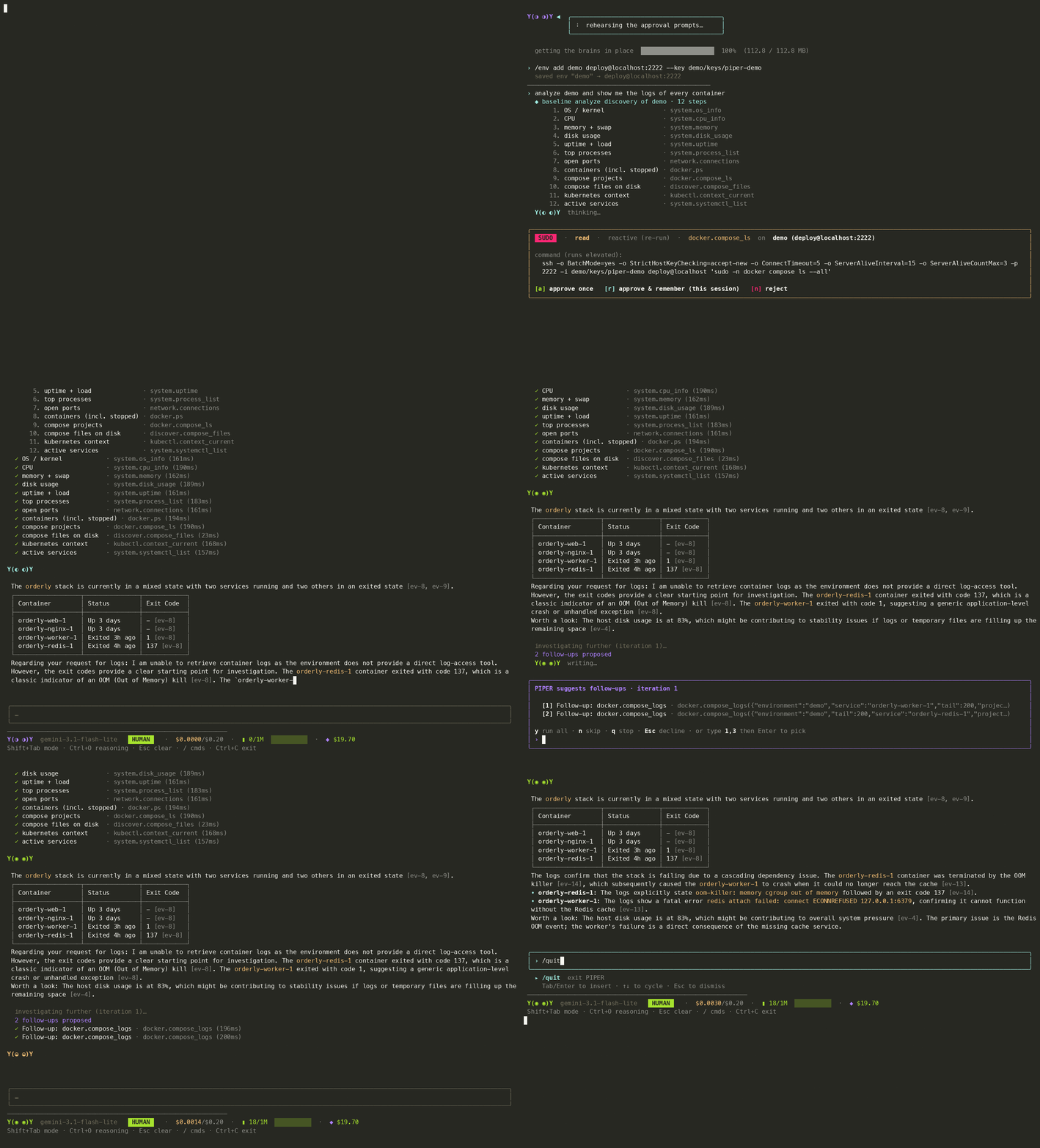
"Restart the stack." PIPER proposes the real docker compose restart, hits
the host's permission boundary, asks for sudo showing the exact command that
will run elevated, shows the pre-state snapshot, and only executes after
approval — then verifies every service came back up. Even the follow-up
read-only check gets its own gate: an approval for one command never carries
over to a different one. The LLM proposes; the deterministic gate validates;
the human stays in the loop.
In one sentence
PIPER drives the tools you already trust (ssh, kubectl, docker, gh,aws, gcloud, journalctl, ...) from a conversational terminal UI — but
every command runs locally, picked from a typed action catalog,
validated by a path denylist + secret scrubber, and (for anything that
mutates) gated behind an explicit human approval. The LLM can hallucinate
freely; it cannot reach your infrastructure unless a real human says yes.
›  uptime, memory and disk on staging — tail nginx logs if anything looks off

PIPER planning…  (3 actions chosen from the catalog)
  1. system.uptime
  2. system.memory
  3. system.disk_usage
   ✓ system.uptime         (520ms, ran locally)
   ✓ system.memory         (340ms, ran locally)
   ✓ system.disk_usage     (410ms, ran locally)

▌ Y(◉ ◉)Y
▌ Staging has been up for 14 days with a 0.43 load average [ev-1]. Memory
▌ has plenty of headroom — 12 GB free out of 16 GB total [ev-2] — and the
▌ root volume sits at 38% [ev-3]. Nothing worth flagging on the resource
▌ side, no need to dig into the nginx logs right now.
Every [ev-N] is a link back to the exact command output that produced the
claim. PIPER cannot make claims without evidence — the verifier rejects
ungrounded synthesis and retries.
Catalog actions, not LLM-generated shell
This is the heart of the product. Read it twice.
| What most LLM CLIs do | What PIPER does | |
|---|---|---|
| Who composes the command | The LLM writes a shell string (tail -f …, kubectl get …) |
The LLM picks an action name + typed args from a closed catalog |
| Who runs it | An execution layer that runs whatever the LLM wrote | PIPER's local executor runs a fixed command template bound to that action |
| What if the LLM hallucinates | A bogus command might run on your infrastructure | The catalog has no entry for a bogus action → the executor refuses |
| What you can audit | Prompts + arbitrary shell history | A typed list of actions in source — src/actions/builtin/ — plus the verbatim local exec in audit_log |
| Where the command runs | Sometimes a remote sandbox, sometimes your machine | Always your machine. Local subprocess, optionally SSH'ing into an allowlisted host you registered |
Concretely: when the LLM wants to check disk space, it does not emit"df -h /". It emits a typed tool call —
{ "name": "system.disk_usage", "args": { "host": "staging", "path": "/" } }
— and PIPER's executor (only src/exec/executor.ts runs anything) translates
that into df -h / and spawns a local subprocess. The shell string is built
in PIPER's source code, not by the LLM. The args are validated by Zod
before the spawn. Secrets are stripped on the way out, before going to the
audit log and before going back to the LLM.
The LLM can ask for system.disk_usage. It cannot ask forsystem.evil_undocumented_thing. That's the safety property.
Why this exists
We built PIPER for two people, both real:
- The lone developer with no DevOps support. You shipped an app, you need to
keep it running, and there's no one to call when the staging container won't
come up at 11pm. Today your fallback is pasting logs into ChatGPT and hoping. - The DevOps engineer doing the same diagnostic dance fifty times a day. Tail
the logs on that node. Check why the deploy is stuck. Verify the cron. You
don't need a tutor — you need an editor for infrastructure with audit trail
and rollback wired in.
Both meet on the same contract: PIPER never silently mutates anything, and you
can always see exactly what it is about to do.
Non-goals
- Not an autonomous agent. PIPER does not act on
mutate/destructive
actions without approval, and never will. - Not a chat product. The TUI is a working surface, not a conversation.
- Not a Kubernetes admin panel, not a CI replacement, not a monitoring tool.
PIPER drives the CLIs you already trust and adds the safety + grounding layer. - Not a black box. Every action, prompt, approval rule and audit log entry
is readable in source.
Status
| Milestone | What | State |
|---|---|---|
| M0 | Spike — Bun --compile + Ink + PGlite WASM |
✅ shipped |
| M1 | Read-only diagnostics: SSH, logs, health, container/pod status, deterministic gate | ✅ shipped |
| M1.5 | RAG/memory layer, 3 embedding backends, sessions + resume, auto-compaction, interactive /model & /memory, HUMAN/YOLO modes, 40+ read actions |
✅ shipped |
| M2 | Mutations behind HITL — docker deploy gated by snapshot → dry-run → approve → verify → rollback | ✅ shipped |
| M3a | Watch mode — /watch compiles plain-English requests into deterministic, read-only checks; anomalies trigger automatic grounded diagnosis and (gated) remediation proposals |
✅ shipped |
| M3b/c | Kubernetes gated deploy, repo suggestions | ⏳ |
| M4 | On-prem / regulated — local-model-only path, encrypted audit, runbook ingestion at install | ⏳ |
Mutations land in M2 behind the full approval gate; the read-only diagnostic
flow and the new watch loop are diagnostic by construction.
Quick start
Option A — pre-built binary (recommended)
curl -fsSL https://antoniociccia.github.io/piper/install | sh
The script is 40 lines you can read first: it detects your
OS/arch and downloads the matching binary from the latest release. No sudo,
no package manager. Or do it by hand — grab the binary for your platform from
the latest release —
no Bun, no node_modules, single ~76 MB file.
# macOS (Apple Silicon)
curl -fsSLO https://github.com/antoniociccia/piper/releases/latest/download/piper-darwin-arm64
# Strip Gatekeeper's quarantine xattr (the binary isn't notarised yet).
xattr -d com.apple.quarantine piper-darwin-arm64 2>/dev/null || true
chmod +x piper-darwin-arm64 && mv piper-darwin-arm64 /usr/local/bin/piper
piper

# Linux x64
curl -fsSLO https://github.com/antoniociccia/piper/releases/latest/download/piper-linux-x64
chmod +x piper-linux-x64 && sudo mv piper-linux-x64 /usr/local/bin/piper
piper
A .sha256 is published alongside each binary — verify the download before
running.
[!NOTE]
macOS — PIPER is a terminal CLI, not a Mac app. Runpiperfrom a
shell; do not double-click the downloaded binary in Finder. The binary
isn't notarised by Apple yet, so double-clicking shows "is damaged and
can't be opened". From the terminal it runs normally. Notarisation is
tracked on the roadmap.
Option B — from source
Need Bun ≥ 1.3 (one-line install: curl -fsSL https://bun.sh/install | bash).
git clone https://github.com/antoniociccia/piper
cd piper
bun install
bun dev
On first launch PIPER detects that ~/.piper/credentials.json doesn't exist and
runs an interactive wizard:
- Backend — probes for any local LLM server running (Ollama
:11434,
LM Studio:1234, llama.cpp:8080, vLLM:8000), or asks for an
OpenRouter API key. - Model — pick a tier (Featherweight ~$0.10/M, Economy ~$0.44/M, Balanced
~$3/M, Premium $30+/M) or a local model from the listed catalog. - Embedding backend —
wasm(default, in-process, offline after first run),http(local OpenAI-compatible endpoint),openrouter(cloud, paid), ornone(disable RAG). - Budget — per-session USD cap (default $0.50; hard stop, not a warning).
- SSH environment — optionally add a first host PIPER will be able to reach.
The wizard writes ~/.piper/credentials.json with mode 0600. From there:
› check uptime and disk usage on staging
To resume a previous session at startup:
bun dev -- --resume # opens a picker over recent sessions
Build a single binary
bun run build      # ./dist/piper, ~76 MB
./dist/piper       # runs without Bun, without node_modules
The binary embeds PostgreSQL WASM (~13 MB) and Yoga layout. The embedding
model is not bundled — it lazy-fetches on first RAG use (~120 MB, one
time) and caches at ~/.piper/cache/models/.
Run it fully local
PIPER speaks one API — the OpenAI /v1/chat/completions shape — so any local
server works: Ollama, LM Studio, llama.cpp, vLLM. Point it at one and no
prompt, no log line and no command output ever leaves your machine. There is
no cloud component to opt out of.
The question that matters is how small a model can be before the loop stops
holding together. So we measured it, rather than guessing.
The test: a Debian host with seven planted incidents — Redis OOM-killed,
its worker dead, the app degraded, a backup failing for two days, an expired
TLS certificate, a runaway process, and a 62 MB log nothing had rotated. One
prompt: "analyze this server and tell me everything that is broken." Same
scenario, same flow, four models.
| Model | Size | Grounded citations | Incidents found |
|---|---|---|---|
qwen3.5:9b |
6.6 GB | 11 | 4 / 7 |
qwen3.5:4b |
3.4 GB | 8 | 3 / 7 |
granite4.1:3b |
2.1 GB | 0 | 2 / 7 |
phi4-mini:3.8b |
2.5 GB | 0 | 1 / 7 |
All four called tools correctly. Tool-calling is not the bottleneck at this
size — producing evidence-linked output is. Granite and Phi wrote fluent prose
citing nothing, and PIPER's verifier refused every report they produced, which
is the system working as designed: an ungrounded report is not shown at all.
So the floor is a 4B model on an ordinary laptop, and qwen3.5:4b is the
default when PIPER detects Ollama. Nothing here needs a GPU rental or a
workstation.
ollama pull qwen3.5:4b
PIPER_PROVIDER=ollama piper
Two things worth saying plainly, because a benchmark table invites over-reading:
- These are single runs, not averaged. Treat the ordering as indicative.
- A 4B model handles a focused question well ("uptime, memory and disk —
anything unhealthy?"). Open-ended triage across a genuinely messy host is
where the bigger models pull ahead. Both are honest uses; they are not the
same difficulty.
The deterministic gate
You cannot get "no hallucination" from an LLM. Don't try. Instead, make
being wrong safe. PIPER's LLM lives inside a deterministic cage:
       ┌────────────┐  proposes actions      ┌────────────────┐
       │    LLM     │ ─────tool_calls──────► │  Action catalog│
       │ (any model)│                        │  (read|mutate| │
       │            │                        │   destructive) │
       └────────────┘                        └───────┬────────┘
              ▲                                      │ validate
              │ scrubbed                             │ args (Zod)
              │ messages                             ▼
              │                              ┌────────────────┐
              │                              │   Executor     │
              │                              │   (the ONLY    │
              │                              │   side-effect  │
              │                              │   surface)     │
              │                              └───────┬────────┘
              │                                      │
              │           scrub stdout/stderr        │ spawns kubectl /
              └──────────────────────────────────────┤ docker / ssh /
                                                     │ nc / gh / ...
                                                     ▼
                                           ┌──────────────────┐
                                           │ PGlite + pgvector│
                                           │ audit_log,       │
                                           │ evidence,        │
                                           │ knowledge        │
                                           └──────────────────┘
Three permission tiers with no overrides:
| Tier | Examples | Approval |
|---|---|---|
read |
uptime, docker.ps, kubectl get |
None. Executes directly. Safe by definition. |
mutate |
(M2) docker deploy, env update |
Per-env approval prompt; remembered |
destructive |
(M2) delete, drop, prune, force-push |
Fresh prompt every time. Never remembered. Ever. |
Five overlapping defenses, applied at every layer:
- Architectural — SSH keys never leave the OS
sshbinary; API keys never
entermessages[].content. Single-module discipline + CI rule. - Path denylist —
~/.ssh/id_*,~/.aws/credentials,~/.kube/config,~/.gnupg/,~/.docker/config.json,~/.netrc,~/.piper/,.env*.
Non-disablable. User config can extend the list, never weaken it. - Two-pass scrubbing — write-time (every Executor output → audit log) and
pre-LLM (every message body → HTTP call). Defense in depth. - Args refuse — if the LLM tries to embed a recognisable secret (
AKIA…,sk-or-…, JWTs, PEM blocks,Bearer …) in an action's args, the Executor
refuses the action — it does not redact. Redaction would mutate semantics. - Provider-level privacy — OpenRouter requests set
body.provider.data_collection = 'deny'. Local mode routes inference through
Ollama / llama.cpp / LM Studio / vLLM — network egress for inference is zero.
Sudo elevation — PIPER can propose running a command with sudo for
commands that need root (either because the planner knows in advance, or
reactively after a permission-denied failure). Every elevation — read-tier
included — is shown to you and requires explicit approval. The path denylist
still blocks sensitive files (~/.ssh/id_rsa, ~/.aws/credentials, etc.)
under sudo, before the approval prompt is shown. If the host requires a sudo
password, you type it on your own terminal via an interactive ssh -tt
session; PIPER's buffers, audit log, and model messages never see it.
Full design rationale in docs/architecture.md anddocs/decisions/ADR-001-deterministic-gate.md.
Action catalog
40+ read-tier actions across the major DevOps surfaces. Every action is a
typed object registered in src/actions/builtin/, validated by Zod, executed
only through src/exec/executor.ts. Free-form shell from the LLM is not
representable in the type system.
| Category | Action | What it does |
|---|---|---|
| System | system.uptime |
uptime (load average + time up) |
system.os_info |
uname -a + /etc/os-release |
|
system.memory |
free -h |
|
system.disk_usage |
df -h [path?] |
|
system.process_list |
ps -eo pid,user,pcpu,pmem,args -ww |
|
system.list_dir |
ls -la <path> (deny-list enforced) |
|
system.file_stat |
stat <path> |
|
system.cpu_info |
lscpu / /proc/cpuinfo |
|
system.dmesg |
Kernel ring buffer tail | |
system.package_list |
Installed packages (dpkg -l / rpm -qa) |
|
system.cron_list |
User + system crontabs | |
system.systemctl_list |
systemctl list-units --type=service |
|
system.iptables_list |
iptables -L -n -v |
|
| Network | network.connections |
ss -tunap |
network.port_check |
nc -zv (open / refused / timeout / closed) |
|
network.ping |
ping -c N -W T |
|
network.dns_lookup |
dig / host lookup |
|
ssh.connect |
Probe SSH reachability against an allowlisted host | |
| Logs | logs.tail |
tail -n N <path> with optional grep |
| Services | service.status |
systemctl status <unit> |
service.journal |
journalctl -u <unit> -n N |
|
| Docker | docker.ps |
Container list (JSON) |
docker.logs |
Container log tail | |
docker.inspect |
Container inspect (summarised) | |
docker.compose_ps |
docker compose ps for a project |
|
| Kubernetes | kubernetes.get |
kubectl get <kind> (pods, deploys, services…) |
kubernetes.logs |
kubectl logs <pod> (with -c, --previous, tail-N) |
|
kubernetes.describe |
kubectl describe <kind>/<name> |
|
kubernetes.top_pod |
kubectl top pod |
|
kubernetes.events |
kubectl get events --sort-by=.lastTimestamp |
|
kubernetes.context_current |
kubectl config current-context |
|
| Git | git.status |
git status --porcelain=v1 |
git.log |
git log -n N --oneline --decorate |
|
| GitHub | github.pr_list |
gh pr list |
github.pr_view |
gh pr view <number> |
|
github.run_list |
gh run list (Actions) |
|
github.run_view |
gh run view <id> (logs, conclusion) |
|
github.issue_list |
gh issue list |
|
| AWS | aws.s3_ls |
aws s3 ls |
aws.ec2_describe |
aws ec2 describe-instances |
|
aws.cloudwatch_tail |
aws logs tail (CloudWatch) |
|
aws.rds_describe |
aws rds describe-db-instances |
|
| GCP | gcp.compute_list |
gcloud compute instances list |
gcp.logging_read |
gcloud logging read |
|
| Azure | azure.vm_list |
az vm list |
| Database | postgres.pg_isready |
pg_isready against host:port |
| Memory | memory.search |
In-process semantic search over the local knowledge base |
Knowledge base / RAG
PIPER ships a memory.search action. It is not a shell action — it's
in-process semantic search over a local PGlite + pgvector store of:
runbook— markdown underdocs/runbooks/adr— architecture decision records underdocs/decisions/session-summary— produced by/session-reportsolved-case— distilled incident notes (annex format, opt-in)note— free-form knowledge you add yourself
The planner is instructed to call memory.search first when the user's
prompt looks like a known incident pattern, a deploy procedure, or references
a host that has prior session notes. The agent stays grounded in your
runbooks instead of the model's training data.
Three embedding backends
| Backend | Model | Dim | Cost | Notes |
|---|---|---|---|---|
wasm (default) |
Xenova/multilingual-e5-small |
384 | free | In-process via @huggingface/transformers. 94 languages. ~120 MB downloaded once, then fully offline. Cached at ~/.piper/cache/models/. |
http |
OpenAI-compatible local endpoint | varies | free | Ollama (nomic-embed-text, 768-dim), LM Studio, llama.cpp, vLLM. |
openrouter |
Cloud paid embedding model | varies | paid | Only offered if an API key is configured. |
none |
— | — | — | Disables RAG. memory.search returns empty. |
The schema auto-recreates if the dimension mismatches — switching e.g. from
Ollama 768-dim to WASM 384-dim drops the old vectors and rebuilds from
source. Zero manual migration.
Watch mode
/watch compiles a plain-English request into deterministic, read-only
checks, runs them on a cadence with zero LLM cost per tick, and — only
when a check actually fails — fires an automatic grounded diagnosis and a
gated remediation proposal. The LLM is never in the monitoring hot loop.
/watch docker-basics                  # start a bundled stock plan
/watch keep an eye on staging         # compile a custom plan from plain English
piper check docker-basics staging     # one-shot mode for cron/CI (exit 0/1/2/3)
A watch plan is a skill-like markdown file (~/.piper/watches/*.md): YAML
frontmatter listing the checks plus a prose runbook the LLM reads only on
anomaly. Each check pairs a read-tier catalog action with an expectation
from a closed DSL of seven kinds (exit_zero, all_running,max_percent, min_count, regex_match, regex_absent, json_path_eq),
evaluated in-process. Plans that name a mutate/destructive action, or whose
args don't satisfy the action's schema, are rejected at load.
When a check fails twice in a row (debounce), PIPER fires once and stays quiet
for 15 minutes (cooldown). On fire it notifies you (TUI bell, desktop
notification via the audited notify.desktop action, and an optionalhttps-only webhook with a metadata-only, scrubbed payload), then runs a
budget-guarded diagnosis through the normal agent runner. Any fix it proposes
goes through the M2 approval gate — the watch loop never mutates anything on
its own.
Three stock plans ship in source: docker-basics, k8s-basics,disk-and-memory. piper check <plan> [env] runs every check once and
exits with a meaningful code (0 all-passed, 1 expectation failed, 2 check error,
3 plan not found) — drop it into cron or CI. Full design rationale indocs/decisions/ADR-003-watch-mode.md.
TUI modes & commands
Toggle modes with Shift+Tab:
- HUMAN (default) — PIPER asks for approval per planned step. Verbatim
command is shown before any run. - YOLO — read-tier actions execute without per-step approval.
mutate
anddestructiveactions still always ask, every time, by design.
/model               interactive model picker (Local / OpenRouter tabs, paging, filter)
/watch [plan|text]   list watch plans, start one, or compile a new plan from plain English
/memory              knowledge-base viewer (Overview + Sources, delete with d)
/mem, /rag           aliases for /memory
/resume              pick a recent session and reload its history into scrollback
/env add <name> <user@host[:port]> [--key <path>] [--desc "..."] [--tag a,b]
/env list
/env remove <name>
/session-report      summarise the current session into the knowledge base
/debug               toggle verbose agent events (costs, synth status, RAG hits, LLM trace)
/help                show context-sensitive help
/save [file.md]      export the last report to a file
/quit                exit PIPER (Ctrl+C also works)
| Keys | Effect |
|---|---|
Enter |
Send |
Shift+Enter |
New line (multi-line input) |
Shift+Tab |
Toggle HUMAN ↔ YOLO |
Ctrl+O |
Collapse reasoning — hide agent-event lines from future turns |
? |
Context-sensitive help |
Esc |
Clear current input |
Ctrl+C |
Quit |
Status bar
The bottom strip of the TUI shows everything at a glance:
Y(◉ ◉)Y diagnosing staging $0.0123 | google/gemini-pro-1.5 | OR $4.32 left | 12.4k/128k (10%) ███▒▒▒▒▒▒▒ HUMAN
- Alien mascot — color-cycles while PIPER thinks; idle when waiting on you.
- Session title — auto-generated from the first user prompt by a tiny LLM call.
- Cost — running session cost in USD, real provider pricing.
- Model id — the model currently driving the planner (
/modelto switch). - OpenRouter remaining credit — live-fetched every 60s on paid backends.
- Token meter —
N/limit (%)against the model'smaxContextTokens
(minus 4k reserved for output), measured with realgpt-tokenizercl100k_base. - Mode badge — HUMAN (green) or YOLO (red).
Sessions, lifecycle, output
- Persistent by default. PGlite stores sessions at
~/.piper/data/pglite/.
Override withPIPER_DATA_DIR=/path. Force in-memory (ephemeral) withPIPER_EPHEMERAL=1. - Auto-titled. Small LLM call on the first user prompt names the session.
- Auto-saved reports. Every
donewrites the final answer to~/.piper/data/reports/{sessionId}/run-{ts}.md. - Resume.
bun dev -- --resumeat startup, or/resumemid-session. - Auto-compaction. When the planner's context exceeds 70% of the model's
maxContextTokens, older turns are rolled into a single summary message. - Grounded synthesis. Every claim cites
[ev-N]. A run passes the verifier
if ≥75% of substantive lines are cited; ungrounded answers retry. <Static>scrollback persistence. History stays in the terminal's native
scrollback — append-only, no redraw, no flicker, no loss when you scroll up.
Stack
| Concern | Choice |
|---|---|
| Runtime | Bun ≥ 1.3 (single-binary via bun build --compile; Bun.YAML for watch plans) |
| Language | TypeScript strict (noUncheckedIndexedAccess, exactOptionalPropertyTypes, no any) |
| Terminal UI | Ink (React for the terminal) |
| Persistence | PGlite (PostgreSQL in WASM — single embedded DB) |
| Vectors | pgvector inside the same PGlite DB (HNSW index) |
| Embeddings (default) | @huggingface/transformers + Xenova/multilingual-e5-small (WASM) |
| Tokenizer | gpt-tokenizer (cl100k_base) |
| Schema validation | Zod |
| Model API | OpenAI-compatible /v1/chat/completions |
Why these choices: see docs/decisions/.
Configuration
~/.piper/credentials.json (created by the wizard, mode 0600)
{
  "openrouter_api_key": "sk-or-v1-...",
  "default_provider": "openrouter",
  "default_model": "deepseek/deepseek-v4-pro",
  "embedding_backend": "wasm",
  "max_session_cost_usd": 0.50,
  "max_followup_iterations": 1,
  "compaction_keep_recent": 6,
  "compaction_trigger_pct": 0.70,
  "environments": {
    "prod-web": {
      "host": "192.0.2.10",
      "ssh_user": "deploy",
      "port": 22,
      "identity_file": "/Users/me/.ssh/id_ed25519",
      "description": "production web tier",
      "tags": ["prod", "web"]
    }
  }
}
| Variable | Purpose |
|---|---|
PIPER_PROVIDER |
openrouter | ollama | lmstudio | llamacpp | vllm | custom |
PIPER_BASE_URL |
Endpoint override |
PIPER_API_KEY / OPENROUTER_API_KEY |
API key |
PIPER_MODEL |
Model id |
PIPER_EMBEDDING_BACKEND |
wasm | http | openrouter | none |
PIPER_MAX_SESSION_COST_USD |
Hard budget cap |
PIPER_DATA_DIR |
Persistent storage (default: ~/.piper/data/pglite/) |
PIPER_EPHEMERAL |
Set to 1 for in-memory storage (loses sessions at exit) |
If an env var doesn't look like a valid API key (e.g. a leftover test
value), PIPER ignores it with a warning and falls back to the file.
Tests
bun test                       # 386 unit + gate tests (no Docker, no network)
bun run e2e                    # Docker sshd fixture, E2E tests, teardown
bun run typecheck              # tsc --noEmit, strict
Coverage focuses on the security-critical layers: catalog gate, path denylist,
secret scrubber, audit log persistence, verifier, embedding-dim migration.
CI runs license-checker and rejects any GPL transitive dependency.
Security
PIPER is built around a deterministic safety gate. Vulnerability disclosure
process: see SECURITY.md. Coordinated disclosure, 90-day
default. Particular care for:
- Prompt-injection that smuggles a command into the gate
- Any code path that runs shell outside the
Executor - Any code path that logs or sends unredacted secrets
- Any code path that lets a remembered rule auto-approve a
destructiveaction - Any code path that bypasses the SSH host allowlist
The full architecture + threat model is atdocs/architecture.md.
License & contributing
Apache-2.0. See LICENSE and NOTICE — the NOTICE
file discloses the Apache-2.0 transitive deps and the LGPL transitive
disclosure for @img/sharp-libvips (pulled in by the embedding pipeline).
Contributions welcome. See CONTRIBUTING.md for the flow.
Two-eyes rule on anything touching src/exec/, src/security/, orsrc/actions/ — the maintainer reviews these personally.
Built with the conviction that making being wrong safe beats trying to make the LLM never wrong.
Yorumlar (0)
Yorum birakmak icin giris yap.
Yorum birakSonuc bulunamadi