Janux
Health Uyari
- License — License: MIT
- Description — Repository has a description
- Active repo — Last push 0 days ago
- Low visibility — Only 5 GitHub stars
Code Gecti
- Code scan — Scanned 12 files during light audit, no dangerous patterns found
Permissions Gecti
- Permissions — No dangerous permissions requested
Bu listing icin henuz AI raporu yok.
Janux - One component, two faces: UI for humans, MCP tools for AI agents. The agent-native fullstack framework.

Janux
The fullstack framework for the Agentic Web.
One component, two faces: a live view for humans, typed MCP tools & resources for AI agents — generated from the same definition, so they can never drift.
[!WARNING]
Janux is currently under active development. This repository is public to enable collaboration and transparency, but it has not been officially announced yet. Expect breaking changes, incomplete documentation, and unfinished features until the first public release.







Website · Docs · Quick start · The Agentic Web · Playground · RFC 0001
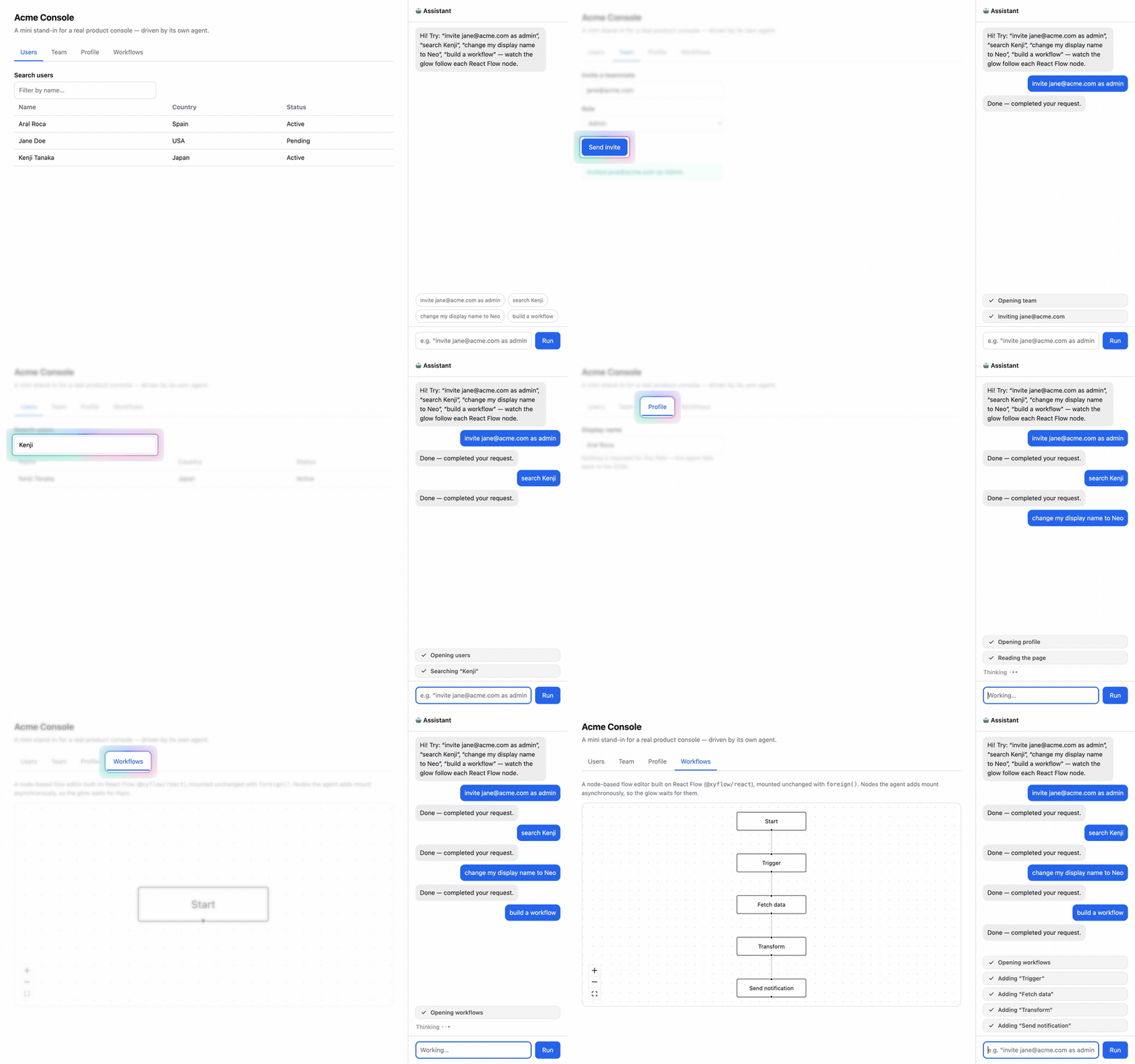
examples/with-web-agent — the agent calls the same intents a human clicks, and createCopilot({ visualize }) is the whole of the feedback: a chip per tool call, a gradient ring on the element being operated, and a backdrop veil that keeps the user's focus on the action.
Why Janux
The web is growing a second audience. People still click, but agents now read, plan and act on the same pages — through MCP clients, through browser agents, through copilots embedded in your own product. The Agentic Web is the web both of them can operate, and it is being standardized in the open: MCP for tools over HTTP, WebMCP for tools in the browser, llms.txt for discovery, Web Bot Auth for identity.
Today, making an app agent-operable means building it twice. The UI already holds the logic — the validation, the permissions, the business rules — and then a second, hand-written integration re-declares a fraction of it as tools. Two artifacts, one source of truth, and the gap between them grows with every sprint. Tools drift, guardrails are ad-hoc, and nobody can say exactly what an agent is allowed to do.
Janux removes the second artifact. A component is simultaneously a view, an agent-readable resource and a set of typed tools — one definition, projected three ways by the framework. A human click and an agent tool call enter the same pipeline: guard check → schema validation → run() → audit entry. The contract can't rot, because it is generated from the code that renders.
Named after Janus, the two-faced Roman god of doorways: one face toward the human, one toward the agent, one threshold. Designed in RFC 0001.
Table of Contents
- Install
- Quick start
- One component, three projections
- Two agent surfaces, zero integration
- Humans stay in the loop
- Highlights
- How it works
- Performance
- Packages
- Documentation
- Benchmarks
- Templates
- Examples
- Develop
- Contributing
- Releases
- License
Install
bunx create-janux my-app
cd my-app && bun install && bun run dev
Requires Bun ≥ 1.3 for the dev server and the build. Production is a choice: Bun, Node 24+ via @janux/node, Vercel, or a static export — same app, one adapter.
Or add the pieces to an existing workspace:
bun add janux @janux/server @janux/agent @janux/cli
Quick start
import { component, intent, schema, str, int, money, list } from 'janux';
import { pay } from './pay.api';

//  UI component + 2 WebMCP tools (intents), grouped together for maintainability
export const Cart = component({
  name: 'cart',
  description: 'Shopping cart with line items.',
  state: schema({ items: list({ productId: str(), qty: int().min(1), unitPrice: money() }) }),
  derived: { total: (s) => s.items.reduce((a, i) => a + i.qty * i.unitPrice, 0) },
  intents: {
    addItem: intent({
      description: 'Add a product to the cart',
      input: schema({ productId: str(), qty: int().default(1), unitPrice: money().default(0) }),
      run: ({ state, input }) => state.items.push(input),
    }),
    checkout: intent({ description: 'Pay for the cart', guard: 'confirm', run: ({ state }) => pay({ items: state.items }) }),
  },
  view: ({ state, derived, intents }) => (
    <section>
      <ul>
        {state.items.map((i) => (
          <li key={i.productId}>{i.productId} × {i.qty}</li>
        ))}
      </ul>
      <button onClick={intents.checkout}>Pay ({derived.total}¢)</button>
    </section>
  ),
});
You wrote a shopping cart. You also shipped an agent surface — generated, no second file:
{
  "resources": ["ui://cart"],
  "tools": [
    { "name": "cart.addItem", "description": "Add a product to the cart", "guard": "auto" },
    { "name": "cart.checkout", "description": "Pay for the cart", "guard": "confirm" }
  ]
}
One component, three projections
| Projection | For | What it is |
|---|---|---|
| View | humans | server-rendered HTML that resumes on first interaction |
| Resource | agents | ui://cart — typed JSON state, readable and subscribable |
| Tools | both | cart.addItem (auto), cart.checkout (confirm → a human approves) |
They cannot drift: there is one definition, and the framework derives the other two. A human click and an agent tool call run the exact same pipeline — guard check → schema validation → run() → audit entry.
Two agent surfaces, zero integration
Every Janux app speaks the Agentic Web's protocols out of the box. You declare no tools twice, and you write no adapters.
| Standard | What Janux does with it |
|---|---|
| MCP — tools over HTTP | A real, stateless MCP server at /_janux/mcp, generated from your api() functions. Dual-era: negotiates 2026-07-28 and 2025-06-18. |
| A2A — agent to agent | A derived /.well-known/agent-card.json and a JSON-RPC endpoint at /_janux/a2a, over the same pipeline and the same guards as MCP — so an agent that arrives by A2A holds no authority an MCP client would be refused. |
| WebMCP — tools in the browser | Every mounted intent is registered with document.modelContext the moment its island mounts, so browser agents and the DevTools panel see it. Polyfilled where the API is missing. |
llms.txt — discovery |
Opt-in site index at /llms.txt (dynamic routes expanded via staticParams), plus a Markdown projection of every page by appending .md. |
| Web Bot Auth (RFC 9421) | Signed agent identity, verified per request under an observe or require policy. |
| Human approval | guard: 'confirm' reaches MCP clients as annotations.requiresApproval, arrives over A2A as TASK_STATE_INPUT_REQUIRED, and parks agent calls as Proposals whichever door they came through. |
Pointing Claude, Cursor or any MCP client at your app is a URL, not an integration project:
claude mcp add --transport http my-app https://your.app/_janux/mcp
Humans stay in the loop
Guards are a language feature, not a convention. Every intent and every api() declares who may call it:
auto— agents call it directly.confirm— a human click runs it; an agent call parks as a Proposal that a person approves or rejects on the real UI, executing exactly once.forbidden— never exposed as a tool. The agent falls back to the DOM, under the same permissions as a user.
Every invocation records its origin (human / agent) in an audit trail, and janux verify fails the build if an agent-reachable tool ships without a description. See examples/human-in-the-loop.
Highlights
- 🧿 One definition, three projections. The mounted tree is the MCP tree — UI and agent surface cannot drift.
- 🪶 0 KB JS static pages. Components without state compile to plain HTML; a page with no islands ships no
<script>at all. - ⚡ Structural resumability. State is schema-typed JSON, behavior is named — the client resumes from snapshots with no hydration replay and no closure serialization. Zero component code runs until first interaction (asserted in the test suite).
- 🔌
api()= endpoint + stub + tool. A server function is at once a validated HTTP endpoint, a ~100-byte typed client stub (SWC transform) and an agent tool. - 🤖 Zero-config copilot.
JANUX_MODELor one provider API key (Anthropic, OpenAI, Google or OpenRouter) is all it takes. Every app ships the agent endpoint, the manifest and the gui-agent bridge (window.janux). - 🗺️ App-wide agent control. Every turn advertises built-in client tools (
ui_navigate,ui_get_view_context,ui_read_page,ui_click,ui_fill,ui_wait_settled) plus the full route map — andui_callsturns resume with their results (act → observe → continue), so navigate-then-act works in one turn. - ⚛️ Foreign-UI interop.
foreign()mounts React components unchanged — real embedded roots, tracked props, callbacks→intents — surviving SPA navigation. - 🧘 Observable quiescence.
await janux.settled()— thesleep(500)idiom dies here. - 🧪 CI for the agent surface.
janux verifygates undescribed tools;janux evalreplays scripted agent tasks — including real human-approval steps — against a live app.
How it works
Browser ── janux core (signals, resume, morph, delegation, window.janux bridge)
   │  HTML + state snapshots │ RPC │ agent turns
Server ── @janux/server (SSR, api(), manifest, proposals)
              └── @janux/agent (model resolution, provider loop: api.* server-side, ui_calls → bridge)
- SSR: sources load server-side; islands arrive with real content plus a JSON state snapshot.
- Resume:
boot()indexes islands, installs two delegated listeners, and mounts an island only on first interaction or agent call — from the snapshot, morphing the SSR DOM in place. - Agents:
GET /_janux/manifest?path=/shopfor discovery;POST /_janux/api/*for server tools;window.janux.call()for UI tools;POST /_janux/approvefor proposals. - Static export:
output: "static"prerenders every page intodist/client— deploy docs and marketing sites to any static host, agent face included, no server.
Configure the copilot model
Zero config — first match wins:
defineAgent({ model: 'anthropic/claude-fable-5' })JANUX_MODEL=provider/model- Provider key sniffing:
ANTHROPIC_API_KEY/OPENAI_API_KEY/GOOGLE_GENERATIVE_AI_API_KEY - Nothing set → the endpoint answers with a setup card; the app never crashes.
Performance
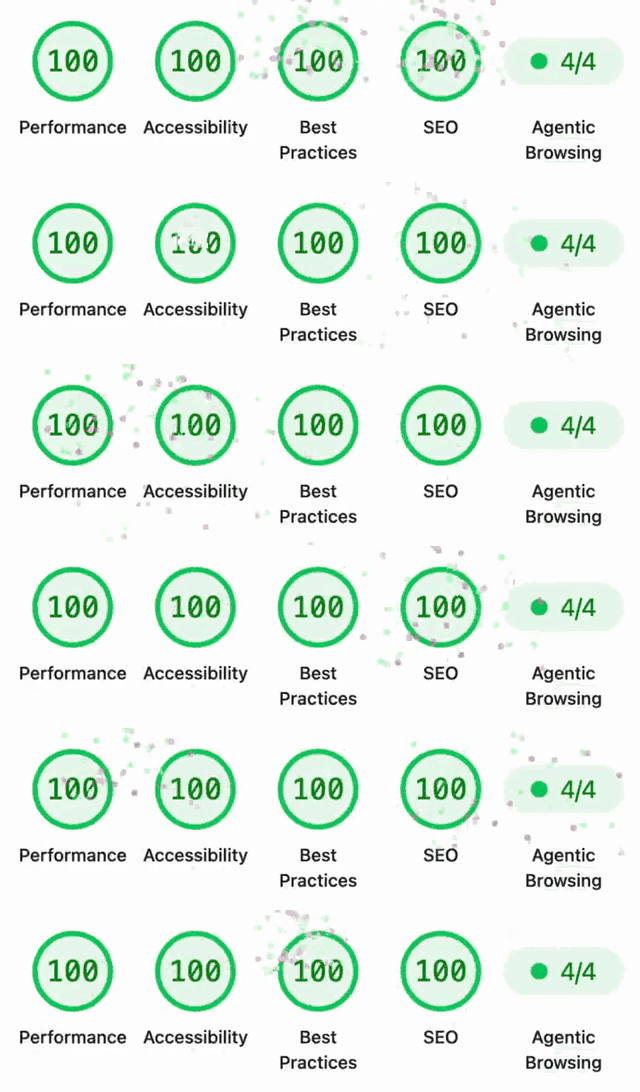
The documentation site is built with Janux (apps/docs) and scores 100 across the board — including Agentic Browsing, Lighthouse's check for whether an agent can actually read and operate the page. A CI job re-runs the audit on every pull request.
Packages
| Package | What |
|---|---|
janux |
Core: schema, signals, reactive state, component runtime, SSR islands, manifest, client resume + bridge, foreign interop, data cache, built-in client tools, glow |
@janux/server |
api() RPC, file-system router (layouts, groups, matchers, middleware), HTTP handlers + uploads, HTML shell, /_janux/* endpoints incl. the hosted MCP + .md projections, llms.txt, Web Bot Auth |
@janux/agent |
Model resolution, providers, the tool loop with turn continuation, and the embedded harness: memory (in-memory/Postgres), durable workflows, guardrail processors, rate limiting (in-memory/Redis), attachments, outbound MCP client |
@janux/vite |
Vite plugin (SWC api stubs, SSR bridge) |
@janux/cli |
janux dev / build / start / verify / eval, plus the adapter API third-party deploy targets are written against |
@janux/node · @janux/vercel |
Deployment adapters: a self-contained build/ for any Node 24+ host, and a Build Output API directory for Vercel |
create-janux |
Scaffolder |
Documentation
janux.build — 111 pages, ⌘K search, dark mode, and a copilot that answers from the docs themselves.
| Section | Start here |
|---|---|
| Getting started | What is Janux? · Quick start · The Agentic Web · Mental model |
| Guide | Components · Views and JSX · Intents and guards · Navigation · The agent and your copilot |
| Tutorial | A task board with two faces (3 parts) |
| Reference | one page per export: reactivity, client, data cache, agent harness, CLI |
| Recipes | Testing · Forms · Optimistic UI · Error handling · Custom server · Docker · Monorepo · Tailwind · Local model copilot |
| More | Examples · Comparison · Benchmarks · FAQ · Glossary |
Agents read the same docs at /llms.txt and any page as Markdown by appending .md.
Every example is verified. packages/docs-tests compiles every snippet, checks it imports only symbols the packages really export, runs the main example of a page and asserts what the prose claims. Three guards fail the build when an export has no reference page, when a page's executable claims aren't executed, or when any documented link stops resolving. Both backlogs are empty: every public export is documented, and every page that imports the framework has a test that runs it.
Benchmarks
19 multi-framework suites — client runtime, hydration, SSR, streaming and
shipped bytes — measuring Janux against react 19, preact, solid 2, svelte 5
and vue-vapor, with correctness gates before any number counts. The harness
is a port of octane's benchmarks (MIT,
Dominic Gannaway; js-framework fixtures derive from
krausest, Apache-2.0).
| Category | Where Janux stands |
|---|---|
| Resume vs hydration | 0.14× react — 0.39ms to make the news page interactive (react 2.86); 10.70ms vs 57.62 at 6× throttle |
| Shipped JS | 32.5KB gzip total vs react 60.7 (preact 9.8 · solid 13.7 · svelte 17.9 · vue-vapor 23.5); islands-free pages ship 0KB |
| Fine-grained updates | <For> + class={() => …}: swap 1.10ms vs react 3.98; reverse 1.95 vs 2.24; rotate 0.51 vs 1.51 |
| Mass DOM work | 10k rows: 68.94ms vs react 136.86; clear 38.40 vs 41.74; 512-field reset 14.74 vs 38.64; 512-field typing 16.84 vs 45.58 |
| Whole-app suites | parity: lifecycle cycle 49.35ms vs 49.56, store integrations within ±1.4×, suspense recovery within 1.14× |
| Building rows in bulk | behind: create-1000 6.56ms vs react 4.88 (solid 1.90) — a row carries an Owner, a signal and an effect |
| SSR throughput | behind: buffered 0.26ms vs react 0.07; streaming end-to-end at parity (50.86 vs 51.06) |
Across the 19 suites, 88 of 156 janux/react cells are ahead of react and 68 are
behind — the full signed table is inbenchmarks/BASELINE-2026-07.md.
Full tables, methodology and machine specs:
docs page · reproduce withbun run bench from benchmarks/.
Templates
An example teaches a feature; a template starts a product. Each one is a complete app
with its own README, a one-command deploy, and agent evals that prove its agent surface
works — scaffold one and you have something to ship, not something to read.
bun create janux my-app --template dashboard
cd my-app && bun install && bun run dev
Run --template with no name and the gallery lists itself. Every template starts with no
API key: the copilot degrades to a setup card plus a no-model demo that drives the page
with real tool calls.
| Template | What you start with |
|---|---|
dashboard |
Incident triage whose copilot really operates the board — it acknowledges and resolves through the same tools the buttons call, and maintenance mode is confirm-guarded, so its call becomes a proposal a human approves. |
back-office |
A customers CRUD where who is asking changes what happens: routine edits execute, deleting parks in an approvals inbox, and one audit trail records the actor from the invocation origin. |
content-site |
Markdown with a typed frontmatter contract, served twice: pages for people, and llms.txt + per-page .md projections + a typed search tool for agents — the same code as the search box. |
Full gallery with screenshots: janux.build/docs/more/templates.
Examples
34 runnable apps, each a real Janux project — bun run --cwd examples/<name> dev.
Start here
| Example | What it shows |
|---|---|
shop |
The full picture: catalog source, debounced persist effect, confirm checkout with human approval, copilot included. |
hacker-news |
The canonical clone: streaming suspense front page, [page=integer] pagination, a server-rendered nested comment tree, useQuery refresh and hover prefetch. |
The agentic surface
| Example | What it shows |
|---|---|
with-web-agent |
The demo above: a console operated in natural language, createCopilot({ visualize }) for the chips/ring/veil, glowTarget for React Flow nodes that mount late, and a forbidden intent that forces the DOM fallback. |
human-in-the-loop |
Who invokes changes what happens: the same confirm intent executes on a human click but parks as a Proposal for an agent, with an approvals inbox and an origin-labeled audit trail. |
with-mcp-url |
The app as a bearer-protected MCP server by URL, with a committed tool contract (agent-contract.json) that turns CI red if the agent surface drifts. |
with-mcp-client |
The outbound direction: the app's agent connects to an external MCP server by URL, filters the remote tools and re-exposes them on its own surface. |
a2a-supplier |
The app as an agent for other agents: a derived /.well-known/agent-card.json, an A2A endpoint beside the MCP one, and a confirm guard that parks a remote agent's call for a human here. |
a2a-buyer |
The other side: discovers the supplier by its agent card and hires it over A2A, then follows the task while a human at the supplier decides. |
durable-agent |
The harness in production shape: Postgres conversation memory that survives restarts, Redis rate limiting, injection guardrails, a durable two-step workflow, and a schedule that triggers it and resumes the same run after the process is killed. |
with-subagents |
Agent composition: a front desk that delegates lookups to a budgeted research subagent (own prompt, intersected tools — never wider than the parent's) and hands money conversations off to a billing agent that answers from then on. |
with-local-llm |
The copilot's model runs in the browser over WebGPU (localLlm()), with supportsLocalLlm() detection, a serverLlm() fallback and a live local↔cloud swap. |
agent-evals |
janux eval as a CI gate: scripted, model-free agent tasks replayed over the real webMCP surface, including a human approval step — plus a broken eval that proves the gate can fail. |
with-skills |
Skills: a multi-step returns procedure shipped as markdown the model loads on demand, projected to MCP — and janux verify failing on a skill that names a tool the app does not have. |
with-channels |
Channels: the same on-call agent answering in the browser and over an HTTP webhook — same confirm guard on both doors, and a browser-only intent the model is told it does not have. |
Components & state
| Example | What it shows |
|---|---|
nested-islands |
Stateful islands inside stateful islands, with dispose semantics. |
cross-island-state |
A store() cart shared by five islands with no prop drilling, persist: 'local' across reloads, a bus event that crosses islands, and batch()ed bundle adds. |
with-forms |
One schema() as the contract for three surfaces: the form UI (per-field errors, no reload), the api() endpoint, and the typed agent tool. |
with-optimistic-ui |
mutation() with optimistic writes and real rollback: the server rejects every third save and onError restores the snapshot with a visible notice. |
data-cache |
useQuery with a reactive query key, typed URL state (urlState) that deep-links and honors Back, agent parity for the same filter — plus the HTTP cache model: a public /catalog a CDN may keep, a private /account, and revalidation by tag readable in the headers. |
React interop
One example per category, each verified in CI — the compatibility matrix states what works, what works with caveats, and what does not.
| Example | What it shows |
|---|---|
interop-react |
A React component (unchanged) mounted with foreign(): tracked props, callbacks→intents. |
interop-data-grid |
@tanstack/react-table fully controlled from island state, with its updater-function callbacks mapped onto intents — the case on: { prop: 'intent' } cannot express. |
interop-virtual-list |
@tanstack/react-virtual over 10,000 rows, server-rendered as a real first window, and scrollToRow reaching a row no DOM-scraping agent could click. |
interop-charts |
recharts, whose onClick(data, **index**, event) payload is the second argument — and an e2e that asserts what Recharts does not server-render. |
interop-drag-drop |
@dnd-kit with its a11y wiring server-rendered, and an unserializable drag event mapped onto move { id, toIndex } — the tool an agent calls to reorder without dragging. |
interop-graph-editor |
@xyflow/react driven both ways: a node drag and a drawn edge become moveNode / connect. hydrate: 'only', because React Flow measures its viewport on mount. |
interop-forms |
The honest caveat: react-hook-form + zod own the inputs, so an agent's fill has to be reconciled into them explicitly. |
interop-command-palette |
cmdk, with an e2e assertion that the rendered command ids and palette.run's enum are the same list. |
interop-a11y-primitives |
@radix-ui/react-dialog with its focus trap and scroll lock intact, portalling out of the foreign host — and a navigation with the dialog open that neither throws nor leaves <body> unscrollable. |
Rendering & routing
| Example | What it shows |
|---|---|
with-suspense |
Streaming SSR: independent suspense boundaries that reveal mid-stream, and error boundaries that bubble. |
with-advanced-routing |
The full router grammar: [slug], [...path], [[...rest]], [id=integer]/[uid=uuid] matchers, nested _layout.tsx chains, (marketing) groups and the _404.tsx/_500.tsx pages, plus SPA navigation with a persist island. |
blog-static |
A markdown blog exported with output: 'static' + staticParams: zero-JS pages, speculation rules, and the agent face (llms.txt, sitemap, .md projections) from the same build. |
with-content |
Typed content collections: frontmatter validated by the same schema() as component state, and MDX notes that embed a real Janux island and a React component via foreign() — compiled on the server, so a note of prose still ships 0 KB. |
with-images |
Both halves of CLS: one <Image> renders AVIF/WebP candidates written by janux build, and a declared font is self-hosted, subset, preloaded and given a metric-adjusted fallback — CLS 0 with output: 'static' and 0 KB of JS. |
i18n |
Internationalization: locale-prefixed routing, language switcher, type-safe t() with plurals, and page-scoped client translations. |
Styling
| Example | What it shows |
|---|---|
with-tailwind |
@janux/tailwind zero-config: a pricing page with dark mode and a stateful billing toggle, styled only with v4 utilities. |
with-sass |
Sass with no config beyond the file extension: tokens, nesting, a mixin and four accent classes generated by one @each loop, compiled to a single /styles.css. |
with-css-variables |
Runtime theming: island state writes --brand/--pad/--radius onto one wrapper and the cascade rethemes the page, with no rebuild and no extra stylesheet. |
Server & data
| Example | What it shows |
|---|---|
with-sqlite |
Real persistence with bun:sqlite and both server surfaces on one database: api() RPC (delete is confirm-guarded — agents propose, humans approve) next to classic REST handlers. |
with-uploads |
End-to-end file uploads: dropzone() feeding a validating multipart handler (type + size), server-rendered gallery, previews without a reload. |
realtime-chat |
A custom server composing createJanuxServer with Bun's native WebSockets: optimistic delivery, cursor-based replay on reconnect, live presence. |
with-offline |
Service worker, offline and PWA: src/sw.ts plus offlineFirst(), a prerendered site that opens with no network, an offline fallback for pages never visited, and a deploy that takes over without stranding an open tab. |
with-worker |
worker(): the same prime-counting function on a Web Worker and on the main thread, with a ticker that proves which one froze the page. |
with-node-adapter |
The same app deployed to Node with @janux/node: one build/ directory, no Bun on the box, and a click counter that only moves if the island hydrated from the bundle Node served. |
Develop
bun install
bun test             # the whole suite: schema, signals, runtime, SSR, resume, morph, interop, router, cache, guards, agent loop, harness, SWC stubs
bun run test:census  # per-area counts, the coverage floor, and the count the docs claim
bun run typecheck
Contributing
PRs welcome — see CONTRIBUTING.md and our Code of Conduct. Third-party work Janux builds on is credited in CREDITS.md; security reports go through SECURITY.md.
Releases
Janux is 0.x, and every published package moves on one version.
- CHANGELOG.md — what changed, newest first.
- VERSIONING.md — what a minor is allowed to break, how much notice you get, and how long each one is supported.
- STABILITY.md — every public export marked stable, experimental or internal. Generated from the exports themselves.
License
Yorumlar (0)
Yorum birakmak icin giris yap.
Yorum birakSonuc bulunamadi