cad-cae-copilot
Health Gecti
- License — License: MIT
- Description — Repository has a description
- Active repo — Last push 0 days ago
- Community trust — 11 GitHub stars
Code Gecti
- Code scan — Scanned 12 files during light audit, no dangerous patterns found
Permissions Gecti
- Permissions — No dangerous permissions requested
Bu listing icin henuz AI raporu yok.
CAD/CAE Copilot — an AI-native CAD/CAE/CAX workbench for AI agents. Text-to-CAD, text-to-CAE, real build123d/OpenCASCADE geometry, editable parameters, stable topology pointers, deterministic critique, and MCP server tools.
CAD/CAE Copilot
Most AI CAD tools stop when a picture appears. CAD/CAE Copilot turns an engineering spec into real, editable, verifiable CAD — and keeps every artifact reproducible.
An AI-native CAD/CAE/CAX workbench. An MCP-capable agent writes real
build123d / OpenCASCADE geometry, exports STEP/STL/GLB, names the parts,
exposes stable topology pointers, runs a deterministic critique, and can
continue into CAE — all preserved in one reproducible .aieng package.
You bring your own MCP client (e.g. Claude Code, Codex, Copilot, Cursor),
which carries its own model access. The aieng backend itself needs no API key.






Quick Start ·
CAD Examples ·
Why aieng ·
MCP Setup ·
Agent Guide
English | 中文
Real STEP/STL/GLB · Editable parameters · Named parts · Stable topology pointers · Deterministic critique · CAD → CAE artifacts · Approval-gated actions
Quick start
Three ways in — pick one and you're modeling in minutes.
Before you start: you need your own MCP client (Claude Code, OpenAI
Codex, GitHub Copilot, Cursor, …) with its own model access. The aieng
backend itself needs no API key — your agent connects to it over MCP and
drives the workbench through its own harness.
For a first try, Docker (Option 2) is the most reliable — it pins the
build123d / OpenCASCADE / CalculiX stack so nothing has to compile on your
machine. The local dev install is best once you intend to hack on the code.
Option 1: GitHub Codespaces (fastest, zero install)
Click "Open in GitHub Codespaces" above. The environment sets itself up;
when it finishes loading, run make dev (or python3 scripts/dev.py if make
is unavailable). Then connect an agent and paste the
motor mounting fixture prompt, or the
shorter bracket prompt:
Create a 120 × 80 × 12 mm machined bearing support bracket with a centered
Ø42 mm horizontal bearing bore, four Ø10 mm base mounting holes, and two
mirrored gussets. Preserve the exact dimensions, expose editable parameters,
verify the final geometry, and run the deterministic engineering critique.
Inspect the generated model, named parts, verification results, and stable@face:* references in the workbench.
Option 2: Docker all-in-one (recommended local package)
Packages the backend, built viewer, MCP HTTP server, build123d / OpenCASCADE
dependencies, and CalculiX into one container.
docker build -t aieng/workbench:local .
docker run --rm -it -p 8000:8000 -p 8765:8765 -v aieng-data:/data aieng/workbench:local
Open the viewer at http://localhost:8000/app/ and point an MCP-over-HTTP client
at http://localhost:8765/sse. Projects and .aieng packages persist in theaieng-data volume. The container enables AIENG_MCP_MANAGED_APPROVAL=1 by
default, so approval-gated CAD/CAE tools surface through the workbench UI.
Option 3: Local developer install
Best when you intend to modify the code. Prerequisite: a conda env named
exactly aieng311 (Python ≥ 3.11) with build123d — the MCP configs
and run scripts assume this name. The build123d / OpenCASCADE (OCP) install
can be slow or fail on some platforms; if it does, prefer the Docker path
above.
conda create -n aieng311 python=3.11 -y
conda activate aieng311
pip install build123d
cd aieng-ui/backend && pip install -e .
Then start both services in one terminal (Ctrl+C stops both):
make dev                  # macOS / Linux / WSL
.\dev.ps1                 # Windows PowerShell
python scripts/dev.py     # cross-platform fallback
Backend → FastAPI on http://127.0.0.1:8000; frontend → Vite onhttp://localhost:5173. Custom ports: BACKEND_PORT=8080 FRONTEND_PORT=3000 make dev.
make backend     # or: cd aieng-ui/backend && uvicorn app.main:app --host 127.0.0.1 --port 8000 --reload
make frontend    # or: cd aieng-ui/frontend && npm install && npm run dev
cd aieng-ui/backend && python -m pytest    # backend test suite
From specification to verified CAD
The hero model above was built from an explicit industrial fixture
specification — fixed dimensions, named parts, exact hole and slot locations,
required symmetry, and no permission to invent extra geometry. The agent
executes and verifies the spec; it does not silently fill in the engineering.
Create a fully specified industrial motor mounting fixture using millimeters.

Coordinate system:
- X is the fixture width, Y is the fixture depth, and Z is vertical.
- Center the complete fixture on X=0.
- Place the bottom face of the base plate at Z=0.

Base plate:
- Create a 180 × 140 × 14 mm base plate.
- Add four Ø11 mm vertical through-holes at X=±70 mm and Y=±50 mm.
- Add an Ø18 mm, 5 mm deep counterbore to the top of every mounting hole.
- Add a 3 mm fillet to the four outside vertical corners.

Motor support:
- Add a centered rear vertical support plate, 130 mm wide, 14 mm thick,
  and 120 mm tall above the base.
- Add a Ø72 mm horizontal locating bore through the plate along Y.
- Position its center at X=0 and Z=78 mm.
- Add four Ø8.5 mm horizontal mounting holes on a Ø100 mm bolt circle.

Reinforcement and rails:
- Add two mirrored 12 mm thick triangular gussets extending 45 mm forward
  and rising 65 mm above the base.
- Add two separate 110 × 12 × 8 mm guide rails centered at X=±38 mm, Y=-12 mm.
- Add one centered 70 × 6 mm longitudinal slot to each rail.

Modeling requirements:
- Create named parts "fixture_body", "guide_rail_left", and "guide_rail_right".
- Color the fixture body dark blue-gray and both guide rails orange.
- Declare all major dimensions as editable UPPER_SNAKE_CASE constants.
- Preserve exact left/right symmetry.
- Verify overall dimensions, named parts, and stable topology pointers.
- Run the deterministic engineering critique after modeling.
- Do not add a motor, fasteners, logos, decorative features, or unspecified geometry.
Industrial CAD examples
Each example starts from explicit dimensions, feature locations, and modeling
constraints — the agent executes and verifies the specification rather than
inventing the requirements.

Machined Bearing Bracket Datums, bore, mounting pattern, gussets, fillets, and critique |

Six-Port Pneumatic Manifold Exact envelope, port spacing, counterbores, and editable dimensions |

Industrial Junction Box Named assembly parts, exported artifacts, and stable face pointers |
- Machined bearing support bracket — one manufacturable solid with a
specified base envelope, horizontal bearing bore, symmetric mounting pattern,
mirrored gussets, fillets, and chamfers. The workbench caught and corrected
construction errors, then verified the final datums, topology, editable
parameters, and engineering critique. - Six-port pneumatic manifold — a specification-driven manifold with an
exact160 × 50 × 40 mmenvelope, six equally spaced outlets, axial inlet
ports, counterbored mounting holes, edge fillets, opening chamfers, and
editable dimensions. - Industrial junction-box assembly — a two-part enclosure assembly with
named base and lid solids, internal mounting bosses, cable-gland openings,
separated lid placement, generated STEP/STL/GLB artifacts, and a selectable
stable face pointer for precise follow-up work.
Why aieng — beyond text-to-CAD
Most AI CAD and text-to-CAD demos stop when a model appears. aieng treats
geometry generation as one step in a reviewable engineering workflow built
around self-describing .aieng packages: editable parameters, stable topology,
provenance, and a full CAD → CAE path all survive after the picture.
| Capability | Typical text-to-CAD demo | aieng |
|---|---|---|
| Generate real CAD exports (STEP/STL/GLB) | Yes | Yes |
| Execute explicit dimensions and datums | Partial | Yes |
| Preserve editable source and parameters | Partial | Yes |
| Name parts and expose stable topology references | Rarely | Yes |
| Verify geometry and run deterministic critique | Rarely | Yes |
| Preserve artifacts and provenance in one package | Rarely | Yes |
| Continue from CAD into CAE workflows | Rarely | Yes |
| Require approval for gated engineering actions | Rarely | Yes |
What that buys you:
- Real, exportable CAD — agent-written build123d / OpenCASCADE geometry
produces STEP, STL, GLB, topology maps, feature graphs, and 4-view thumbnails.
Not a stub. - Specification-driven execution — agents follow explicit dimensions,
datums, feature positions, symmetry, and manufacturing constraints instead of
freely inventing a design. - Inspect and correct — geometry reports, deterministic critiques, named
parts, and stable@face:*pointers support precise verification and
follow-up edits. - Reproducible engineering packages —
.aiengpackages preserve geometry,
generated source, analysis state, artifacts, metadata, and provenance, so a
result is reviewable instead of opaque. - Agent-independent MCP tools — Claude Code, GitHub Copilot, OpenAI Codex,
Cursor, and other MCP-capable agents drive the same backend. - CAD → CAE path — material, boundary conditions, mesh, solver runs, result
mappings, and evidence live beside the CAD model.
Who it's for: AI agent / MCP developers wanting engineering tools beyond
text and code; mechanical engineers exploring AI-assisted CAD/CAE with real
geometry; and makers, researchers, and open-source contributors interested in
CAD, CAE, MCP, VS Code extensions, or build123d / OpenCASCADE.
How it works
- Provide a mechanical specification with explicit dimensions and constraints.
- An MCP-capable agent uses aieng tools to create real CAD geometry.
- aieng exports the model and records named parts, topology, editable
parameters, source, and provenance. - Inspect the result visually and numerically, then reference exact parts,
features, or faces (@face:*) for follow-up changes. - Continue into CAE setup and solver workflows once the required engineering
inputs are available.
The workbench UI and theaieng-vscode-extension provide visual inspection for
live backend projects and .aieng packages.
Visual inspection in VS Code
The VS Code extension is the most visual way to experience aieng — a front-end
for the .aieng package format, MCP tools, and CAD/CAE backend that brings the
AI-CAD design loop directly into your editor. It can:
- open a local
.aiengpackage as a read-only custom editor, - connect to a live backend project preview,
- visualize generated GLB/STL CAD outputs,
- and copy stable
@face:idpointers back into your chat with an agent.
The extension is one layer of the system, not the whole thing — the core is the
package format and engineering backend that let agents and humans share
reproducible CAD/CAE project state. Setup and development notes live inaieng-vscode-extension/README.md.
Drive aieng from AI agents via MCP
The backend exposes its tool registry as an MCP server (aieng-workbench),
so agents drive the workbench through their own harnesses — no API key needed on
our side. Connection configs are committed and load automatically for a fresh
clone, assuming the aieng311 env exists:
| Agent | Config file |
|---|---|
| Claude Code | .mcp.json |
| VS Code / GitHub Copilot / Cursor | .vscode/mcp.json |
| OpenAI Codex | add [mcp_servers.*] to ~/.codex/config.toml (see MCP_SETUP) |
First three calls every session:
1. aieng.agent_readme                  -> compact operational onboarding
2. aieng.list_projects                 -> discover project IDs
3. aieng.agent_context { project_id }  -> geometry state, pointers, next steps
Use aieng.guide { topic } for task-specific detail, oraieng.agent_readme { detail: "full" } when the complete canonicalAGENTS.md is genuinely required.
The sustainable modeling loop:
cad.get_source            -> see accumulated source, named parts, has_base
cad.execute_build123d     -> build/extend geometry (mode=replace|append)
                            - set .label on parts -> semantic names you can reference
                            - mode=append builds onto `previous_result`
                            - returns a thumbnail + named_parts / parts_added
(inspect the result, repeat)
Full tool details, pointer syntax, and approval-gated operations live in
AGENTS.md; MCP wiring by client in
aieng-ui/backend/MCP_SETUP.md.
Showcase demos
Canonical backend demos, each runnable as a single test:
1. CAD Generation → Structural FEA → Topology Optimization
Runs the CAD → FEA → topology optimization loop and writes back editable
optimized geometry.
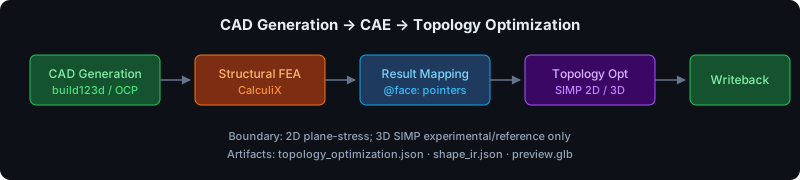
pytest aieng/tests/test_topology_optimization.py -q
Key artifacts: analysis/topology_optimization.json, geometry/shape_ir.json
Boundary: 2D plane-stress; 3D SIMP is experimental/reference only.
Details →
2. Rebuild CAD from Mesh → Export STEP
Reconstructs analytic CAD from a mesh and exports STEP when the shell validates.
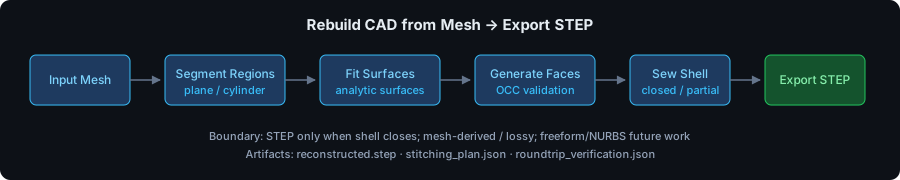
pytest aieng/tests/test_mesh_brep_solidification.py -q
Key artifacts: geometry/reconstructed.step (when valid),graph/mesh_brep_stitching_plan.json
Boundary: Mesh-derived/lossy; plane/cylinder dominant; freeform/NURBS
future work; partial shells do not produce STEP.
Details →
3. Assembly Model → Selected-Part Optimization
Builds a proxy assembly analysis model and optimizes one selected design part.
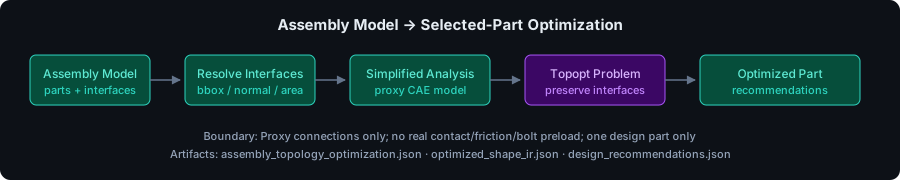
pytest aieng-ui/backend/tests/test_assembly_topopt_demo.py -q
Key artifacts: analysis/assembly_topology_optimization.json,parts/bracket/geometry/optimized_shape_ir.json
Boundary: Proxy connections only; no real contact/friction/bolt preload;
one design part only; not production-certified.
Details →
4. Design Study: Adjustable Dimensions → Compare → Adopt
Validates, executes, compares, and optionally adopts parameterized design
candidates without overwriting the baseline.

pytest aieng-ui/backend/tests/test_design_study_demo.py -q
Key artifacts: analysis/design_study_candidate_ranking.json,analysis/design_study_acceptance.json,accepted/candidate_good/geometry/shape_ir.json
Boundary: Static metrics in demo; no autonomous optimization; no baseline
overwrite; ranking is advisory.
Details →
Current limitations
Honesty boundaries — outputs are review material, not production sign-off:
- Not production-certified CAD/CAE. Outputs still require human engineering judgment.
- Assembly contact and bolt preload are proxy-only; real nonlinear contact is future work.
- 3D SIMP is experimental/reference, not production-certified.
- Mesh-to-CAD works best for plane/cylinder-dominant geometry; broader freeform
and NURBS fitting is future work. - Design study is agent-guided explicit execution, not autonomous global optimization.
Repository layout
| Path | Status | What it is |
|---|---|---|
aieng-ui/ |
Active | FastAPI backend, React workbench, and MCP server — the active CAD/CAE engine (build123d) |
aieng/ |
Core library | .aieng semantic package format engine, schemas, validation, CLI, Shape IR, and evidence model |
aieng-vscode-extension/ |
Active | VS Code visualization front-end for .aieng packages and live project previews |
aieng-agent-skills/ |
Active | SKILL.md contracts teaching agents how to use the ecosystem |
legacy/aieng-freecad-mcp/ |
Legacy | Old FreeCAD execution adapter — not used by the active path |
archive/CAD-Agent-main/ |
Archived | Historical and experimental auxiliary CAD-agent material |
Documentation
| Doc | Purpose |
|---|---|
| AGENTS.md | Canonical agent guide — tools, workflows, and conventions |
| aieng-ui/backend/MCP_SETUP.md | Per-agent MCP wiring for Claude Code, Copilot, Cursor, and Codex |
| aieng-vscode-extension/README.md | VS Code extension usage and development notes |
| aieng/docs/showcase_gallery.md | Showcase gallery — demo talking points, visual guidance, and honesty boundaries |
| aieng/docs/demo_catalog.md | Backend demo catalog — run commands, expected artifacts, and maturity levels |
| aieng/docs/backend_capability_matrix.md | Capability status snapshot |
| aieng/docs/roadmap.md | Phase-by-phase development roadmap |
| CLAUDE.md | Claude Code entry pointer |
| .github/copilot-instructions.md | GitHub Copilot entry pointer |
Contributing
Contributions are welcome across the package format, backend workflows, MCP
tooling, and VS Code front-end. Work that improves reproducibility, visual
inspection, engineering honesty boundaries, or agent usability is especially in
scope.
Notes
- Private repo. No secrets are committed; runtime data (
data/projects/),
virtual environments,node_modules, and embedded conda envs are gitignored. - If your CAD env is not named
aieng311, edit the-n aieng311argument in
the MCP configs or pointcommanddirectly at your interpreter — see
aieng-ui/backend/MCP_SETUP.md. - A running backend at
http://127.0.0.1:8000enables live UI updates when an
agent drives a build; if it is down, the MCP server falls back to in-process
execution.
Yorumlar (0)
Yorum birakmak icin giris yap.
Yorum birakSonuc bulunamadi