paneflow
Health Pass
- License — License: GPL-3.0
- Description — Repository has a description
- Active repo — Last push 0 days ago
- Community trust — 30 GitHub stars
Code Fail
- rm -rf — Recursive force deletion command in .github/workflows/repo_publish.yml
Permissions Pass
- Permissions — No dangerous permissions requested
No AI report is available for this listing yet.
Local-first Rust/GPUI workspace for running coding agents side by side: real terminal panes, live status, worktree review, read-only MCP, and local orchestration.
Paneflow






A native GPUI workspace for running coding agents in parallel.
Paneflow keeps Claude Code, Codex, Gemini, opencode, and any CLI
agent in real terminal panes you can see, interrupt, and take over. It tracks
which agent is thinking, waiting, stalled, failed, or done; keeps each task tied
to its workspace and branch; and gives agents a local control plane when you
want them to coordinate instead of work blind.
It is open source, written in Rust on Zed's GPUI,
and ships native builds for Linux, macOS Apple Silicon, and Windows x64. No
Electron. No WSL required. No hosted agent runtime.
Install · Why Paneflow · Core workflows · Safety model · Docs · FAQ
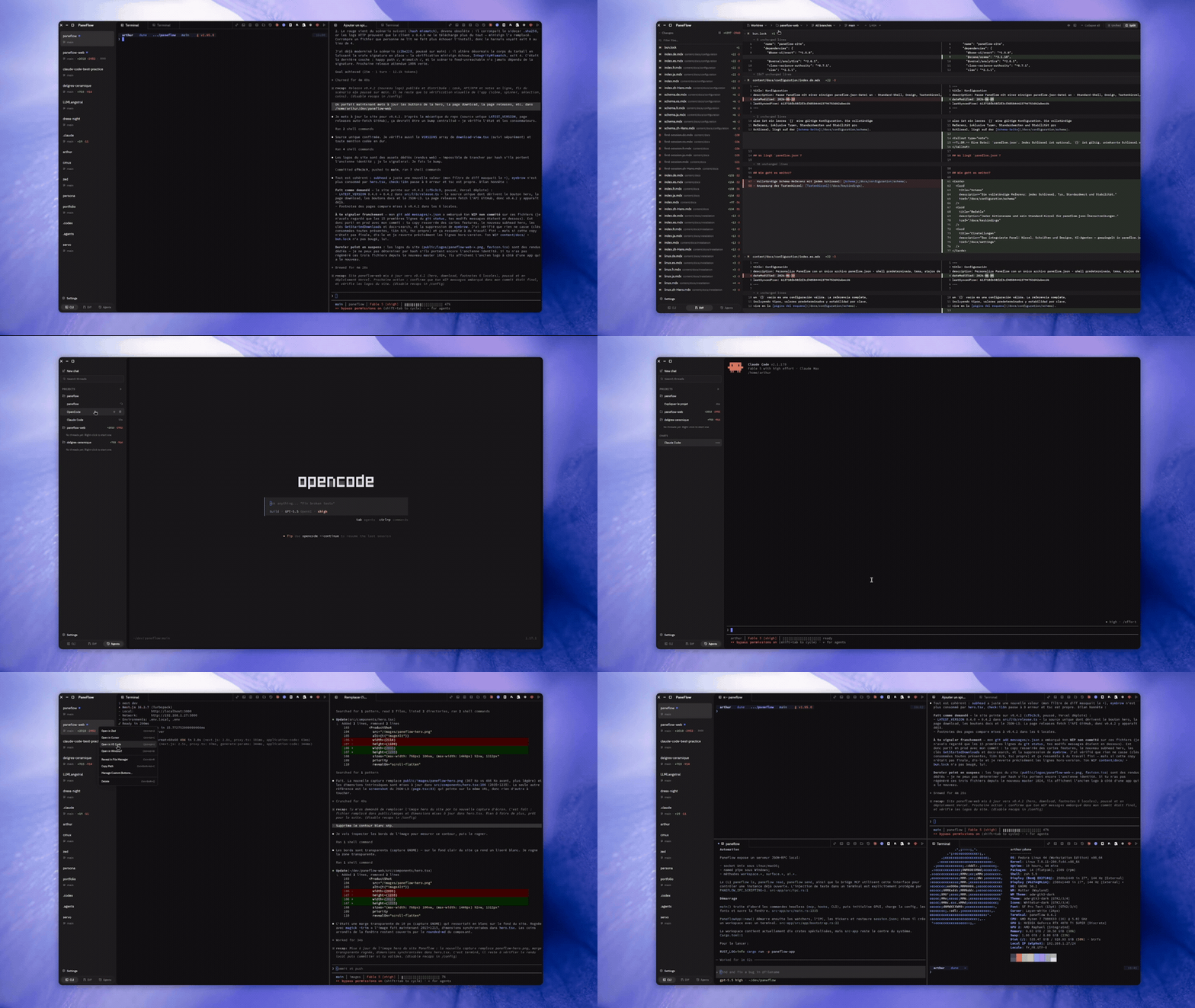
Several coding agents running in parallel panes, with live status for who is thinking, running, waiting, or done.
Install
Release builds are attached to the
latest GitHub release.
You do not need Rust unless you are building from source.
Asset filenames use the version without the leading v from the Git tag
(paneflow-0.7.2-x86_64.AppImage, not paneflow-v0.7.2-...).
| Platform | Recommended path | Status |
|---|---|---|
| Linux x86_64 / aarch64 | AppImage, .deb, .rpm, or .tar.gz |
Active: Wayland and X11 |
| macOS Apple Silicon | Signed and notarized .dmg |
Active |
| macOS Intel | Not shipped today | Planned to return when the release matrix reopens it |
| Windows x64 | Signed .msi |
Active: Windows 10 1809+ and Windows 11 |
| Windows ARM64 | Not shipped today | Deferred pending GPUI DX11 ARM64 reliability |
Linux quickstart
VER=$(curl -fsSL https://api.github.com/repos/ArthurDEV44/paneflow/releases/latest \
      | grep -oE '"tag_name":\s*"v[^"]+"' | cut -d\" -f4 | sed 's/^v//')
ARCH=$(uname -m)
curl -LO "https://github.com/ArthurDEV44/paneflow/releases/latest/download/paneflow-${VER}-${ARCH}.AppImage"
chmod +x "paneflow-${VER}-${ARCH}.AppImage"
./paneflow-${VER}-${ARCH}.AppImage
On Ubuntu 24.04+ or immutable distros, run the AppImage with--appimage-extract-and-run if FUSE 2 is unavailable. .deb, .rpm,.tar.gz, SHA-256 sidecars, and Minisign signatures are published with each
release.
macOS
Download paneflow-X.Y.Z-aarch64-apple-darwin.dmg from the
latest release, open
it, and drag PaneFlow.app into /Applications.
A Homebrew tap is available:
brew tap arthurdev44/paneflow
brew install --cask paneflow
If the cask lags a fresh release, use the DMG directly.
Windows
Download paneflow-X.Y.Z-x86_64-pc-windows-msvc.msi from the
latest release and
double-click it. The MSI is signed; verify it with:
signtool verify /pa /v paneflow-X.Y.Z-x86_64-pc-windows-msvc.msi
See docs/WINDOWS.md for the supported Windows matrix and
known platform caveats.
Why Paneflow
Starting coding agents is easy. Keeping a reliable view of ten running sessions
is the hard part: which one is waiting on you, which branch it touched, which
test output belongs to which task, and how to hand context from one agent to
another without copy-pasting terminal scrollback.
Paneflow is built around that coordination problem:
- Real terminal panes for every agent, so nothing is hidden behind a chat-only
abstraction. - Live agent state from hooks and IPC, not a vague "terminal is active"
heuristic. - Workspaces and git branches visible in the app chrome.
- A review surface for comparing worktree diffs side by side.
- A read-only MCP bridge so one agent can inspect another pane's output.
- A local CLI and JSON-RPC control plane for scripted orchestration.
The goal is not to replace your editor or your shell. It is to make parallel
agent work observable enough that you can supervise it without losing context.
Core workflows
Run agents side by side
Launch Claude Code, Codex, Gemini, opencode, Pi, Hermes, or any CLI
agent in a real PTY pane. Paneflow keeps the raw terminal visible while adding
the app-level state you need for multi-agent work: workspace, branch, title,
status, notifications, and session restore.
See what needs attention
The sidebar, tab dots, desktop notifications, Attention Queue, and Rosetta
surface turn scattered agent events into a readable queue: waiting for input,
running, stalled, errored, or recently finished. Rosetta is the in-app status
surface for agent notifications and can stay quiet unless something needs your
attention.
Coordinate a fleet with Conductor
The paneflow CLI talks to the same local socket as the app:
paneflow ps
paneflow read cargo-run --lines 100
paneflow watch --type ai.stop
paneflow send codex-review "Review this branch and report risks"
paneflow wait --match claude-impl --pattern "REPORT_DONE"
paneflow flow run examples/review-pipeline.flow.toml
paneflow up can spawn declarative workspaces, and paneflow flow run executes
a flow.toml DAG with spawn, wait, send, capture, and review steps. By default
Paneflow pre-fills prompts and a human presses Enter. Auto-submit is explicit
and gated.
Let agents read each other safely
paneflow mcp install registers a local read-only MCP bridge for supported CLI
agents. It exposes:
list_panesread_panesearch_pane
The bridge cannot type into panes or control them. Returned terminal output is
wrapped as untrusted data so downstream agents know to analyze it, not obey it.
The tool manifests live in mcps/paneflow/tools.
Review worktree diffs in one place
When each agent works in its own branch or worktree, Paneflow can show the
resulting diffs side by side: one column per worktree, with hunk navigation,
branch review prompts, attribution, and local cost estimates where token usage
is available.
Feature map
| Area | What Paneflow gives you |
|---|---|
| Terminal workspace | Splits, tabs, resize, layout presets, session restore, markdown panes |
| Agent state | Thinking, waiting, finished, errored, stalled, notifications, Rosetta |
| Review | Worktree diff columns, hunk navigation, review prompts, cost estimate |
| Automation | CLI, JSON-RPC socket, paneflow up, paneflow flow run, event stream |
| Agent context | Read-only MCP bridge with list_panes, read_pane, search_pane |
| Native runtime | Rust, GPUI, alacritty_terminal, Vulkan / Metal / DirectX |
| Trust | GPL-3.0-or-later, signed release artifacts, opt-in telemetry |
Safety model
Paneflow is intentionally local-first.
- Agents run as normal CLI processes inside normal PTYs.
- The UI is a supervisor surface, not a hosted agent runtime.
- Prompt prefill is the default; auto-submit is opt-in.
- IPC writes are gated behind explicit scripting access.
- MCP tools are read-only.
- Terminal output returned to agents is marked as untrusted.
- Telemetry is opt-in and can be disabled unconditionally with
PANEFLOW_NO_TELEMETRY=1. - Release artifacts ship with checksums and detached Minisign signatures.
Build from source
Paneflow pins Rust 1.96.1 through rust-toolchain.toml.
git clone https://github.com/ArthurDEV44/paneflow.git
cd paneflow
cargo build --release -p paneflow-app
cargo run -p paneflow-app
Useful development checks:
cargo fmt --check
cargo test --workspace
cargo clippy --workspace -- -D warnings
Linux builds need Vulkan and the usual Wayland/X11 development libraries. macOS
and Windows packaging have extra signing and bundling steps documented in the
release runbooks.
Docs
- paneflow.dev - product site and public docs
- ARCHITECTURE.md - runtime architecture and thread model
- docs/mcp-bridge.md - MCP bridge behavior and install
- docs/WINDOWS.md - Windows support matrix and caveats
- docs/release/linux-signing.md - Linux release verification
- docs/release/macos-signing.md - macOS signing and notarization
- docs/release/windows-signing.md - Windows MSI signing
- AGENTS.md - repository instructions for coding agents
- llms.txt - compact map for AI agents and crawlers
Compare
| Tool family | Strength | Paneflow difference |
|---|---|---|
| tmux / terminal tabs | Universal shell multiplexing | Paneflow adds agent state, workspaces, review, sidebars, and MCP |
| WezTerm / iTerm2 / Ghostty | Great terminals | Paneflow focuses on supervising several agent sessions in one project window |
| Warp-style AI terminals | Polished single-terminal AI workflows | Paneflow keeps existing CLI agents visible in raw PTY panes |
| cmux-style agent workspaces | Multi-agent coordination | Paneflow is independent Rust/GPUI, cross-platform, and local-first |
Detailed comparisons live at paneflow.dev/compare.
FAQ
Why not tmux with one agent per pane?
Use tmux if you mostly work over SSH or want a headless multiplexer. Paneflow is
for local GUI supervision: agent state, notifications, MCP pane reads, worktree
review, and a native control plane around real terminals.
Is this another Electron app?
No. Paneflow is Rust on GPUI with Vulkan on Linux, Metal on macOS, and DirectX
on Windows.
Does Paneflow drive agents for me?
Only when you explicitly enable that flow. The default is visible terminal
control: prompts are pre-filled, you review them, then you press Enter.
Can agents read sensitive terminal output?
Only agents you configure through the MCP bridge can read pane output, and the
bridge is read-only. Treat that as powerful local context access: useful for
coordination, but still something to enable intentionally.
Does it phone home?
Not unless you opt in. Telemetry never includes terminal contents, paths, or
prompts, and PANEFLOW_NO_TELEMETRY=1 disables it regardless of config.
What about Windows?
Windows x64 is a first-class release target. Windows ARM64 is not shipped yet.
See docs/WINDOWS.md for the support matrix and known issues.
Why GPL-3.0-or-later?
Paneflow is meant to stay open. GPL keeps improvements to the app in the
commons while allowing normal internal and commercial use.
License
Reviews (0)
Sign in to leave a review.
Leave a reviewNo results found