claude-nexus-hyper-agent-team
Health Gecti
- License — License: MIT
- Description — Repository has a description
- Active repo — Last push 0 days ago
- Community trust — 13 GitHub stars
Code Gecti
- Code scan — Scanned 12 files during light audit, no dangerous patterns found
Permissions Gecti
- Permissions — No dangerous permissions requested
Bu listing icin henuz AI raporu yok.
multi-agents operating system layer on top of Claude Cod: multi-agent engineering team for Claude Code, with hook-enforced protocol, adversarial review, Bayesian trust calibration, dynamic specialist hiring, an optional parallel cognitive layer, and a self-improving meta-cognitive loop
Claude Code 32-Agent Team
A production-grade multi-agent engineering team for Claude Code, with hook-enforced protocol, adversarial review, Bayesian trust calibration, dynamic specialist hiring, an optional parallel cognitive layer, and a self-improving meta-cognitive loop.
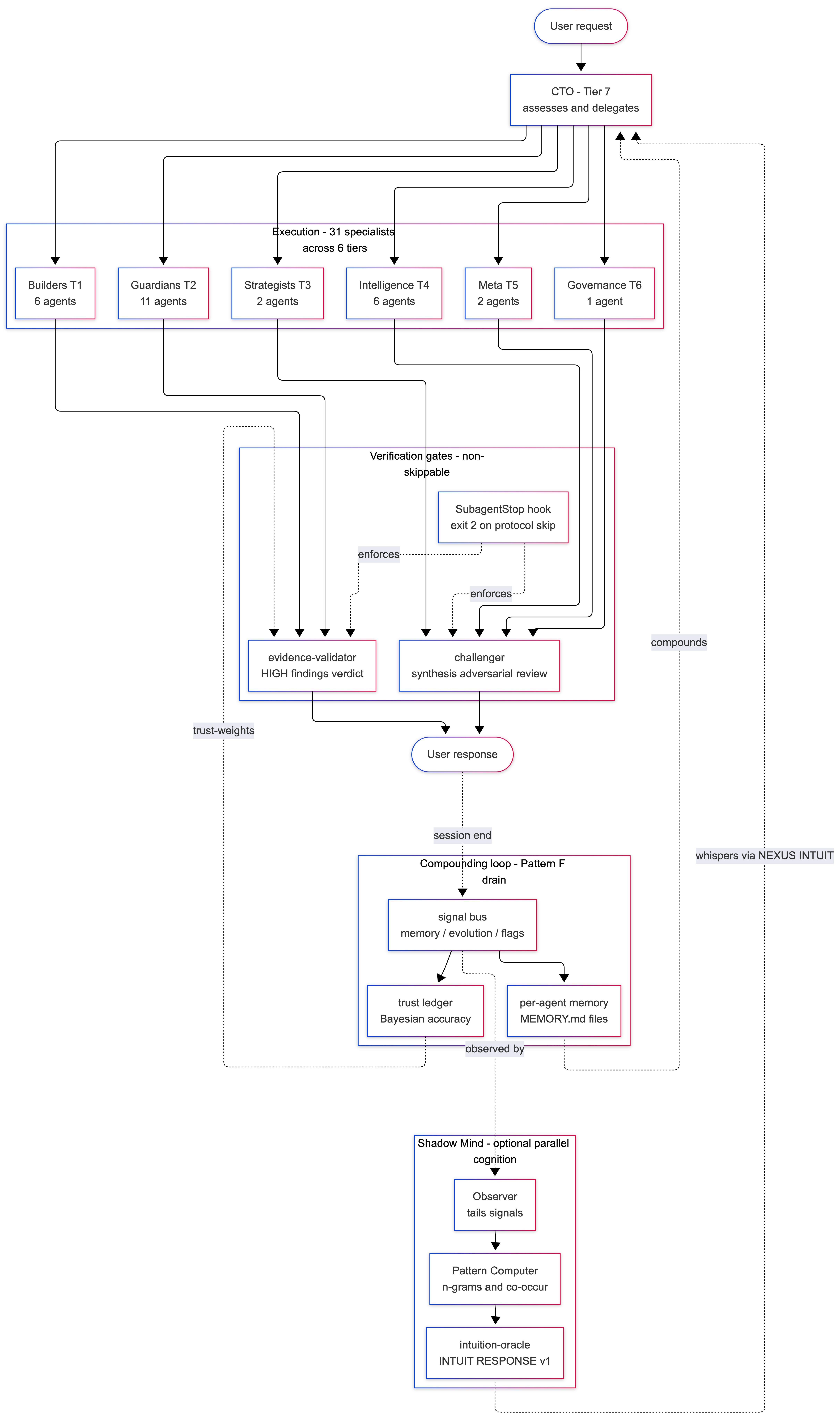
Architecture diagrams: ARCHITECTURE_DIAGRAMS.md (editable Mermaid source + ASCII fallbacks + PNG export instructions)
This is not a framework. It's an operating system layer on top of Claude Code — 32 domain-expert agents coordinated through a syscall protocol (NEXUS), governed by runtime hooks, validated by a 352-assertion contract test suite, calibrated by a per-agent trust ledger, and equipped with a gated hiring pipeline for growing the roster as coverage gaps appear.
What it actually is (verified against itself):
- 32 agent definitions in
agents/(each 20–56 KB of role-specific instructions, spanning Go / Python / TypeScript / Elixir / BEAM / K8s / GCP / security / QA / AI platform / external BEAM retainer / recruiting + team-evolution roles) - Runtime hooks that enforce closing-protocol invariants, persist signals, auto-log syscalls, auto-record trust verdicts, and gate post-hire registration
- A signal bus (
agent-memory/signal-bus/) that carries memory/evolution/cross-agent flags between sessions - A trust ledger (
agent-memory/trust-ledger/) that Bayesian-blends per-agent accuracy from validator verdicts - A documented NEXUS syscall protocol for privileged operations (SPAWN, SCALE, RELOAD, MCP, ASK, CRON, INTUIT, etc.)
- A Dynamic Domain Expert Acquisition pipeline (
talent-scout+recruiter) — the team detects its own coverage gaps (5-signal confidence score + session-sentinel co-sign) and hires new specialist agents through 8 gated phases (research → synthesis → validation → challenger review → atomic registration → post-hire verify → probation → promotion) - An optional Shadow Mind cognitive layer (
intuition-oracle+ Observer + Pattern Computer + Speculator + Dreamer + Pattern Library) that offers probabilistic pattern-based guidance via[NEXUS:INTUIT], with topic cluster pattern retrieval ("have we seen this before? what fixed it?"), delete-to-disable without affecting the conscious team - Execution modes (FAST / BALANCED / FULL_POWER) for speed/cost/quality trade-offs per task
- 6-state agent lifecycle (candidate → probationary → active → trusted → deprecated → retired) with trust-weighted routing preference
- Quality gates by task type — different workflows for code changes vs security findings vs architecture decisions vs incidents
- Conflict arbitration protocol — structured evidence-based dispute resolution when agents disagree
- nexus-doctor.sh — diagnostic health check for framework integrity (agents, hooks, dependencies, Shadow Mind status)
- Planning cache (playbooks) — reusable task workflows that make repeated task types faster over time
- Contract tests (
tests/agents/) that run on every commit and gate prompt evolution
Why this exists
Most agentic frameworks try to enforce discipline inside the agent loop (via code wrapping the model). This team enforces it below the agents (via hooks at the Claude Code runtime layer). That's structurally better: agents cannot talk their way past a SubagentStop hook the way they can talk their way past a Python try/except.
The team's value proposition splits cleanly:
- Methodology layer (NEXUS + signal bus + validator gate + challenger gate + trust ledger + Pattern F + hiring pipeline + Shadow Mind): domain-agnostic, transfers to any engineering work
- Expertise layer (32 agent prompts covering Go / Python / TypeScript / Elixir / BEAM / K8s / GCP / security / QA / AI platform / etc.): extend or customize for your stack — or let the hiring pipeline add specialists as gaps appear
Installation
# 1. Copy the team into your project
cp -R claude-nexus-hyper-agent-team/agents           YOUR_PROJECT/.claude/agents/
cp -R claude-nexus-hyper-agent-team/hooks            YOUR_PROJECT/.claude/hooks/
cp -R claude-nexus-hyper-agent-team/tests            YOUR_PROJECT/.claude/tests/
cp -R claude-nexus-hyper-agent-team/docs             YOUR_PROJECT/.claude/docs/
cp -R claude-nexus-hyper-agent-team/agent-memory     YOUR_PROJECT/.claude/agent-memory/
cp    claude-nexus-hyper-agent-team/settings.json    YOUR_PROJECT/.claude/settings.json
cp    claude-nexus-hyper-agent-team/CLAUDE.md        YOUR_PROJECT/CLAUDE.md

# 2. Verify installation
python3 YOUR_PROJECT/.claude/tests/agents/run_contract_tests.py
# Expected: 352 passed, 0 failed

# 3. Optional — install the git pre-commit hook for agent contract tests
ln -s ../../.claude/hooks/pre-commit-agent-contracts.sh YOUR_PROJECT/.git/hooks/pre-commit
After install
- Open
CLAUDE.mdat your project root and fill in the## Project-Specific Contextsection at the bottom (architecture overview, development commands, environment variables, deployment notes). - Replace the
<placeholder>tokens with your project's specifics:<your project>→ your project name<your-project>→ your project slug<go-service>→ your Go service name (or remove if not applicable)<python-service>→ your Python service name (or remove if not applicable)<frontend>→ your frontend package name (or remove if not applicable)<project-slug>→ a filesystem-safe slug for your project
- Start your first session — say
"use the team, <goal>"and Claude Code will dispatch the CTO.
Customizing the roster
The 32 agents cover: Go, Python, TypeScript, React/Next.js, Elixir, BEAM/OTP, Kubernetes, GCP, Terraform, PostgreSQL, Redis, Firestore, GraphQL, security, observability, testing, AI/ML architecture, benchmarking, and external BEAM retainer advisory. If you work on a different stack (e.g., Rust, embedded, kernel, ML training, AWS-native), you have two paths:
Path A — Let the team hire for you (recommended): Dispatch talent-scout for a coverage audit; if it detects a recurring gap with ≥0.70 confidence AND session-sentinel co-signs, dispatch recruiter to run the 8-phase pipeline. meta-agent performs atomic registration (agent file + contract-test list + hook regexes + trust-ledger default + memory scaffold) in a single commit, gated by post-hire-verify.sh.
Path B — Manual add:
- Add a new agent file to
agents/(follow existing structure — frontmatter withname,description,model+ body with the mandatory sections). Usedocs/team/AGENT_TEMPLATE.mdas a scaffold. - Add the agent name to
tests/agents/run_contract_tests.py:CUSTOM_AGENTS+ the regex in the hooks - Reference it in
CLAUDE.md's dispatch table - Run the contract tests — they'll validate your new agent
- Run
bash hooks/post-hire-verify.sh <agent-name>to confirm atomic registration
How it works — 60-second tour
The 8-tier architecture
TIER 1 — BUILDERS      elite-engineer, ai-platform-architect, frontend-platform-engineer,
                        beam-architect, elixir-engineer, go-hybrid-engineer
TIER 2 — GUARDIANS     go-expert, python-expert, typescript-expert, deep-qa, deep-reviewer,
                        infra-expert, database-expert, observability-expert, test-engineer,
                        api-expert, beam-sre, code-sentinel
TIER 3 — STRATEGISTS   deep-planner, orchestrator
TIER 4 — INTELLIGENCE  memory-coordinator, cluster-awareness, benchmark-agent,
                        erlang-solutions-consultant, talent-scout, intuition-oracle
TIER 5 — META          meta-agent, recruiter
TIER 6 — GOVERNANCE    session-sentinel
TIER 7 — CTO           cto
TIER 8 — VERIFICATION  evidence-validator, challenger
The session lifecycle (Pattern A–F)
- Pattern A — incident / P0 debugging (CTO + cluster-awareness + relevant language expert + deep-reviewer)
- Pattern B — planned build (deep-planner → orchestrator → builders → reviewers → QA)
- Pattern C — code review only (deep-qa + deep-reviewer + language expert, parallel)
- Pattern D — refactor (deep-planner → elite-engineer → deep-qa validates)
- Pattern E — test campaign (test-engineer designs → elite-engineer executes)
- Pattern F — session-end learning drain (memory-coordinator + meta-agent, parallel)
The verification gates (non-negotiable)
- Closing protocol — every agent returns with 4 mandatory sections (MEMORY HANDOFF, EVOLUTION SIGNAL, CROSS-AGENT FLAG, DISPATCH RECOMMENDATION); enforced by
verify-agent-protocol.shwithexit 2 - Evidence validation — every HIGH/CRITICAL finding is routed to
evidence-validatorbefore reaching the user; verdicts auto-record to the trust ledger - Adversarial review — every CTO synthesis / strategic recommendation goes through
challengerbefore surfacing - Pattern F drain — every session ends with memory-coordinator + meta-agent processing the signal bus, baking new lessons into prompts
The NEXUS syscall protocol
Teammates don't have the Agent tool (privileged operation). When they need to spawn another agent, install an MCP, ask the user a question, schedule a cron job, open a worktree, or query the Shadow Mind's pattern library for probabilistic guidance, they send a [NEXUS:*] message via SendMessage to "lead". The main thread (kernel) processes the syscall and responds [NEXUS:OK|ERR]. Full syscall table (including [NEXUS:INTUIT]) is in CLAUDE.md.
The hiring pipeline (Capability 1)
The team can detect its own coverage gaps and hire new specialist agents. When talent-scout's continuous audit yields a requisition with confidence ≥0.70 AND session-sentinel co-signs (both must agree), recruiter runs the 8-phase pipeline: research (benchmark-agent) → synthesis (draft using AGENT_TEMPLATE.md) → validation (contract tests) → challenger (adversarial review of the draft) → handoff to meta-agent → atomic registration (single commit across agent file + contract-test list + hook regexes + trust ledger + memory scaffold) → post-hire-verify.sh gate → probation tracking → promotion on refutation rate <25% across ≥5 verdicts. The team grows when evidence supports growth.
The Shadow Mind (parallel cognitive layer — production-validated, disable-able)
A non-invasive parallel cognitive layer that runs alongside the conscious team. Six components: Observer daemon (shadow-observer.sh — tails signal bus with resolution tracking), Pattern Computer (shadow-pattern-computer.py — derives n-grams + co-occurrences + temporal patterns + topic clusters with fix history), Pattern Library (read-only data), Speculator (counterfactual variants), Dreamer (insight candidates during idle windows), and intuition-oracle agent (the queryable surface with 6 intent types including PATTERN_RETRIEVAL — "have we seen this failure before? what fixed it?"). Agents can OPTIONALLY consult it via [NEXUS:INTUIT] <question> and receive an INTUIT_RESPONSE v1 envelope with a confidence score and evidence IDs.
Production telemetry (2026-04-21): Observer captured 7,228 observations and stays fresh (< 2h heartbeat). Pattern Computer derived 154 transitions across 35 sessions. Oracle queries return structured MEDIUM/HIGH confidence on in-domain questions and correctly return INSUFFICIENT_DATA when the Pattern Library has not yet seen enough of a domain. Three real oracle consultations during 2026-04 sessions produced actionable findings that shaped challenger-gate scope.
Delete agent-memory/shadow-mind/ and the layer is gone — no conscious-layer agent is required to consult it, and all 352/352 contract tests continue to pass either way.
The self-improvement loop
Every session produces four signals: memory handoffs, evolution recommendations, cross-agent flags, dispatch chains. At session end (Pattern F):
memory-coordinatorconsolidates durable learnings into per-agent memory filesmeta-agentreads the evolution-signals queue and edits agent prompts to bake in new patternsevidence-validatorverdicts update the trust ledger via theauto-record-trust-verdict.shhook- Contract tests re-run to ensure no regressions
The team is measurably smarter next session than this session. That's the compounding property single-agent setups structurally lack.
What's intentionally NOT included
agent-memory/*/is empty — each agent's memory starts fresh. Memory builds organically from your project's own sessions.trust-ledger/*.jsonis empty — trust calibration starts at 0.9 default prior for all agents. Real weights accumulate asevidence-validatorissues verdicts.signal-bus/*.mdis drained — the bus starts empty (Pattern F end-state). First session's outputs populate it.- No project-specific context in
CLAUDE.md— the team protocol is generic; project context is your job to fill in.
Directory structure
claude-nexus-hyper-agent-team/
├── CLAUDE.md                         # Team operating protocol + project context stub
├── README.md                         # This file
├── LICENSE
├── agents/                           # 32 agent definitions (YAML frontmatter + markdown body)
├── hooks/                            # Runtime hooks + Shadow Mind scripts
│   ├── verify-agent-protocol.sh      # SubagentStop — blocks bad closing protocols
│   ├── verify-signal-bus-persisted.sh # SubagentStop — warns on signal persistence drift
│   ├── auto-record-trust-verdict.sh  # SubagentStop — records validator verdicts
│   ├── log-nexus-syscall.sh          # PostToolUse — logs NEXUS syscalls
│   ├── pre-commit-agent-contracts.sh # git pre-commit — runs contract tests
│   ├── post-hire-verify.sh           # hiring-pipeline gate — atomic-registration check
│   ├── shadow-observer.sh            # Shadow Mind — Observer daemon (optional)
│   ├── shadow-pattern-computer.py    # Shadow Mind — Pattern Computer (optional, cron)
│   ├── shadow-speculator.py          # Shadow Mind — counterfactual variants (optional, cron)
│   └── shadow-dreamer.py             # Shadow Mind — insight proposer (optional, daily cron)
│   └── nexus-doctor.sh               # Framework health check diagnostic
├── tests/agents/
│   └── run_contract_tests.py         # 11 contracts × 32 agents = 352 assertions
├── docs/team/                        # Team documentation (overview, cheatsheet, runbook, scenarios, AGENT_TEMPLATE)
├── agent-memory/                     # Per-agent memory + signal bus + trust ledger + Shadow Mind
│   ├── <agent-name>/MEMORY.md        # Empty scaffold per agent
│   ├── signal-bus/                   # Header-only files, drained to Pattern F baseline
│   ├── shadow-mind/                  # Shadow Mind data (optional, delete-to-disable)
│   └── trust-ledger/
│       ├── ledger.py                 # CLI: verdict, challenge, show, weight, standings, promote, deprecate
│       └── README.md                 # Schema + usage
├── agent-memory/routing/
│   └── task-classifier.json          # Task type → execution mode dispatch matrix
├── agent-memory/playbooks/
│   └── README.md                     # Reusable task workflow protocol
├── settings.json                     # Claude Code hook wiring (required)
└── settings.local.json               # Per-user overrides (meant to be .gitignored)
Prerequisites
- Claude Code CLI v2.1.32+ (required for team-mode NEXUS syscalls via the agent-teams feature). Earlier versions can still run the team in one-off mode only.
- Python 3.8+ (for contract tests + trust ledger)
jq(for hooks that parse JSON from Claude Code)- Unix shell (bash/zsh) — hooks use POSIX-compatible shell scripts
CLAUDE_CODE_EXPERIMENTAL_AGENT_TEAMS=1enabled insettings.jsonto activate team-mode NEXUS. See Anthropic's official agent-teams docs for current status.
License
MIT — see LICENSE file.
Production Telemetry (2026-04-21, 5 weeks of continuous operation)
| Signal | Observed |
|---|---|
| Trust-ledger verdicts | 67 evidence-validator verdicts across 13 agents. 3 REFUTED (validator is catching real mistakes, not rubber-stamping). go-expert: 15/1/0 → trust 0.952. |
| Challenger activity | 10 real challenges issued, including 4 against CTO's own syntheses. |
| Hiring pipeline | Ran end-to-end on 2026-04-19 for elixir-kernel-engineer; probation dispatches pending. |
| Shadow Mind | Observer 7,228 observations captured (heartbeat < 2h). Pattern Computer 154 transitions across 35 sessions. Oracle returning structured MEDIUM/HIGH confidence on in-domain questions; correctly INSUFFICIENT_DATA on under-observed domains. |
| Signal bus | 506 entries (~100/week): 138 memory-handoffs, 126 NEXUS syscalls, 59 cross-agent flags, 35 evolution signals. |
| Contract tests | 352/352 passing on every commit. |
Built by
| Name | Role | Links | |
|---|---|---|---|
 |
Sherief Attia | CTO & Co-founder | LinkedIn / GitHub |
 |
Khaled El Azab | Chief of AI Strategies & Co-founder | LinkedIn / GitHub |
 |
Hossam Hegazy | Chief of Engineering & Co-founder |
Built while building ASIFlow — a sovereign AI agent platform for regulated industries. The methodology generalizes to any engineering domain; the 32 agent domain specializations reflect the original platform's stack, and talent-scout + recruiter exist so the roster can grow to match yours.
Contributing
- New agents: follow the existing frontmatter schema; contract tests will validate
- Hook improvements: keep hooks POSIX-compatible; use
$CLAUDE_PROJECT_DIRfor paths - Pattern additions: update
CLAUDE.mddispatch table +docs/team/TEAM_RUNBOOK.md
Known Limitations
From Anthropic's agent-teams feature (verified against official docs)
Agent teams is an experimental Claude Code feature. Per Anthropic: "Agent teams are experimental and disabled by default. Enable them by adding
CLAUDE_CODE_EXPERIMENTAL_AGENT_TEAMSto your settings.json or environment. Agent teams require Claude Code v2.1.32 or later."
Impact for this team: the NEXUS syscall protocol (team-mode dispatch viaTeamCreate+SendMessageto"lead") depends on this feature.
Fallback: one-off mode (Agent tool +### DISPATCH RECOMMENDATIONtext signals) does NOT depend on agent-teams and works on stable Claude Code. You can run the team in one-off mode permanently, accepting slower coordination vs. real-time syscalls.No session resumption for in-process teammates (per Anthropic docs).
/resumeand/rewinddo not restore teammates. After resuming a long session, the lead may attempt to message teammates that no longer exist. Mitigation: persist important findings toagent-memory/before long pauses; re-dispatch teammates fresh after resumption.One team per session, no nested teams (per Anthropic docs).
The lead can only manage one team at a time. Teammates cannot spawn their own teams. Clean up the current team before starting a new one. Mitigation: for workflows that conceptually need sub-teams (e.g., "review team" + "build team"), model them as one flat team with role-named teammates (e.g.,reviewer-1,reviewer-2,builder-1).
From this team's own scope
Domain coverage is web/cloud/AI-platform/BEAM-focused. The 32 agents cover Go, Python, TypeScript, Elixir, BEAM/OTP, Kubernetes, GCP, GraphQL, PostgreSQL, Redis, Firestore, and AI/ML platform work. For embedded firmware, OS kernels, compilers, DSP, crypto primitives, AWS-native, or formal verification, you'll want to add domain-specialist agents — the harness supports it via the hiring pipeline (see
Customizing the rosterabove); the existing prompts don't cover these domains.N=1 by codebase, N=15 by domain — with per-agent depth transparency. The team was developed and refined against a single production codebase over 5 weeks (2026-03-18 through 2026-04-21). Multi-codebase, multi-language, multi-team behavior is unproven. However, within that single codebase the team has exercised ~15 technical domains at substantial depth; the real per-agent memory distribution is in
agent-memory/<agent>/and the trust ledger atagent-memory/trust-ledger/shows where validation is deep vs. thin. Deep:go-expert(132 KB, 16 verdicts, trust 0.952),infra-expert(240 KB),api-expert(524 KB),database-expert(260 KB),cluster-awareness(168 KB). Thin:python-expert(12 KB, 1 file). Expect sharper edges on thin-data domains until your sessions populate those agents' records.Opus-heavy — 28 of 32 agents default to opus. Not affordable for all plans. Three agents (
session-sentinel,evidence-validator,challenger) default to sonnet because they're structured-reasoning roles where sonnet is sufficient. Language experts anddeep-qa/deep-reviewershould NOT be downgraded without explicit cost/quality trade-off acceptance — their false-negative rate on sonnet is expensive.Trust ledger starts uncalibrated. Every agent begins at the 0.9 Bayesian prior with zero verdicts. Real calibration emerges as
evidence-validatorissues verdicts during actual sessions. Expect 5–10 sessions before per-agent trust weights carry meaningful signal. Until then, CTO synthesis weights all agents equally.Total agent prompt size scales with roster. Loaded once per Claude Code session. Cost scales with session activity (number of tool calls, agent dispatches), not with prompt size. Still, for cost-sensitive deployments, audit which agents you actually need and trim the roster (or rely on talent-scout to keep it lean — it only adds agents when evidence-gated).
Experimental-feature tracking burden. If you rely on team-mode NEXUS, you're coupled to Anthropic's evolution of the agent-teams feature. Breaking changes to
TeamCreateorSendMessagesemantics will break team-mode syscalls. Mitigation: pin a Claude Code version, test upgrades in a throwaway project before rolling out, and keep one-off mode paths working as a fallback.Shadow Mind requires ongoing data curation. If you enable the Shadow Mind, Observer must keep tailing the signal bus (
heartbeat < 24h) or the oracle returnsSHADOW_MIND_STALE. The Pattern Computer / Speculator / Dreamer crons should be scheduled viaCronCreate(seedocs/team/TEAM_RUNBOOK.mdfor activation commands). If you don't enable it, the team operates identically without it — the Shadow Mind is strictly additive.
Last updated: 2026-05-22. Team v3.2 — 32 agents, execution modes, 6-state lifecycle, quality gates by task type, conflict arbitration, topic clusters, nexus-doctor, playbooks.
Yorumlar (0)
Yorum birakmak icin giris yap.
Yorum birakSonuc bulunamadi