kipi
Health Gecti
- License — License: NOASSERTION
- Description — Repository has a description
- Active repo — Last push 0 days ago
- Community trust — 10 GitHub stars
Code Gecti
- Code scan — Scanned 12 files during light audit, no dangerous patterns found
Permissions Gecti
- Permissions — No dangerous permissions requested
Bu listing icin henuz AI raporu yok.
Open-source, self-hosted OSINT investigation platform: turn documents into a live, investigated entity graph. Autonomous agent, graph analytics (centrality, communities, pathfinding), keyless-first tool belt.
kipi
Drop a dense intel report on it. Get a live, investigated entity graph.
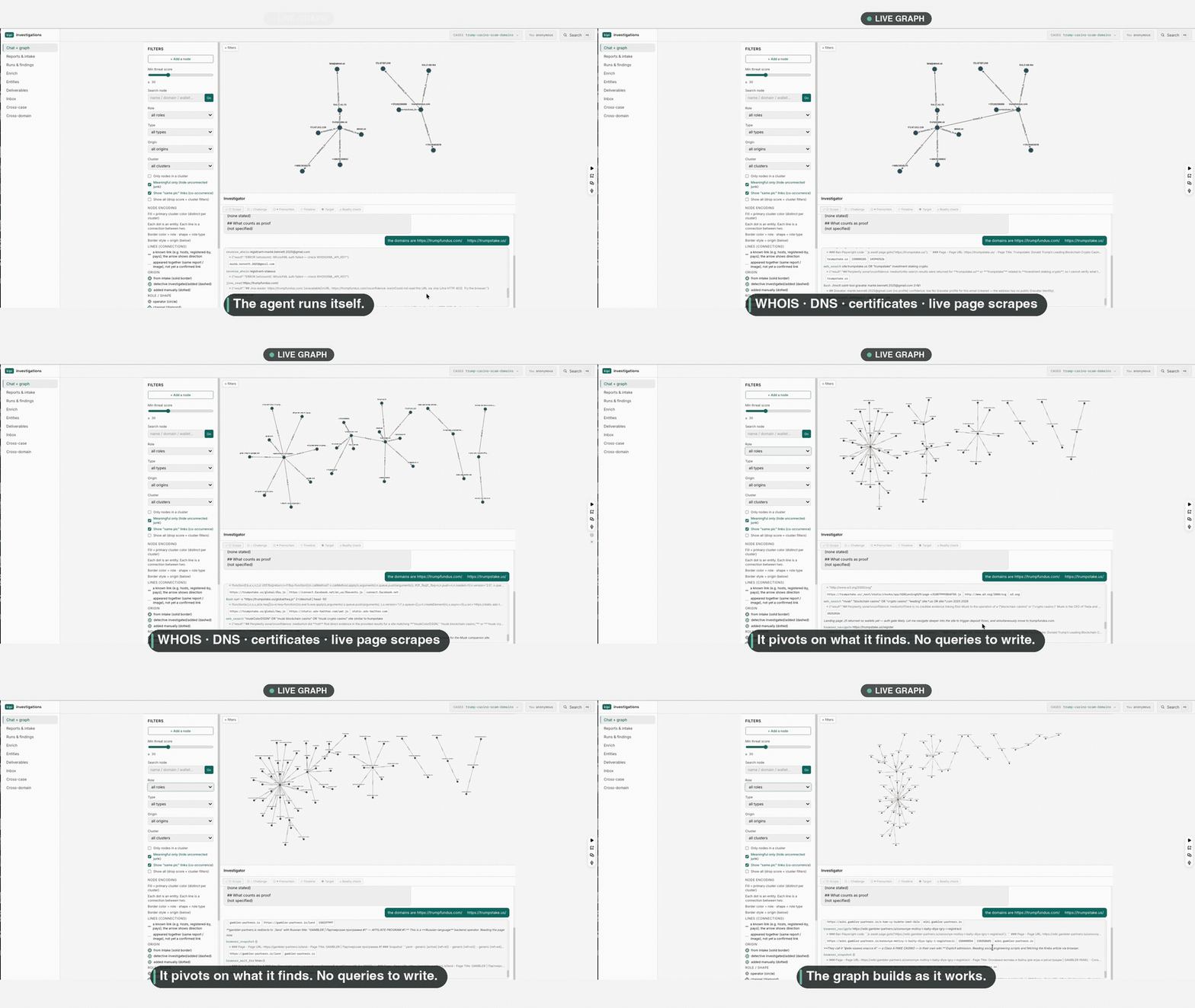
The graph above built itself. One seed domain went in. An agent pulled WHOIS, DNS, certificates, and the live sites, then pivoted on what it found. No queries to write. Watch the full 75 seconds, with sound.
kipi is an open-source, self-hosted OSINT investigation platform. It turns documents into an investigation. PDFs, screenshots, spreadsheets, pasted notes go in. A typed entity graph comes out. Then an autonomous investigator digs the open web and builds the graph out in front of you: infrastructure pivots, typed edges, gated findings, a written brief.
The analyst stays the top authority. Every schema, finding, and edge gets confirmed, corrected, or rejected by a human. The machine proposes. You decide.
Two things sit together here that I never found in one commercial OSINT platform: document ingestion into entities, and real graph analytics (centrality, communities, pathfinding) on the same investigation canvas.
What you're watching
The demo runs a real case. Two seed domains go in: trumpfundus.com and trumpstake.us.
By the end, kipi has mapped a Russian-language affiliate fraud network. White-label fake crypto casinos. The backend operator is registered to a shell company in Reykjavík, one month after Brian Krebs killed its predecessor. 20,000+ affiliates. 60 to 80 percent of stolen deposits, paid out in crypto. A Musk-branded clone, flagged for phishing, sitting in the same cluster.
Then it writes the brief. Every claim carries its source and an evidence grade. A DNS record grades an A. An analyst's read is a lead, nothing more. Nothing gets promoted on a name match.
That grading is the point. Most OSINT output reads like a pile of links. This reads like a case.
Quickstart (10 minutes)
git clone https://github.com/assafkip/kipi.git && cd kipi
./install.sh                           # venv + deps + DB; checks tesseract/claude
export ANTHROPIC_API_KEY=sk-ant-...    # the ONE required key
./invctl serve                         # open http://127.0.0.1:8765
Then:
- Reports → drop a PDF (or paste notes). Entities extract on upload.
- Schema gate → approve the proposed per-case ontology (one click; the agent fits the entity types and roles to your case's domain).
- Process → consolidation, typing, correlation, scoring, graph analytics, the brief. Watch the step bar.
- Graph → tell the investigator chat to dig (
investigate suspicious-domain.com) and watch nodes land live.
Keys
One key is required. Everything else degrades gracefully.
| Key | Required? | Without it |
|---|---|---|
ANTHROPIC_API_KEY |
Yes | No entity classification, no schema proposal, no brief |
claude CLI (+ node 18+) |
Optional | The autonomous investigator agent is disabled; ingest, Process, and the graph still work |
tesseract binary |
Optional | Scanned-PDF / screenshot OCR skipped |
VIRUSTOTAL_API_KEY |
Optional | VT reputation pivots report needs-key and skip |
| Apify / Perplexity / Tavily / Exa / WhoisXML / Censys / abuse.ch / HudsonRock / Etherscan | Optional | Each reports needs-key and skips cleanly |
| Keyless belt | - | whois, DNS, RDAP, reverse-DNS, crt.sh, Shodan InternetDB, Gravatar, IP-geo, username sweep, email triage (MX/SPF/DMARC + header→IP), BTC wallet. All work with zero keys. |
The analyst's graph
- Layouts - force (default), hierarchy (dagre), ego rings around the selected node, circle.
- Pathfinding - pick two nodes; the shortest path lights up, everything else dims. "How is this wallet connected to that channel" in two clicks.
- Graph analytics - betweenness centrality finds the broker between two cells; Louvain communities split a sockpuppet net into operating cells. Computed per case, stored as node properties, drive styling.
- Conditional formatting - persisted per-case style rules with an editor: betweenness→size, analyst-vs-AI origin→border, community→color (opt-in).
- Collection nodes - 200 crt.sh subdomains fold into one expandable "200 domains" bucket instead of flooding the canvas.
- Time-bounded edges - re-observing a relationship updates its first-seen/last-seen instead of duplicating it.
- Provenance everywhere - every node and edge knows how it entered the graph (ingest, enrichment provider, agent, analyst).
Who it's for
kipi is built for people who investigate for a living:
- Boutique threat-intelligence firms running client cases.
- Trust and safety teams mapping abuse networks on a budget.
- Private investigators and OSINT freelancers who need a graph, not a spreadsheet.
- Fraud and AML analysts tracing crypto wallets and infrastructure.
- Journalists working a document leak.
If your job is turning messy documents into "who is connected to whom, and how do we know," kipi is for you.
How kipi compares
Most OSINT tools pick one job. kipi does two that rarely live together: reading documents into entities, and running real graph analytics on the same canvas.
- Link-analysis tools like Maltego draw the graph, but you feed them entities by hand. They don't read your documents.
- OSINT frameworks like SpiderFoot scan infrastructure, but hand you a list, not an investigated graph with provenance.
- Commercial intel platforms do all of this behind a five-figure seat and a model you can't inspect.
kipi reads the document, proposes the ontology, digs the web, grades the evidence, and writes the brief. Self-hosted. One required API key. Source-available.
Runs locally
Everything runs on your machine: SQLite database, local vault, local assets. The only required external call is the Anthropic API for classification and judgment. OSINT lookups go to the providers you enable, nowhere else. Run bash scripts/oss_secrets_audit.sh before sharing anything.
License
Elastic License 2.0, source-available. Use kipi freely, including in your paid investigation work. Modify it. Self-host it for your own use. You may not sell kipi itself, or offer it to others as a hosted or managed service. Commercial licensing of the software stays with KTLYST Labs.
In plain terms: run it, fork it, use it on client work. Don't repackage it and sell it.
FAQ
Is kipi free?
Yes. Source-available under the Elastic License 2.0. Use it, fork it, run it on paid client work. You just can't resell kipi itself or offer it as a hosted service.
Is kipi a Maltego or SpiderFoot alternative?
For a lot of workflows, yes. kipi reads your documents into entities and runs graph analytics (centrality, communities, pathfinding) on the same canvas. Most link-analysis and OSINT-scanning tools do one side, not both.
Do I need API keys?
One: ANTHROPIC_API_KEY, for classification and the brief. Every OSINT provider is optional. The keyless belt (whois, DNS, RDAP, crt.sh, Shodan InternetDB, Gravatar, IP-geo, username sweep, email triage, BTC wallet) works with zero keys.
Is it self-hosted? Does my data leave my machine?
Self-hosted. SQLite, vault, and assets all live locally. The only required external call is the Anthropic API for classification and judgment. OSINT lookups hit only the providers you turn on.
What can kipi ingest?
PDFs, Word docs, images, screenshots, spreadsheets (CSV and XLSX), and pasted notes. Scanned PDFs and screenshots get OCR in six languages.
What does the autonomous agent actually do?
You give it a seed: a domain, a wallet, a handle. It pulls WHOIS, DNS, certificates, and live pages, pivots on what it finds, and lands typed nodes on the graph. Every finding carries a source and an evidence grade.
Can I use kipi for paid client work?
Yes. The Elastic License 2.0 allows commercial use, including paid investigations. The only thing it blocks is selling kipi itself, or running it as a service for others.
What is kipi built on?
Python, SQLite, and the Anthropic API for the language-model work. The autonomous investigator runs on the Claude CLI. No heavyweight database or cloud account required.
Who built this
I spent 12 years running threat intelligence and investigations at LinkedIn, Google, Meta, and ElevenLabs. kipi is the tool I wanted on every one of those desks, and never had.
The repo is free. If you have a network that needs mapping, or you want a case run for you, reach me through KTLYST Labs. The code is open. The tradecraft is the offer.
Yorumlar (0)
Yorum birakmak icin giris yap.
Yorum birakSonuc bulunamadi