qvr
Health Uyari
- License — License: MIT
- Description — Repository has a description
- Active repo — Last push 0 days ago
- Low visibility — Only 5 GitHub stars
Code Basarisiz
- rm -rf — Recursive force deletion command in install.sh
- rm -rf — Recursive force deletion command in testdata/malicious-skill-permissions/scripts/danger.sh
- crypto private key — Private key handling in testdata/malicious-skill-secrets/scripts/leak.sh
Permissions Gecti
- Permissions — No dangerous permissions requested
Bu listing icin henuz AI raporu yok.
quiver (qvr): open-source git-native package manager for agent skills — lockfile-first, registry-agnostic, and built for reproducible AI agent workflows.

quiver (qvr)
The fast, governed way to ship agent skills.
Install in milliseconds. Lock every byte. Scan every install. Trace every run.


A skill is a folder of instructions and scripts your agent loads and executes on
your behalf. That makes it a dependency — with all the same questions npm
and uv taught us to ask: Where did it come from? What version is pinned? Has
it been scanned? Can I reproduce this exact set on another machine?
Today most skills are copy-pasted into agent directories by hand — unversioned,
unscanned, unattributable. Quiver is uv for agent skills: a Git-native,
zero-service CLI that gives skills the full package lifecycle —
resolve → lock → install (immutable) → scan → symlink → reproduce → observe
— across every coding agent that reads skills from a directory: Claude Code,
Cursor, Copilot, Codex, Gemini, and ~60 more.
Fast by architecture, built for agents
qvr is a single Go binary on native git — no daemon, no service, no language
runtime anywhere near your agent. On a named-subset install from a real-world
registry, a cold (first-time) install lands in ~1.3s and a warm (cached)
install in ~0.02s:
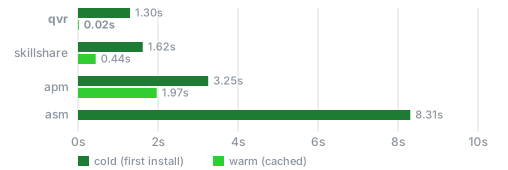
The speed isn't an optimization pass; it's the storage model:
- One bare clone per registry, one sparse worktree per skill. Installs are
SHA-keyed and immutable, so content is shared by construction — two
projects pinned to the same SHA share one copy on disk, and switching
versions is a symlink repoint, not a re-clone. - The read path is a symlink. When your agent loads a skill it follows a
symlink and reads a file. Zero git operations, zero network, zero qvr — the
tool gets out of the way the moment the install lands. - Made to be driven by agents, not just humans. Every command supports
--output json, keeps structured data on stdout and diagnostics on stderr,
and exits with meaningful codes.qvrslots into an agent's tool loop as
cleanly as into your shell.
qvr add code-review            # resolve, scan, lock, symlink — done
qvr add [email protected]     # pin a tag, branch, or SHA
qvr sync                       # reproduce the locked set, byte-identical, anywhere
Governed across projects, teams, and orgs
Quiver treats trust as a first-class output. A project's skill set lives in two
committed files: qvr.toml declares the intent, qvr.lock records the
resolved proof. Clone the repo on any machine, run qvr sync, and you get the
byte-identical, already-vetted skill set — not "whatever the registry serves
today."
# qvr.lock — one resolved, vetted entry per skill (machine-generated)
[[skill]]
name        = 'frontend-design'
registry    = 'anthropics/skills'
commit      = 'da20c92503b2e8ff1cf28ca81a0df4673debdbf7'    # resolved SHA
subtreeHash = 'sha256:21dce9699042…'                        # exact bytes installed
scan        = {reportSHA = 'sha256:8e861d1c…', decision = 'allowed', counts = {…}}
provenance  = {commitAuthor = 'Keith Lazuka <[email protected]>', signatureStatus = 'none'}
Every install is scanned before it lands. The built-in scanner runs a
15-category detection taxonomy over every skill at qvr add, qvr publish,
and on demand — prompt injection, data exfiltration, leaked secrets,
privilege escalation, MCP tool poisoning, supply-chain risks (including OSV
checks on declared dependencies), invisible-Unicode tricks, and more. Findings
gate the install, land in the lock as a verdict, and export as SARIF for
code-scanning pipelines.
Everything is tracked, nothing is ambient. Each lock entry records the
resolved commit, a subtree hash of the exact bytes, the scan verdict, and the
commit author — the lock is the audit trail. On qvr sync, anything in an
agent directory that isn't in the lock is hidden from the agent: the lockfile
is the only source of truth for what your agent loads.
Policy travels and CI enforces it.
qvr lock verify --strict    # CI gate: every entry verifiably matches disk
qvr sync --frozen           # CI gate: fail on any drift, change nothing
qvr trust pin               # per-registry commit-author allowlists
qvr provenance <skill>      # origin, signature status, author trust
qvr add --global <skill>    # ambient scope: governed the same way, machine-wide
Invalid signatures always block. Default agent targets are recorded inqvr.toml, so routing policy is reviewed in the same PR as the skills
themselves — no machine-local drift between teammates.
See what your skills actually do
Skills are software, so Quiver gives them the inspection surface software gets.
Agents already keep session history on disk; qvr audit reads those native
stores directly — zero agent configuration, and months of existing history
back-fill on the first scan.
Every capture is stored verbatim, then projected into OpenTelemetry spans
(Turn / Tool / Skill) using the GenAI semantic conventions. A skill.*
attribute family marks which skill each span belongs to — and whether that
identity was proven from the artifact the agent actually loaded. Pair proven
attribution with the lock's per-ref pinning and an A/B test stops being
anecdotal: each variant's spans trace back to a specific SHA.
qvr audit enable                    # opt in
qvr audit discover                  # scan agents' native session stores (incremental)
qvr audit sessions                  # recorded skill-using sessions
qvr audit logs                      # turn / tool / skill spans
qvr audit export > traces.jsonl     # OTLP-ready JSONL for Jaeger, Tempo, Honeycomb, …
The embedded dashboard — qvr ui, baked into the binary, no install — puts the
whole supply chain on one screen:
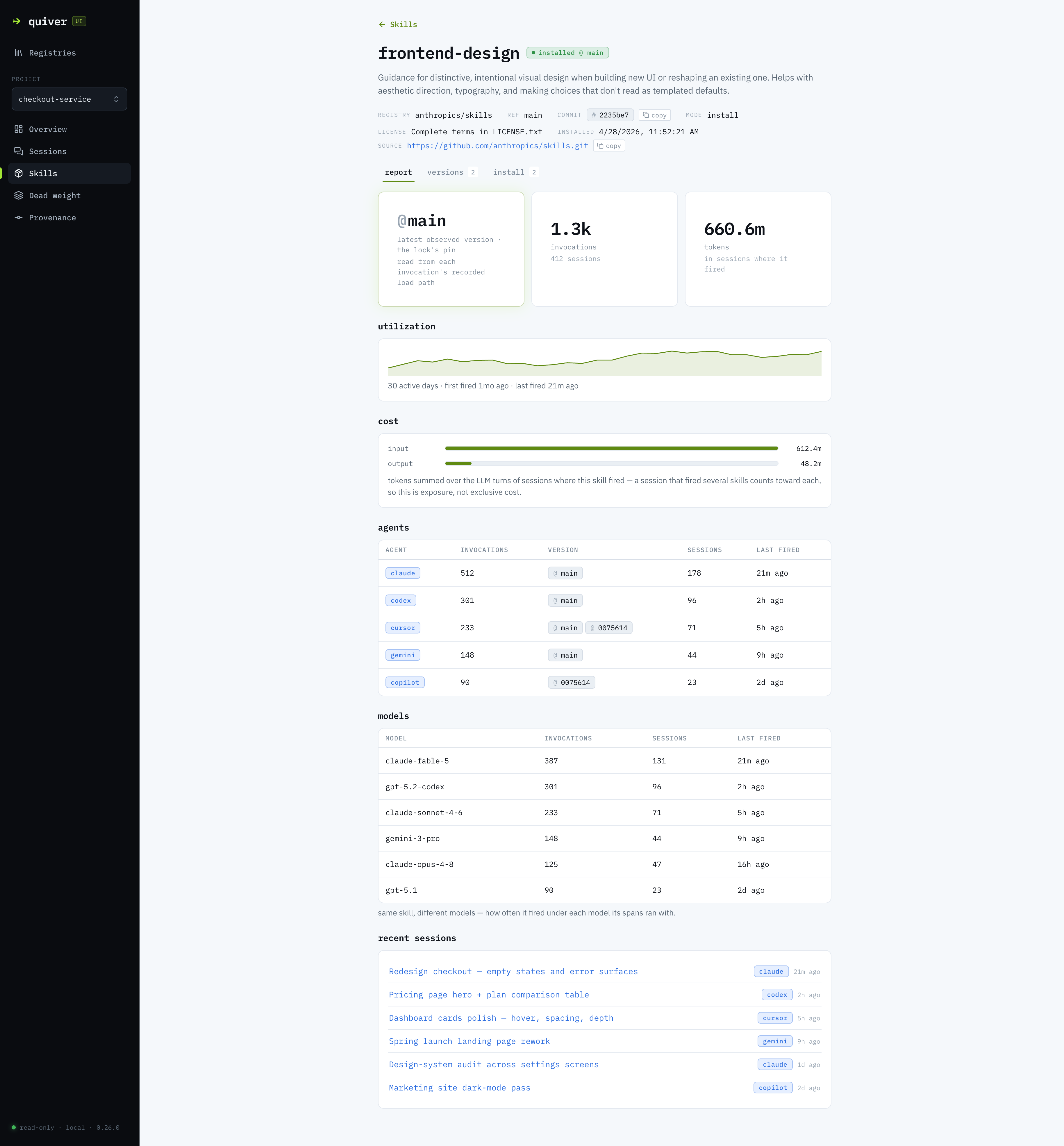
- Skills & registries — drill from a registry to a single skill: files,
agent targets, scan results, version pins, and full version history. - Sessions & traces — every recorded session, down to individual turn,
tool, and skill spans. - Provenance — where every installed byte came from, by author and
signature status. - Dead weight — skills that are installed but have never fired, and stale
skills with no recent runs. Stop paying context for skills nobody uses.
[!NOTE]
Traceability is the foundation for optimizing skills: once every run is
attributable to the exact skill bytes that produced it, you can tell which
version actually moved the needle — and close the authoring loop on evidence
instead of guesswork.
Installation
Prebuilt binary (recommended)
A single self-contained binary with the dashboard baked in — no Go or Node
required.
# Linux / macOS
curl -fsSL https://github.com/astra-sh/qvr/raw/main/install.sh | sh
# Windows (PowerShell)
irm https://github.com/astra-sh/qvr/raw/main/install.ps1 | iex
The installer detects your OS/arch, downloads the matching release, verifies
its checksum, and drops qvr on your PATH. Tune it with QVR_VERSION (pin a
release) and QVR_INSTALL_DIR (install location). Then:
qvr --version
qvr doctor          # sanity-check the environment and any existing installs
Updating is in-place — download, checksum verify, and atomic swap, all
in-process:
qvr upgrade                     # latest release (brings the embedded UI current too)
qvr upgrade --check             # report whether a newer release exists
From source
For contributors, or to build the latest main. Requires Go 1.25+ and
Node 20+.
git clone https://github.com/astra-sh/qvr.git
cd qvr
make build          # builds the React UI, then embeds it into the binary
make install        # -> /usr/local/bin/qvr  (use sudo if needed)
[!NOTE]
Plaingo installis intentionally not a supported path — it can't run
the npm build, so it ships without the dashboard. Use the prebuilt binary ormake build.
Quick start
# register a source — any git clone URL, one skill or fifty
qvr registry add [email protected]:acme/skills.git
qvr search deploy

# add skills to the current project (scans, then writes qvr.toml + qvr.lock)
qvr add code-review
qvr add [email protected]          # pin a tag, branch, or SHA

# commit qvr.toml + qvr.lock; teammates and CI reproduce with one command
qvr sync
The full lifecycle
Quiver runs skills through a software lifecycle — and it closes. Authoring
a new version isn't a fresh start; it re-enters the same gate every consumer's
install went through.
source ─► registry add ─► scan ─► lint ─► add ─► edit ─► publish ─────┐
                          ▲                                           │
                          └──────────────── re-gate ◄─────────────────┘
Consume
qvr registry add <git-url>        # index any git repo as a skill source
qvr add <skill>[@ref]             # scan, lock, symlink into every target agent
qvr add --global <skill>          # ambient: available in every session
qvr switch <skill> --latest       # follow the latest semver tag
qvr outdated                      # pinned SHAs vs. upstream tips
Author
qvr init                          # bootstrap a project (writes qvr.toml)
qvr create my-skill               # scaffold a spec-valid skeleton
qvr lint my-skill                 # check against the agentskills.io spec
qvr edit code-review              # eject immutable install -> editable dir
qvr publish code-review --tag v1.3.0 -m "v1.3.0"   # re-gate, then push upstream
Version control is first-class because the lock pins git refs, not opaque
archives:
qvr add [email protected] --as code-review-rc # two versions coexist for A/B
Inspect & verify
qvr list                    # skills in the project lock (--all unions global)
qvr status [skill...]       # per-skill state: clean / dirty / drift
qvr scan <skill>            # run the security pipeline on demand (SARIF out)
qvr provenance <skill>      # origin, signature + author trust
qvr lock verify --strict    # CI gate: every entry is verifiably the recorded state
qvr doctor                  # broken installs, orphan artifacts (--strict to fail)
Maintain
The SHA-keyed store is derived state — qvr sync rebuilds any missing
worktree from the lock — so it garbage-collects freely:
qvr cache list              # reachable + orphan worktrees with sizes
qvr cache prune             # drop worktrees no project lock references
qvr cache clean             # wipe the store and the registry index cache
How it's wired
Storage: bare git clones → per-skill immutable worktrees (sparse checkout)
→ symlinks into agent dirs.
 ~/.quiver/                              shared store + index cache
 ├── config.yaml                         registered sources (URLs + names)
 ├── qvr.lock                            global ambient lock (--global lane)
 ├── registries/<org>/<repo>.git/        bare clones (source of truth)
 ├── worktrees/<org>/<repo>/<skill>/<sha7>/   immutable, SHA-keyed, shared
 └── cache/index/<name>.json             TTL'd registry index cache

 <project>/
 ├── qvr.toml                            declarative intent (skills + default targets)
 ├── qvr.lock                            resolved lock — source of truth
 ├── .claude/skills/<skill>   -> symlink into ~/.quiver/worktrees/
 ├── .agents/skills/<skill>   -> symlink into ~/.quiver/worktrees/
 └── .github/skills/<skill>   -> symlink into ~/.quiver/worktrees/
Agent targets
Targets are a data-driven registry (~60 agents) compiled into the binary — runqvr target list for the full set with directories and aliases. Paths are
sourced from each tool's official docs; many newer CLIs share the AGENTS.md.agents/skills project location. Common core targets:
| Target | Local dir | Global dir | Aliases |
|---|---|---|---|
| claude | .claude/skills |
~/.claude/skills |
claude-code |
| codex | .agents/skills |
~/.agents/skills |
|
| cursor | .agents/skills |
~/.cursor/skills |
|
| copilot | .github/skills |
~/.copilot/skills |
github-copilot |
| gemini | .agents/skills |
~/.gemini/skills |
antigravity |
| hermes | .hermes/skills |
~/.hermes/skills |
hermes-agent |
| openclaw | .agents/skills |
~/.openclaw/skills |
clawdbot |
| project | .agents/skills |
~/.agents/skills |
agents |
Pick which agents a project installs into with qvr target add <name>...; the
choice is recorded in qvr.toml so it travels with the repo. Selection order
is --target flag > qvr.toml default-targets > machine config.
Standards
Quiver builds on open standards rather than inventing its own formats.
- Skills follow agentskills.io. A
skill is a directory with aSKILL.mdwhose YAML frontmatter carriesname+description(plus optionallicense,compatibility,allowed-tools,metadata). Quiver's parser (pkg/skillspec) and linter enforce the spec —
nothing Quiver-proprietary is required to author a skill. - Traces follow
OpenTelemetry.
Captures are stored verbatim and projected into OTLP spans, stamped with aderiver_versionso an improved deriver can re-run over old captures
(qvr audit rederive) without re-capturing. - Scan findings export as SARIF for GitHub code scanning and any
SARIF-aware pipeline.
Documentation
In-depth docs live under documentation/:
- Architecture — storage layout, hot/warm/cold
paths - Skill format —
SKILL.mdfrontmatter and
contract - Registry format — repo layouts the indexer
accepts - Config reference —
~/.quiver/config.yamlkeys - Security scanning —
qvr scan, the
install-time gate, and CI integration - Audit & tracing —
qvr auditcapture
and OpenTelemetry spans - Guides: getting started ·
creating a skill ·
creating a registry ·
agent integration ·
team workflows
Built and maintained by SRP · MIT licensed ·
Issues and PRs welcome
Yorumlar (0)
Yorum birakmak icin giris yap.
Yorum birakSonuc bulunamadi