atalanta
Health Uyari
- License — License: AGPL-3.0
- Description — Repository has a description
- Active repo — Last push 0 days ago
- Low visibility — Only 5 GitHub stars
Code Basarisiz
- rm -rf — Recursive force deletion command in .github/workflows/ci.yml
Permissions Gecti
- Permissions — No dangerous permissions requested
Bu listing icin henuz AI raporu yok.
Mobile, web and API tests in YAML. One Rust binary runs suites on Android emulators, iOS simulators and Chrome, with no JVM, Node or Appium. An AI agent can write the tests, and they replay in CI without calling a model.
 Atalanta
Mobile, web and API tests in YAML, from one static binary.





Docs · How it works · Example · FAQ · Status · Changelog
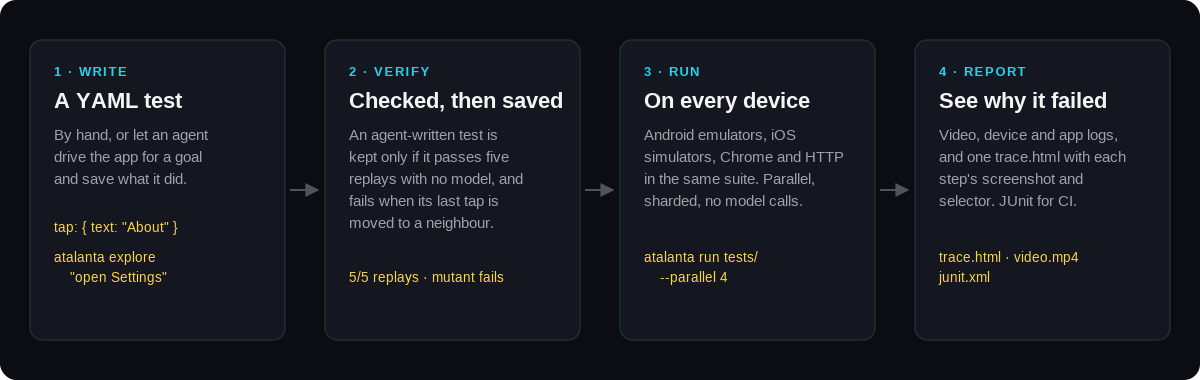
Atalanta runs test suites on Android emulators, iOS simulators and Chrome. It is written in Rust: no JVM, no Node, no Appium server. Write the tests in YAML, or let an AI agent drive your app and write them for you. An agent-written test is checked before it is saved, and a saved test replays in CI without calling a model.
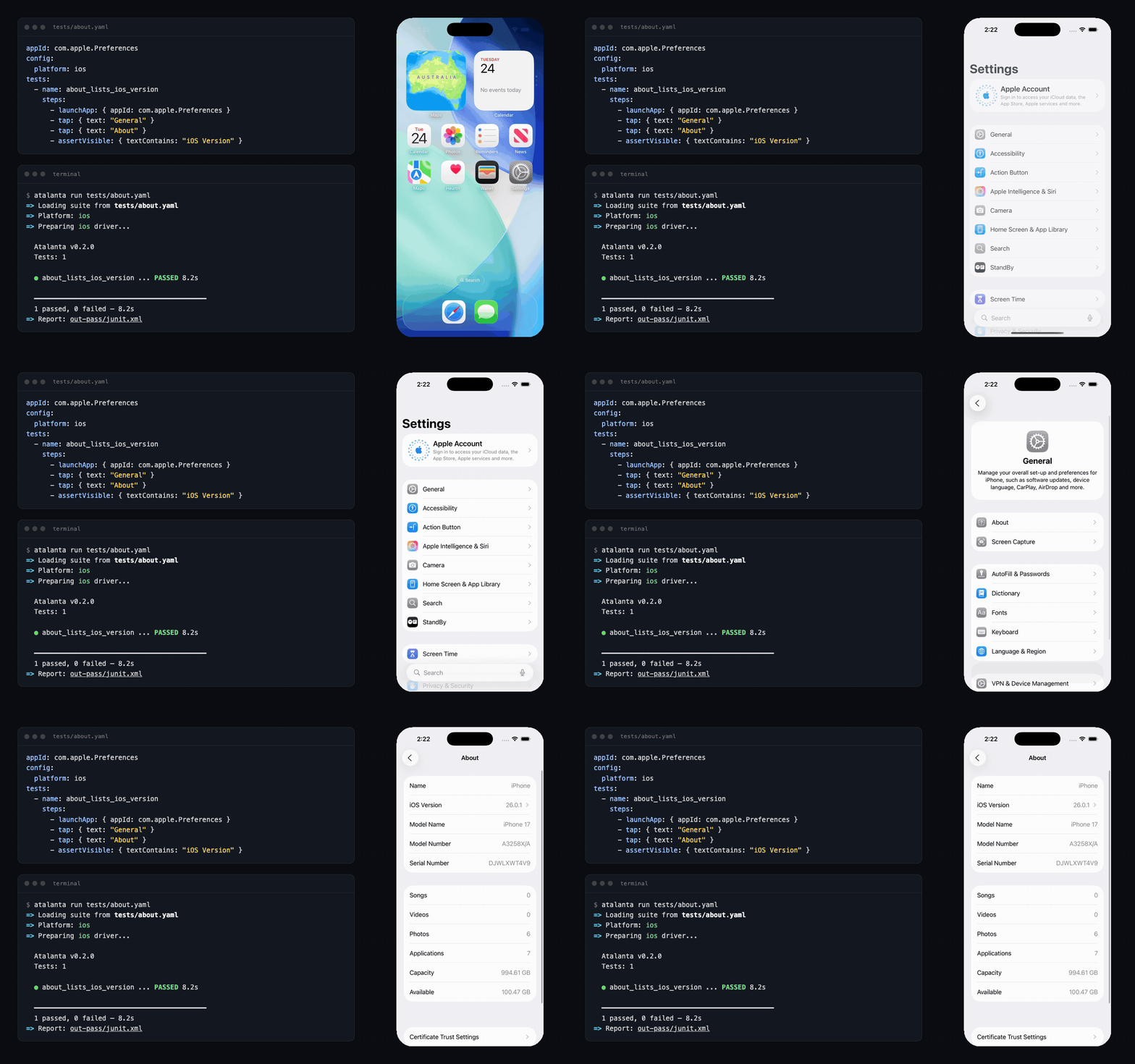
A real run on an iOS 26 simulator. The phone is the video Atalanta recorded of the test.
The latest release is 0.2.0. docs/STATUS.md lists what has been verified, and on which devices.
What it does
- No sleeps. Every step waits for its element and for the screen to settle.
- Agent-written tests.
atalanta explore "<goal>"drives the app and saves the session as a YAML test. - Checked before saving. An agent-written test is kept only if it passes five replays with no model and fails when its last tap is moved to a neighbouring element.
- No model in CI. The model picks an operation and an element number; code builds every selector and fills every value. Saved tests make no model calls.
- APIs in the same suite. An
httpstep checks the response and captures values for later UI steps. - Evidence on your machine. A failed test keeps a video, the device and app logs, and one
trace.html. No cloud account. - A local console. It mirrors every device and browser, shows the selector under the cursor, and runs suites and agent sessions.
- Agent tooling. Agents drive devices through an MCP server or plain shell commands.
- Fast CI. Run in parallel across devices, shard by past durations, or run only the tests a change can affect.
- Your model. Use any of 19 AI providers, local models included.
| Platform | Driven with | Requires | Verified on |
|---|---|---|---|
| Android | adb and Atalanta's on-device UI server | Android SDK platform-tools | 100+ devices (emulators API 33–34; physical phones and tablets through Android 14) |
| iOS | WebDriverAgent or Atalanta's own XCUITest runner | macOS with Xcode | iOS 26 simulators; multiple iPhones (12 and later) |
| Web | Chrome DevTools Protocol | Chrome or Chromium | Headless Chrome on macOS and Linux |
| API | HTTP | Nothing |
Quick start
Install on macOS or Linux:
brew install atalantahq/tap/atalanta
# or
curl -fsSL https://atalanta.sh/install.sh | sh
Or build from a checkout: cargo install --path atalanta-cli --locked.
To try the YAML first, the playground checks a suite in your browser and runs API tests there.
Start an emulator or simulator with your app installed, then:
atalanta doctor          # checks adb, Xcode, devices, Chrome and AI keys; --fix applies the safe fixes
atalanta init --run      # writes a first test from the app's launch screen and runs it
atalanta explore "open Network & internet" --app-id com.android.settings   # an agent writes a test
atalanta run open-network-internet.yaml                                    # replays it, no model
In CI:
atalanta run tests/ --parallel 4 --report junit,github --retries 1
atalanta run tests/ --shard 2/4 --shard-timings history/
atalanta run tests/ --changed-since origin/main
atalanta init also writes a sharded GitHub Actions example to atalanta/ci/. See docs/CI.md.
Install
Every route installs the same binary:
curl -fsSL https://atalanta.sh/install.sh | sh   # macOS / Linux
brew install atalantahq/tap/atalanta
npm install --save-dev @atalantahq/cli
cargo install atalanta-cli --locked
The first iOS run builds WebDriverAgent, which takes about a minute once per Xcode version. Signing, checksums and attestations are under Install details.
How it works
Example
appId: com.example.app
tests:
  - name: Log in and open an order
    steps:
      - launchApp: { clearState: true }
      - inputText: { selector: { id: email }, text: "[email protected]" }
      - inputText: { selector: { id: password }, text: "${LOGIN_PASSWORD}" }
      - tap: { id: login_button }
      - assertVisible: { text: "Welcome" }
      - do: "open the first order"          # natural language, cached once verified
      - http:
          method: GET
          url: https://api.example.com/orders/latest
          expect: { status: 200 }
          capture: { ORDER_ID: id }
      - assertVisible: { text: "${ORDER_ID}" }
Secrets are typed by name (${LOGIN_PASSWORD}) and masked in every report, log and trace. The full format is in docs/DSL.md, and examples/ has suites you can run as they are: Android, web, API only, and API plus web.
When a test fails
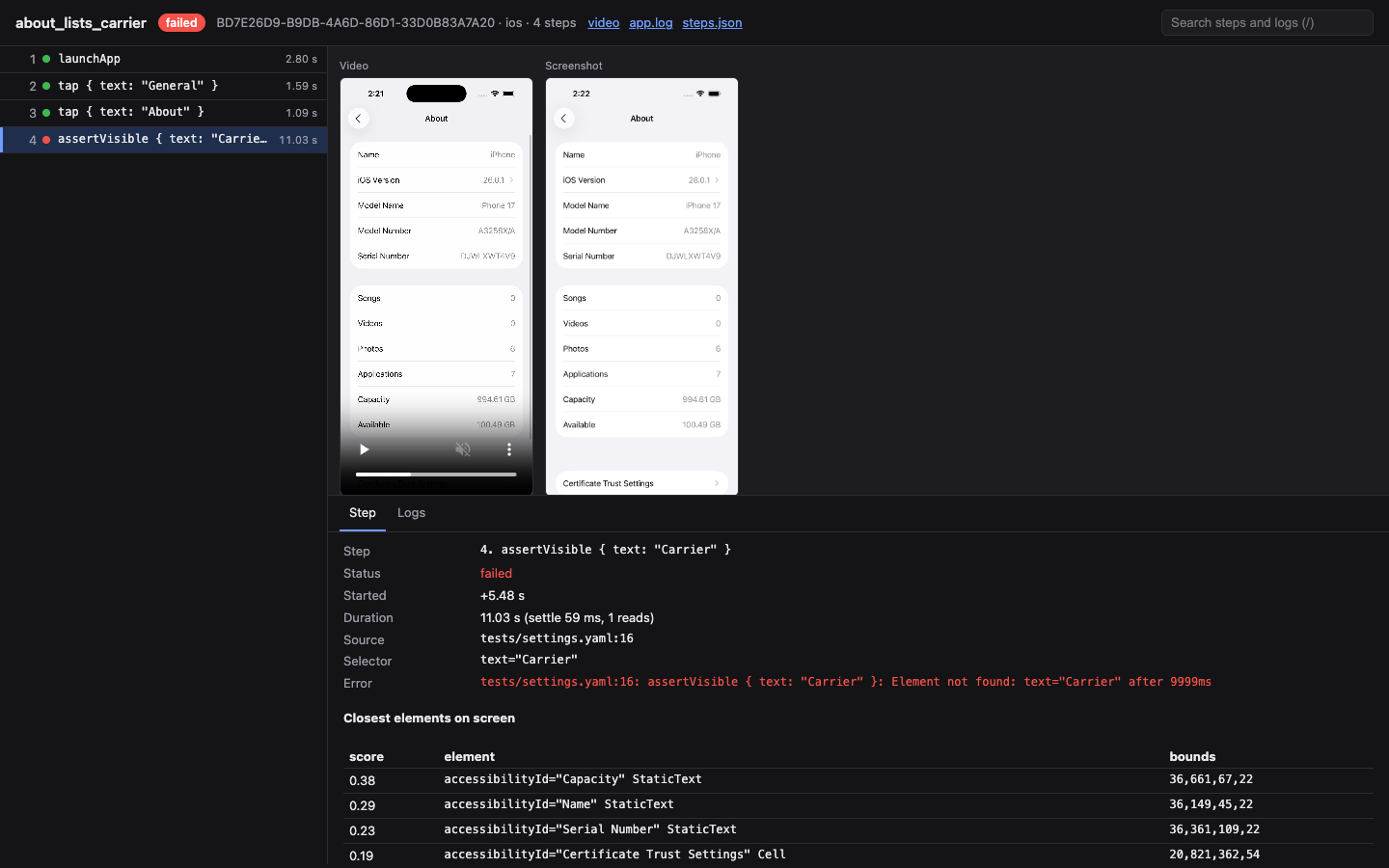
● about_lists_carrier ... FAILED 17.3s
  └ tests/settings.yaml:16: assertVisible { text: "Carrier" }: Element not found: text="Carrier" after 9999ms
Each failed test gets a trace.html: the steps with their timings, the video, the screen at the failing step, the selector and the closest elements that were on screen.
Console and agents
atalanta inspect --open   # the console
atalanta mcp install      # registers the MCP server with your coding agents
The console is one browser page for every booted device and the web browser: a live mirror you can click and type on, an element overlay that shows the selector Atalanta would use, and panels to run suites, watch an agent explore and read a failure's trace. See docs/CLI.md.
atalanta mcp install covers Claude Code, Cursor, Codex, Windsurf, VS Code, Cline and Gemini CLI. It serves five tools by default; --profile full serves all 33. An agent reads the screen as one line per element, acts by reference, and exports what it did as a YAML test. Agents with a shell can skip MCP: atalanta snapshot, atalanta tap @e7, atalanta export --out flow.yaml. See docs/MCP.md.
Why not Maestro or Appium?
| Atalanta | Maestro | Appium | |
|---|---|---|---|
| Tests are written in | YAML | YAML | Code, through a WebDriver client |
| Runs as | One static binary | A Java CLI | A Node.js server plus a driver per platform |
Atalanta's YAML takes ideas from Maestro, so moving over is short: atalanta migrate maestro ./flows/ converts your flows and lists anything it skipped.
Limits
- Pre-1.0: minor releases can change behaviour. Tested on 100+ real Android devices and multiple iPhones; STATUS.md lists specifics.
- Windows is not supported. WSL2 works as Linux.
- Web tests run on Chrome and Chromium only.
FAQ
Does a saved test call an AI model?
No. A model is used to write a test with atalanta explore and to resolve a do: step before it is cached. Replays make no model calls.
Do I need an API key?
Only for explore and do: steps. Plain YAML tests need none. Local models work too: see AI providers.
Can my company use it? It's AGPL.
Yes. Running atalanta against your app, locally or in CI, puts no AGPL obligations on your app, your tests or your pipeline: they are not derived from Atalanta's code. The AGPL applies only if you change Atalanta itself and ship it or offer it as a network service. See Licence.
Documentation
- Guide: selectors, natural-language steps, visual checks, sharding, configuration and troubleshooting.
- Explore: how agent-written tests are checked.
- AI providers: models, keys and local models.
- Drivers: what each platform needs and supports.
- Security: the threat model. Report vulnerabilities through SECURITY.md.
- Status: what has been verified, and on what.
- All docs.
Install details
- Install script. Checks the download against the release's
SHA256SUMSand installs into~/.atalanta/binwithout sudo. Flags:--dir DIR,--version X.Y.Z,--no-modify-path,--keep-quarantine. - macOS signing. Release binaries are ad-hoc signed, not notarised. If the binary carries the quarantine flag, the script removes it after the checksum check. With
--keep-quarantine, approve it in System Settings > Privacy & Security on first run. - Release archives. Built for macOS (arm64, x86_64) and static Linux (arm64, x86_64), each with a build provenance attestation:
gh attestation verify <file> --repo atalantahq/atalanta. - Console UI from source.
brew install --HEAD atalantahq/tap/atalantaincludes it. A plaincargo builddoes not; runnpm ci && npm run buildincrates/atalanta-inspector/frontendfirst.
Feedback and contributing
- Report a bug: open an issue with the bug report form. SUPPORT.md says what to include.
- Ask for a feature: use the feature request form.
- Report a vulnerability: follow SECURITY.md. Do not open a public issue.
- Contribute: CONTRIBUTING.md covers the build, tests and pull requests. Please also read the code of conduct.
Star history
Acknowledgements
Atalanta's Android screen streaming is adapted from scrcpy. Its iOS runner speaks the API of WebDriverAgent. The YAML format takes ideas from Maestro. Visual diffs use the anti-aliasing detector from pixelmatch. Web device profiles come from Playwright. Details are in NOTICE.
Licence
Atalanta is licensed under the GNU Affero General Public License, version 3 only (AGPL-3.0-only): see LICENSE, and NOTICE for third-party material. Using the binary to test your own apps puts no obligations on those apps or their tests. Copying or adapting Atalanta's code into another project, or running a modified version as a network service, means releasing that work's source under the AGPL-3.0 and keeping the copyright notices. AI agents: read AGENTS.md before copying code from this repository.
Yorumlar (0)
Yorum birakmak icin giris yap.
Yorum birakSonuc bulunamadi