lemoncrow
Health Gecti
- License — License: NOASSERTION
- Description — Repository has a description
- Active repo — Last push 0 days ago
- Community trust — 29 GitHub stars
Code Gecti
- Code scan — Scanned 12 files during light audit, no dangerous patterns found
Permissions Gecti
- Permissions — No dangerous permissions requested
Bu listing icin henuz AI raporu yok.
Faster runtime for coding agents. Make coding agents 25% faster and 30% cheaper while improving the quality.
LemonCrow Runtime
Keep your coding agent sharp on real codebases
LemonCrow runs underneath Claude Code, Codex, and other supported hosts with a local code graph, exact-range reads, bounded output, durable memory, and verified runtime controls. On matched SWE-bench Verified runs: +12.0pp resolved, 37.7% fewer turns, and 23.7% faster — same model.











Matched proof, same model: 92.8% vs 80.8% resolved · 37.7% fewer turns · 23.7% faster · raw runs published · see live savings
Install · Working set · Results · Code-search benchmark · Pricing
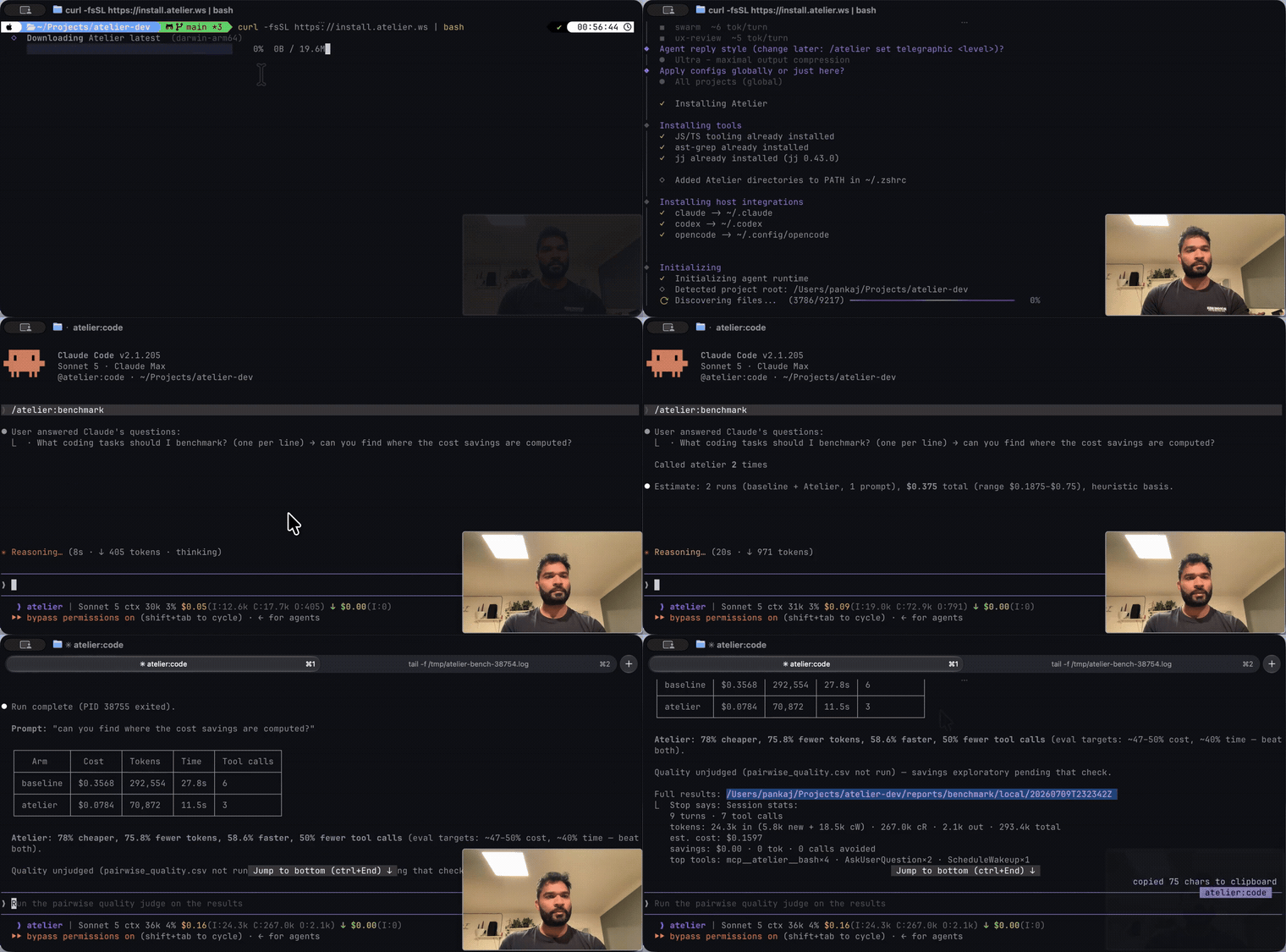
Click for the full walkthrough on lemoncrow.com.
Install in 30 seconds
Run this once:
curl -fsSL https://install.lemoncrow.com | bash
Then create or sign in to a free LemonCrow account and activate it inside the project where you use your coding agent:
cd your-project
lc account login
lc init
LemonCrow wires in better tools behind the scenes and starts tracking local savings as sessions finish. Remote telemetry is on by default; turn it off anytime with lc telemetry remote off.
lc update
Check that everything is connected:
lc doctor
Account boundary: anonymous evaluation includes up to $50 in measured
savings over a rolling 30-day window. Creating or signing into a Free
account is required for uncapped core usage. Recall, handovers, verification,
and local multi-worktree swarm are included in Free.
The clean working set
LemonCrow keeps your existing coding agent and changes the working set around
it:
| Stage | Runtime behavior |
|---|---|
| Find | Rank symbols, definitions, callers, callees, usages, and exact source ranges before broad file exploration. |
| Read | Return an outline or only the requested lines; cap noisy command and web output with recoverable spill files. |
| Carry | Preserve useful task state through memory, deduplication, compaction manifests, and handover packets—not the raw transcript forever. |
| Verify | Notice code changes without tests or checks, then nudge the agent before it declares completion. |
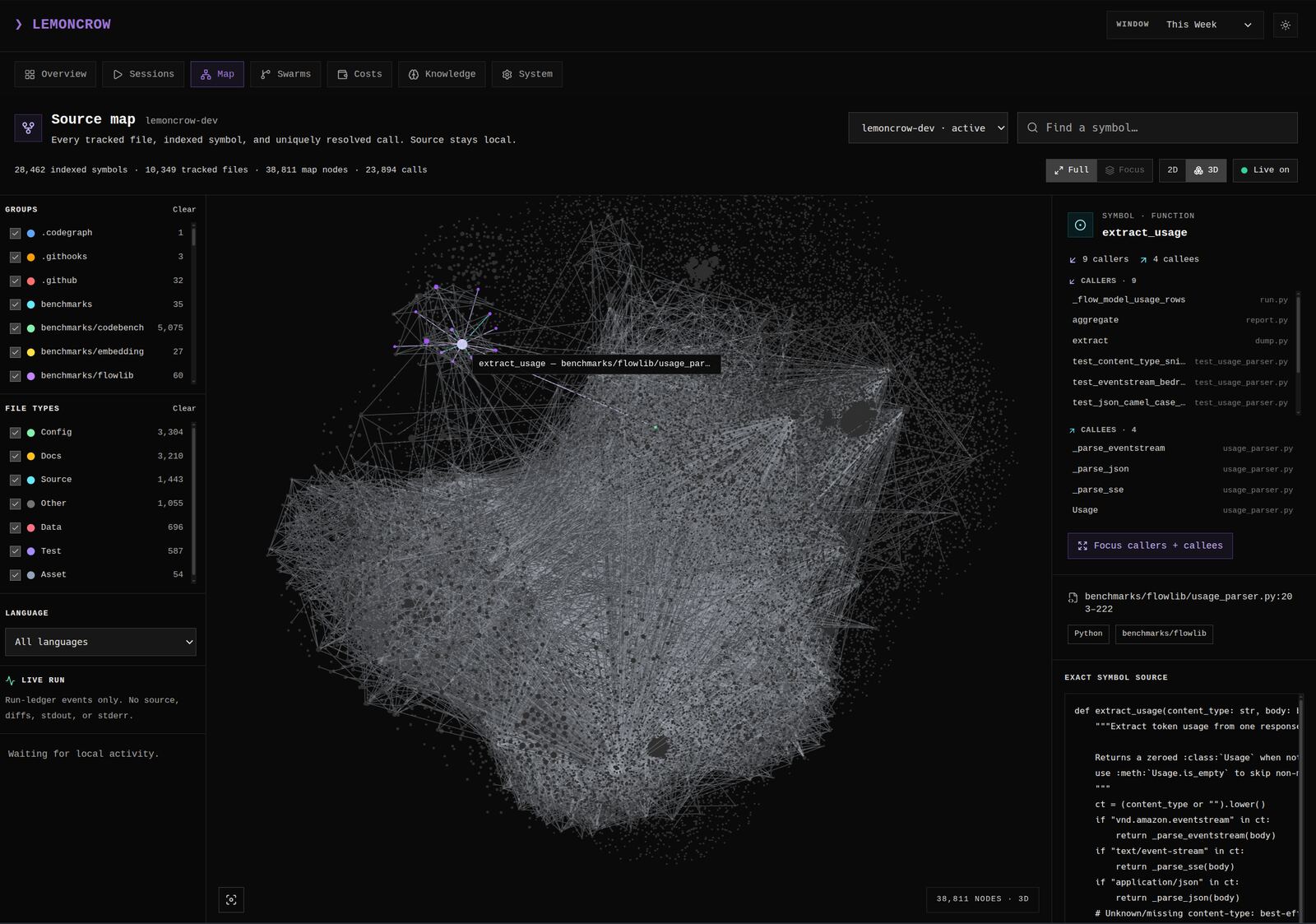
Open the existing dashboard with lc dashboard open, then choose Map. The
browser opens the full tracked source map: files, indexed symbols, and only
uniquely resolved call edges. Groups stay spatially grouped; filters split
source, tests, Markdown/docs, config, data, assets, and languages. Search any
symbol, click it for its exact source range, or double-click to focus callers
and callees. Live mode adds glow, edge flow, and camera-follow from the local
run ledger; switching it off leaves the same zoomable, clickable graph in
place. Raw source, diffs, stdout, and stderr never enter the map feed.
What actually gets replaced
On Claude Code, lc init gives the agent five grounded tools and hides the
equivalent built-ins—one way to do each job, not two. Other hosts use the
strongest equivalent controls they expose.
Find things in one shot -- no wandering the codebase call after call.
| LemonCrow tool | Replaces (hidden from the model) | Why |
|---|---|---|
code_search |
Grep, Glob | One call returns the symbol, its callers/callees, and ranked source -- no grep-loop-then-read-whole-file. Ranked by call-graph centrality over a tree-sitter symbol table |
read |
Read | Returns an outline or the exact :L10-L40 range, budgeted, instead of the full file |
edit |
Edit, Write | Verified, cross-file edits in one call instead of per-file patch-or-create guessing |
bash |
Bash | Output is capped and structured so a noisy build log can't blow the context window |
web_fetch |
WebFetch | Strips a page to clean Markdown instead of a raw HTML dump |
What's unchanged: Claude Code itself, the model, your workflow. Full internals: Architecture.
Why a runtime, not just tools
A bare MCP server is a library the model can call if it remembers to. A runtime decides what's callable at all — four jobs, four layers:
| Layer | Without it | With it |
|---|---|---|
| Agents — process isolation | a "read-only" agent can still edit | explore/plan/research/review hard-deny edit/write at the host-config level |
| Skills — standard library | multi-step procedures re-improvised every session | encoded once, invoked the same way every time |
| Hooks — interrupts | wasteful re-reads; "done" without a check | bad calls denied before they run; on Claude Code, session close blocked until verification ran (advisory on other hosts today) |
| MCP tools — syscall surface | agents fall back to grep-and-read under pressure | natives hidden — LemonCrow tools are the only surface for those jobs |
The engine underneath — not just for code
Under the coding runtime is a domain-neutral context engine with one contract: one-shot retrieval — a single call returns what the model needs, packed to a token budget; follow-up queries are allowed, retry loops are never required. Retrieval, compression, memory, and replay do not assume code — code is the first conforming retriever (Retriever protocol, lemoncrow.core.capabilities.retrieval), chosen because the pain is mature and the results are measurable. The same engine is being opened to teams building any LLM agent: lemoncrow.com/engine.
Agents
Packaged in integrations/agents/ — each a distinct capability grant (subagent name lemoncrow:<mode>), not a persona:
| Agent | Writes? | Use |
|---|---|---|
code |
Yes | default interactive — edits, refactors, features |
auto |
Yes | fully autonomous — CI/headless runs |
solve |
Yes | end-to-end solving of a well-defined task |
execute |
Yes | one verified pass of an accepted plan |
general |
Yes | catch-all for mixed work |
bare |
Yes | minimal toolset, same discipline |
explore |
No | read-only exploration — locate and cite |
plan |
No | read-only planning, stops for human checkpoint |
review |
No | adversarial read-only review |
research |
No | external web research — cited memo |
Skills
Packaged in integrations/skills/:
| Skill | What it does |
|---|---|
lc |
manage LemonCrow itself via the CLI |
benchmark |
measure savings on your repo — offline scan or live A/B |
orchestrate |
one structured multi-step task, routed to the right surface |
swarm |
N parallel attempts in isolated worktrees — best result wins |
perf-review |
gate a change on measured performance, not read code |
ux-review |
gate shipped UI on objective checks in a real browser |
recall |
retrieve what past sessions learned |
Check your own savings
After LemonCrow is installed, inspect all savings and missed opportunities in
your local session history:
lemoncrow session stats
The report is read-only. It counts wasted tool calls and round-trips in your
Claude Code, Codex, and opencode sessions, then shows the associated token,
cost, and time opportunity.
Replay a past session
lemoncrow session replay plays back a recorded session and, for each native call, runs the real LemonCrow tool that would have replaced it — grep/read loops collapse into one code_search, whole-file reads become budgeted outlines, bash logs get capped. It then estimates — from that session alone — the cost, savings opportunity, and time LemonCrow would have saved. No model re-run, nothing written; opens a shareable HTML page.
lemoncrow session replay
Works on Claude Code, Codex, and opencode sessions. The saving is an estimate; the live re-measured A/B is lc benchmark local.
Results
These are fixed results from pinned benchmark runs—not a live counter. Every
headline number links back to committed raw runs and methodology in
BENCHMARKS.md. The model, tasks, containers, turn limits, and
verification harness were held constant. Community telemetry remains separate:
see live savings.
| Benchmark | Baseline correct | LemonCrow correct | Correct delta | Baseline cost | LemonCrow cost | Cost delta |
|---|---|---|---|---|---|---|
| SWE-bench Verified, 50 tasks x 5 reps | 80.8% | 92.8% | +12.0 pp | $234.84 | $165.45 | 29.5% cheaper |
| SWE-bench Lite, 10 tasks x 5 reps | 98.0% | 96.0% | -2.0 pp | $19.83 | $17.51 | 11.7% cheaper |
| SWE-bench Pro, 10 tasks x 5 reps | 88.0% | 90.0% | +2.0 pp | $39.01 | $30.61 | 21.5% cheaper |
| Exploration tasks across 7 large repos x 5 reps | - | - | - | $19.11 | $6.29 | 67% cheaper |
| Telegraphic Q&A, 20 prompts x 5 reps | - | - | - | $8.68 | $6.18 | 28.8% cheaper‡ |
| Terminal-Bench 2.1, 89 tasks vs public leaderboard* | 78.9% expected | 78.7% | -0.2 pp | $96.76 | $69.52† | 28.1% cheaper† |
* LemonCrow 1 rep/task vs public leaderboard 5-rep average. † 5 timed-out tasks excluded from cost. ‡ Caveman (free terse-persona system prompt, no install) also ran in the same invocation: $8.57, 1.2% cheaper than baseline -- LemonCrow's edge is durable cost, not just shorter replies; see /vs/caveman.
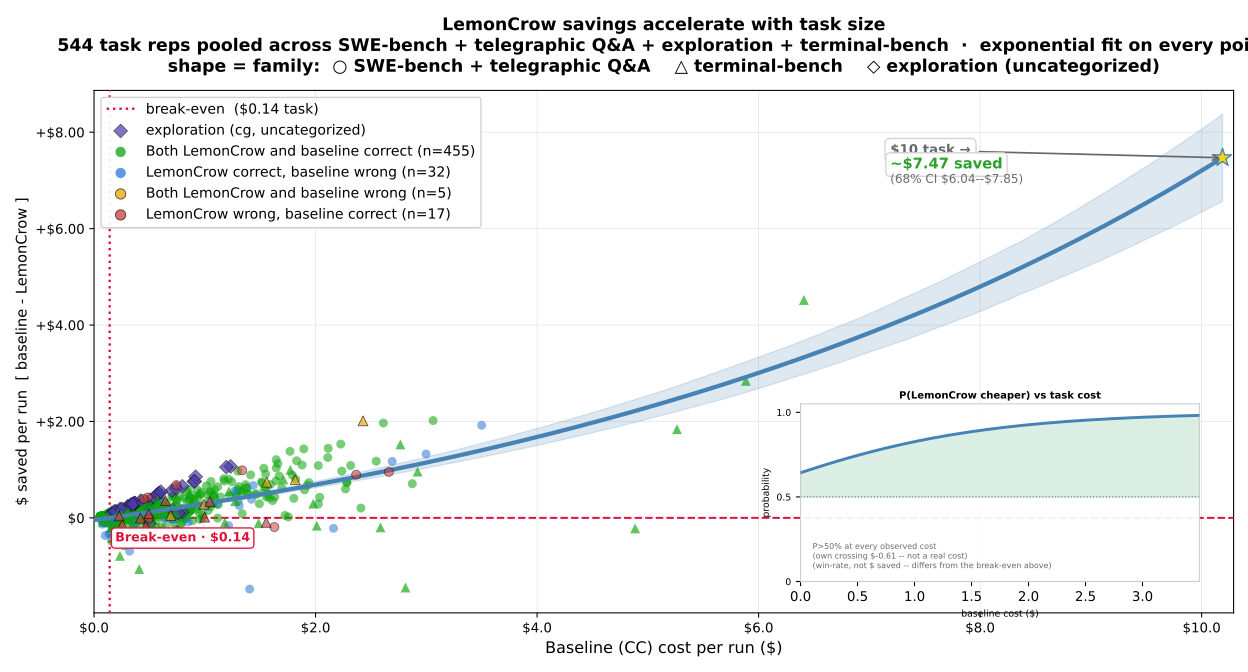
SWE-bench Verified detail (250 runs a side) — one-shot search collapses the grep-and-read loop, so turns, wall-clock, and tool calls drop together:
| Metric | Baseline | LemonCrow | Delta |
|---|---|---|---|
| Turns | 6,962 | 4,336 | 37.7% fewer |
| Wall-clock | 14.3h | 10.9h | 23.7% faster |
| Total tool calls | 6,700 | 4,167 | -37.8% |
| Output tokens | 3.04M | 2.19M | 27.9% fewer |
| Bash | 3,327 | 1,785 | -46.3% |
| Read | 1,733 | 1,050 | -39.4% |
| Edit + Write | 1,628 | 759 | -53.4% |
| Search (code_search) | - | 568 | lemoncrow-only |
Exploration detail (7 large repos × 5 reps, read-only Q&A, no edits):
| Tool | Baseline calls | LemonCrow calls | Delta |
|---|---|---|---|
| Read | 672 | 23 | -96.6% |
| Bash | 508 | 71 | -86.0% |
| Search (code_search) | - | 23 | lemoncrow-only |
| Agent + orchestration calls* | 79 | 1 | -98.7% |
| Total tool calls | 1,259 | 118 | -90.6% |
| input | 286,191 | 205,967 | -28.0% |
| cache read | 35,862,919 | 2,753,393 | -92.3% |
| cache write | 2,811,356 | 233,381 | -91.7% |
| output | 426,367 | 68,893 | -83.8% |
| input + cache write | 3,097,547 | 439,348 | -85.8% |
Source: exploration_2026_06_29 · telegraphic_2026_07_16.
One-shot code search vs 10 named tools
The search is the engine: right code in front of the agent on the first try. MRR and first-hit rate (rec@1) across ~7,200 query/gold pairs on 14 repos — 10 tools scored on the identical corpus. LemonCrow semantic search returns the right code first on 65.0% of queries at 390ms p95; the lexical path returns it first on 58.2% at 134ms p95:
| Provider | MRR | rec@1 | p95 |
|---|---|---|---|
| LemonCrow +semantic (BGE) | 0.727 | 0.650 | 390ms |
| LemonCrow lexical (default) | 0.676 | 0.582 | 134ms |
| cocoindex-code (best rival) | 0.557 | 0.457 | 595ms |
| serena | 0.401 | 0.359 | 3834ms |
| ripgrep | 0.376 | 0.320 | 66ms |
| universal-ctags (worst rival) | 0.237 | 0.226 | 1ms |
No one had scored these 10 tools against each other on a shared query set before -- each publishes its own number, on its own terms, against its own baseline.
What you get
- Works with Claude Code, Codex, Copilot, Copilot CLI, and opencode today; Cursor, Hermes Agent, and Antigravity integrations are in progress. Any MCP-compatible agent (LangChain, the OpenAI SDK, Gemini ADK, ...) can connect to the same tools.
- Runs locally by default.
- Open-source runtime (Apache-2.0); the compiled engine (
lemoncrow.pro) is proprietary and required at runtime. - Anonymous evaluation is capped at $50 in measured savings; a free account unlocks uncapped core usage.
- Live local stats for cost, tokens, and savings; anonymous remote telemetry is on by default (opt out anytime).
- Free: grounded local tools, recall, handovers, verification, and swarm.
- Pro: larger-repo indexing, cross-vendor memory, compression, optimization, and reusable knowledge for $20/month or $200/year.
Learn more
- Installation
- Troubleshooting
- Benchmarks · full results, backed by docs · every "vs" comparison, with sources
- CLI reference
- Architecture
Star History
License
Open-core. All source published in this repository is Apache-2.0 — free to read, use, modify, and redistribute.
The engine — the lemoncrow.pro package (the retrieval-quality and token-savings core) — is proprietary: it ships only as compiled binaries, its source is not published, and it is required at runtime (without it, LemonCrow falls back to a degraded built-in-only mode). See LICENSE for the exact terms.
Yorumlar (0)
Yorum birakmak icin giris yap.
Yorum birakSonuc bulunamadi