oh-my-android
Health Uyari
- License — License: MIT
- Description — Repository has a description
- Active repo — Last push 0 days ago
- Low visibility — Only 6 GitHub stars
Code Basarisiz
- rm -rf — Recursive force deletion command in Scripts/release.sh
Permissions Gecti
- Permissions — No dangerous permissions requested
Bu listing icin henuz AI raporu yok.
Android emulator & ADB GUI for Mac: dark mode, font size, RTL, TalkBack, network, GPS, Layout Inspector in dp. Built-in MCP server lets Claude Code, Codex and Cursor drive the emulator.
Oh My Android
The missing control panel for the Android Emulator on macOS.
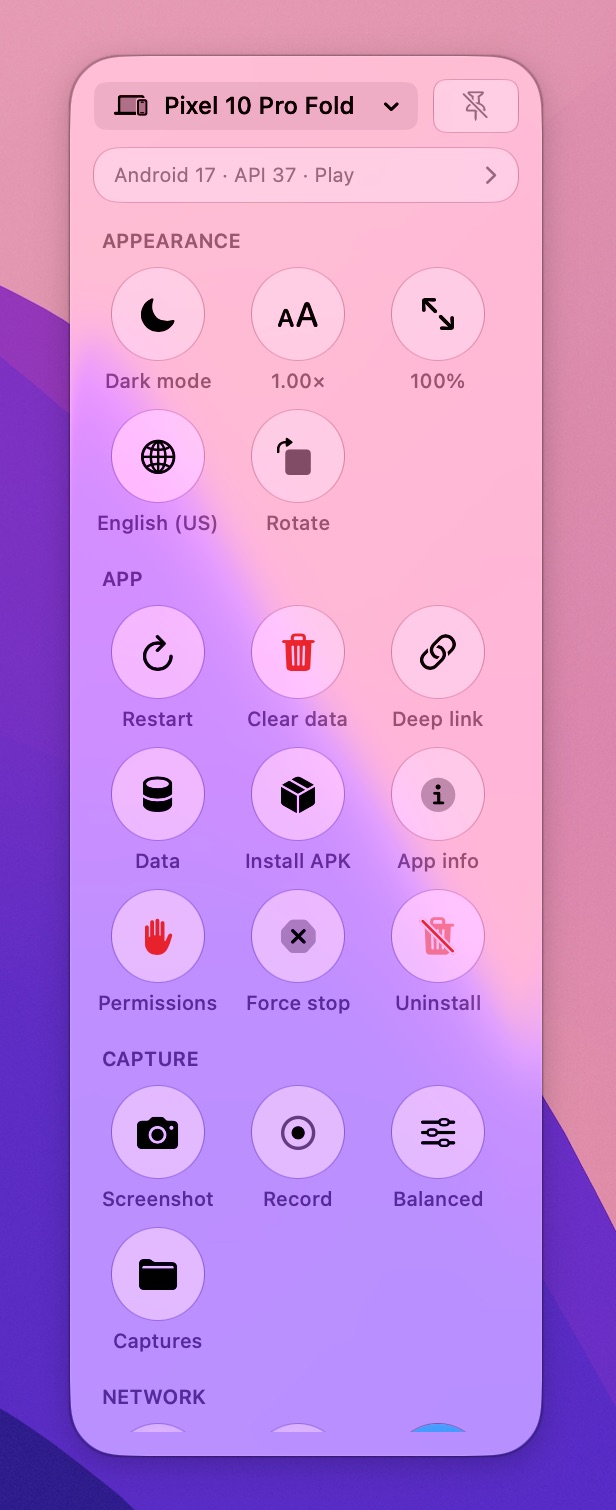
Dark mode, font size, RTL language, TalkBack, network speed, GPS and more: one click each, no adb commands.
Layout Inspector in dp, accessibility audit, and an MCP server so AI agents can drive your emulator.





Install: brew install --cask ateymoori/tap/oh-my-android · free and open source
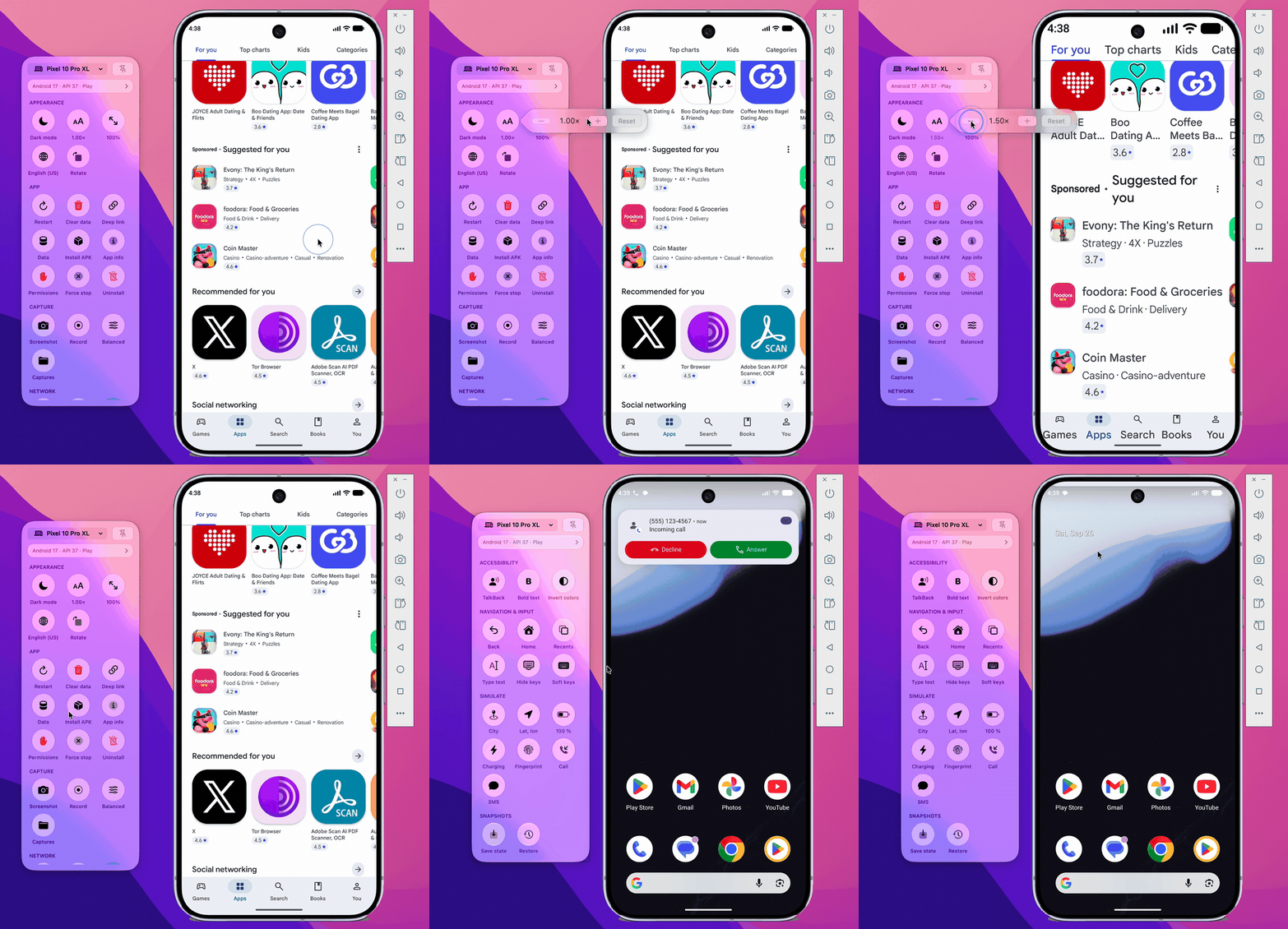
Dark mode, font size, Arabic RTL, incoming SMS and call. Each is one click.
 |
 |
 |
| Control panel | Layout Inspector + TalkBack audit | MCP server for AI agents |
Features · adb cheat sheet · Layout Inspector · AI agents (MCP) · Troubleshooting · FAQ · Contribute
Why Oh My Android?
Testing an Android app means doing the same chores over and over: switch to dark mode, make the
font huge, change the language to Arabic to check RTL, turn on TalkBack, throttle the network to 3G,
clear the app data, take a screenshot. Each one is buried in the emulator's settings or needs anadb shell command you have to look up again.
Oh My Android puts all of them in a floating panel next to the emulator. Every icon shows the
real state of the device, and one click changes it.
- ⚡ One click for nearly 50 everyday test actions
- 📱 Emulators and real phones: USB or Wi‑Fi
adb - 🔍 Layout Inspector: measure any view in dp, Figma-style, and overlay your design
- ♿ Accessibility audit: TalkBack order, missing labels, small touch targets
- 🗄️ Data Inspector: SharedPreferences and SQLite of your debug build
- 🤖 MCP server for AI agents: your coding agent can see the screen, tap, switch settings and read logs
- 🪶 Native and light: SwiftUI, Liquid Glass, event-driven (easy on the battery), no Electron, no telemetry
- 🆓 Free and open source (MIT)
How it compares with Android Studio, scrcpy and other tools: docs/COMPARISON.md.
Install
brew install --cask ateymoori/tap/oh-my-android
Or download the zip from the latest release,
unzip it, and move Oh My Android.app to Applications. The app is signed and notarized by Apple.
Updates: when a new version is out, a dot shows on the menu bar icon. Click Update to … in the
menu, read what's new, and install in one click. The app never updates without asking. It checks once a
day; turn it off in Settings → Updates. brew upgrade --cask oh-my-android works too.
Requirements: macOS 26 Tahoe or later, Apple silicon, and the Android SDK from
Android Studio (or brew install --cask android-commandlinetools).
The app finds the SDK by itself. If yours is in an unusual folder, pick it in Settings → Android SDK.
Use it from Claude Code, Codex or Cursor
brew install --cask ateymoori/tap/oh-my-android

claude mcp add --scope user oh-my-android -- ohmyandroid-mcp   # Claude Code
codex mcp add oh-my-android -- ohmyandroid-mcp                 # Codex CLI
gemini mcp add --scope user oh-my-android ohmyandroid-mcp      # Gemini CLI
For Cursor and VS Code, use the install buttons in AI agents (MCP).
Then start an emulator and ask your agent: "Take a screenshot of the emulator and check this screen in dark mode."
Features
| What you get | |
|---|---|
| 🎨 Appearance | Dark mode · Font size (0.85× → 2×) · Display size · Language and locale, incl. RTL and pseudo-locales · Rotate |
| 📦 Your app (whatever is on screen) | Restart · Clear data · Open deep link · Install APK (or drag it onto the panel) · App info · Reset permissions · Force stop · Uninstall |
| 📸 Capture | Screenshot saved and copied to the clipboard · Screen recording with audio · Quality presets |
| 🌐 Network | Emulate LTE, HSDPA, 3G, EDGE, GPRS or GSM speed and latency · Airplane mode · Wi‑Fi · Mobile data |
| 📐 Layout & performance | Layout Inspector · Show layout bounds · GPU overdraw · GPU profile bars · Show taps · Pointer location · Animations off (for Espresso / Maestro) · Developer options |
| ♿ Accessibility | TalkBack on/off · Bold text · Invert colors · TalkBack order audit |
| 🧭 Navigation & input | Back · Home · Recents · Type text into the focused field · Hide keyboard |
| 🛰️ Simulate (emulator) | GPS location: city presets or latitude/longitude · Battery level · Charging · Fingerprint · Incoming call · Incoming SMS |
| 💾 Snapshots (emulator) | Save a clean state and restore it in seconds |
Destructive actions (Clear data, Uninstall, Reset permissions) ask before they run.
No more adb commands
Every icon replaces a command you would otherwise type or search for:
| Task | The adb way | Oh My Android |
|---|---|---|
| Dark mode on the emulator | adb shell cmd uimode night yes |
🌙 one click |
| Bigger font size | adb shell settings put system font_scale 1.3 |
Aa − / + |
| Change the device language | adb shell cmd locale set-device-locale sv-SE |
🌐 pick from a menu |
| Test RTL layout | adb shell cmd locale set-device-locale ar-EG |
🌐 "العربية (RTL)" |
| Slow network (3G / EDGE) | adb emu network speed edge + adb emu network delay edge |
pick a profile |
| Mock GPS location | adb emu geo fix 18.0686 59.3293 |
pick a city |
| Turn off animations for UI tests | 3 × adb shell settings put global …_scale 0 |
one click |
| Show layout bounds | adb shell setprop debug.layout true + a system refresh call |
one click |
| Clear app data | find the package, then adb shell pm clear <package> |
🗑 one click |
| Take a screenshot | adb exec-out screencap -p > shot.png |
📷 saved and copied |
| Turn on TalkBack | adb shell settings put secure enabled_accessibility_services … |
one click |
| Open a deep link | adb shell am start -a android.intent.action.VIEW -d "myapp://…" |
paste and open |
Layout Inspector
Freeze the screen and measure it like in Figma. Works with Jetpack Compose and classic Views.
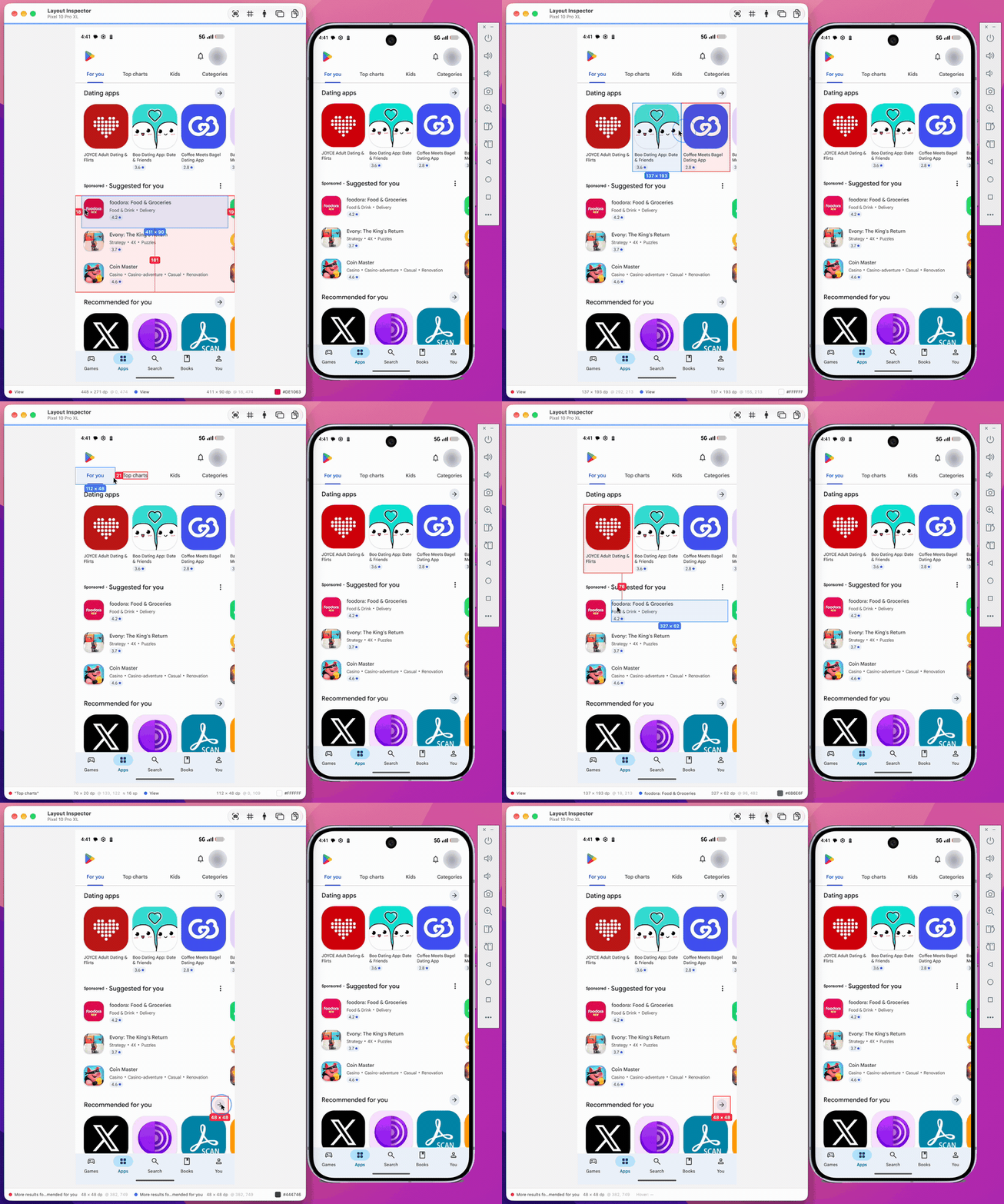
- Hover any element to see its size in dp. Click one, hover another, and see the distance between them
(gaps between siblings, paddings inside a parent). - 8 dp grid, color picker (hex, ⇧⌘C to copy), and an estimated text size in sp.
- Design overlay: drop a Figma PNG export on the window, choose 1× / 2× / 3× or Fit width, set the
opacity or use Difference blend, and nudge it with the arrow keys. Compare design and build pixel by pixel.
Accessibility audit
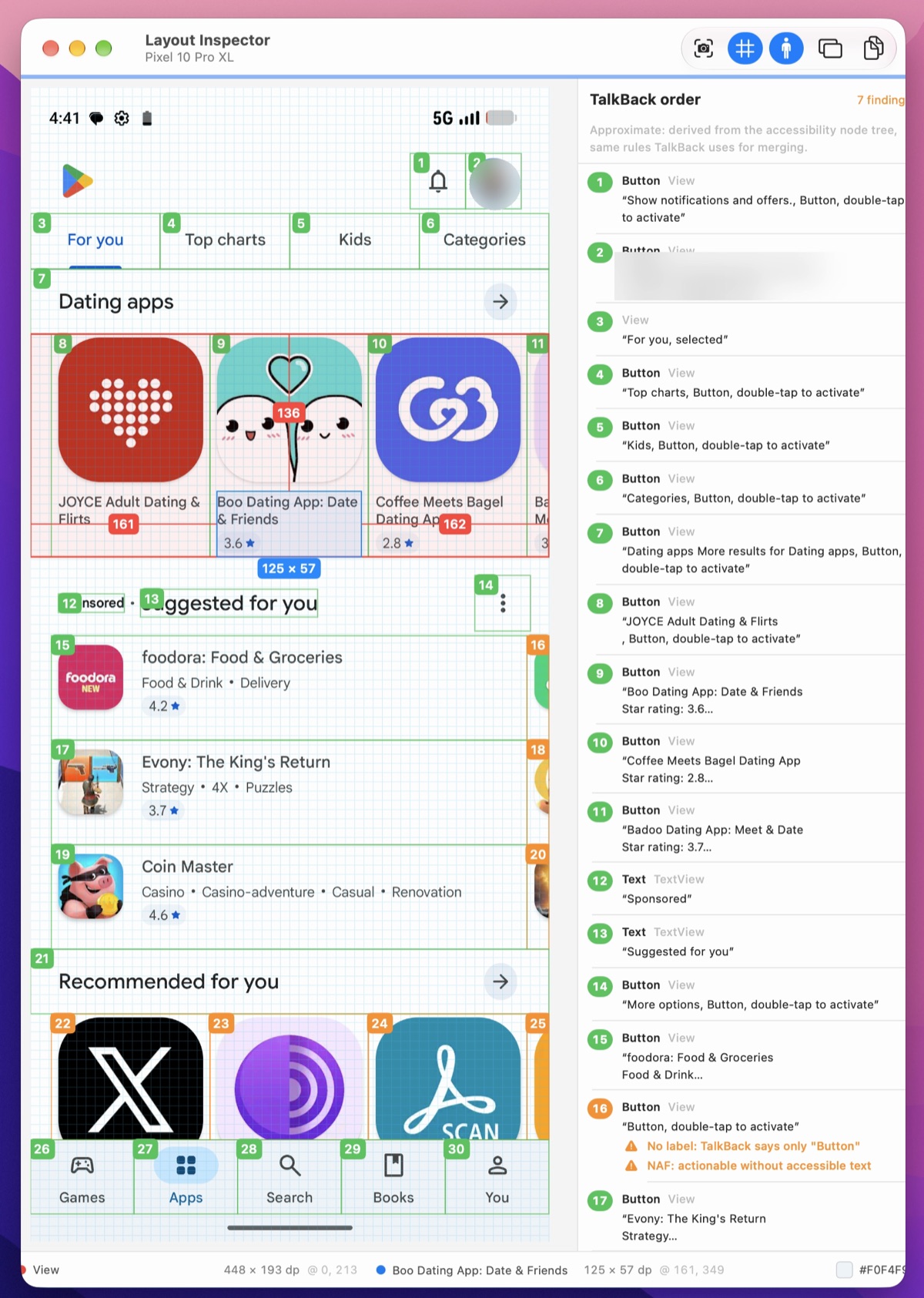
Press ⇧⌘A in the Layout Inspector. Every screen-reader stop gets a number in approximate
TalkBack order, with what TalkBack announces and a list of problems: unlabeled buttons, images
without a content description, and touch targets smaller than 48 × 48 dp.
Data Inspector
Browse the SharedPreferences (key, type, value) and SQLite databases (tables, first 500 rows)
of any debuggable app, with search. It uses adb shell run-as, the same access Android Studio uses, so
release builds stay closed. It is read-only: nothing on the device changes.
AI agents (MCP)
Oh My Android includes an MCP server, so your AI coding agent can
see and drive the emulator: screenshot, read the UI tree in dp, tap and type, switch to dark mode or
RTL, read logcat and the app's database. The agent can build a screen, run it, look at the result, and
fix it by itself.


The buttons use the Homebrew path /opt/homebrew/bin/ohmyandroid-mcp. With the zip install, use the menu bar setup below.
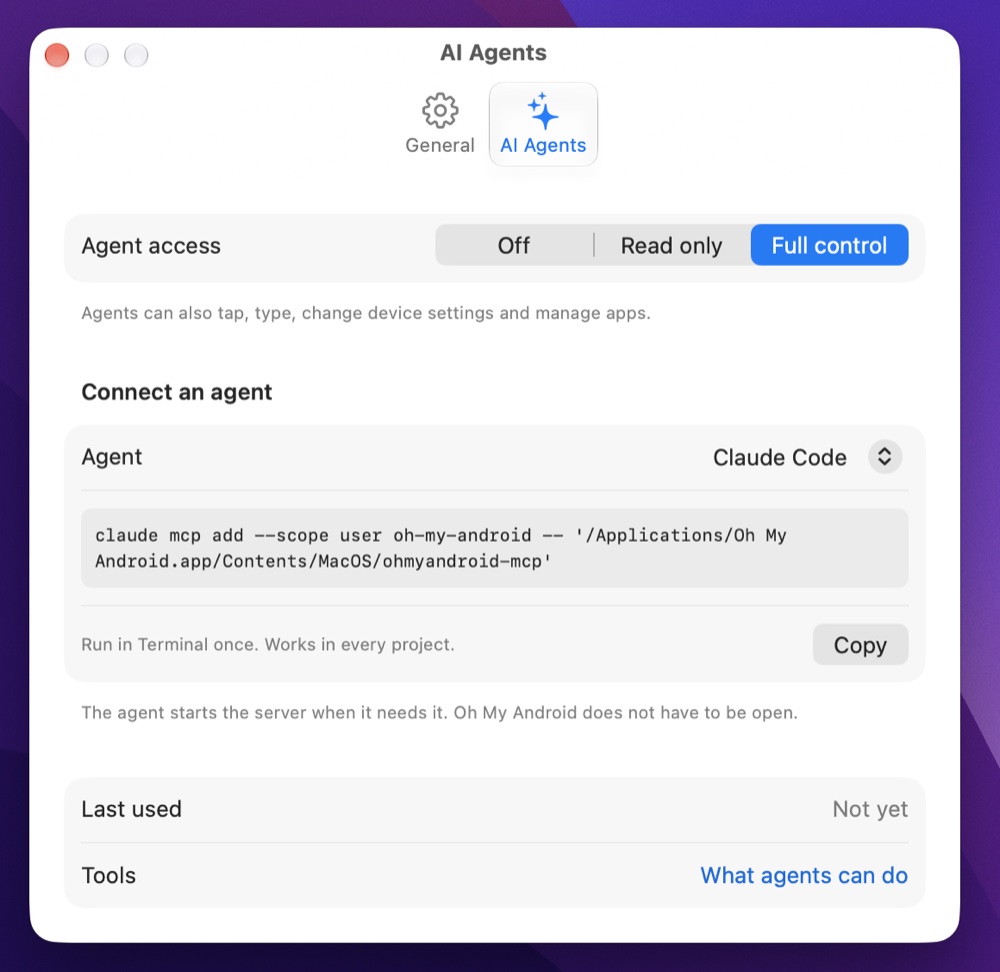
Set up in one step: menu bar icon → AI Agents → Set Up…, choose your agent, click Copy
(or Add to Cursor / Add to VS Code). Or by hand:
claude mcp add --scope user oh-my-android -- ohmyandroid-mcp   # Claude Code
codex mcp add oh-my-android -- ohmyandroid-mcp                 # Codex CLI
{ "mcpServers": { "oh-my-android": { "command": "/Applications/Oh My Android.app/Contents/MacOS/ohmyandroid-mcp" } } }
The JSON works in Cursor, Claude Desktop, Windsurf, Gemini CLI and other agents (VS Code uses "servers").
Homebrew puts ohmyandroid-mcp on your PATH. With the zip install, use the full path above.
Other ways to add it:
- Claude Code plugin:
/plugin marketplace add ateymoori/oh-my-android, then/plugin install oh-my-android@oh-my-android - Claude Desktop extension: open
oh-my-android-<version>.mcpbfrom the latest release - MCP Registry: listed as
io.github.ateymoori/oh-my-android
You stay in control: menu bar icon → AI Agents → Off, Read only or Full control. The server
checks it on every call, so a change applies at once. Tools that can lose data are marked destructive,
so your agent asks you first.
| Group | Tools |
|---|---|
| 👀 See | screenshot (scaled to 1 px = 1 dp) · get_ui (compact UI tree with refs) · accessibility_audit |
| 👆 Act | tap (by ref, text or x,y) · swipe · type_text · press_key |
| 📱 Device | list_devices · get_device_state · set_device_settings: dark mode, font scale, display size, locale / RTL, orientation, TalkBack, animations, Wi‑Fi, airplane mode, network speed, GPS, battery |
| 📦 Apps | list_apps · open_app (package or deep link, reports cold start time) · manage_app · install_apk · logcat |
| 🗄️ Data | read_preferences · query_database (read-only SQL on a copy) |
| 🧪 Emulator | emulator_action: fingerprint, incoming call, SMS, save / load snapshot |
Ready-made prompts: accessibility_review, ui_matrix (dark mode, large fonts, RTL, pseudo-locales)
and debug_crash.
Try asking your agent:
- "Open the app, go to Settings, and check it in dark mode, font scale 2 and Arabic. Fix what breaks."
- "The app crashes when I tap Save. Reproduce it, read the crash, and fix it."
- "Audit the login screen for TalkBack and fix the problems in the code."
Built for models: every position is in dp, like your layout code. Output is compact text: a UI tree
is about 10× smaller than the raw uiautomator XML, and all 18 tool definitions take about 3k tokens.
The server supports MCP 2026-07-28 and the earlier versions (2024-11-05 to 2025-11-25) over stdio,
has no dependencies, and needs no network.
Privacy and security
- 🔒 No analytics, no telemetry, no account. The only network request of its own is the update
check: once a day it reads a small feed from this repo's GitHub releases. It sends nothing about you or
your devices. Turn it off in Settings → Updates. - Updates (Sparkle) install only when you choose, and only if they are
signed with this project's EdDSA key and the same Developer ID. - Talks only to the
adbof your own Android SDK. Text you type is shell-quoted before it reaches the device. - Database copies from the Data Inspector are deleted when you reload and when the app quits.
- The MCP server runs only when your AI agent starts it, and only with the access you allow. What it
reads (screen, UI, logs, app data) goes to your agent, and from there to the agent's model provider. - Signed with a Developer ID, hardened runtime, notarized by Apple.
Found a vulnerability? See SECURITY.md.
Troubleshooting
- adb not found: pick your SDK in Settings → Android SDK, or set
ANDROID_HOME. - The agent says there is no device: start an emulator or connect a phone, then ask the agent to run
list_devices. - Agent cannot start
ohmyandroid-mcp(zip install): only Homebrew puts it on yourPATH. Use the full path/Applications/Oh My Android.app/Contents/MacOS/ohmyandroid-mcp. - Homebrew says the tap is not trusted: Homebrew 6 and later ask you to trust third-party taps. The full
brew install --cask ateymoori/tap/oh-my-androidtrusts only this cask. For short names, runbrew trust --cask ateymoori/tap/oh-my-androidfirst. - The agent gets "Access is Off": menu bar icon → AI Agents → Read only or Full control.
FAQ
Is Oh My Android free?Yes. It is free and open source under the MIT license.
Does it replace the Android Emulator or Android Studio?No. It is a companion. It controls Google's emulator and your phones through the Android SDK you
already have. It bundles no emulator and no SDK.
Yes, over USB or Wi‑Fi adb. Only the emulator-only blocks (GPS, battery, calls, SMS, snapshots,
network speed, screen recording) need an emulator.
Yes. The Layout Inspector and the accessibility audit read the Compose semantics tree throughuiautomator, the same as for Views.
Any agent that supports MCP over stdio: Claude Code, Claude Desktop, Codex CLI, Cursor, VS Code
(GitHub Copilot), Windsurf, Gemini CLI, JetBrains AI, Zed and more. The app does not have to be open;
the agent starts the server when it needs it.
No. The server is one native binary with no runtime; Homebrew puts ohmyandroid-mcp on your PATH.
Not now. It is a native macOS app built with SwiftUI.
Why is it not in the Mac App Store?Mac App Store apps must run in the App Sandbox, and a sandboxed app cannot start adb.
Homebrew and GitHub releases are signed and notarized by Apple instead.
The panel uses Liquid Glass and other APIs that are new in macOS 26 Tahoe.
Build from source
brew install xcodegen
git clone https://github.com/ateymoori/oh-my-android.git && cd oh-my-android
xcodegen generate
open OhMyAndroid.xcodeproj
Needs Xcode 26. Local builds are ad-hoc signed, so you need no Apple Developer account.
ArchitectureSources/
App/ entry point, AppDelegate (host actions), Settings, assets
Core/ no UI, no feature knowledge
Shell/ ShellRunning: non-blocking Process runner with a watchdog timeout
Android/ AndroidSDK, ADBClient, DeviceTracker (adb track-devices), UI hierarchy, app data
SQLite/, Imaging/
Features/ one small type per capability, registered in FeatureCatalog (Foundation only)
MCP/ ohmyandroid-mcp: stdio MCP server built on Core and Features, shipped inside the app
State/ AppModel (composition root), DeviceStore, FeatureStore, inspector stores
Windows/ FloatingPanel, emulator window docking, tool windows
UI/ SwiftUI; FeatureCell renders any feature from its protocol
Dependencies point one way: UI → State → Features → Core. Features talk to the device through theADBClient protocol and to the Mac through HostActions (file picker, clipboard, Finder), so each one
is a small value type. Swift 6 language mode, strict concurrency, zero warnings.
| Protocol | Control | Example |
|---|---|---|
ToggleFeature |
on/off icon | Dark mode, TalkBack, Wi‑Fi |
BatchReadable (add-on) |
state read in one shared adb shell round-trip |
every settings / getprop feature |
StepperFeature |
popover with − / + | Font size, Display size |
ChoiceFeature |
menu | Language, Network speed, Battery |
ActionFeature |
one tap | Screenshot, Rotate, Force stop |
TextActionFeature |
popover with a text field | Deep link, Type text, SMS |
Energy: nothing polls. Device changes come from adb's track-devices stream. Feature values are
read in one batched adb shell call when you select a device, after an action, and when the pointer
comes back to the panel. Docking uses a 1 Hz timer only while an emulator runs and the panel is visible.
The app and menu bar icons are drawn in code: Scripts/make-icon.swift.
Roadmap
- Compare mode: two devices side by side, mirrored input, pixel diff
- The emulator screen embedded in the panel window
- DataStore (
.preferences_pb) support in the Data Inspector - MCP: start and stop emulators, record the screen
Have an idea? Open a feature request.
Adding a feature is one small Swift struct: see CONTRIBUTING.md.
⭐ If Oh My Android saves you time, please star this repository.
Stars help other Android developers find it and show that new features are worth building.
To get a notification for every new version, click Watch → Custom → Releases.

License
MIT © 2026 Royan AB.
Android is a trademark of Google LLC. Oh My Android is not affiliated with or endorsed by Google.
The Android robot is reproduced or modified from work created and shared by Google and used according
to terms described in the Creative Commons 3.0 Attribution License.
Yorumlar (0)
Yorum birakmak icin giris yap.
Yorum birakSonuc bulunamadi