fomo-kernel
Health Warn
- License — License: MIT
- Description — Repository has a description
- Active repo — Last push 0 days ago
- Low visibility — Only 5 GitHub stars
Code Pass
- Code scan — Scanned 12 files during light audit, no dangerous patterns found
Permissions Pass
- Permissions — No dangerous permissions requested
No AI report is available for this listing yet.
把交易 CSV 復盤成一張行為誠實卡的 Claude Code skill:機械層抓大放小 × 大師鏡片問動機 | Turn your broker CSV into one behavioral review card
FOMO Kernel
English · 繁體中文
A Claude Code skill that reviews your real trades through one master's lens (a swappable distillation of a trading philosophy) and hands you back a single card —
the one thing you did right + your biggest leak (in your own numbers) + one rule to keep next time + one line from the master.
Not another stats report. It does what a report can't: first it computes the behavioral leaks you can't see, then it asks the motive you won't admit, then it forces you to change exactly one thing next time.
📝 Note on language. This README is in English, but the skill's runtime output, the master lens,
SKILL.md, andAGENTS.mdare currently in Traditional Chinese — FOMO Kernel is Chinese-first today. This page covers setup and concepts so you can decide whether to install; the card you'll actually get renders in Chinese.
Quick start
The full flow (this is the actual product) — inside Claude Code:
/fomo-kernel ~/Downloads/my.csv   # review your own trades (CSV from any broker)
/fomo-kernel                      # no file → asks you for one, or offers a "test drive" on built-in fake data (nothing written to coach memory)
The card's value is in step ② — the engine flags a suspicious position and asks "averaging down on conviction, or refusing to cut a loser?"; your one-sentence answer is what turns the raw diagnosis into a verdict. You can't see that layer from the engine's raw output alone. Install steps under Install.
Want zero-install, just to see what the engine computes (the raw diagnosis from the mechanical layer — not yet the finished card):
git clone https://github.com/atomchung/fomo-kernel && cd fomo-kernel
pip install -r requirements.txt      # if it errors with externally-managed-environment → see the venv steps under Install
cd skills/fomo-kernel && python3 engine/trade_recap.py   # runs the built-in mock, prints the raw diagnosis
What it looks like
Running the built-in mock, the illustrative card looks like this (below is the simplified quick-view; the actual engine output is a full-color terminal card that also includes a what-if drawdown stress test, 5-dimension behavior bars, and a return-attribution section — the finished verdict card is what Claude converges on after asking about motive in Step ②). Translated below to show the shape — the engine currently renders in Traditional Chinese:
Review card · Master lens · mock sample
On paper you're up +$138k, but almost all of it is "held and never sold";
your active trades are what need discipline, not luck.

  Total P&L             +$138,058    (realized $19k + unrealized $119k)
  Active win/loss ratio  2.9         (avg win $2,851 vs avg loss $1,000)
  Beat the market +247pp · β 2.04 · AI exposure 98% (30% drawdown = −$50k)
      └ splitting "beat the market" into luck vs skill: right sector +67pp + picking within the sector +181pp
        (the α interval is still wide — can't yet tell skill from luck; don't take the demo literally)

Per-position diagnosis (sorted by size; small lots not nitpicked):
  PLTR  +$74,058   [v] likely DCA (buys up and down, not averaging a loser) · [!] too heavy 50%
  NVDA  +$56,412   [v] likely DCA · [!] too heavy 46%
  ORCL   +$1,658   [v] disciplined hold: +22%
  AMD    -$1,000   --  roughly neutral

[v] What you did right: you averaged down twice, but both times stayed within your position cap — no ticker got averaged into an oversized position
[X] Biggest leak: position sizing — largest single lot PLTR is 50%, the rest average 17%
[*] Change only this next time: hard-cap any single position at 20% — trim if it goes over
 >  Lens principle: a cheap one-time probe is allowed — it doesn't count as completing long-term validation of trust
The same card, rendered as a dark visual card:
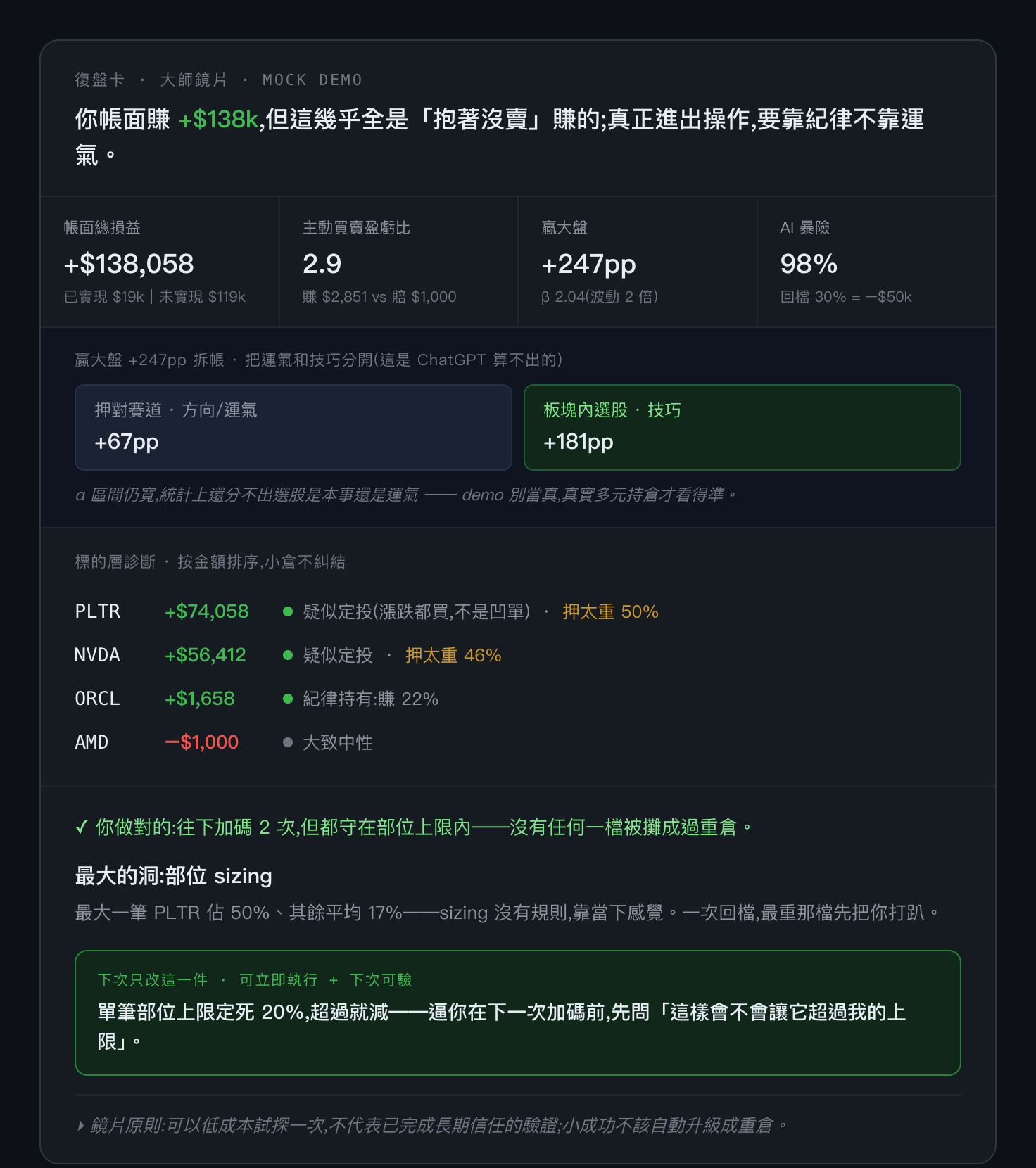
In real use, the engine also flags positions that are "large + being averaged down while underwater" and asks you, before the card is issued, "is this a dip-buy or refusing to cut a loser?" — the motive a machine can't tell apart, settled by your one sentence, is what lets the card reach a verdict.
⚠️ The mock's α numbers are distorted (too concentrated, too narrow a cross-section) — don't take them literally; real α needs a genuinely diversified book.
How it differs from "pasting your statement into ChatGPT"
ChatGPT can't compute the real FIFO-matched α/β, can't tell "DCA" from "averaging a loser," and has none of your history. This skill layers three passes:
- Mechanical layer (Python, deterministic) — computes what ChatGPT only estimates:
- 5-dimension behavioral diagnosis: position sizing / averaging down / exit / diversification / holding consistency
- Per-position diagnosis: every ticker ranked by dollar size (small lots not nitpicked), with a classifier splitting "likely DCA vs likely averaging-a-loser vs unclear"
- Return attribution: splits "beat the market" into "right sector (luck / direction)" vs "stock picking (skill)" — so you see whether the gains were edge or nerve
- Lens layer (a master's principles × dialogue) — the "why" a machine can't infer, asked before the card is issued:
- Thesis check: "MSTR — you kept adding and it's still down. Do you still believe the thesis, or just won't book the loss?"
- Motive: "You sold a winner early — was the thesis at target, or were you afraid of giving back the gain?"
- The engine picks the few positions worth asking about; your answer sets the read — the machine is always guessing, your one sentence decides
- Prescription layer — from "where you're leaking" to "what to do differently next time": amplify (scale your edge) / cut waste (a mechanical rule you can check next time)
→ It all converges into one card: one leak, one checkable rule for next time. Come back a second time and it first reconciles "did you keep that rule?"
🔒 Privacy: no backend upload, the author can't see it
- The skill runs your CSV on your own machine — no upload to any backend, no storage anywhere else, nothing written to any memory.
- The author can't see your trade detail. The only (voluntary) thing collected back is a single "was this card useful?" — no trade content — via the card feedback form, 30 seconds if you're willing.
.gitignoreis set so no.csvis ever committed, with only the mock/sample fixtures excepted.- Precisely: the only thing that reads your trades is the Claude you're already using — it has to read the CSV to review it for you, exactly like any other time you use Claude. That's a different thing from handing your statement to a SaaS that stores it, that you can't see into, that the author can query. (So it's not "never touches any server" — it's "not persisted, not sent to the author, not through a third party.")
📁 Where your coach memory lives / how to maintain it
On your second visit, the card first reconciles "did you keep last time's rule?" — backed by three local-only files (all under ~/.trade-coach/, never sent anywhere, never to the author):
cat ~/.trade-coach/log.jsonl       # one line per review (thin metrics + the rule you committed to); empty = first time
cat ~/.trade-coach/theses.jsonl    # per-position "why I hold + what would prove me wrong" (append-only, never overwritten)
cat ~/.trade-coach/profile.md      # your trading goals + 3 personal principles (the baseline each review compares against)
cat ~/.trade-coach/last_state.json # the thin state the engine last computed (per-position shares/cost, for reconciliation; overwritten each run)
- See past reviews →
cat ~/.trade-coach/log.jsonl. - Switch philosophy lens / reset the reconciliation baseline → delete or rename
~/.trade-coach/(deleting makes next time a fresh first visit). - Wrote a thesis wrong → edit
theses.jsonl; it's append-only, so a correction = append a new event (don't overwrite the old one — that's how you see, across time, how you first reasoned and how it later changed). - Privacy, self-verifiable: coach memory is just these files under
~/.trade-coach/, all on your machine; there isn't a single row on the author's side. - Want to preview the multi-week loop first (runs entirely in a temp directory, never touches your real
~/.trade-coach/) →python3 skills/fomo-kernel/engine/demo_weeks.py: slices the built-in mock into 3 time windows to simulate "first visit → reconcile → reconcile", so you can watch the second card cite last week's commitment andlog.jsonlgrow line by line.
💡 Want to share with a community? By default the card is the full private version only. Tell me "give me the shareable version" and it outputs a de-sensitized plain-text version (hides amounts / share counts / exact ratios, keeps only the behavior pattern + relative performance β / beat-the-market pp) — ready to paste to X / Threads.
Install
Prerequisite: this is a skill for Claude Code — Anthropic's terminal / desktop AI tool (needs a Claude subscription). If you haven't used it, spend 5 minutes to install and log in first, then come back for the three steps below.
Needs Python 3.11+. On recent macOS (Homebrew / system Python) a bare pip install is blocked by PEP 668 (externally-managed-environment); use a venv:
python3 -m venv .venv && source .venv/bin/activate
pip install -r requirements.txt                            # yfinance + pandas + rich
python3 -c "import yfinance, pandas, rich; print('ok')"    # verify: only 'ok' means it installed
Hook the skill into Claude Code (pick one):
ln -s "$(pwd)/skills/fomo-kernel" ~/.claude/skills/fomo-kernel   # A. symlink (recommended)
cp -r skills/fomo-kernel ~/.claude/skills/                         # B. copy (to hand to someone)
⚠️ If you installed via venv, Claude Code needs those dependencies on its path when it runs the engine: launch
claudefrom a terminal with the venv activated, or when the engine reportsModuleNotFoundError, swappython3for.venv/bin/python3and re-run (SKILL.md has this fallback built in).
Usage
Inside Claude Code:
/fomo-kernel ~/Downloads/my.csv   # review your own trades (a statement screenshot works too)
/fomo-kernel                      # no file → asks you for one, or a "test drive" through all four steps on built-in fake data (labeled as demo, nothing written to coach memory)
Your CSV can come from any broker — Claude reads and maps it into the columns the engine needs (Symbol / Action(BUY|SELL) / Quantity / Price / TradeDate); you don't hand-clean anything.
🏷️ For obscure tickers the engine's sector table doesn't recognize, Claude auto-generates a driver map for you to confirm (each tagged
[sector, theme]), so the "diversification" dimension doesn't count same-theme names as real diversification — you don't do this by hand, and don't let it fall back to thedriver map: 0 tickerscase (diversification goes off). Details in SKILL Step 0.5.
What happens: ① the engine runs the diagnosis → ② Claude asks you 1–3 thesis/motive questions in dialogue (dip-buy or averaging a loser?) → ③ with your answers, it issues one verdict card. Card layout is in card-template.html (a full four-layer HTML example).
Using it from other coding agents
You don't need Claude Code's skill system — the core engine is plain Python and depends on no agent machinery:
cd skills/fomo-kernel && python3 engine/trade_recap.py ~/Downloads/my.csv
If you use Codex / Cursor or another coding agent, point it at AGENTS.md and have it follow along — that file is the routing guide for non-Claude-Code agents, telling it how to run the engine, ask about motive, and issue the card.
Style samples (runnable — see how different styles surface different leaks)
mock/ holds 12 sample sets (3 retail-style baselines + 4 investor-persona extensions + 5 engine edge-case fixtures) plus mock_trades, all fictional, each triggering one archetypal leak or engine boundary. Four representatives below; the full twelve and their design intent are in mock/SAMPLES.md:
cd skills/fomo-kernel
TR_DRIVER_MAP=mock/sample_fundamental.driver_map.json python3 engine/trade_recap.py mock/sample_fundamental.csv
TR_DRIVER_MAP=mock/sample_momentum.driver_map.json    python3 engine/trade_recap.py mock/sample_momentum.csv
TR_DRIVER_MAP=mock/sample_value.driver_map.json       python3 engine/trade_recap.py mock/sample_value.csv
python3 engine/trade_recap.py                          # no args = mock_trades.csv
| sample | style | the leak it should surface |
|---|---|---|
sample_fundamental |
fundamental stock-picking | exit discipline (rides a winner 120 days then bails, holds a loser 378 days waiting to break even) |
sample_momentum |
chase-the-momentum | position all-in + fake diversification (mistaking beta for alpha) |
sample_value |
only-buy-cheap | averaging down (the lower it goes the more you add, averaging INTC into a single dominant position) |
mock_trades |
methodology-building phase | FOMO all-AI fake diversification + PLTR averaging down |
Four more investor-persona extensions (
sample_ai_holder/sample_oldecon/sample_swing/sample_day_trader— from an AI believer holding for a year and a half to a same-day in-and-out day trader) — how to run them and their design intent inmock/SAMPLES.md.
⚠️ The engine uses yfinance to pull real historical prices for α/β, market cap, and how far each position is underwater — so absolute numbers drift with the current share price on each rerun; but the headline leak each set is designed to trigger is stable (it's set by the trading behavior, not by any particular price).
Layout
skills/fomo-kernel/
  SKILL.md                  ← the skill itself (four-step flow: format → engine → pre-card confirm → verdict card)
  card-spec.md              ← Step 3 card spec (blocklist / redact / narrative rules; read only after Step 2 questions)
  engine/trade_recap.py     ← mechanical layer: 5-dim + per-position DCA/loser classifier + attribution (pure functions, no real paths)
  rubric/
    vincent-yu.md           ← the default lens's principle distillation (each cited to source; swappable for another master)
    vincent-yu.lens.json    ← the lens's "swappable master layer": rules / quotes / motive prompts (swap master = swap this file)
  behavior-diagnosis.md     ← diagnostic philosophy: on the act not the person, multi-label behavior (the "why" design record)
  card-template.html        ← review-card HTML layout example
  mock/                     ← 12 sample sets + mock_trades + each one's driver map + SAMPLES.md
Disclaimer
The default lens is a principle distillation from one investor's public writing (sources cited line-by-line in rubric/) — quoted, not reproduced, and not endorsed by that person; the lens is swappable, with more to come.
This tool is positioned as research / coaching support; all output is trade-behavior review and discipline suggestions only — not investment advice, and no buy/sell recommendation on any instrument; final investment decisions and outcomes are your own.
The code is licensed under the MIT License; the lens content in rubric/ is principle quotation with sources cited line-by-line, and is not relicensed under MIT.
Reviews (0)
Sign in to leave a review.
Leave a reviewNo results found