oauthlint
Health Uyari
- License — License: MIT
- Description — Repository has a description
- Active repo — Last push 0 days ago
- Low visibility — Only 6 GitHub stars
Code Gecti
- Code scan — Scanned 12 files during light audit, no dangerous patterns found
Permissions Gecti
- Permissions — No dangerous permissions requested
Bu listing icin henuz AI raporu yok.
Catch the OAuth, OIDC, JWT & MCP security bugs AI coding assistants ship on repeat, across ten languages (JavaScript, Python, Go, C#, and more). A free, low-false-positive linter for your CLI, CI, and editors.
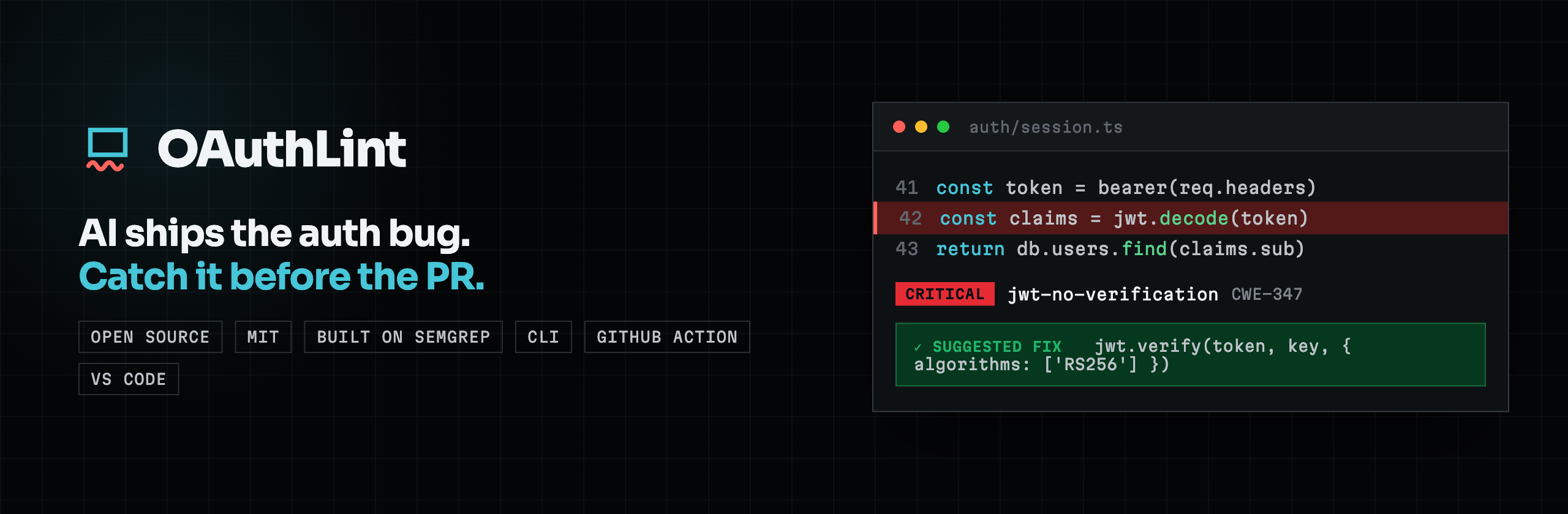
Catch the OAuth / OIDC / JWT / MCP / session / CORS anti-patterns AI coding tools systematically produce.
A static-analysis linter with a curated, auth-only rule pack and dataflow (taint) analysis (JS/TS · Python · Go · Rust · Java · C#/.NET · PHP · Ruby · Kotlin, and growing) · CLI + GitHub Action + VS Code extension · free & MIT licensed








npx oauthlint scan ./src
Self-contained: nothing to install and no config. The CLI bundles the rule pack and, on first run, downloads and checksum-verifies a small pinned scan engine (~41 MB, one time, cached). It reuses an installed
opengreporsemgrepif one is on yourPATH; override it withOAUTHLINT_ENGINEor--engine.
📖 Full documentation & rule catalogue: oauthlint.dev · 🔬 the empirical case for it: oauthlint.dev/research
What it is
AI coding assistants (tools like GitHub Copilot, Cursor, and Claude Code, and others) ship the same OAuth/JWT bugs across every project they touch:
- JWT verified with
alg: noneaccepted client_secrethard-coded in sourceredirect_uriwhitelisted with*wildcards- token written to
localStorage(XSS-readable) - OAuth flow without
state/ without PKCE /loginPOST without rate limiting- password persisted in plaintext
Math.random()used for CSRF tokens- untrusted input flowing into a redirect or an outbound request (open-redirect / SSRF), caught by dataflow (taint) analysis rather than plain pattern-matching
- MCP server auth: token pass-through (confused deputy), missing RFC 8707 audience/resource binding, unauthenticated MCP transports, and SSRF from tool-handler arguments, for the official TypeScript and Python MCP SDKs
- …and many more: 280+ rules across eleven languages (JavaScript, TypeScript, Python, Go, C#, and more), including mobile auth (Swift/iOS, Android) and framework-aware coverage (ASP.NET Core, Gin/Echo/Fiber, Hono + better-auth, FastAPI, Django/Flask, Ktor, Spring Security, Laravel/Socialite, Rails/Devise/OmniAuth/Doorkeeper, NextAuth/Passport, Express/Fastify/NestJS, MCP, and more)
oauthlint sits between generic SAST (Snyk, Semgrep) and enterprise IAM ($50K+/year): free, focused, and built for the developer who has to fix the finding. Every finding links to a page explaining why it matters and how to fix it.
Why OAuthLint?
Honest answer: nothing stops you from writing these rules yourself. Semgrep is open source, it's the engine we run, and a capable engineer could reproduce a lot of this. We don't have a technical moat, and we won't pretend otherwise.
What we have is the work most people never do:
- Low false positives, validated against real auth libraries. We run the rules against
jose, NextAuth, PyJWT, Authlib,golang/oauth2,oauth2-rs, Spring and more. Anything that fires on mature library source goes to a triage queue, not to you. Tuning a rule so it doesn't trip onjose's internals is the tedious, invisible work the generic Semgrep registry skips. (See the validation report: thousands of files of real auth-library source, zero false positives on the clean libraries.) - One coherent product across every language it covers. Same concept, same ID scheme, same docs.
AUTH-JWT-001in JS maps toAUTH-GO-JWT-001in Go, instead of a patchwork of community rules with mismatched styles. - Every finding teaches. Every rule links to a fix page with CWE and OWASP mappings, so a finding is a lesson rather than a grep hit.
- Dataflow, not only patterns. Taint-mode rules trace untrusted input through to dangerous sinks (open-redirect, SSRF), catching bugs a single-line pattern would miss.
- The angle the registry doesn't have. OAuthLint targets the OAuth/JWT bugs AI coding tools ship on repeat. Each rule encodes that in its
llm-prevalencemetadata, and the empirical /research report measures it.
Use OAuthLint when you'd rather not write and maintain an auth rule pack yourself. That's the whole pitch.
What it looks like
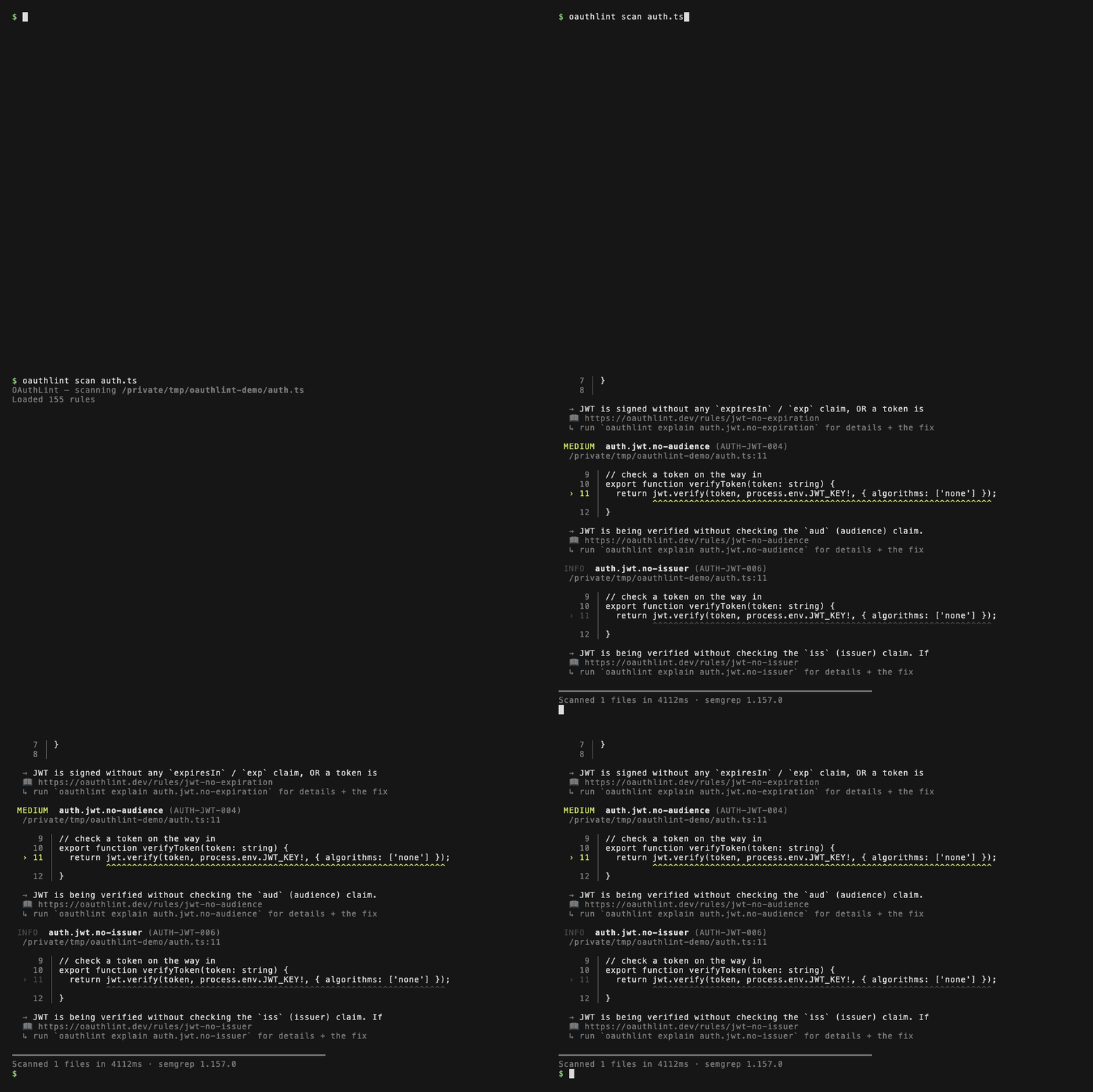
Every finding names the rule, the exact file and line, why it is dangerous, and
a link to the fix.
Quick start
CLI
# one-shot scan, no install
npx oauthlint scan ./src

# fail CI on HIGH severity and above
npx oauthlint scan ./src --fail-on HIGH

# machine-readable output
npx oauthlint scan ./src --json

# GitHub Code Scanning
npx oauthlint scan ./src --format sarif > oauthlint.sarif

# a shareable, self-contained HTML audit report
npx oauthlint scan ./src --format html > report.html

# auto-apply safe fixes (e.g. cookie flags); preview them first with --fix-dry-run
npx oauthlint scan ./src --fix-dry-run
npx oauthlint scan ./src --fix

# incremental: scan only what changed (fast; great for pre-commit hooks)
npx oauthlint scan --diff       # vs the default branch
npx oauthlint scan --staged     # only git-staged files

# adopt on an existing codebase: snapshot today's findings, then alert on NEW ones only
npx oauthlint baseline ./src
npx oauthlint scan ./src --baseline --fail-on HIGH
Other commands: oauthlint list (browse rules), oauthlint explain <rule-id> (read a rule's why and fix in your terminal), oauthlint init (write a config), oauthlint doctor (check your setup).
GitHub Action
- uses: OAuthLint/oauthlint@v1
  with:
    severity: HIGH
    fail-on: HIGH
The Action is Docker-based, so it runs in any repository's CI regardless of the project's language. OAuthLint/oauthlint@v1 is the GitHub Marketplace entrypoint; the original OAuthLint/oauthlint/action@v1 subpath still works and behaves identically. The SARIF output (--format sarif) uploads to GitHub Code Scanning, and there's a recipe for GitLab CI too.
VS Code, Cursor, Windsurf, and other VS Code forks
Install oauthlint from the VS Code Marketplace (or OpenVSX for Cursor, Windsurf, and other VS Code forks and agentic editors) for inline diagnostics on save, a status-bar finding count, an "Apply fix" Quick Fix where a rule ships a safe autofix, and Quick Fix suppressions. The extension is self-contained: the rule pack and scan engine come with it, so there is no CLI or Semgrep to install.
MCP server (scan AI-generated code in-loop)
oauthlint-mcp is an MCP server that hands the rule pack to AI coding tools (Claude Code, Cursor, Windsurf, and others) so they can scan the OAuth code they just wrote, in the same loop that produced it. The bug gets caught before it reaches your diff.
// add to your tool's MCP config
{
  "mcpServers": {
    "oauthlint": { "command": "npx", "args": ["oauthlint-mcp"] }
  }
}
The oauthlint-mcp package is on npm, so npx oauthlint-mcp runs it with no install. Setup for each tool is at oauthlint.dev/docs/mcp.
Use directly with Semgrep
Already have Semgrep? Run the full pack with one command, no install and no config file:
semgrep --config https://oauthlint.dev/r/oauthlint.yaml ./src
Per-language bundles are available too (e.g. oauthlint-python.yaml, oauthlint-go.yaml). The hosted config is always the latest pack; for a pinned ruleset, use the oauthlint CLI / oauthlint-rules on npm. See the Semgrep docs.
Inline suppression
// oauthlint-disable-next-line auth.jwt.alg-none -- legacy code, replaced in Q2
return jwt.verify(token, key, { algorithms: ['RS256', 'none'] });
Wholesale silencing (oauthlint-disable-file *) is intentionally unsupported. The next reviewer needs to see exactly which lines opted out.
Rules
280+ rules across OAuth 2.0, OIDC, JWT, cookies, CORS, secrets, session hygiene and MCP server auth, spanning eleven languages from JavaScript and Python to Go, C#, and Kotlin, plus mobile auth (Swift/iOS, Android), with framework-aware coverage (ASP.NET Core, Laravel, Rails, Ktor, and more). Each is mapped to CWE and OWASP and has a documentation page. Some are taint-mode dataflow rules that follow untrusted input to its sink rather than matching a single line: an OAuth credential reaching a log sink, request input reaching a JWT verification key, or a value flowing into a redirect or outbound request (open-redirect, SSRF). SSRF coverage now spans JS/TS, Python, Go, Java (Spring) and Rust (reqwest), and a dedicated rule catches Authorization: Basic credentials written to logs. A dedicated MCP rule pack catches the OAuth 2.1 resource-server mistakes MCP servers ship (token pass-through, missing RFC 8707 audience binding, unauthenticated transports, tool-handler SSRF) for the official TypeScript (@modelcontextprotocol/sdk) and Python (mcp / FastMCP) SDKs. The catalogue grows with every release.
👉 Browse the full catalogue at oauthlint.dev/rules.
Language support
oauthlint is built on Semgrep, whose engine is language-agnostic. The rules are plain YAML data, so adding a language means writing rule packs, not re-architecting anything.
| Language | Status |
|---|---|
| JavaScript / TypeScript | ✅ shipping |
| Python (PyJWT, requests, Flask, Django) | ✅ shipping |
| Go (golang-jwt, crypto/tls, net/http) | ✅ shipping |
| Rust (jsonwebtoken, reqwest, actix/tower) | ✅ shipping |
| Java (Spring Security, jjwt, nimbus-jose-jwt) | ✅ shipping |
| C#/.NET (ASP.NET Core, Microsoft.IdentityModel JWT) | ✅ shipping |
| PHP (Laravel, Socialite, firebase/php-jwt) | ✅ shipping |
| Ruby (Rails, Devise, OmniAuth, Doorkeeper) | ✅ shipping |
| Kotlin (Ktor, java-jwt, nimbus-jose-jwt) | ✅ shipping |
| Swift (iOS, Vapor) | ✅ shipping |
| Android (Kotlin, manifest/config XML) | ✅ shipping |
| IaC / config auth (Terraform, GitHub Actions YAML, AWS IAM JSON) | ✅ shipping |
| More (open an issue to request your stack) | 🔜 planned |
Why JS/TS first? That's where AI coding tools generate the most code, and so the most OAuth/JWT bugs. It's the densest place to start, not the ceiling. Want your stack covered? Open an issue.
What's in this repo
| Package | What it does |
|---|---|
rules/ |
Semgrep rules (JS/TS · Python · Go · Rust · Java · C#/.NET · PHP · Ruby · Kotlin · Swift · Android), schema-validated, with vulnerable + safe fixtures |
cli/ |
scan (incremental --diff / --staged), baseline, list, init, doctor, with pretty + JSON + SARIF + HTML output |
action/ |
Docker-based GitHub Action wrapping the CLI, with inline PR annotations + job summary |
vscode/ |
Editor extension for VS Code, Cursor, Windsurf, and other VS Code forks (Marketplace + OpenVSX): diagnostics, status bar + Quick Fix suppressions |
mcp/ |
oauthlint-mcp, an MCP server that lets AI coding tools scan the OAuth code they generate, in-loop (docs) |
examples/ |
Deliberately-vulnerable demo apps used for dogfooding |
Develop
pnpm install
pnpm test:run     # full suite: rule pack + CLI + Action + VS Code + scripts
pnpm lint
pnpm build
pnpm typecheck
The website, rule catalogue and documentation live in a separate repository,
OAuthLint/web (served at oauthlint.dev), and
are generated from this rule pack.
Adding a rule: drop a YAML file in rules/rules/<category>/, add vulnerable.ts + safe.ts fixtures, and the schema-driven tests pick it up automatically. The website (OAuthLint/web) generates its rule pages straight from this rule pack, so no separate docs-refresh step is needed.
Commits & releases
- Conventional Commits are enforced (
feat:,fix:,docs:,chore:, …) via acommit-msghook. - Git hooks (husky):
pre-commitruns Biome on staged files;pre-pushruns typecheck + the full test suite. - Releases use Changesets; see RELEASE.md.
Roadmap
Where OAuthLint stands, and where it is going. Want to help with any of it? See
Contributing below; false-positive reports and new rules are
especially welcome.
Shipped
- 280+ rules across eleven languages (JavaScript, TypeScript, Python, Go, C#, and more), including mobile auth (Swift/iOS, Android), a dedicated MCP server-auth pack, and framework-aware packs (ASP.NET Core, Gin/Echo/Fiber, Hono + better-auth, FastAPI, Django/Flask, Ktor, Spring Security, Laravel/Socialite, Rails/Devise/OmniAuth/Doorkeeper, NextAuth/Passport, Express/Fastify/NestJS)
- Autofix with a dry-run preview, plus dataflow (taint) analysis
- SARIF output and GitHub code scanning, a GitHub Action, and GitLab CI
- VS Code extension, also on Open VSX for Cursor, Windsurf, and similar editors
- JetBrains IDE plugin (IntelliJ, WebStorm, PyCharm, GoLand, and more) on the JetBrains Marketplace
- MCP server, so AI coding tools scan the auth code they generate, in-loop
oauthlint probe, a live OAuth 2.1 conformance check for running MCP servers- Shareable HTML reports
- A guide for writing your own low-false-positive rules (docs)
Now
- Deeper framework-aware coverage across the stacks already supported,
tuned for high signal and low false positives - Closing rule-parity gaps across the eleven supported languages
Next
- A reproducible "auth and AI" benchmark: which OAuth/JWT anti-patterns each AI
coding tool actually produces - More integrations: Azure and Bitbucket pipelines
- Wider autofix coverage, so more findings ship a safe one-click rewrite
Exploring
- Interprocedural dataflow for deeper taint tracking
- A hosted MCP endpoint for cloud-based agents
Contributing
The most useful contribution is telling us when a rule is wrong: open a
false-positive issue.
Want a new anti-pattern caught, or want to write the rule yourself? See
CONTRIBUTING.md. A rule is one YAML file plus avulnerable.ts / safe.ts fixture pair. By participating you agree to the
Code of Conduct.
License
Yorumlar (0)
Yorum birakmak icin giris yap.
Yorum birakSonuc bulunamadi