openvidia
Health Warn
- License — License: MIT
- Description — Repository has a description
- Active repo — Last push 0 days ago
- Low visibility — Only 5 GitHub stars
Code Fail
- rm -rf — Recursive force deletion command in .github/workflows/ci.yml
Permissions Pass
- Permissions — No dangerous permissions requested
No AI report is available for this listing yet.
Multi-key proxy for NVIDIA NIM with a native desktop dashboard — auto-rotation, cooldown, RPM limiting, Claude Code + Codex CLI + opencode support. Free-tier keys pooled behind one endpoint.
OpenVidia






Multi-key proxy for NVIDIA NIM with a native desktop dashboard.
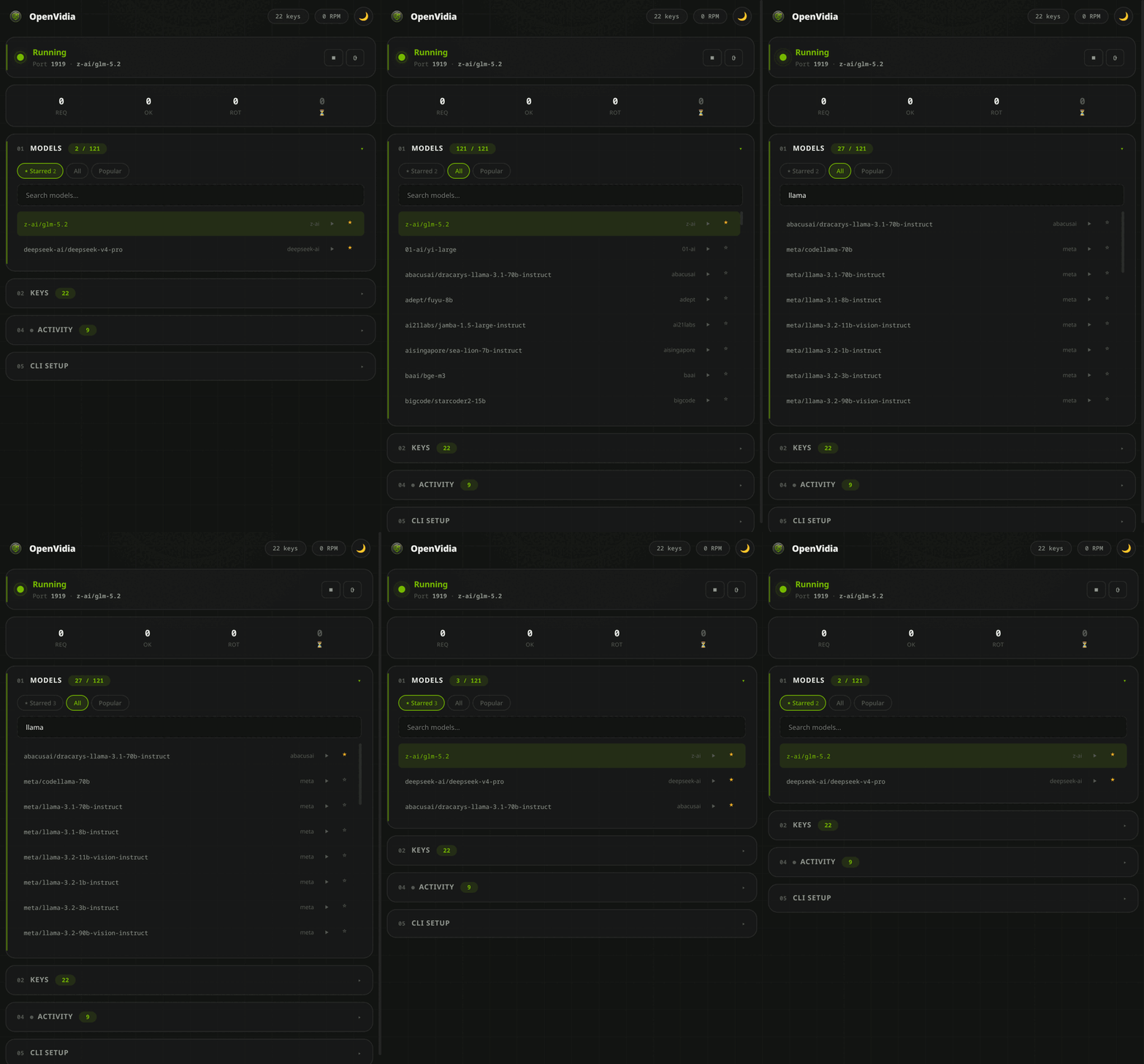
Pool multiple free-tier API keys behind one endpoint. Automatic rotation, per-key cooldown, sliding-window RPM limiting, and a compact desktop app — no browser needed.
Built for opencode, Codex CLI, Claude Code, Grok, Jcode, and any OpenAI-compatible client.
Quick Start
Linux (Arch / Ubuntu / Fedora)
git clone https://github.com/ciroautuori/openvidia.git
cd openvidia
./install.sh
Or manually:
# Install uv (recommended) — https://astral.sh/uv
curl -LsSf https://astral.sh/uv/install.sh | sh

uv sync                          # install dependencies
uv run openvidia setup           # auto-configure opencode
uv run openvidia                 # start proxy + desktop app
With pip:
pip install -e .
openvidia setup
openvidia
macOS
brew install [email protected] pygobject pkg-config
git clone https://github.com/ciroautuori/openvidia.git
cd openvidia
pip install -e .
openvidia setup
openvidia
pywebview on macOS uses system WebKit (native, no extra deps).
If you hit a GTK build error, installpygobjectvia Homebrew or just skip it — macOS doesn't need it.
Windows
git clone https://github.com/ciroautuori/openvidia.git
cd openvidia
pip install -e .
openvidia setup
openvidia
pywebview on Windows uses EdgeChromium (WebView2, pre-installed on Windows 10/11).
If WebView2 is missing, install it from Microsoft.
How It Works
┌─────────────────────────────────────────────────────────────┐
│                     OpenVidia (:1919)                       │
│                                                             │
│  ┌─────────────────────────────────────────────────────┐    │
│  │               Desktop App (pywebview)               │    │
│  │  310×570 native window — Keys, Presets, Models,     │    │
│  │  Activity log, CLI setup — all in one panel         │    │
│  └─────────────────────────────────────────────────────┘    │
│                          │                                  │
│  ┌─────────────────────────────────────────────────────┐    │
│  │               Proxy Engine (:1919/v1)               │    │
│  │                                                     │    │
│  │  Request → override model → pick key → forward      │    │
│  │            ↑                ↑           ↑           │    │
│  │            │            cooldown?   RPM < 28?       │    │
│  │            │            skip if yes  skip if no     │    │
│  │            │                                        │    │
│  │  On 429: read Retry-After → set cooldown → next key │    │
│  │  On 401/403: cooldown 3600s (dead key)              │    │
│  │  On 400/404: cooldown 60s (deterministic)           │    │
│  │  On 504: cooldown 30s (model bottleneck, not key)   │    │
│  │  On 5xx: cooldown 10s (gateway) / 30s (other)       │    │
│  │  On network error: no cooldown, 0.5s pause          │    │
│  │  3 consecutive network errors → stop (network down) │    │
│  └─────────────────────────────────────────────────────┘    │
│                          │                                  │
│                   NVIDIA NIM API                            │
│            integrate.api.nvidia.com/v1                      │
└─────────────────────────────────────────────────────────────┘
Why?
NVIDIA's free NIM tier limits each API key to ~40 RPM. Aggressive bursts trigger a penalty box that can lock keys for hours. OpenVidia:
- Pools multiple keys behind a single endpoint
- Rotates automatically on 429/401/403/5xx — zero manual intervention
- Per-key cooldown timers — on real 429s, trusts
Retry-Afterexactly (no multiplication); distinguishes transient worker saturation (ResourceExhausted) from true RPM limits and never burns key cooldowns for the former - Network-error circuit breaker —
ConnectTimeout/ConnectErrordon't trigger key cooldown (the key is fine). After 3 consecutive network errors across different keys, rotation stops entirely and returns 503 (the network is down, no key can help) - 504 model timeouts don't burn keys — gateway timeouts cool the key for 30s but don't consume the attempt budget, since the model (not the key) is the bottleneck
- Sliding-window RPM limiting — keeps each key under 28 RPM (safe margin below 40); the ceiling self-tunes down from real
Retry-Afterheaders, so the pool never spends its full budget against a tighter upstream limit - Health checks — revives keys whose cooldowns have expired, but skips 401/403 invalid keys (dead keys stay dead)
- No silent model substitution — the model you select is the model that answers; if it fails on every key you are told so, never handed output from a different model
- Auto-compaction — summarizes long histories so requests never fail on context overflow (details)
- Per-key × per-model scoring — rotation is ordered by a composite score (success rate + median time to first token) learned per key and per model from live traffic: the best key for the requested model goes first
- Multi-endpoint routing — extra NVIDIA endpoints (
endpoints.jsonorOPENVIDIA_UPSTREAM_ENDPOINTS), a 60s blacklist on ≥500 errors, automatic recovery - Multi-node sync via Redis (opt-in) — cooldowns, invalid keys, pool throttling and model circuit breakers shared across instances (details)
- Embedding cache —
/v1/embeddingshits are served from memory (TTL 300s) without touching upstream quota - Free-tier provider fallback — when every NVIDIA key is exhausted, requests fail over to OpenAI-compatible providers declared in
providers.json(details) - Graph engine — programmatic multi-agent orchestration (Hub, run_agent, generator-verifier loops) on top of the proxy (details)
CLI Commands
| Command | Description |
|---|---|
openvidia |
Start proxy in background + open desktop app |
openvidia foreground |
Foreground mode (logs to stdout, no UI) |
openvidia setup |
Auto-configure detected CLIs: opencode, Codex, Grok (Claude Code requires manual env vars) |
CLI Setup Guides
TL;DR — run
openvidia setuponce. It auto-detects and configures every CLI you have installed. You only need to read the manual steps below if something doesn't work or you prefer to configure things yourself.
Supported clients:
| CLI | Protocol | Endpoint | Auto-setup |
|---|---|---|---|
| opencode | OpenAI-compatible | http://localhost:1919/v1 |
✅ openvidia setup |
| Codex CLI | OpenAI Responses API | http://localhost:1919/v1 |
✅ openvidia setup |
| Claude Code | Anthropic Messages API | http://localhost:1919 |
❌ manual env vars |
| Grok (xAI) | OpenAI-compatible | http://localhost:1919/v1 |
✅ openvidia setup |
| Jcode | OpenAI-compatible | http://localhost:1919/v1 |
✅ openvidia setup |
opencode
openvidia setup    # configures provider + model + compaction + instructions
opencode           # then /model openvidia
Manual (if setup didn't find it):
# ~/.config/opencode/opencode.json
{
  "provider": {
    "openvidia": {
      "npm": "@ai-sdk/openai-compatible",
      "options": { "apiKey": "ignored", "baseURL": "http://localhost:1919/v1" },
      "models": { "openvidia": { "name": "OpenVidia", "tools": true } }
    }
  },
  "model": "openvidia/openvidia"
}
Codex CLI
openvidia setup    # writes ~/.codex/config.toml automatically
codex --model openvidia
Manual (if setup didn't find it):
# ~/.codex/config.toml
model = "openvidia"
model_provider = "openvidia"

[model_providers.openvidia]
name = "OpenVidia"
base_url = "http://localhost:1919/v1"
env_key = "OPENVIDIA_API_KEY"
wire_api = "responses"
export OPENVIDIA_API_KEY=ignored # also added automatically by setup
Claude Code
# Add to ~/.zshrc or ~/.bashrc manually (auto-setup is disabled)
export ANTHROPIC_BASE_URL=http://localhost:1919
export ANTHROPIC_API_KEY=ignored
source ~/.zshrc    # (or restart your terminal)
claude --model openvidia
Auto-setup for Claude Code is intentionally disabled to avoid mutating shell rc files. Set the two environment variables manually as shown above.
The
/v1/messagesendpoint translates Anthropic Messages format ↔ NVIDIA chat/completions bidirectionally — streaming, tool use, and system prompts all work.Images: NVIDIA NIM models are text-only. Image blocks (e.g. screenshots) are replaced with
[image omitted: model has no vision]so the model stays aware of the context and logs a warning in the Activity panel.
Grok (xAI)
openvidia setup    # writes ~/.grok/config.toml automatically
grok -m openvidia
Manual (if setup didn't find ~/.grok/):
# ~/.grok/config.toml
[models]
default = "openvidia"

[model.openvidia]
api_key = "ignored"
base_url = "http://localhost:1919/v1"
api_backend = "chat_completions"
context_window = 128000
Jcode
openvidia setup    # writes ~/.jcode/config.toml automatically
jcode               # then /model openvidia to switch
Manual (if setup didn't find ~/.jcode/):
# ~/.jcode/config.toml

[provider]
default_provider = "openvidia"
default_model = "openvidia"

[providers.openvidia]
type = "openai-compatible"
base_url = "http://localhost:1919/v1"
auth = "none"
default_model = "openvidia"
requires_api_key = false
model_catalog = true
stream_idle_timeout_secs = 300

[[providers.openvidia.models]]
id = "openvidia"
context_window = 202752
openvidia setupadds the[providers.openvidia]block and sets it as default — but only when no provider is configured yet. If you already use another provider, it leaves your choice alone and you can switch with/model openvidiainside Jcode.Jcode is an open-source coding agent: github.com/1jehuang/jcode
Any OpenAI-compatible client
from openai import OpenAI

client = OpenAI(base_url="http://localhost:1919/v1", api_key="ignored")
response = client.chat.completions.create(
    model="openvidia",
    messages=[{"role": "user", "content": "Hello!"}]
)
curl http://localhost:1919/v1/chat/completions \
  -H "Content-Type: application/json" \
  -H "Authorization: Bearer ignored" \
  -d '{"model":"openvidia","messages":[{"role":"user","content":"Hello!"}]}'
Streaming (SSE) is fully supported — tokens flow through unbuffered.
Smart Rate Limiting
Per-Key Cooldown
| HTTP Status | Cooldown | Reason |
|---|---|---|
| 429 (real RPM limit) | Retry-After header (trusted as-is, no multiplication), or 45s + jitter |
Rate limited — honour NVIDIA's own window exactly |
| 429 (worker concurrency) | 0 — retried after 0.8s pause | ResourceExhausted: Worker local total request limit reached — transient pool saturation, key is healthy |
| 401 / 403 | 3600s | Dead key — don't waste requests |
| 400 / 404 | 60s | Deterministic request error — short cooldown, key untouched for rotation. Every key gets the same error, so rotating only burns cooldown budget. |
| 504 (gateway timeout) | 30s | Model is the bottleneck, not the key — longer cooldown, but doesn't burn the attempt budget |
| 5xx (other) | 10s (502/503) / 30s (500) | Server error — retry soon |
| Network error (ConnectTimeout/ConnectError) | 0 — 0.5s pause, no cooldown | Network is down, not the key. After 3 consecutive errors across different keys, rotation stops entirely (503). |
Retry-After is used as-is. When NVIDIA provides a
Retry-Afterheader (e.g. 60s), the cooldown is exactly that value. Earlier versions multiplied it by an adaptive factor (1.5^N), which caused a doom loop: at 3 failures a 60s backoff became 135s and all 26 keys locked out longer than the real rate-limit window required.When no
Retry-Afteris provided the proxy uses 45s + random jitter (≤10s). Repeated failures get a flat 1.5× multiplier from the second failure onward (no exponential scaling — capped at ~65s max).
Sliding-Window RPM
Each key tracks requests in a rolling 60-second window. If a key has sent 28+ requests in the last 60s, it is skipped. Only if all keys are simultaneously RPM-saturated or on cooldown does the proxy return 429 to the client.
Key Rotation Flow
Request arrives
    │
    ├─ For each candidate key (ordered least-loaded first):
    │   ├─ Key on cooldown?  → skip (including keys cooled mid-pass)
    │   ├─ Key RPM ≥ 28?    → skip
    │   ├─ Send to NVIDIA   → 200? ✅ record RPM, return response
    │   │                   → 400/404? set 60s cooldown, next key
    │   │                   → 429 ResourceExhausted? pause 0.8s, retry (key untouched)
    │   │                   → 429 rate-limit? use Retry-After as-is, set cooldown, next key
    │   │                   → 401/403? set 3600s cooldown, next key
    │   │                   → 504? set 30s cooldown, next key (doesn't burn attempt budget)
    │   │                   → 5xx? set 10s (502/503) or 30s (500), next key
    │   │                   → network error? 0.5s pause, key untouched (3 consecutive → stop)
    │   └─ (max 5 sends per pass, 3 passes with 1s pause between)
    │
    └─ All candidates exhausted? → 503 naming the model (never a substitute model)
Health Check
Every 60 seconds:
- Finds keys still on cooldown (skips 401/403 invalid keys — they're dead, not temporarily rate-limited)
- Sends a lightweight
GET /v1/modelsprobe - If the key responds OK — clears the cooldown (revived)
- If still failing — leaves the cooldown in place
Auto-Compaction
Long conversations eventually exceed the model's context window. Without handling, the upstream returns a 400, and — since that error is identical on every key — a naive proxy would burn through the whole pool before dying. OpenVidia never blocks on context overflow.
Before forwarding a request, if the estimated history exceeds a token budget, OpenVidia compacts it:
history > budget?
    │
    ├─ Cached summary still fits?
    │      └─ Serve summary + EVERY later message verbatim.  ← steady state,
    │         zero upstream calls. The summary boundary only moves when this
    │         no longer fits, so you pay for a summarize once every N turns.
    │
    ├─ Boundary must advance → summarize the oldest slice on top of the
    │      previous summary (incremental — never the whole history again).
    │      The verbatim tail is sized to FILL the remaining budget.
    │
    └─ Summary not ready before `inline_deadline`?
           └─ Serve now (cached summary + verbatim remainder, or a
              deterministic trim) while the summarize keeps running
              detached and lands in the cache for the next turn.
- Never blocks the client — the request waits at most
inline_deadlineseconds, regardless of how slow the upstream is. Compaction latency is bounded by config, not by the provider. - Works for every client — hooks
/v1/chat/completions(opencode / Codex),/v1/responses, and the/v1/messagesAnthropic shim (Claude Code). - Cheap — the steady state costs zero extra calls; only genuinely new content is ever summarized, and concurrent requests on the same conversation share a single summarize.
- Safe — every fallback is bounded, so a request goes through even with the whole key pool rate-limited.
Watch it in the Activity log: ⧉ compaction: summarized N new msg (covers M) → ….
Tuning
Set
model_budgetsfirst. The generic default (80k) is deliberately conservative because NVIDIA NIM does not advertise a context window on/v1/models. If your model accepts more, compaction at 80k throws away context you paid nothing for. To find the real number, send an oversized request — the400states it exactly:This model's maximum context length is 202752 tokens. However, your messages resulted in 320011 tokens.
Optional — create ~/.config/openvidia/compaction.json (built-in defaults shown):
{
"enabled": true,
"budget_tokens": 80000,
"model_budgets": { "your-provider/your-model": 160000 },
"reserved_tokens": 8000,
"compact_ratio": 0.6,
"keep_recent": 8,
"summary_model": "",
"summary_max_tokens": 1024,
"inline_deadline": 6.0,
"summarize_timeout": 45.0
}
| Field | Meaning |
|---|---|
enabled |
Turn compaction on/off |
budget_tokens |
Generic trigger for any model without an explicit budget |
model_budgets |
Per-model context window. The one setting worth tuning — leave ~20% headroom, the estimator is a ~4 chars/token approximation |
reserved_tokens |
Generation headroom subtracted from the budget |
compact_ratio |
Compact down to this fraction of the budget. Landing exactly on the threshold re-triggers compaction on the very next turn |
keep_recent |
Floor for the trim fallback. On the summary path the verbatim tail is sized to fill the budget instead |
summary_model |
Model used to summarize. Point it at a fast model: it runs on a different traffic stream than the one your agent is saturating. Empty = the default model |
summary_max_tokens |
Cap on the generated summary length |
inline_deadline |
Seconds the client request will wait for a summary before being served from the fallback ladder |
summarize_timeout |
Upstream cap for the summarize call itself, which continues in the background past the deadline |
Desktop App
Native window via pywebview. Opens at 310×570 px — a compact utility panel, like a phone in portrait. Resize freely.
| Backend | Platform | Engine |
|---|---|---|
| Qt WebEngine | Linux (KDE/Wayland) | PyQt6-WebEngine (native, best experience) |
| GTK WebKit | Linux (GNOME/X11) | PyGObject + WebKitGTK |
| WebKit | macOS | system WebKit (no extra deps) |
| EdgeChromium | Windows | WebView2 (pre-installed on Win 10/11) |
pywebview auto-detects the best available backend.
Linux desktop integration
# .desktop file (auto-installed by install.sh)
cp openvidia.desktop ~/.local/share/applications/
# Icon
cp openvidia/web/assets/logo.png ~/.local/share/icons/hicolor/256x256/apps/openvidia.png
update-desktop-database ~/.local/share/applications/
Dashboard Sections
| Section | Features |
|---|---|
| Status | Proxy state, active model, start/stop/restart controls |
| Stats | Request count, success rate, rotations, cooldown counter |
| Keys | Per-key status (Active filter default), live cooldown countdown, RPM, success/fail, freshness dots, add/remove/copy |
| Models | Single list — filters: ★ Starred (default; your quick-switch shortlist) · All · Popular. Search, test ▶, star/unstar. Active model highlighted and pinned to top. |
| Thinking | auto / on / off next to the active model — a hybrid reasoning model emits nothing while it thinks |
| Activity | Real-time SSE log stream with color-coded levels |
| CLI Setup | Copy-paste config for opencode / Codex / Claude / Grok |
Key Status Indicators
| Indicator | Meaning |
|---|---|
| 🟢 Green | Key healthy, has successful requests |
| 🟡 Amber | Key has failures but not on cooldown |
| ⚪ Gray | Key idle (no requests yet) |
| 🔴 Red + ⏳ | Key on cooldown — shows countdown + reason |
active badge |
Currently selected key in rotation |
Configuration
Config directory
| Platform | Path |
|---|---|
| Linux | ~/.config/openvidia/ |
| macOS | ~/Library/Application Support/openvidia/ |
| Windows | %APPDATA%\openvidia\ |
Config files
| File | Purpose |
|---|---|
keys.json |
API keys (JSON array) |
presets.json |
★ Starred models — quick-switch shortlist |
active_model |
Currently active model (persists across restarts) |
index |
Key rotation index |
compaction.json |
Auto-compaction tuning (optional — see Auto-Compaction) |
timeouts.json |
Upstream timeouts (optional — see Slow models) |
model_limits.json |
Context windows the proxy learned by itself — never edit by hand |
model_options.json |
Reasoning toggle + the payload used to express it (see Thinking) |
endpoints.json |
Extra NVIDIA upstream endpoints (optional — see Resilience & Scale) |
redis_config.json |
Redis URL for multi-node sync (optional — OPENVIDIA_REDIS_URL also works) |
providers.json |
Free-tier fallback providers (optional — name, base URL, env var for the key, model map) |
Add keys via the dashboard (Keys section) or edit keys.json:
["nvapi-xxx", "nvapi-yyy", "..."]
Thinking (reasoning toggle)
A hybrid reasoning model emits nothing at all while it thinks. That is the
whole difference between a 2-second and a 160-second first token, and it is
not something you can see from the outside — the socket just sits there.
Three buttons next to the active model in the dashboard: auto (send nothing,
let the model decide), on, off. The setting is per-model and stored
server-side, so all four CLIs pick it up without touching their own configs.
The parameter name is configuration, not code. Providers spell this flag
differently and rename it every model generation, so model_options.json
carries the payload to merge:
{
"thinking": "auto",
"thinking_off_payload": { "chat_template_kwargs": { "enable_thinking": false } },
"thinking_on_payload": { "chat_template_kwargs": { "enable_thinking": true } },
"per_model": { "vendor/model": { "thinking": "off" } }
}
A future model that wants {"reasoning_effort": "none"} instead needs an edit
here, not a release. The merge only fills what the client did not set, at
every level of nesting: a CLI that spells the parameter out in its own request
has made an explicit choice and wins.
Context windows are learned, not configured
A model the proxy has never seen must reach full context with zero
configuration — providers add models continuously, and a hand-maintained
budget table means every new model runs silently truncated until someone
notices.
NVIDIA does not advertise the window on /v1/models, but it states it exactly
when a request exceeds it:
This model's maximum context length is 202752 tokens. However, your
messages resulted in 320011 tokens.
So the proxy asks once, in the background, caches the answer inmodel_limits.json, and also harvests it from any real overflow. Precedence:
your model_budgets override → learned → the conservative default. An unknown
model is never allowed to overflow while it is being learned.
The day your provider ships a new flagship, you select it and it runs at full
context. Nothing to configure.
No pinned model
There is no DEFAULT_MODEL constant. The model a request runs on is resolved
live: your active selection, then the first starred preset, otherwise an error
saying no model is selected. A hardcoded model name is a liability the day the
provider retires it, and it silently overrides what you picked.
Slow models
A read timeout is the wait for the first byte, and a reasoning model
emits nothing at all while it thinks. Measured on the NVIDIA free tier, the
same key, within the same minute:
| Model | Time to first token |
|---|---|
deepseek-ai/deepseek-v4-flash |
2.1s |
deepseek-ai/deepseek-v4-pro |
12.3s |
minimaxai/minimax-m3 |
44.5s |
z-ai/glm-5.2 |
2–4s (thinking=off) / 162s (thinking=on) |
Provider capacity for one model can collapse without warning while the others
stay fast — so a timeout short enough to feel responsive is also short enough
to make a slow model fail on every key in the pool. OpenVidia therefore
waits (default 240s) and keeps the SSE stream alive with periodic comments, so
your CLI can tell "thinking" from "dead". A read timeout never puts a key on
cooldown: the key connected fine and the upstream accepted the request — it is
the model that is slow, and cooling keys down for it drains the whole pool.
Override in ~/.config/openvidia/timeouts.json:
{ "connect": 5.0, "read": 240.0, "write": 30.0, "pool": 240.0 }
If a model is too slow to work with, switch model in the dashboard. OpenVidia
will not silently answer from a different one.
Rate limit tuning
Constants in openvidia/proxy_state.py:
MAX_RPM = 28              # Safe margin below NVIDIA's 40 RPM limit
RPM_WINDOW = 60.0         # Sliding window in seconds

COOLDOWN_DURATIONS = {
    400: 60.0,            # Deterministic client error — key untouched
    401: 3600.0,          # Unauthorized — dead key
    403: 3600.0,          # Forbidden — dead key
    404: 60.0,            # Endpoint issue — short cooldown
    429: 45.0,            # Rate limited (Retry-After overrides when provided)
}
# 400/404 are deterministic content errors: the key is left untouched,
# so rotating on them would only burn cooldown budget.
DEFAULT_COOLDOWN = 30.0   # Network errors, unknown 5xx
API Endpoints
Proxy
| Method | Path | Description |
|---|---|---|
* |
/v1/{path} |
Forward to NVIDIA NIM (streaming supported) |
POST |
/v1/responses |
OpenAI Responses API shim (Codex CLI) |
POST |
/v1/messages |
Anthropic Messages API shim (Claude Code) |
GET |
/v1/models |
List available models from upstream |
GET |
/health |
Health check — key count, port, status |
Dashboard
| Method | Path | Description |
|---|---|---|
GET |
/api/status |
Proxy running state + cooldown count |
GET |
/api/stats |
Requests, rotations, success, cooldowns, total RPM |
GET |
/api/keys/stats |
Per-key: requests, success/fail, cooldown, RPM, reason |
GET |
/api/keys |
List keys |
POST |
/api/keys |
Replace all keys |
POST |
/api/keys/add |
Add a key |
POST |
/api/keys/remove |
Remove a key |
GET/POST |
/api/model |
Get/set active model override |
GET/POST |
/api/presets |
Get/save model presets |
GET/POST |
/api/thinking |
Get/set the reasoning mode of the active model (auto / on / off) |
GET |
/api/model-health |
What the proxy learned from live traffic: per-model success rate, median time to first token, gateway timeouts, 429s |
POST |
/api/test-model |
Test a model directly (bypasses override) |
POST |
/api/stop |
Stop proxy (returns 503 to clients) |
POST |
/api/start |
Resume proxy |
POST |
/api/restart |
Zero-downtime restart (spawn new, kill old) |
GET |
/api/logs/stream |
SSE log stream (real-time) |
Ops (control plane — token protected)
| Method | Path | Description |
|---|---|---|
GET |
/ops/keys |
Per-key status: cooldown, RPM + learned ceiling, per-model score, in-flight |
GET |
/ops/health |
Pool, per-model health, endpoints, embedding cache, Redis sync, recent logs |
Graph Engine
Programmatic multi-agent orchestration on top of the proxy, following the
graph-engine coordination patterns:
a single Hub owns mailboxes and tasks, agents run with hard caps, and workers
can be spawned, messaged and killed from inside the loop. Runs on any model the
proxy serves.
import asyncio
from openvidia import Hub, Provider, ToolSpec, run_agent

async def add(args, ctx):
    return str(args["a"] + args["b"])

async def main():
    hub = Hub(default_provider=Provider())  # http://127.0.0.1:1919/v1 — the proxy above
    try:
        result = await run_agent(
            hub, "math",
            system="You are a calculator. Always use the add tool.",
            first_turn="What is 5 + 2?",
            tools=[ToolSpec(
                name="add", description="Sum two integers",
                handler=add,
                parameters={"type": "object", "properties": {
                    "a": {"type": "integer"}, "b": {"type": "integer"}},
                    "required": ["a", "b"]},
            )],
        )
        print(result)
    finally:
        await hub.close()
Highlights: run_agent caps every run with max_iterations, budget_tokens
and timeout_s; graph_tools(hub, worker_factory=...) providesget_status, send_message, wait_for_message, create_subagents (depth-bound:
workers cannot spawn workers) and kill_subagents; generate_and_verify runs
generator → verifier loops with explicit rubrics until APPROVED ormax_rounds; providers are swappable per worker (a Provider or aCallable[[str], Provider]). 10 regression tests ship in tests/test_graph_engine.py.
Resilience & Scale
Beyond the core pool, OpenVidia is built to survive upstream trouble and to
scale across machines.
Multi-endpoint routing — by default requests go to
integrate.api.nvidia.com; add endpoints viaendpoints.jsonorOPENVIDIA_UPSTREAM_ENDPOINTS(comma-separated). A status ≥500 blacklists an
endpoint for 60s; a success revives it. Deterministic client errors never
retry on another endpoint.Multi-node sync (Redis, opt-in) — one proxy per machine, shared state:
cooldowns, invalid keys, pool throttling and model circuit breakers propagate
over pub/sub so a 429 learned on node A protects node B. Enable withOPENVIDIA_REDIS_URLorredis_config.json({"url": "..."}); install the
extra withpip install "openvidia[redis]".Embedding cache — repeated
/v1/embeddingsrequests (same model + input)
are answered from an in-memory cache (TTL 300s) keyed by SHA-256; hit/miss
counters are exposed on/ops/health.Free-tier provider fallback — when every NVIDIA key is exhausted, the
catch-all fails over to OpenAI-compatible providers listed inproviders.json:[ { "name": "glm", "base_url": "https://api.example.com/v1", "api_key_env": "GLM_API_KEY", "models": { "deepseek-ai/deepseek-v4-flash": "glm-5" } } ]A provider without its
api_key_envset in the environment is skipped
silently; model names are rewritten through themodelsmap.
Tech Stack
- FastAPI — async web framework
- httpx — HTTP/2 client for upstream
- uvicorn — ASGI server
- pywebview — native desktop window (Qt/GTK/WebKit/EdgeChromium)
- psutil — cross-platform process management
- tomlkit — TOML config editing (preserves comments)
- Vanilla HTML/CSS/JS — zero frontend build, no node_modules
- Python 3.12+ — single process, no external services
- redis (optional) — multi-node state sync via
redis-py
License
MIT
Built by Ciro Autuori.
Reviews (0)
Sign in to leave a review.
Leave a reviewNo results found