AutoR
Health Warn
- No license — Repository has no license file
- Description — Repository has a description
- Active repo — Last push 0 days ago
- Community trust — 808 GitHub stars
Code Fail
- rm -rf — Recursive force deletion command in docs/ui-design/generate_progress_docx.py
Permissions Pass
- Permissions — No dangerous permissions requested
This tool is a terminal-based AI co-pilot that automates long-form research workflows. It drives a fixed 8-stage research pipeline using Claude Code, requires explicit human approval at every stage, and saves all artifacts to a local directory for auditing.
Security Assessment
The light code scan checked 9 files and found no dangerous patterns, hardcoded secrets, or dangerous permission requests. The core design is inherently secure because it enforces a "human-in-the-loop" model, meaning the AI cannot progress to the next stage without manual approval. However, since it integrates with Claude Code to execute research tasks and write files to disk, it inherently handles user prompts and makes network requests to the AI provider's API. Overall risk: Low.
Quality Assessment
The project is actively maintained, with its last repository push occurring today. However, there are two notable drawbacks: it lacks a license file, which creates legal ambiguity and may restrict usage in corporate environments, and it has very low community visibility with only 5 GitHub stars. The code appears cleanly structured based on the README, but the small user base means it has not been broadly battle-tested.
Verdict
Use with caution. The human-in-the-loop design and clean code scan make it functionally secure to try, but the lack of a license and low community adoption mean you should review its legal suitability before integrating it into formal projects.
AI handles execution, humans own the direction, and every run becomes an inspectable research artifact on disk.
AutoR: A Human-Centered Research OS
AI handles execution. Humans own the direction.
A terminal-first research harness, with a local browser Studio, that turns long, messy research work into reproducible, artifact-backed runs.







Overview · News · Showcase · Quick Start · How It Works · Run Layout · Architecture · Documentation · Roadmap
Start Here: English Guide · 中文教程 · Full Documentation
AutoR is not a chat demo, not a generic agent framework, and not a markdown-only research toy.
It is a structured research harness over a coding agent execution layer:
AI handles execution, humans own the direction, and every run becomes an inspectable research artifact on disk.
New users should start with the step-by-step guides:
English Guide or 中文教程.
📖 Overview
Most autoresearch systems optimize for autonomy.
AutoR takes a different position: research is too important to hand over as a blind end-to-end loop. The goal is not to remove humans from research. The goal is to give them a stronger execution system.
✨ At a Glance
| Dimension | AutoR |
|---|---|
| Execution model | A coding agent as the execution layer, AutoR as the research control loop |
| Control model | Human approval by default, with an optional strict reviewer-agent gate for unattended runs |
| Research unit | A reproducible run under runs/<run_id>/ |
| Workflow shape | 9-stage workflow: optional intake plus eight formal research stages |
| Quality bar | Artifact-backed outputs, not markdown-only summaries |
| Recovery | Resume, redo-stage, rollback-stage, stage-local continuation |
🔦 Highlights
| Layer | Highlight | What AutoR actually does |
|---|---|---|
| Big idea | Human-centered research execution | AutoR is not an autonomous scientist. AI handles execution; humans retain approval and direction at every stage boundary. |
| Big idea | Research loop over agent loop | The system manages stage progression, validation, repair, recovery, and human checkpoints above the lower-level agent execution loop. |
| Big idea | Every run is a reproducible research artifact | Each run leaves behind prompts, logs, approved summaries, code, data, figures, writing sources, and packaged outputs under runs/<run_id>/. |
| Big idea | Verifiable outputs, not paper-shaped theater | The workflow is judged by inspectable artifacts and human approval, not by whether a generated document merely looks polished. |
| Useful feature | Structured literature organization | Survey notes, bibliographies, related-work tables, and reading artifacts stay under workspace/literature/ instead of disappearing into chat history. |
| Useful feature | Automated experiment manifests | Machine-readable experiment and result files make runs inspectable, comparable, and reusable downstream. |
| Useful feature | Citation verification and writing checks | Writing expects citation verification, build logs, and self-review artifacts before Stage 07 is considered complete. |
| Useful feature | Artifact indexing across stages | artifact_index.json and related manifests help later stages find data, results, and figures without guessing from filenames. |
| Useful feature | Resume, redo, and rollback controls | Long research runs can continue in place, retry a stage, or roll downstream state back without starting over. |
| Useful feature | Venue-aware packaging | AutoR can package manuscript sources, PDFs, review materials, and release-ready artifacts instead of stopping at markdown summaries. |
In practice, that means AutoR is useful not only because of the high-level framing, but also because it handles real research chores: literature organization, experiment manifests, citation verification, artifact indexing, manuscript packaging, and recoverable long-running workflows.
✅ What AutoR Guarantees
- By default, human approval is required before the workflow advances.
- An optional reviewer agent can simulate that gate for unattended runs, but the human-centered default remains manual review.
- Approved summaries become the only cross-stage memory.
- Every run is isolated, resumable, and auditable.
- Later stages must produce real artifacts, not only prose.
- A coding agent is the execution layer; AutoR is the research control loop above it.
🤔 Why AutoR?
Many systems aim to generate research outputs that look ready.
AutoR takes a harder path:
- it requires real experiments
- it enforces artifact validation
- it keeps humans in control
So the question is not:
Does it look ready?
It is:
Can you verify every part of it?
📰 News
Latest mainline updates:
- 2026-06-02: Added a configurable Codex sandbox mode. Codex-backed runs still default to
workspace-write, but users who intentionally need remote GPU or SSH execution can now opt into--codex-sandbox danger-full-access; the setting is persisted inrun_config.jsonand preserved on resume. - 2026-05-10: Refined the terminal-first run experience. Stage 00 now uses a dedicated clarification flow: the first intake pass asks the user questions one by one with selectable options, custom answers, and skip; the revised intake brief then uses a compact refine / approve / abort menu instead of showing the normal suggestion template. The terminal UI also keeps colored frames on wrapped body rows, handles long lines and wide characters more reliably, and the Codex backend now uses the current
--sandbox workspace-writeexecution flag instead of the deprecated Codex CLI--full-autoflag. - 2026-04-20: Added an optional
--full-autoapproval mode. The execution loop is unchanged, but the manual approval gate can now be replaced by a strict simulated reviewer agent backed by Claude or Codex, with reviewer settings persisted inrun_config.json. - 2026-04-19: Merged AutoR Studio into main: a local browser workspace for the same run-based workflow, with live stage monitoring, human review, restart-safe recovery, paper preview, version history, and a Notebook view. The browser UI shares the same run directories and artifact model as the terminal workflow and is currently Claude-backed.
- 2026-04-18: Fixed a stage-summary recovery bug so local normalization now restores the required
Decision Ledgersection and validates draft outputs against the correct.tmp.mdpath. Added stage recovery controls that let operators/skipthe current stage,/back <stage>to an earlier stage, or choose skip / roll back directly after retry exhaustion. - 2026-04-15: Added minimal
--operator codexsupport alongside Claude, persisted the selected execution backend inrun_config.json, and improved terminal rendering for backend JSON streams. - 2026-04-13: Added literature evidence ledgers and citation verification outputs, introduced typed hypothesis manifests, hardened experiment manifest parsing, and added regression coverage for research diagram injection.
- 2026-04-10: Added a decision ledger for human approvals and refined the public showcase gallery so research artifacts are presented more clearly.
- 2026-04-08: Documented optional
--research-diagramdependencies and tightened the README positioning around human-centered, artifact-backed research execution.
🌟 Showcase
AutoR already has a full example run used throughout the repository: runs/20260330_101222.
🧪 Example Run Snapshot
| What the run produced | What it demonstrates |
|---|---|
| example_paper.pdf | A compiled manuscript artifact within a broader research package |
| Executable research code | The run is not just a writing pipeline |
| Machine-readable datasets and result files | Claims are backed by inspectable experiment outputs |
| Real figures used in the research package | The run produces publication-style visuals, not placeholders |
| Review and dissemination materials | The workflow continues past writing into release readiness |
Highlighted outcomes from that run:
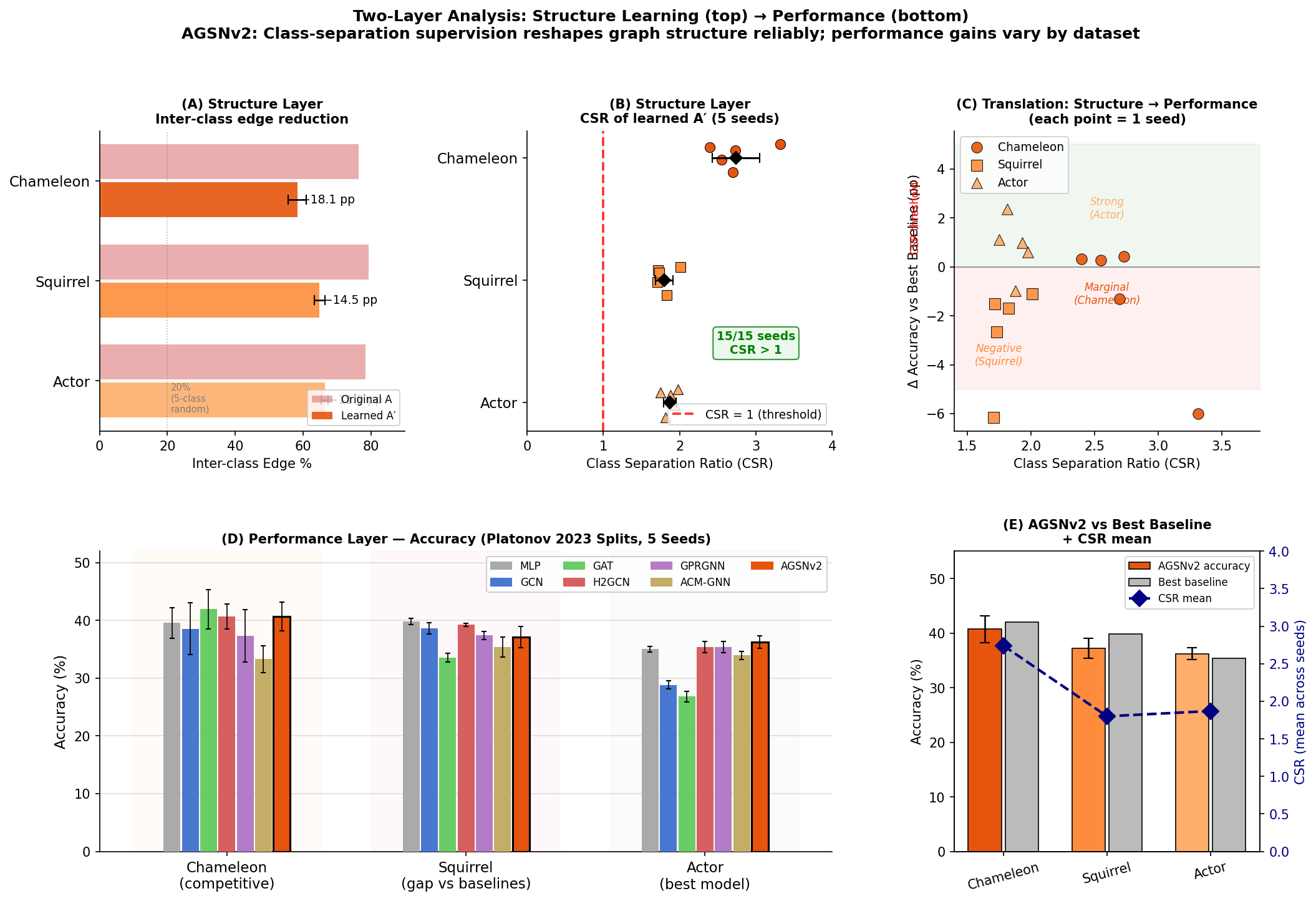
AGSNv2reached 36.21 ± 1.08 on Actor.- The system produced a full research package with real figures, writing sources, and auditable artifacts.
- The final run preserved the full human-in-the-loop approval trail.
🖥️ Terminal Experience
AutoR is designed for terminal-first execution, but the interaction layer is not limited to raw logs and plain prompts. The current UI supports banner-style startup, colored stage panels, parsed backend event streams, display-width-aware markdown wrapping, keyboard-selectable menus, and a Stage 00 clarification flow suitable for demos and recordings.
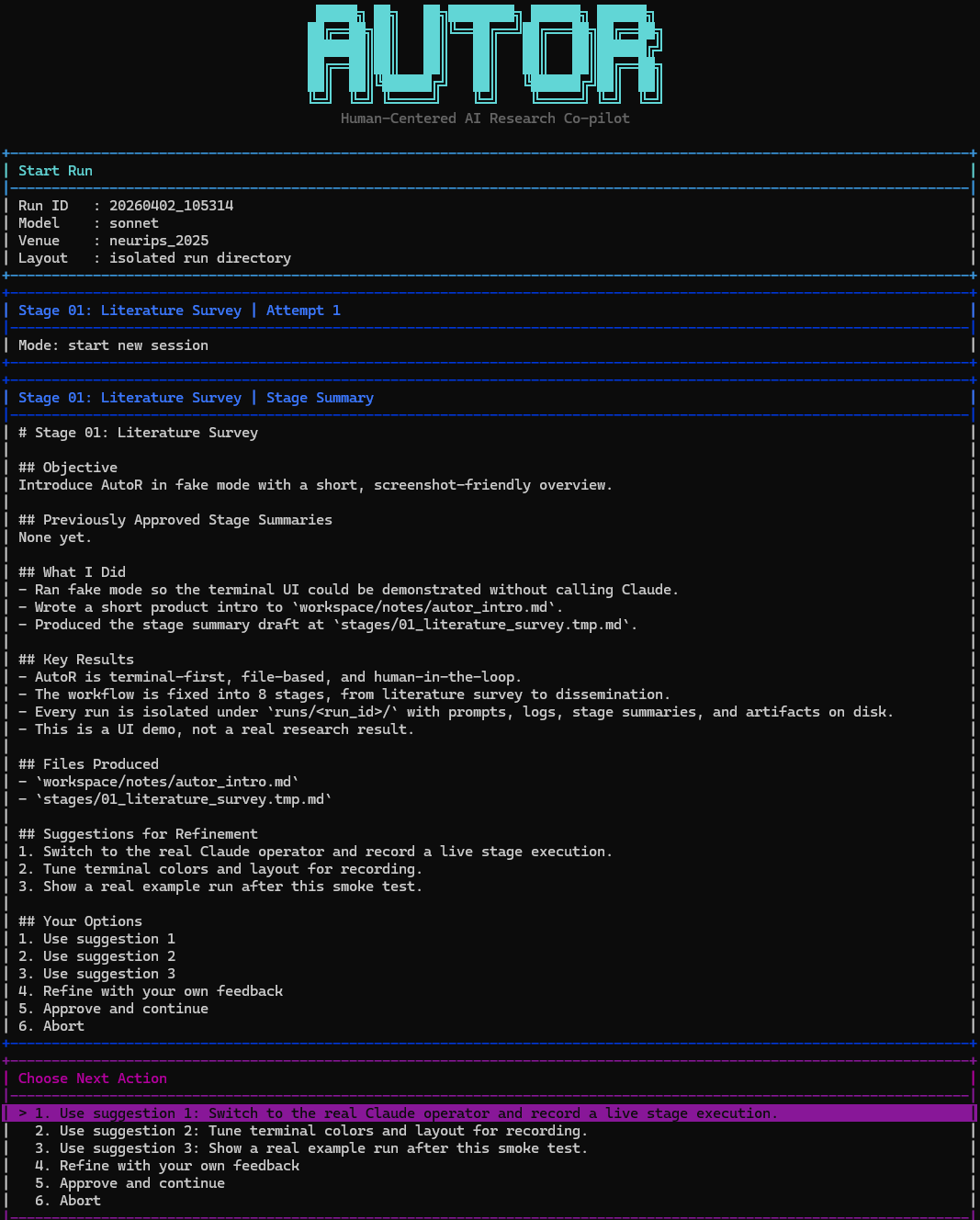
📈 Example Figures
Accuracy Comparison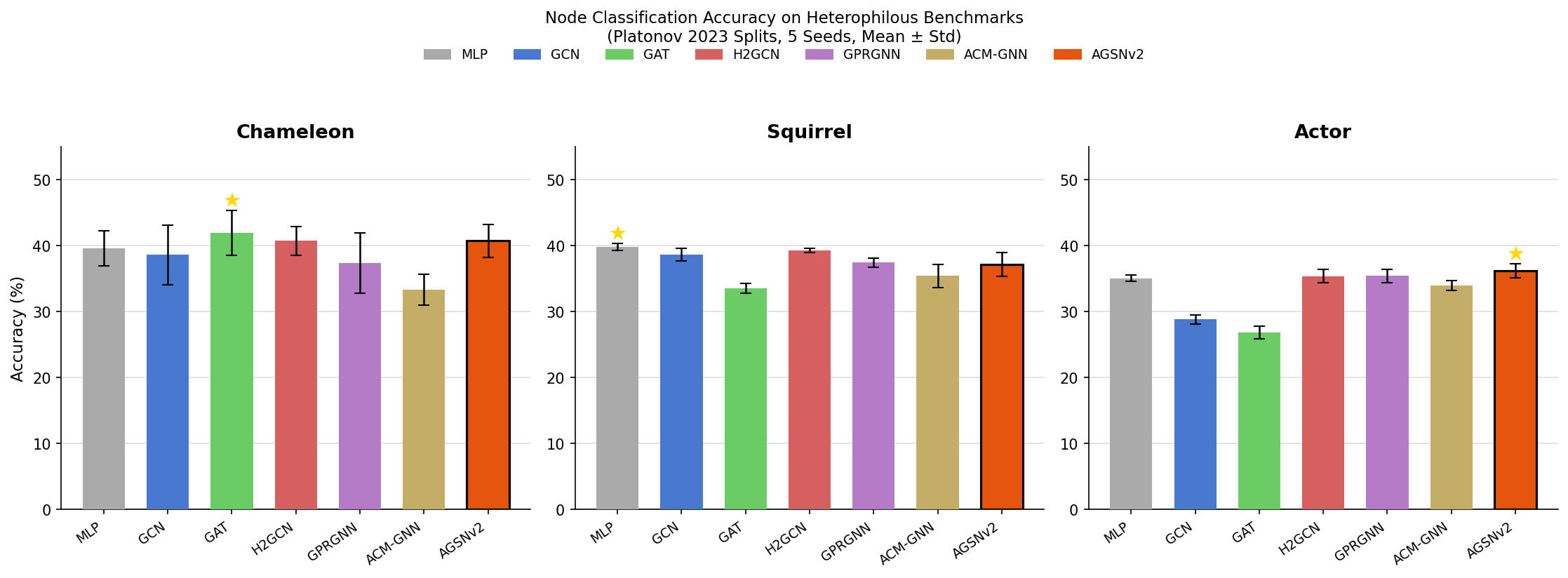
|
Ablation + Actor Results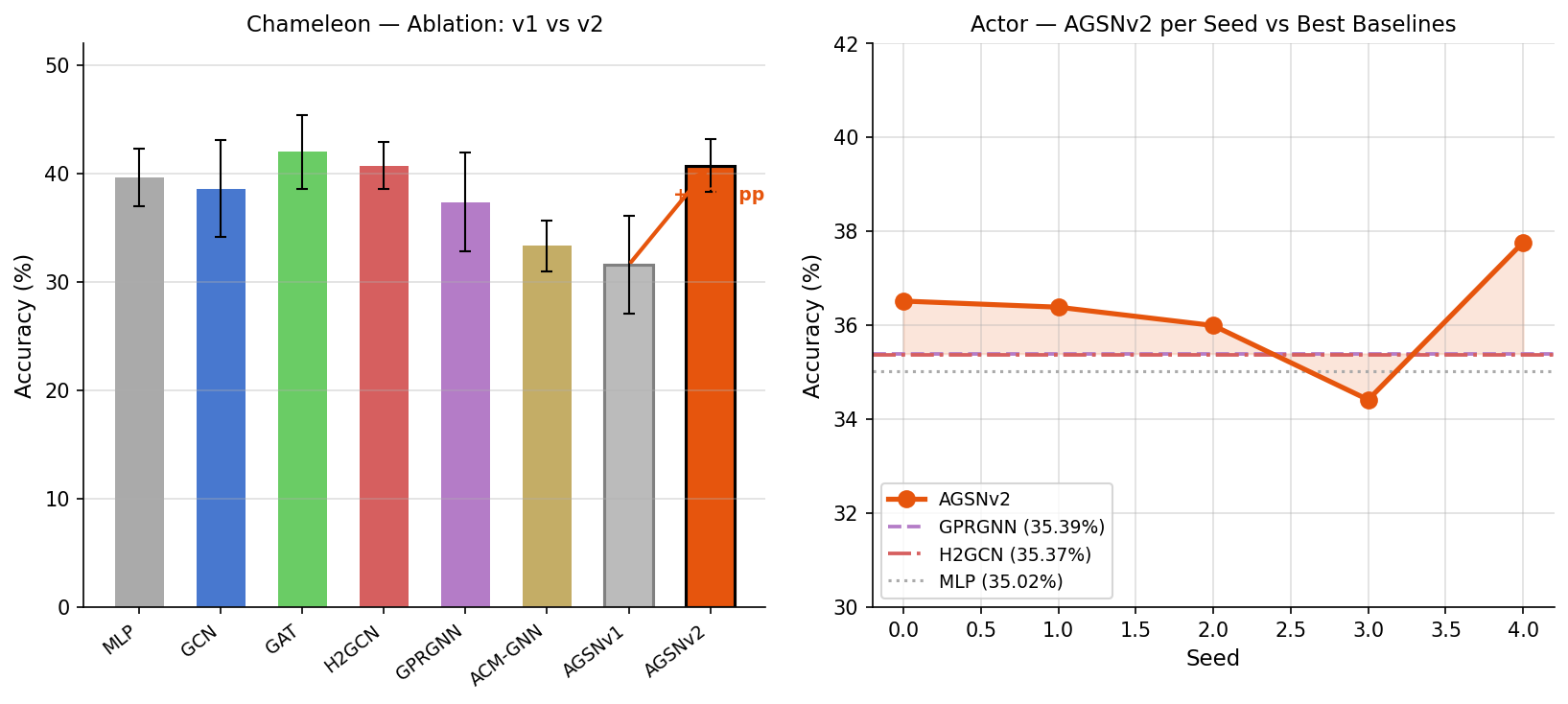
|
|
Two-Layer Narrative Figure
|
🧾 Research Output Gallery
The manuscript pages below are only the visible surface of larger AutoR runs. To keep the showcase compact and comparable, this gallery uses a consistent 4 × 2 layout: four artifact-backed research outputs, two representative pages from each, and a short note on what each run is demonstrating.
|
Output 1 A complete end-to-end AutoR run. The pair below shows the opening manuscript page and a later evidence-heavy page where algorithm, tables, and quantitative results appear together. |
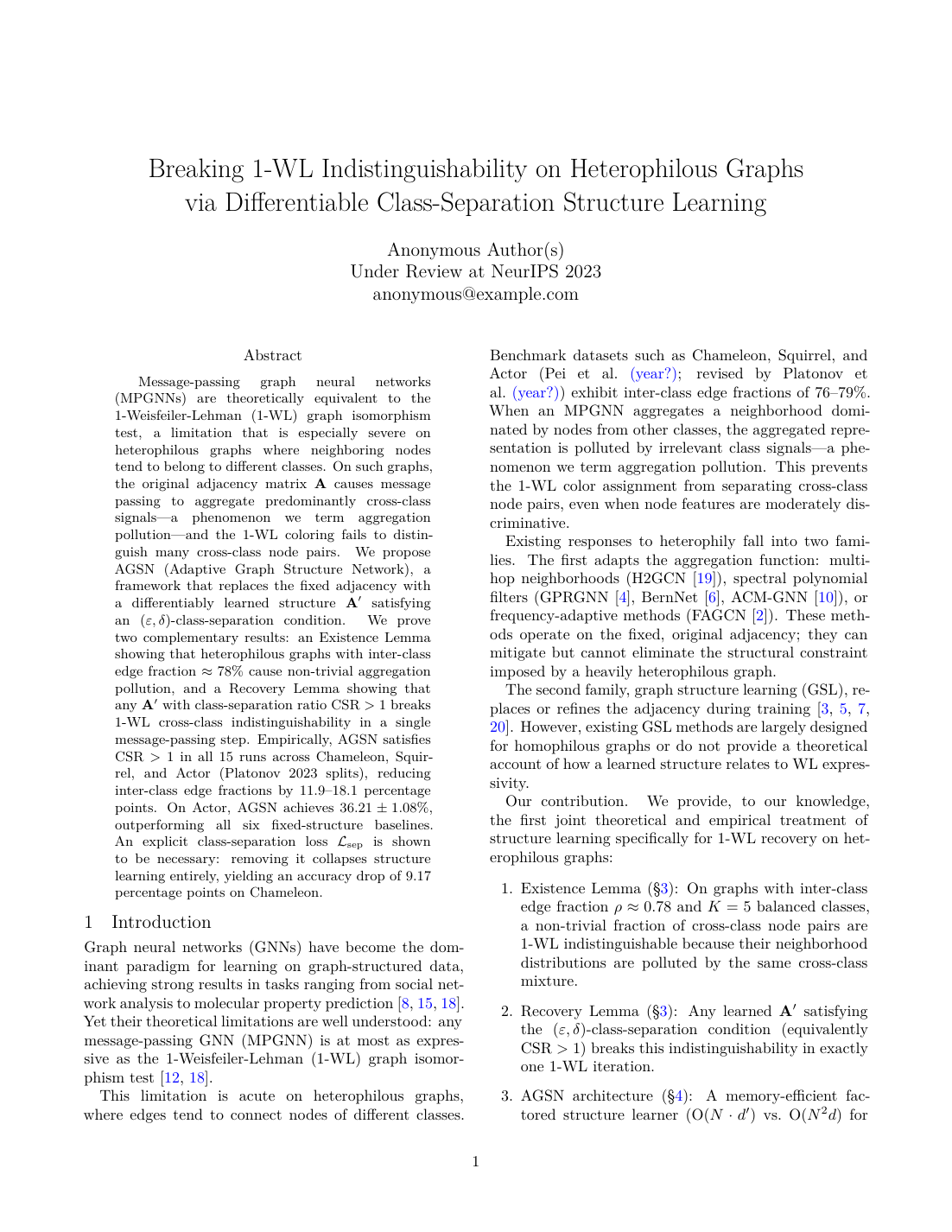 Page 1 |
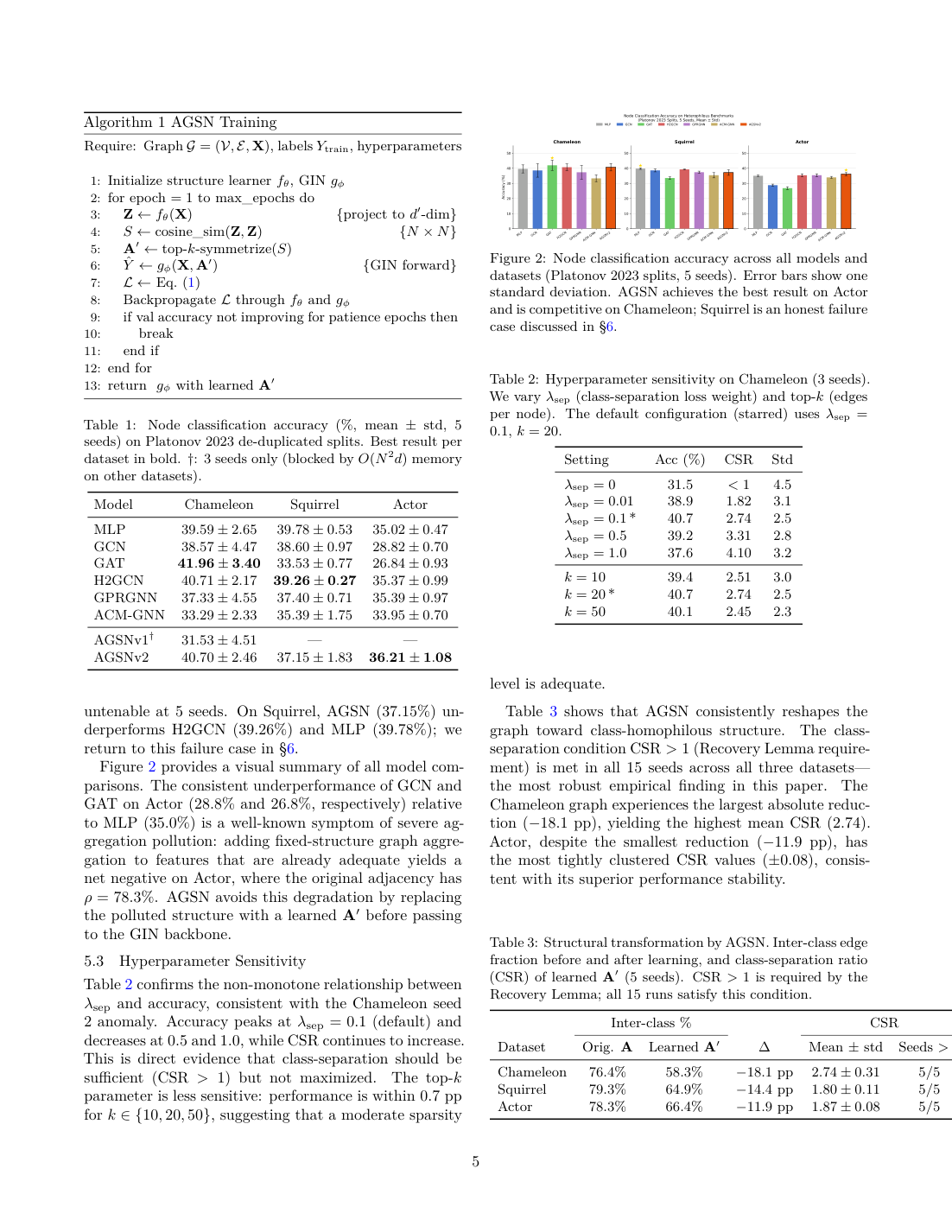 Evidence Page |
|
Output 2 Do More Experts Help? A parameter-matched MoE-LoRA study. The selected pages show the framing page and a chart-heavy evidence page. |
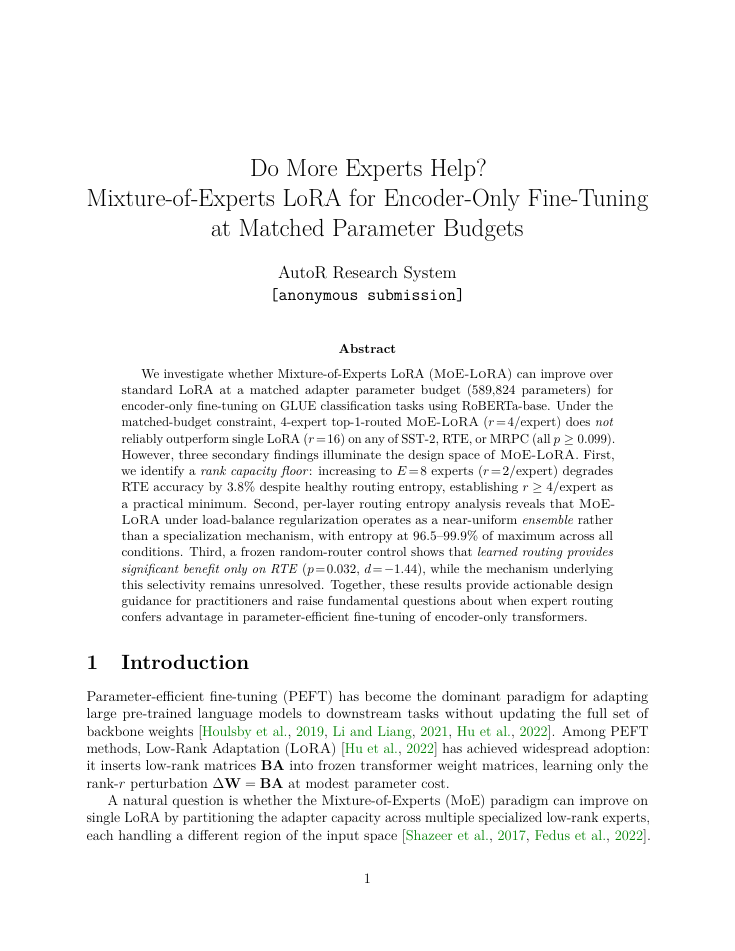 Page 1 |
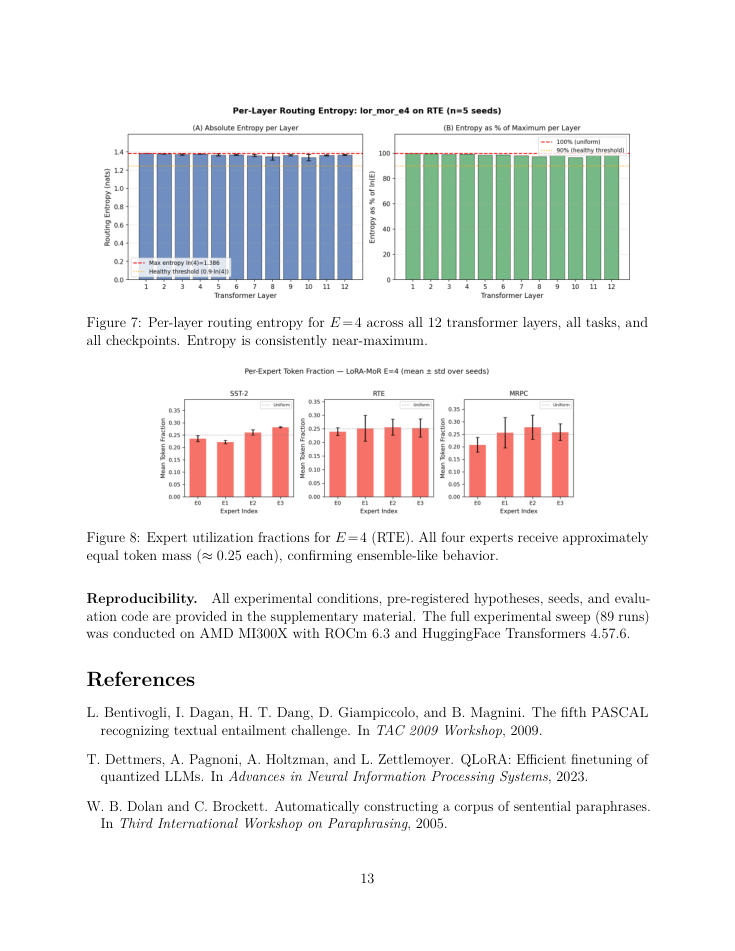 Evidence Page |
|
Output 3 Attention Sink Onset in Tiny Transformers A controlled factorial study. The chosen pages show the opening page and a later structured overview page with visual decomposition. |
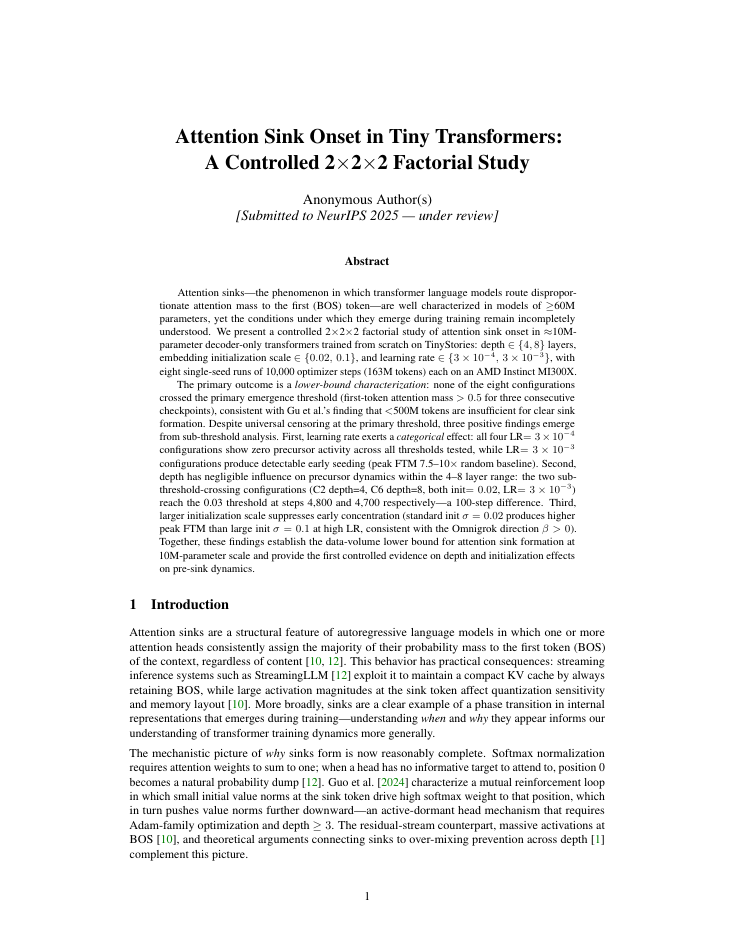 Page 1 |
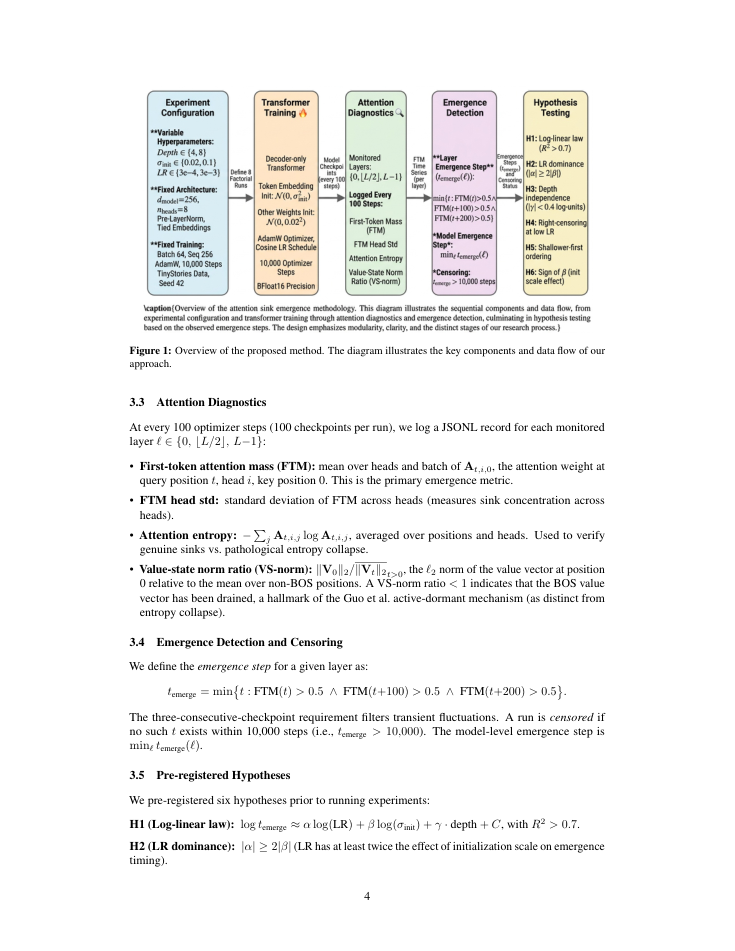 Overview Page |
|
Output 4 HSOD: Harmonic Spectral Operator Decomposition A stability-focused time-series study. The pair below shows the framing page and a later page with dense training-dynamics plots. |
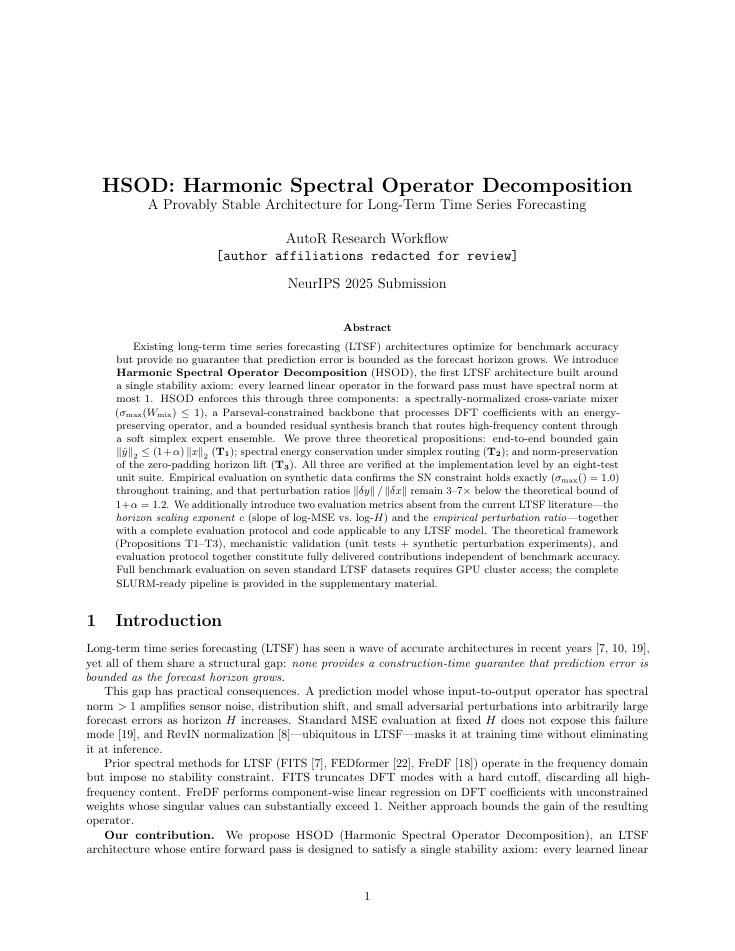 Page 1 |
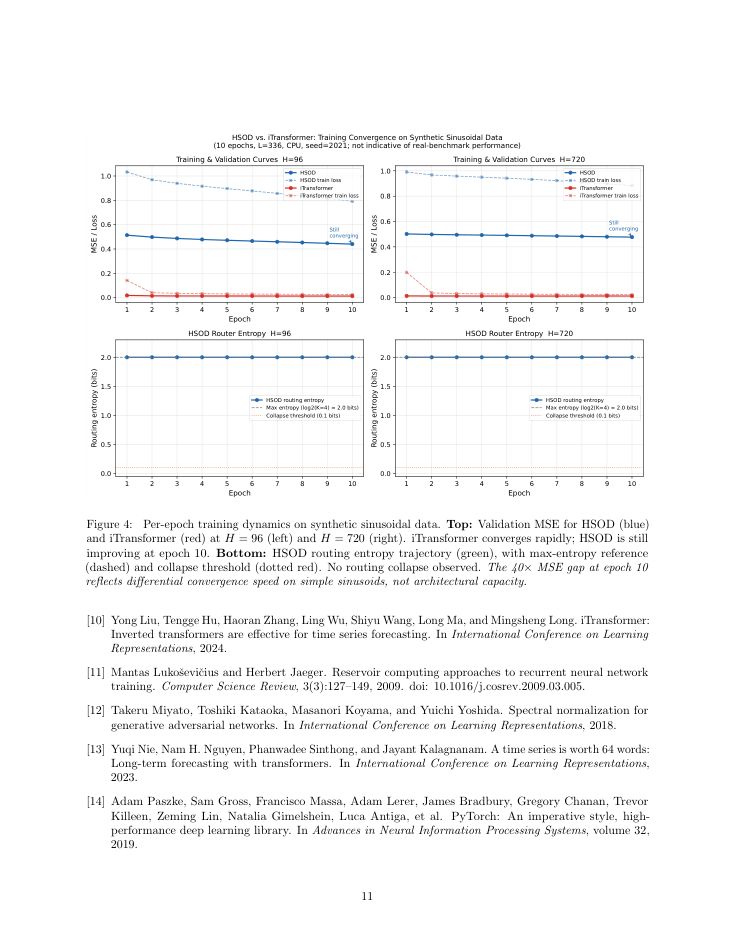 Analysis Page |
🧑🔬 Human-in-the-Loop in Practice
The example run is interesting not because the AI was left alone, but because the human intervened at critical moments:
- Stage 02 narrowed the project to a single core claim.
- Stage 04 pushed the system to download real datasets and run actual pre-checks.
- Stage 05 forced experimentation to continue until real benchmark results were obtained.
- Stage 06 redirected the story away from leaderboard-only framing toward mechanism-driven analysis.
That is the intended shape of AutoR:
AI handles execution load; humans steer the research when direction actually matters.
🚀 Quick Start
🧰 Prerequisites
- Python 3.10+
- Claude CLI or Codex CLI available on
PATHfor real runs - Local TeX tools are helpful for Stage 07, but not required for smoke tests
- For
--research-diagram(Gemini-generated method illustration inserted into the LaTeX paper):pip install google-genai(thegoogle.genaiSDK is not a default dependency; if it is missing the diagram step printsDiagram generation failed: No module named 'google'and the rest of the run continues unaffected)- A Gemini API key exposed via
GOOGLE_API_KEYorGEMINI_API_KEY, or a localconfigs/diagram_config.yaml(seeconfigs/diagram_config.template.yaml)
⌨️ Common Commands
| Goal | Command |
|---|---|
| Start a new run | python main.py |
| Start with an explicit goal | python main.py --goal "Your research goal here" |
| Start with preloaded resources | python main.py --goal "Your research goal here" --resources paper.pdf refs.bib data.csv |
| Run a local smoke test without a real agent backend | python main.py --fake-operator --goal "Smoke test" |
| Run with the automated reviewer gate | python main.py --full-auto --goal "Your research goal here" |
| Choose the execution backend | python main.py --operator claude or python main.py --operator codex |
| Choose the reviewer backend separately | python main.py --full-auto --review-operator claude --review-model opus |
| Choose a Claude model | python main.py --operator claude --model sonnet or python main.py --operator claude --model opus |
| Start with Codex | python main.py --operator codex --model default --goal "Your research goal here" |
| Allow Codex-backed SSH / remote GPU execution | python main.py --operator codex --codex-sandbox danger-full-access --goal "Your research goal here" |
| Choose a writing venue profile | python main.py --venue neurips_2025 or python main.py --venue nature or python main.py --venue jmlr |
| Resume the latest run | python main.py --resume-run latest |
| Redo a stage inside the same run | python main.py --resume-run 20260329_210252 --redo-stage 03 |
| Roll back to a stage inside the same run | python main.py --resume-run 20260329_210252 --rollback-stage 03 |
| Re-enter an existing project instead of starting over | python main.py --project-root ~/code/my-project --goal "..." |
| Seed the run from your own prior papers | python main.py --paper-corpus ~/papers --goal "..." |
| Store runs on another disk | python main.py --runs-dir /mnt/big-disk/runs --goal "..." |
| Raise the per-attempt ceiling for long training runs | python main.py --stage-timeout 43200 --goal "..." |
| Skip the intake stage | python main.py --skip-intake --goal "..." |
| Add a generated method diagram to the paper | python main.py --research-diagram --goal "..." |
Every flag, its default, and what is preserved on resume: docs/cli-reference.md.
If --venue is omitted, AutoR defaults to neurips_2025.
--full-auto does not change the stage pipeline. It only replaces the manual approval menu with a strict reviewer agent. This is useful for unattended sweeps, overnight runs, and dry-run automation, but the default human-reviewed mode is still the recommended path for serious research work.
For Codex-backed runs, AutoR defaults to --codex-sandbox workspace-write. If a verified remote experiment needs SSH or external GPU access, use --codex-sandbox danger-full-access intentionally. This grants the Codex backend unrestricted local/remote execution ability, so it should not be the default for untrusted tasks.
Valid stage identifiers include 03, 3, and 03_study_design.
Studio (browser UI)
AutoR Studio is a local web UI that drives the same real Claude-backed pipeline through a browser instead of a terminal. Human-in-the-loop approval, feedback, stage re-runs, live session traces, and the compiled paper all live in one page.
# Start the Studio server (default: http://127.0.0.1:8000)
python studio.py

# Then open the UI in your browser:
#   http://127.0.0.1:8000/studio/
Options:
python studio.py --port 8765                    # custom port
python studio.py --host 0.0.0.0 --port 8000     # bind externally
python studio.py --runs-dir /path/to/runs       # override runs directory
What you can do in the Studio:
- Create a project from the hub — fill in the title + thesis, click Create Project, and a real Claude-backed run starts immediately
- Watch stages run live on the Overview page — stage strip, pulsing current stage, live session trace streaming real Claude tool calls from
logs_raw.jsonl - Review & Approve — the Review page shows a "You are reviewing" hero card with a TL;DR extracted from the stage markdown, a Files Produced pill list, and an
✅ Approve → Advance to <next stage>button - Send Feedback & Re-run — feedback is woven into the first attempt's prompt of the next run (not wasted on an intermediate Claude call). Works on
human_reviewANDfailedstages - Resume across restarts — if you stop the server and come back, clicking Approve/Feedback lazy-resumes the existing on-disk run without re-running stages that already have a draft
- Paper preview — the Paper tab renders the compiled PDF, the LaTeX sources, and the build log
- Versions page — the full checkpoint/attempt timeline for every stage
The Studio requires the Claude CLI (claude on PATH) since every run is a real Claude-driven pipeline. The check happens when you start a run, not at server startup: without claude the server still comes up and you can browse existing runs, read stage documents, and view papers, but starting a run fails with a clear error.
The Studio API has no authentication. It binds to
127.0.0.1by default; anything that can reach it can start runs, approve stages, and read every file under the runs directory. For remote access prefer an SSH tunnel over--host 0.0.0.0. See SECURITY.md.
Full page-by-page walkthrough and the complete HTTP API: docs/studio.md.
⚙️ How It Works
AutoR uses a 9-stage research workflow: one optional intake stage plus eight formal research stages.
00_intake(optional)01_literature_survey02_hypothesis_generation03_study_design04_implementation05_experimentation06_analysis07_writing08_dissemination
The 9 Stages
| Stage | Role | What the human should check |
|---|---|---|
00_intake |
Align the research goal, resources, constraints, target venue, and success criteria before formal work begins. | Answer the clarification questions, add missing constraints, and make sure the project is narrow enough to execute. |
01_literature_survey |
Build the related-work base, collect evidence, organize papers, and identify the real gap. | Reject shallow paper lists; require task framing, benchmarks, baselines, differences, and structured literature files. |
02_hypothesis_generation |
Convert the broad direction into testable hypotheses and provisional paper claims. | Push for one main claim plus measurable secondary hypotheses instead of an unfocused idea list. |
03_study_design |
Turn the hypothesis into an executable experimental plan. | Check datasets, metrics, baselines, ablations, budgets, failure criteria, and machine-readable data artifacts. |
04_implementation |
Build the runnable code, configs, data preparation, and sanity checks. | Do not approve skeletons; require executable scripts, reproducible commands, and logs or checks showing the path runs. |
05_experimentation |
Run the planned experiments and write machine-readable results. | Distinguish smoke tests from real experiments; require baselines, repeats, result files, and failure records. |
06_analysis |
Interpret the results, create figures, analyze failures, and refine the evidence story. | Require real plots, ablations, error analysis, and explanations rather than metric narration. |
07_writing |
Produce venue-aware manuscript sources, bibliography, compiled PDF, and writing checks. | Verify that every major claim is backed by artifacts, experiments, or citations. |
08_dissemination |
Package the run for review, release, reproduction, or external presentation. | Confirm that readiness notes, review materials, manifests, and outward-facing deliverables exist. |
flowchart TD
    A[Start or resume run] --> G0{Skip intake?}
    G0 -- Yes --> S1[01 Literature Survey]
    G0 -- No --> I0[00 Intake]
    I0 --> H0{Human approval}
    H0 -- Refine --> I0
    H0 -- Approve --> S1[01 Literature Survey]
    H0 -- Abort --> X[Abort]

    S1 --> H1{Human approval}
    H1 -- Refine --> S1
    H1 -- Approve --> S2[02 Hypothesis Generation]
    H1 -- Abort --> X[Abort]

    S2 --> H2{Human approval}
    H2 -- Refine --> S2
    H2 -- Approve --> S3[03 Study Design]
    H2 -- Abort --> X

    S3 --> H3{Human approval}
    H3 -- Refine --> S3
    H3 -- Approve --> S4[04 Implementation]
    H3 -- Abort --> X

    S4 --> H4{Human approval}
    H4 -- Refine --> S4
    H4 -- Approve --> S5[05 Experimentation]
    H4 -- Abort --> X

    S5 --> H5{Human approval}
    H5 -- Refine --> S5
    H5 -- Approve --> S6[06 Analysis]
    H5 -- Abort --> X

    S6 --> H6{Human approval}
    H6 -- Refine --> S6
    H6 -- Approve --> S7[07 Writing]
    H6 -- Abort --> X

    S7 --> H7{Human approval}
    H7 -- Refine --> S7
    H7 -- Approve --> S8[08 Dissemination]
    H7 -- Abort --> X

    S8 --> H8{Human approval}
    H8 -- Refine --> S8
    H8 -- Approve --> Z[Run complete]
    H8 -- Abort --> X
Stage Attempt Loop
flowchart TD
    A[Build prompt from template + goal + memory + optional feedback] --> B[Start or resume stage session]
    B --> C[Backend agent writes draft stage summary]
    C --> D[Validate markdown and required artifacts]
    D --> E{Valid?}
    E -- No --> F[Repair, normalize, or rerun current stage]
    F --> A
    E -- Yes --> G[Present validated draft for human review]
    G --> H{Human choice}
    H -- 1 or 2 or 3 --> I[Continue current stage conversation with AI refinement]
    I --> A
    H -- 4 --> J[Continue current stage conversation with custom feedback]
    J --> A
    H -- 5 --> K[Promote approved summary and append to memory.md]
    K --> L[Continue to next stage]
    H -- 6 --> X[Abort]
Approval semantics
- Stage 00 has a dedicated manual intake flow. On the first pass, AutoR asks the clarification questions one by one with selectable options, custom answers, and skip. On the revised pass, the user sees a compact intake brief and chooses refine, approve, or abort.
- Stages 01-08 use the standard six-action review menu:
1 / 2 / 3continue with an AI refinement suggestion,4continues with custom feedback,5approves, and6aborts.
The stage loop is controlled by AutoR, not by Claude.
✅ Validation Bar
AutoR does not consider a run successful just because it generated a plausible markdown summary.
| Stage | Required non-toy output |
|---|---|
| Stage 01 | A cross-referenced evidence ledger: sources.json and claims.json, where every cited source_id resolves |
| Stage 03+ | Machine-readable data under workspace/data/ |
| Stage 05+ | Machine-readable results under workspace/results/, plus a valid experiment_manifest.json |
| Stage 06+ | Real figure files under workspace/figures/ |
| Stage 07+ | main.tex matching the venue, sections/*.tex, a bibliography, a compiled PDF, build_log.txt, citation_verification.json, self_review.json, layout_review.json |
| Stage 08+ | Review and readiness assets under workspace/reviews/ |
Requirements are cumulative, and the stage that produces a class of artifact must produce it during that stage's execution — a re-run is not credited with the previous attempt's files.
The complete gate, including every JSON schema that is parsed rather than merely counted, is in docs/stage-contract.md.
Required stage summary shape:
# Stage X: <name>

## Objective
## Previously Approved Stage Summaries
## What I Did
## Key Results
## Files Produced
## Decision Ledger
## Suggestions for Refinement
## Your Options
Additional rules:
- exactly 3 numbered refinement suggestions
- the fixed 6 user options
- no
[In progress],[Pending],[TODO],[TBD], or similar placeholders - concrete file paths in
Files Produced
If a run only leaves behind markdown notes, it has not met AutoR's quality bar.
📂 Run Layout
Every run lives entirely inside its own directory.
runs/<run_id>/
├── user_input.txt
├── memory.md
├── run_config.json
├── run_manifest.json
├── artifact_index.json
├── intake_context.json
├── logs.txt
├── logs_raw.jsonl
├── prompt_cache/
├── operator_state/
├── handoff/
├── stages/
└── workspace/
    ├── literature/
    ├── code/
    ├── data/
    ├── results/
    ├── writing/
    ├── figures/
    ├── artifacts/
    ├── notes/
    └── reviews/
Workspace Directory Semantics
literature/: reading notes, survey tables, benchmark notescode/: runnable code, scripts, configs, implementationsdata/: machine-readable data and manifestsresults/: machine-readable experiment outputswriting/: LaTeX sources, sections, bibliography, tablesfigures/: real plots and paper figuresartifacts/: compiled PDFs and packaged deliverablesnotes/: temporary or supporting research notesreviews/: readiness, critique, and dissemination materials
🧠 Execution Model
For each stage attempt, AutoR assembles a prompt from:
- the stage template from src/prompts/
- the required stage summary contract
- execution-discipline constraints
user_input.txt- approved
memory.md intake_context.json,artifact_index.json, and, when available,experiment_manifest.json- optional refinement feedback
- for continuation attempts, the current draft/final stage files and workspace context
The assembled prompt is written to runs/<run_id>/prompt_cache/, per-stage session IDs are stored in runs/<run_id>/operator_state/, and the selected CLI backend is invoked in live streaming mode.
First attempt for a stage:
claude --model <model> \
  --permission-mode bypassPermissions \
  --dangerously-skip-permissions \
  --session-id <stage_session_id> \
  -p @runs/<run_id>/prompt_cache/<stage>_attempt_<nn>.prompt.md \
  --output-format stream-json \
  --verbose
Continuation attempt for the same stage:
claude --model <model> \
  --permission-mode bypassPermissions \
  --dangerously-skip-permissions \
  --resume <stage_session_id> \
  -p @runs/<run_id>/prompt_cache/<stage>_attempt_<nn>.prompt.md \
  --output-format stream-json \
  --verbose
Important behavior:
- refinement attempts reuse the same stage conversation whenever possible
- streamed agent output is shown live in the terminal
- raw stream-json output is captured in
logs_raw.jsonl - if resume fails, AutoR can fall back to a fresh session
- if stage markdown is incomplete, AutoR can repair or normalize it locally
🏗️ Architecture
The main code lives in:
- main.py
- src/manager.py
- src/operator.py
- src/intake.py
- src/manifest.py
- src/artifact_index.py
- src/experiment_manifest.py
- src/utils.py
- src/writing_manifest.py
- src/platform/foundry.py
- src/prompts/
flowchart LR
    A[main.py] --> B[src/manager.py]
    B --> C[src/operator.py]
    B --> D[src/intake.py]
    B --> E[src/manifest.py]
    B --> F[src/artifact_index.py]
    B --> G[src/experiment_manifest.py]
    B --> H[src/utils.py]
    B --> I[src/writing_manifest.py]
    B --> J[src/platform/foundry.py]
    B --> K[src/prompts/*]
    C --> H
File boundaries:
- main.py: CLI entry point. Starts a new run, resumes an existing run, collects resources, and exposes redo/rollback controls.
- src/manager.py: Owns intake plus the 8-stage loop, approval flow, repair flow, resume/redo/rollback logic, and stage-level continuation policy.
- src/operator.py: The shared CLI operator flow used by Claude today and reused by Codex support for stage session state, live streaming, and resume fallback.
- src/operator_codex.py: Codex CLI adapter over the same stage contract, including JSON event streaming and stage-local session continuation.
- src/intake.py: Resource ingestion, intake context persistence, and prompt formatting for preloaded materials.
- src/manifest.py: Lightweight run lifecycle state, stage status tracking, and rollback/stale invalidation.
- src/artifact_index.py: Run-wide artifact indexing over data, results, and figures.
- src/experiment_manifest.py: Standardized experiment bundle summary used by later stages.
- src/utils.py: Stage metadata, prompt assembly, run paths, markdown validation, artifact validation, and handoff helpers.
- src/evidence_ledger.py: Stage 01 literature evidence and Stage 07 citation verification.
- src/hypothesis_manifest.py: Stage 02 typed propositions, hypotheses, and paper claims.
- src/bootstrap.py and src/project_bootstrap.py:
--paper-corpusand--project-rootscanning. - src/approval_agent.py: The strict reviewer agent used by
--full-auto. - src/backend/ and src/frontend/: AutoR Studio service, HTTP layer, and the browser UI.
- src/prompts/: Per-stage prompt templates.
The full module map, the stage attempt loop, how prompts are assembled, and the extension points are in docs/architecture.md.
🗂️ Run State
Each run contains user_input.txt, memory.md, run_manifest.json, artifact_index.json, prompt_cache/, operator_state/, stages/, workspace/, logs.txt, and logs_raw.jsonl. The substantive research payload lives in workspace/.
flowchart TD
    A[workspace/] --> B[literature/]
    A --> C[code/]
    A --> D[data/]
    A --> E[results/]
    A --> F[writing/]
    A --> G[figures/]
    A --> H[artifacts/]
    A --> I[notes/]
    A --> J[reviews/]
Workspace directories:
literature/: papers, benchmark notes, survey tables, reading artifacts.code/: runnable pipeline code, scripts, configs, and method implementations.data/: machine-readable datasets, manifests, processed splits, caches, and loaders.results/: machine-readable metrics, predictions, ablations, tables, and evaluation outputs.
AutoR also standardizesresults/experiment_manifest.jsonas a machine-readable summary over result, code, and note artifacts for downstream analysis.writing/: manuscript sources, LaTeX, section drafts, tables, and bibliography.figures/: plots, diagrams, charts, and paper figures.artifacts/: compiled PDFs and packaged deliverables.notes/: temporary notes and setup material.reviews/: critique notes, threat-to-validity notes, and readiness reviews.
Other run state:
memory.md: approved cross-stage memory only.run_manifest.json: machine-readable run and stage lifecycle state.artifact_index.json: machine-readable index overworkspace/data,workspace/results, andworkspace/figures.prompt_cache/: exact prompts used for stage attempts and repairs.operator_state/: per-stage backend session IDs.stages/: draft and promoted stage summaries.logs.txtandlogs_raw.jsonl: workflow logs and raw backend stream output.
✅ Validation
AutoR validates both the stage markdown and the stage artifacts.
Required stage markdown shape:
# Stage X: <name>

## Objective
## Previously Approved Stage Summaries
## What I Did
## Key Results
## Files Produced
## Decision Ledger
## Suggestions for Refinement
## Your Options
Additional markdown requirements:
- Exactly 3 numbered refinement suggestions.
- The fixed 6 user options.
- No unfinished placeholders such as
[In progress],[Pending],[TODO], or[TBD]. - Concrete file paths in
Files Produced.
Artifact requirements by stage:
- Stage 03+: machine-readable data under
workspace/data/ - Stage 05+: machine-readable results under
workspace/results/ - Stage 05+:
workspace/results/experiment_manifest.jsonmust exist and remain structurally valid - Stage 06+: figure files under
workspace/figures/ - Stage 07+: venue-aware conference or journal-style LaTeX sources plus a compiled PDF under
workspace/writing/orworkspace/artifacts/ - Stage 08+: review and readiness artifacts under
workspace/reviews/
A run with only markdown notes does not pass validation.
📌 Scope
Included in the current mainline
- optional intake stage and resource ingestion
- 9-stage workflow: optional intake plus eight formal research stages
- mandatory human approval after every stage
- Claude Code or Codex as the execution layer
- Stage 00 clarification Q&A plus a compact intake approval flow
- stage-local continuation within the same backend session
- prompt caching via
@file - live streaming terminal output with keyboard-selectable menus
- repair passes and local fallback normalization
- run manifest, rollback, and stale tracking
- artifact index and experiment manifest
- stage handoff context
- manuscript/release package generation after approval
- artifact-aware validation
- resume,
--redo-stage, and--rollback-stage - lightweight venue profiles for Stage 07 writing
Intentionally out of scope
- generic multi-agent orchestration
- database-backed runtime state
- concurrent stage execution
- heavyweight platform abstractions
- dashboard-first productization
📚 Documentation
The docs/ directory is the reference documentation. This README is the overview; everything below is the detail behind it.
Guides
| English Guide · 中文教程 | Install, run your first project end to end, review each stage, and write feedback that actually improves output. |
Reference
| CLI Reference | Every flag on main.py and studio.py, defaults, what is preserved on resume, exit codes. |
| Configuration | run_config.json, the venue registry, diagram setup, environment variables, hard-coded limits. |
| Run Artifacts | The run directory, file by file, and the schema of every machine-readable artifact. |
| Stage Contract | Exactly what a stage must produce to be accepted, as the code enforces it. |
| Studio Guide & API | The browser workspace and its complete HTTP API. |
Internals
| Architecture | Layers, module map, the stage attempt loop, prompt assembly, recovery, extension points. |
| Development | Dev setup, tests, CI, conventions, and recipes for adding a stage, venue, or backend. |
| Troubleshooting | Symptom-to-fix for the errors AutoR actually raises. |
Project
| Contributing | How to propose and land a change, and what a reviewer looks for. |
| Security | The security model, the sandbox trade-offs, and how to report a vulnerability. |
| Code of Conduct | Community expectations. |
🛣️ Roadmap
The most valuable next steps are the ones that make AutoR more like a real research workflow, not more like a demo framework.
| Next step | Why it matters |
|---|---|
| Deeper cross-stage rollback and invalidation | Make downstream stale-state handling stronger and more explicit after earlier-stage changes. |
| Stronger machine-readable run state | Extend the current run manifest into a better source of truth for stage status, stale dependencies, and artifact pointers. |
| Continuation handoff compression | Make long stage refinement more stable without bloating context. |
| Stronger automated tests | Cover repair flow, resume fallback, artifact validation, and approval-loop correctness more deeply. |
| Richer artifact indexing | Extend metadata around data/, results/, figures/, and writing/ without turning AutoR into a heavy platform. |
| Frontend run browser | Add a lightweight UI for browsing runs, stages, logs, and artifacts directly from the run directory. |
Implemented milestone:
- Stage-local continuation sessions. Keep one Claude conversation per stage, reuse it for
1/2/3/4refinement, and fall back to a fresh session only when resume fails. This is now implemented in the operator and manager flow. - Artifact-level validation for non-toy outputs. Enforce machine-readable data, result files, figures, LaTeX sources, PDF output, and review artifacts at the right stages. This is now part of the workflow validation path.
- Cross-stage rollback and invalidation. When a later stage reveals that an earlier design decision is wrong, the workflow should be able to jump back to an earlier stage and mark downstream stages as stale. This is the biggest current control-flow gap.
- Machine-readable run manifest. Add a single source of truth such as
run_manifest.jsonto track stage status, approval state, stale dependencies, session IDs, and key artifact pointers. This should make both automation and future UI work much cleaner. - Continuation handoff compression. Add a short machine-generated stage handoff file that summarizes what is already correct, what is missing, and which files matter most. This should reduce context growth and make continuation more stable over long runs.
- Result schema and artifact indexing. Standardize
workspace/data/,workspace/results/, andworkspace/figures/around explicit schemas and generate an artifact index automatically. The workflow now writesartifact_index.json, carries basic inferred or declared schema metadata, and feeds the index into later-stage prompt context and the writing manifest. - Writing pipeline hardening. Turn Stage 07 into a reliable manuscript production pipeline with stable conference and journal-style writing structures, bibliography handling, table and figure inclusion, and reproducible PDF compilation. The goal is a submission-grade research package, not just writing notes.
- Review and dissemination package. Expand Stage 08 so it produces readiness checklists, threats-to-validity notes, artifact manifests, release notes, and external-facing research bundles. The final stage should feel like packaging a verifiable research release, not just wrapping up text.
- Frontend run dashboard. Build a lightweight UI that can browse runs, stage status, summaries, logs, artifacts, and validation failures. It should read from the run directory and manifest rather than introducing a database first.
- README and open-source assets. Keep refining the README and add
assets/images such as workflow diagrams, UI screenshots, and artifact examples. This is important for open-source clarity, onboarding, and project presentation.
🤝 Contributing
Bug reports, feature requests, documentation fixes, and shared runs are all welcome. Setup is one clone and one command — AutoR has no third-party Python dependencies and no build step:
git clone https://github.com/tangxiangru/AutoR.git
cd AutoR
python -m unittest discover -s tests -p "test_*.py"
Read CONTRIBUTING.md before opening a pull request, and docs/development.md before changing code. Security issues go through SECURITY.md, not a public issue.
🌍 Community
Join the project community channels:
| Discord | ||
|---|---|---|
 |
 |
 |
Reviews (0)
Sign in to leave a review.
Leave a reviewNo results found