Flovart
Health Gecti
- License — License: AGPL-3.0
- Description — Repository has a description
- Active repo — Last push 0 days ago
- Community trust — 137 GitHub stars
Code Gecti
- Code scan — Scanned 12 files during light audit, no dangerous patterns found
Permissions Gecti
- Permissions — No dangerous permissions requested
Bu listing icin henuz AI raporu yok.
Open-source agent-native visual production workspace where humans and coding agents edit the same live canvas — local-first, BYOK image/video models.
Flovart
Your coding agent, now with a visual production studio.
Open-source, local-first and agent-native workspace for AI image and video production.
Let Codex, Claude Code and other local agents inspect, edit and run the same live Workflow you can see and change — with your own models, API keys, assets and reusable Production Skills.
English · 简体中文
Try live demo · Download preview · Get started · Compatibility





README views · third-party counter, not unique visitors
The next direction is native Flovart effects inside creative software: generate a version, refine it in the host, and open Workflow for complex work. Windows AE/PR effects come first; macOS will be evaluated separately. Native effects remain planned, distinct from today's experimental panels. See the product and implementation design.
See the workspace
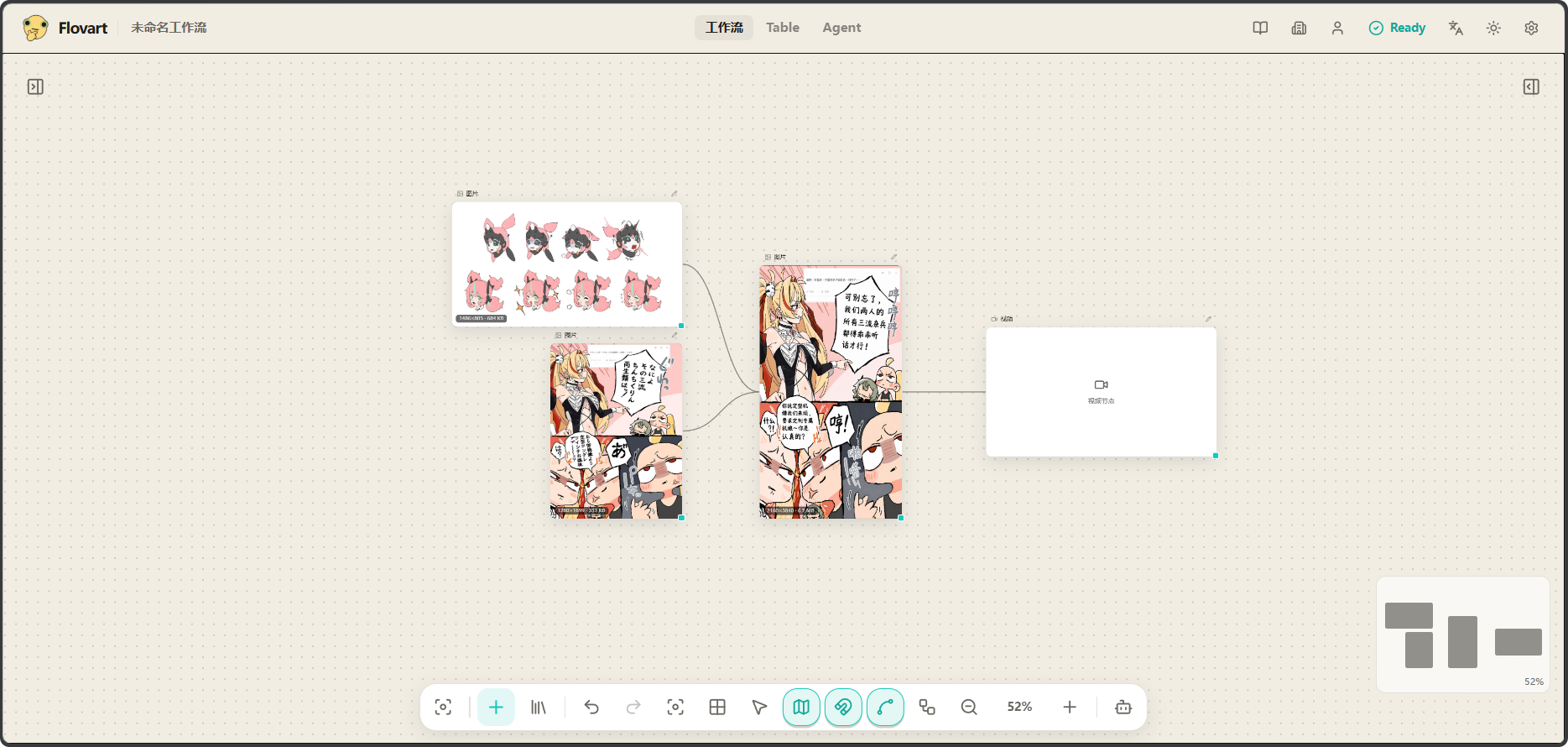
A real Workflow view for organizing references, generation nodes, connections and results.
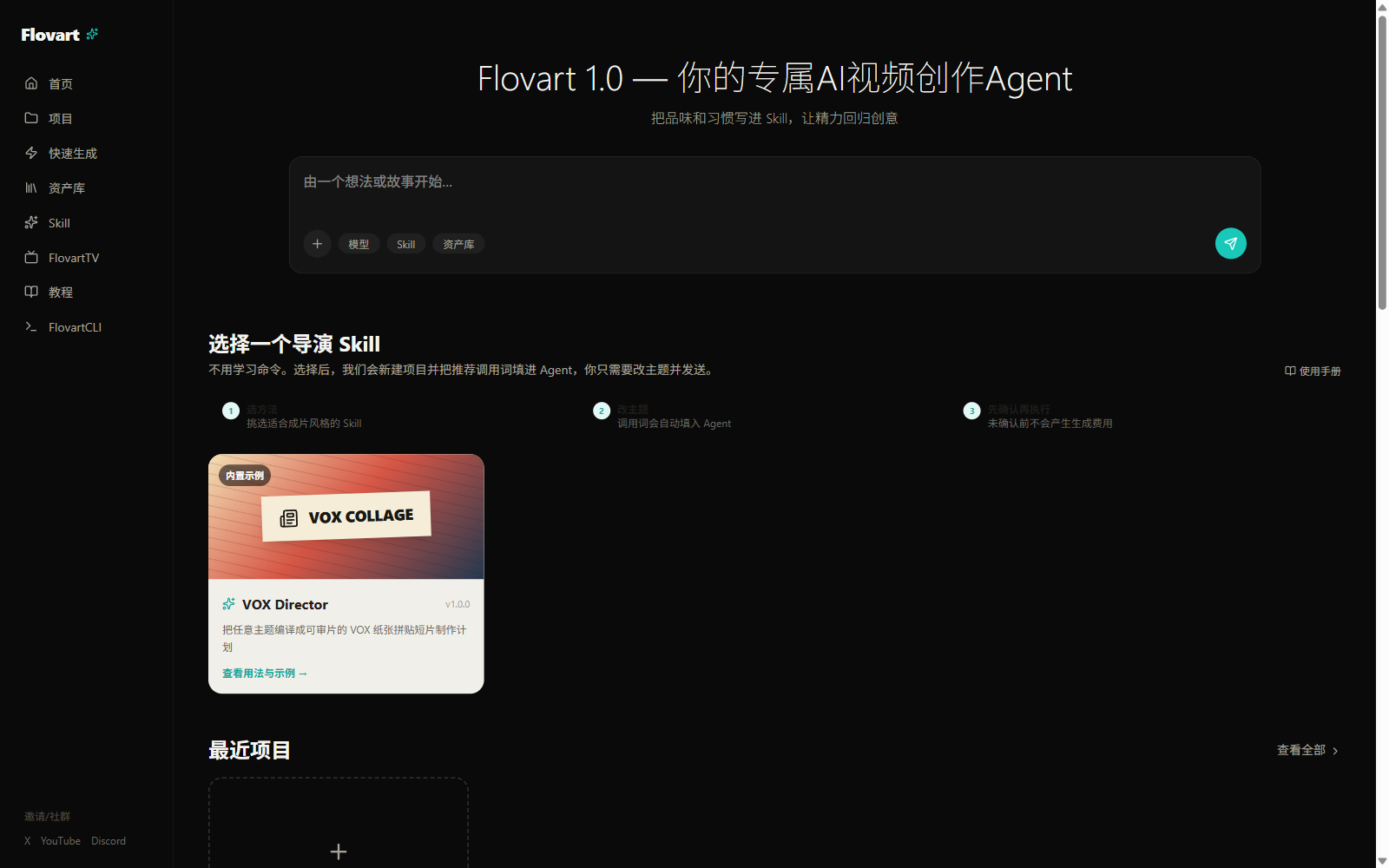
Choose a production method before entering a project. |
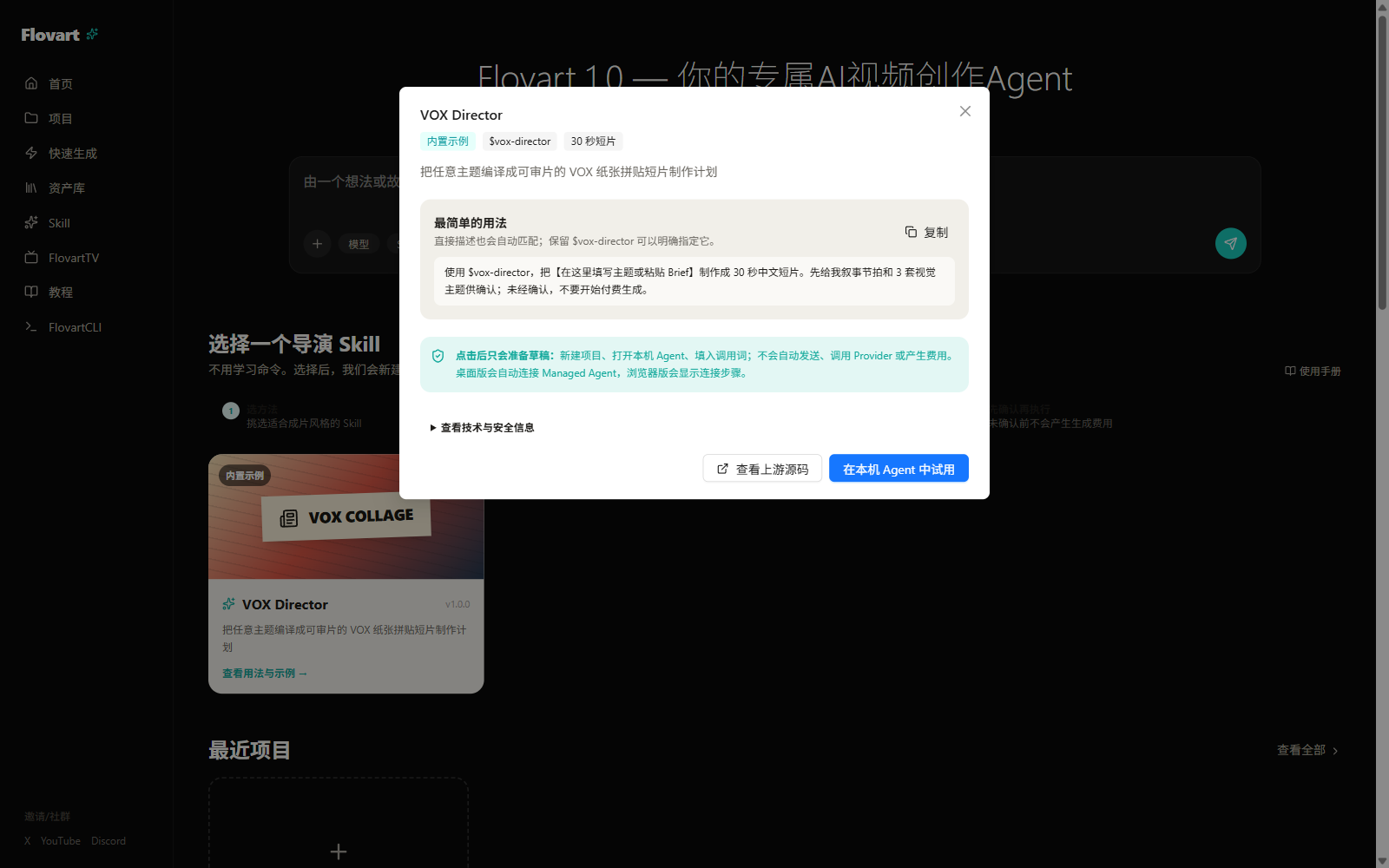
See invocation, cost boundaries and safety guidance before running it. |
The current screenshots are real Workflow and Skill surfaces. A future recording that shows an agent changing that same Workflow is specified in README_VISUAL_TODO.md; this README does not fabricate that evidence.
Why Flovart?
Most AI creative tools make you choose between a visual editor and an autonomous agent. Flovart is built around one production state that both can use:
- Agent-native: a coding agent reaches the visible Workflow through typed Flovart Link and CLI operations, not mouse automation or a hidden project copy.
- Human-editable: nodes, connections, assets and results stay in the Workflow you can inspect and continue editing.
- BYOK and multi-provider: bring your own model services and API keys; real provider and billing behavior remains explicitly tracked as Experimental where it is not certified.
- Production Skills: package visual language, shot rules, workflow recipes, checkpoints and acceptance criteria into reusable production methods.
One workspace, two ways to create
With your agent
Creative brief
      ↓
Codex / Claude Code / OpenCode
      ↓
Flovart Link + CLI
      ↓
Inspect · Apply · Run
      ↓
The visible Workflow
For example:
“Open Flovart and build a three-shot product video Workflow from these references.”
The agent reads the current project and revision, applies explicit operations, and can run a confirmed node. The exact Host status is shown in the Support Matrix.
By hand
You can still add, move, resize and connect nodes, drop local image or video files, configure a model, run generation, inspect artifacts and iterate visually. There is no separate “agent version” of your project: the human and agent paths converge on the same Workflow authority.
What makes Flovart different?
| Capability | Flovart |
|---|---|
| Agent control | Typed operations against the actual visible Workflow |
| Human editing | The same graph, assets and results remain directly editable |
| Models | BYOK and multi-provider adapters, with capability-specific status |
| References | Graph connections, mentions, local assets and artifacts resolve into generation inputs |
| Production knowledge | Reusable Production Skills, not only reusable prompt text |
| Automation | Explicit inspect/apply/run operations with revision and approval boundaries |
| Data | Local-first storage with documented browser and runtime boundaries |
What you can make
- Agent-native Workflow: compose image, text, video, audio and configuration nodes into visual generation flows.
- Image and video generation: choose modes, references and parameters, then monitor results and recovery through the Workflow.
- Reference-aware production: combine graph references, mentions, assets and generated artifacts as typed inputs instead of pasting everything into one prompt.
- Production Skills: reuse a method for a visual language, shot structure or production checklist across projects.
- Local projects and assets: keep projects, references and generation history close to the workspace, with no cloud-sync promise.
- Extensible contracts: providers, hosts, node operations and Skills meet explicit contracts so integrations can be tested without pretending a mock is a certified host.
The product surfaces behind this story are Workflow for generation orchestration, Table for the still-evolving media-preprocessing workbench, and Agent for the spatial production-control surface. Table and Agent are real application entries, but their remaining implementation and migration work is not presented as complete; see Features.
Production Skills
Prompts are reusable text.
Production Skills are reusable production methods. A Skill can capture:
- visual language and style rules;
- shot structure and workflow recipes;
- checkpoints and human approvals;
- model policy, cost boundaries and safety rules;
- acceptance criteria for the final artifact.
The repository contains a local Flovart Skill surface and the VOX Skill reference. The broader community contract and ecosystem are still in design and implementation, so the Skill section is an active capability rather than a promise of a mature marketplace. Start with the Skill guide.
Bring your own models
Your provider
      ↓
Your API key
      ↓
Your assets + Workflow
      ↓
Your generated result
Flovart does not bundle model services. Configure a provider in the app, choose the capabilities and model you need, and keep the provider terms, cost and output rights in your own hands. OpenAI-compatible BYOK and remote-provider paths are currently Experimental; adapter presence is not paid-provider certification. Use the Support Matrix as the status source of truth.
Compatibility
| Host or package | Status |
|---|---|
| Codex CLI + Browser Workflow | Experimental |
| Claude Code CLI projection | Experimental |
| OpenCode CLI projection | Experimental |
| DeepSeek Harness RC8 bundle/profile | Experimental |
| WorkBuddy CLI Connector + Skill | Experimental |
| CodeBuddy Code | Planned |
| Pi | Planned |
| Photoshop UXP panel | Experimental |
| Premiere Pro UXP panel | Experimental |
| After Effects | Experimental |
| DaVinci Resolve Studio | Experimental |
Experimental, Planned and External Gate items are not Stable claims. Evidence, boundaries and release gates live in the Support Matrix; this table is intentionally not a second compatibility policy.
Quick start
For creators
- Download a preview build from GitHub Releases.
- Open Flovart and add an AI service in Settings.
- Create or open a Workflow, add references, and start creating.
The public Releases page may contain test or preview artifacts; it is not a claim that every Host or Provider is Stable.
For coding-agent users
Use the repository-verified source path while the versioned CLI package publication remains a release gate:
git clone https://github.com/avabbbb/Flovart.git
cd Flovart
npm install
npm run flovart:cli -- start --source --web --open
npm run flovart:cli -- workflow.inspect --json
Then ask your local agent: “Open Flovart.” The normal agent loop is status, workflow.inspect, workflow.selection.get, workflow.apply and workflow.node.run; the Getting Started guide covers development-only diagnostics and isolated browser checks.
Architecture
flowchart LR
  H["Human creator"] <--> W["Live Workflow"]
  A["Coding-agent harness"] --> L["Flovart Link + CLI"]
  L --> W
  W --> P["Provider adapters"]
  W --> R["Local assets + artifacts"]
  T["Table workspace"] -. separate surface .-> W
CLI and the experimental stdio MCP share operation semantics and the current Browser Workflow binding. Deterministic operations do not require a second AI to reinterpret them.
The native-effect design keeps two short paths: one shared generation function produces durable media versions; the host effect reads a fixed version and renders locally. It does not require a director/Operator/Crew chain. Product scope, interactions, implementation and benchmarks live in the main design; the current implementation record describes existing code, not an additional target architecture.
Local-first and security
- Projects, assets and generation history are stored primarily in the browser today; cloud sync is not promised.
- The current Web path stores API keys locally through the encrypted
localforagevault, while the frontend calls the configured model service directly. Treat the browser as part of the secret boundary. - Web, Desktop WebView and extension storage are normally isolated. Cross-entry synchronization through a restricted runtime bridge is still pending.
- Never put API keys in a Skill, prompt, log or repository. Agent and CLI paths should receive redacted readiness/capability state, not raw credentials.
- Use only the repository, the live demo and desktop artifacts published by the repository's Actions as official project channels. Review each provider's terms and the rights for your inputs and outputs.
Roadmap
The next product-facing directions are:
- validate AE/PR native effects with fixed assets, saved parameters and offline export;
- connect durable generation tasks and external/internal Agent entry points through shared operations;
- extend to Photoshop and Resolve after the first host workflow is verified, while maintaining existing workspaces and Skills.
These are directions, not current Stable support. Follow the roadmap and pending verification for the evidence trail.
Contributing
Contributions are especially useful in four areas: provider adapters, Production Skills, Host integrations and Workflow capabilities. Open an Issue, read the contribution conventions, and include verification evidence with UI changes.
Acknowledgements
Thanks to @labiaaaaaaaaa for driving third-party service compatibility and aggregation-endpoint fixes.
License and disclaimer
Flovart is licensed under the GNU Affero General Public License v3.0 only. By using the project, you agree to the Terms of Service and Privacy Policy.
Flovart does not bundle model services and makes no intellectual-property claim over generated content. You are responsible for the copyright, compliance and lawful use of your models, input assets and generated output. See project data and statistics.
Yorumlar (0)
Yorum birakmak icin giris yap.
Yorum birakSonuc bulunamadi