OfferU
Health Pass
- License — License: MIT
- Description — Repository has a description
- Active repo — Last push 0 days ago
- Community trust — 23 GitHub stars
Code Warn
- process.env — Environment variable access in agent-runtime/src/hosted-executor-worker.mjs
Permissions Pass
- Permissions — No dangerous permissions requested
No AI report is available for this listing yet.
Local-first AI Career OS — research jobs, tailor resumes, track applications, and learn from every interview.

OfferU
Your local-first AI Career OS.
Understand every job. Tailor every application. Learn from every interview.
English · 简体中文 · Quickstart · Demo · Architecture · Docs
Local-first · Evidence-driven · Human-controlled
[!IMPORTANT]
OfferU is currently a local single-user Internal Beta / Public Release Candidate, not a public release.
The core local workflow works, but signed installer, previous-release upgrade, clean-machine validation,
full security/privacy gates and live external Role Intelligence evidence are still open, so the release
verdict staysOFFERU_PUBLIC_RELEASE_NOT_READY. See STATUS.md for the current evidence.
OfferU is not an auto-apply bot: it never submits applications, sends mail or contacts third parties
on its own. AI output becomes career truth only after you review and approve it.
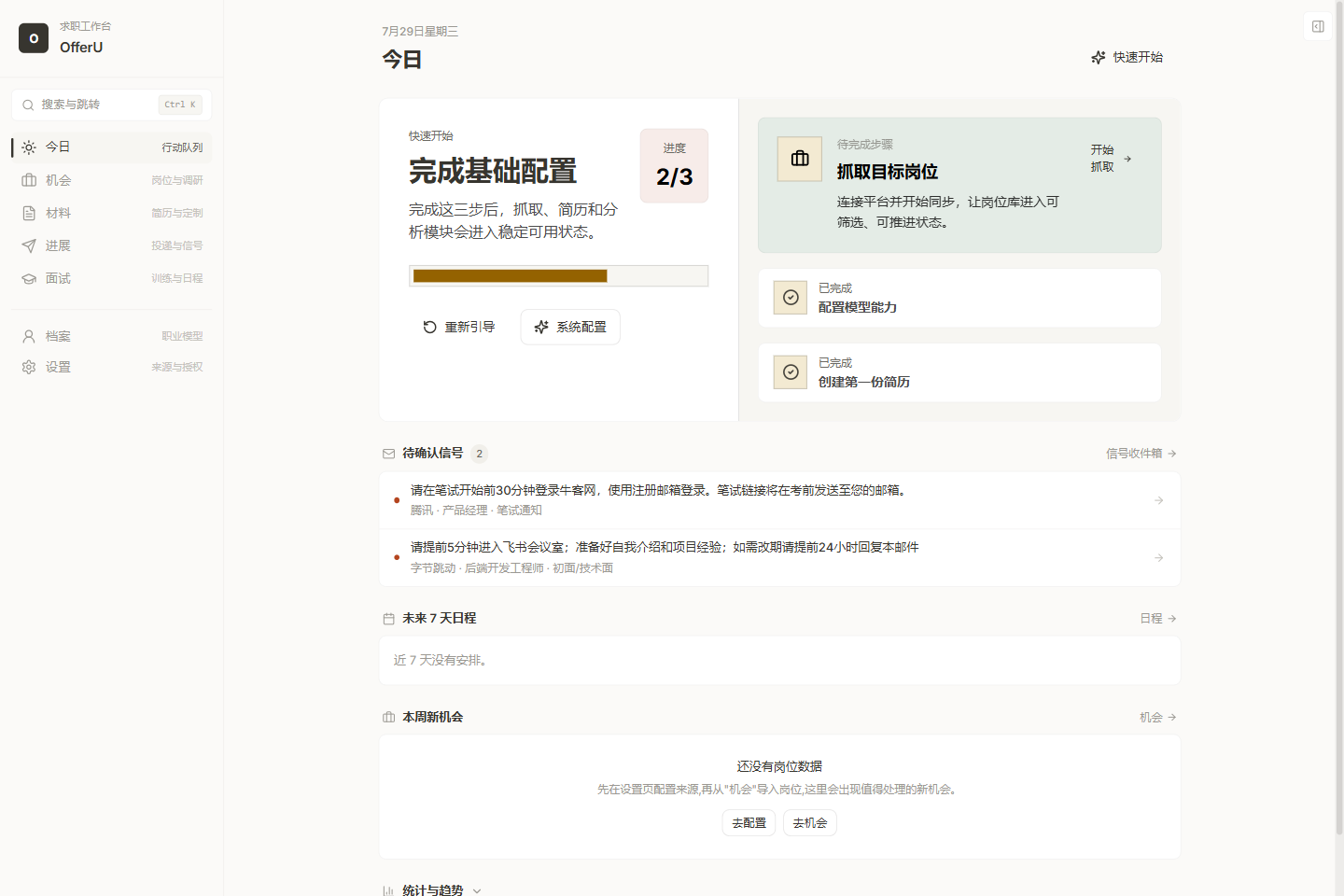 |
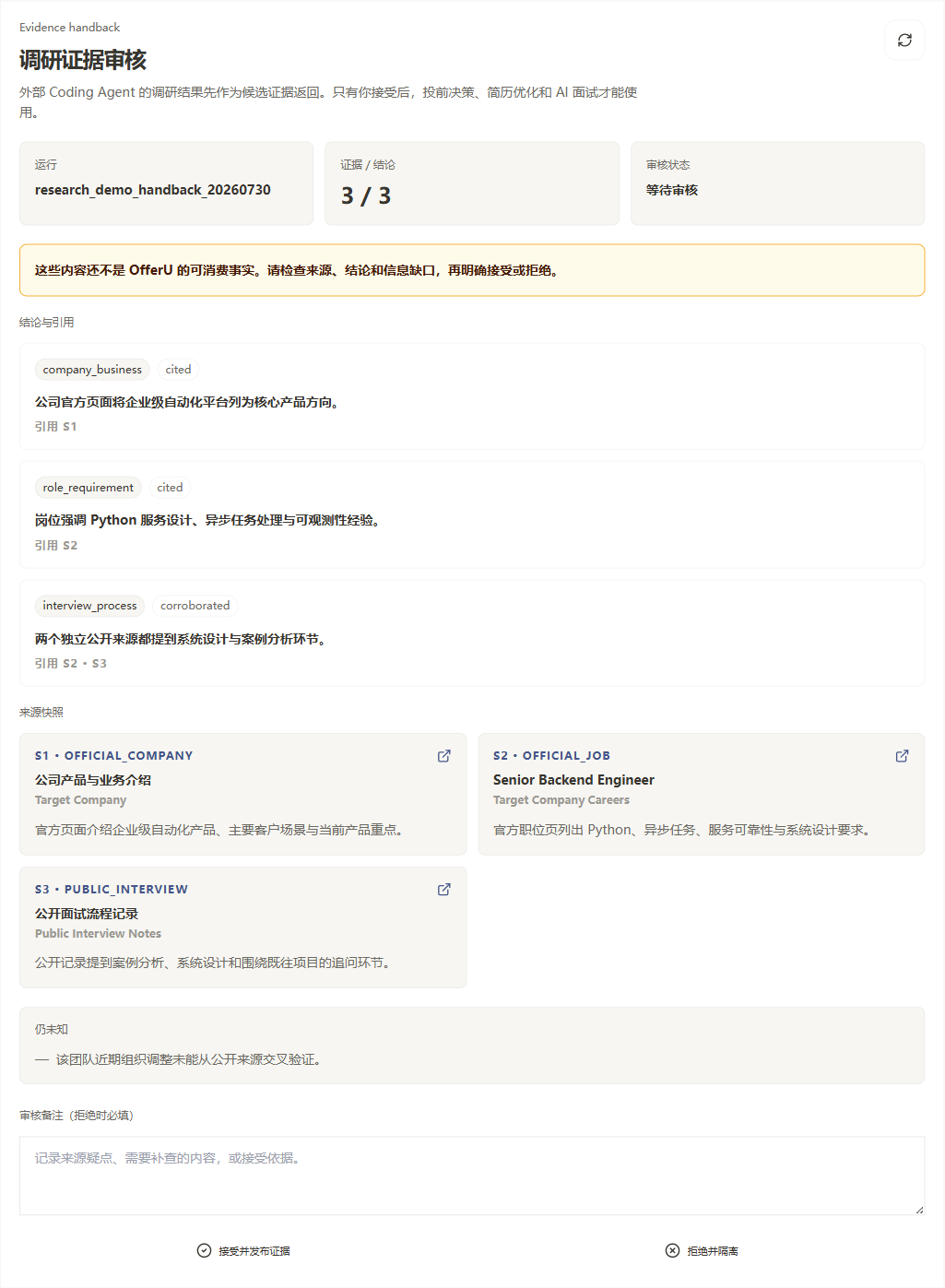 |
| Workbench: jobs, evidence and next actions | Job research: sources, unknowns, candidate review |
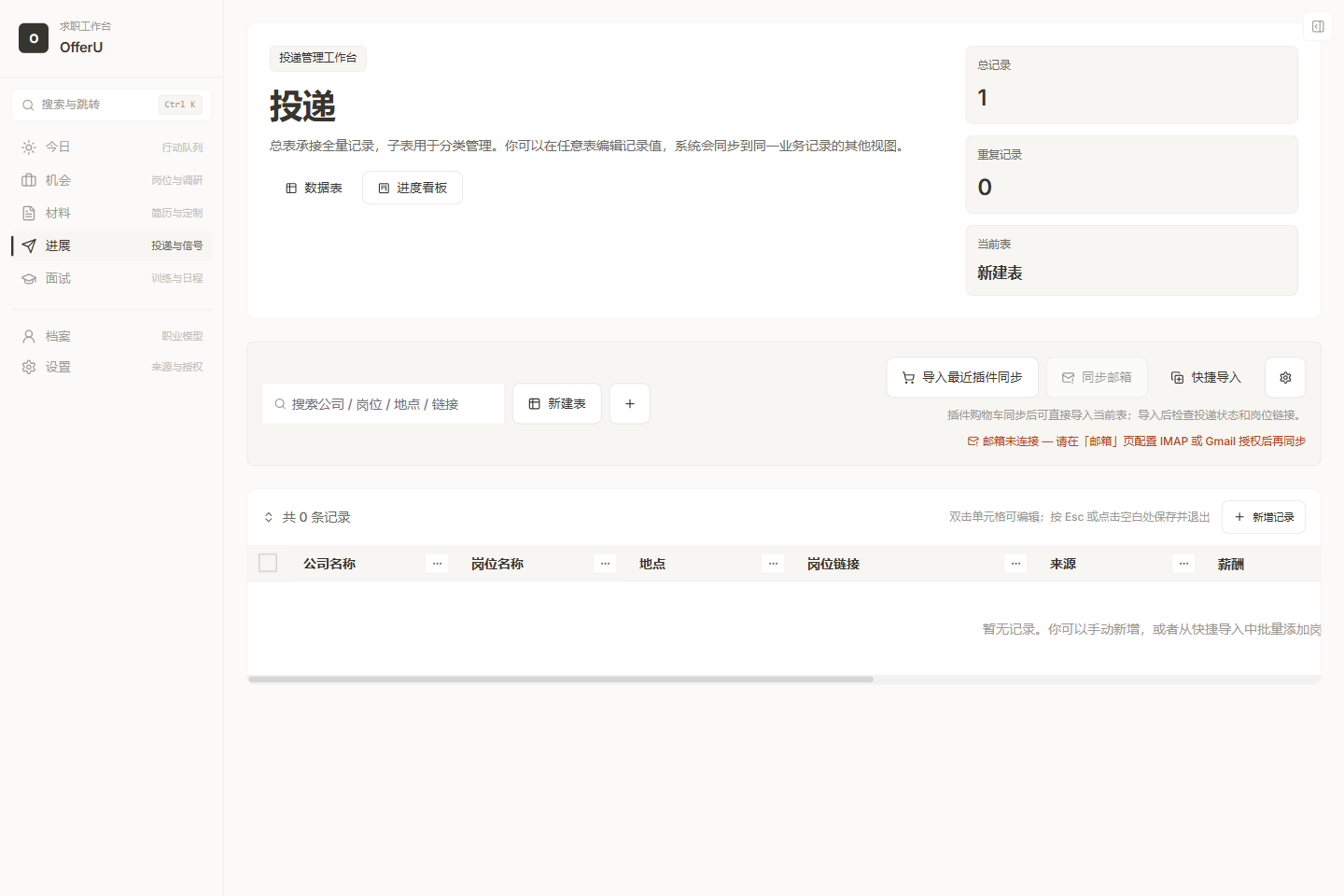 |
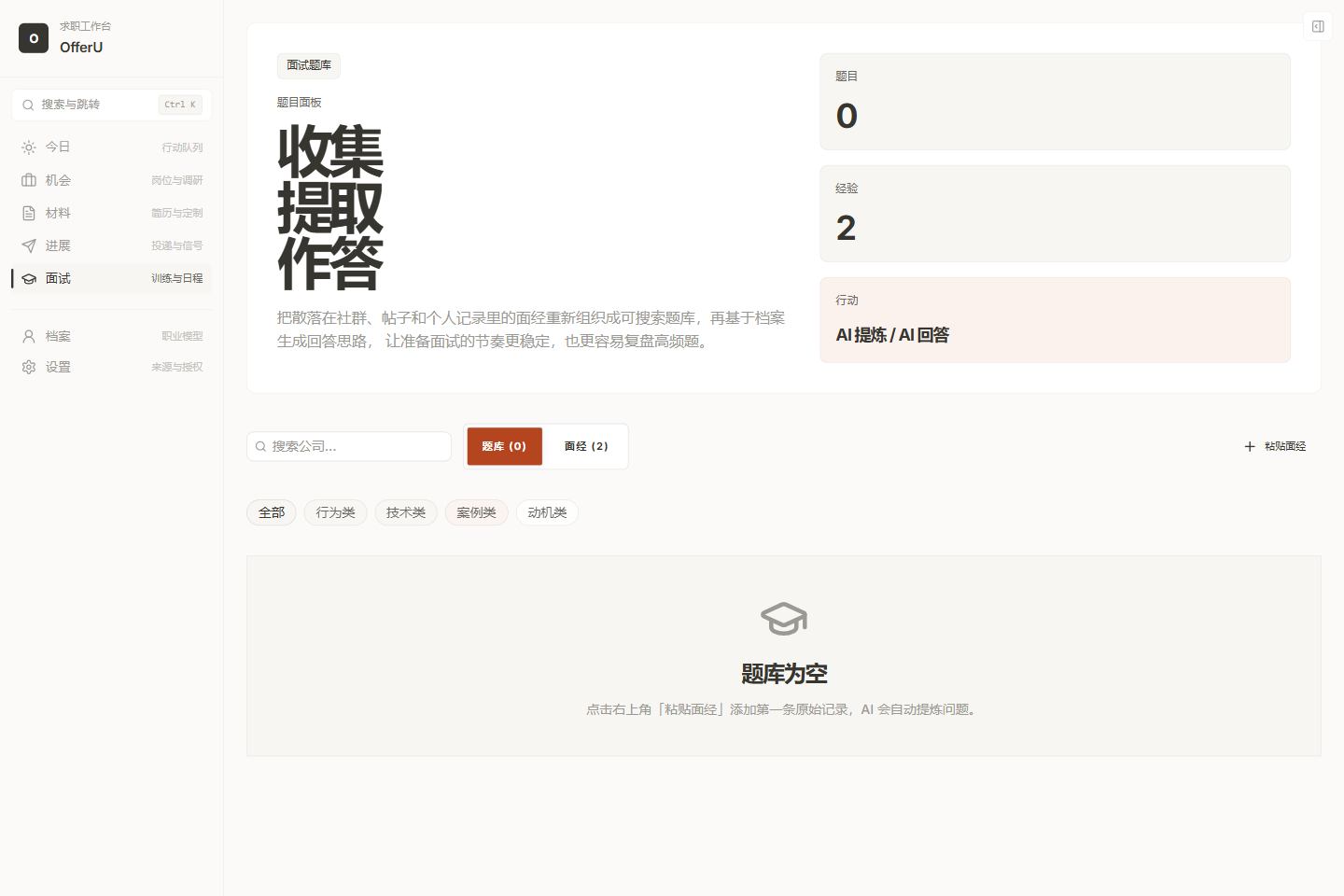 |
| Pipeline: stages, timeline, next action | Interview: targeted practice and debrief |
Why OfferU?
Most job-search tools solve one step.
Your resume lives in one place. Job research lives in another. Application tracking becomes a spreadsheet.
Interview practice starts from zero every single time.
OfferU treats the whole search as one evolving system instead of four disconnected chores:
Career Profile
      ↓
   Save Job
      ↓
Role Intelligence
      ↓
Evidence Gap
      ↓
Tailored Resume
      ↓
Application Pipeline
      ↓
Targeted Interview
      ↓
Debrief & Learning
      ↺
Instead of opening a fresh AI chat for every job, OfferU keeps one persistent, evidence-backed career
context and carries what it learns across the entire search.
Persistent career context
OfferU maintains structured career evidence — experience, achievements, skills, preferences, goals and
reviewed learning observations.
AI suggestions never silently become career facts. New information enters a reviewable candidate flow
before it can update your long-term profile.
Role Intelligence
OfferU does not only summarize a job description. It compares the target role against a cohort of
similar jobs, separates what is common from what is distinctive, and maps those signals against your
own evidence.
What does this role emphasize?
           ×
What can I actually prove?
           ↓
What should I prepare next?
Evidence-grounded resume tailoring
Every target job can have its own tailored resume without overwriting the source resume.
The Resume Workspace supports structured manual editing, live A4 / Letter preview, job-specific resume
versions, AI proposals with before / after diffs, accept / reject review, stale-proposal protection and
PDF export.
AI-generated claims are checked against career evidence before they become trusted application content.
Application pipeline
Today, Pipeline, Job Detail and Timeline all read from the same underlying career state. Application
progress is modeled as events rather than independent UI state, so OfferU can project one truth
across the product instead of asking you to maintain several trackers.
Targeted interview practice
Interview preparation is grounded in the intersection of role delta, career evidence gap and previous
interview learning:
Role Delta
×
Career Evidence Gap
×
Previous Interview Learning
OfferU generates targeted focus areas, runs turn-based practice, challenges vague answers, produces
transcript-backed debriefs and turns useful observations into reviewable learning candidates.
A controlled agent, not a black box
OfferU lets an AI agent reason and use tools, but the model never owns business truth.
Agent Runtime
    ↓
Operation Registry
    ↓
Proposal / Approval
    ↓
Career Runtime
The agent reasons. The Operation Registry controls capabilities and side effects. The Career Runtime
owns persisted truth. You remain the approval authority for sensitive changes and irreversible actions.
Product surfaces
| Surface | Purpose |
|---|---|
| Today | What changed, what OfferU finished, what needs your attention, and what matters next |
| Pipeline | Every opportunity, application stage, timeline and next action |
| Job | Research, Role Intelligence, evidence gaps, resume, application packet and interview preparation |
| Profile | Long-term career evidence, goals, preferences and reviewed learning |
Memory is a mechanism for evolving Profile — not a separate product silo.
The Agent is a system-wide capability — not another disconnected chat window.
AI setup
The product direction is Connect → Auto → Ready.
Beginner: connect an agent. Advanced: configure the stack.
Normal users should not have to understand runtimes, protocol versions, model IDs or custom endpoints.
OfferU detects a local agent you already have, checks it, and consumes its own model and account:
        OfferU

   AI Connection
        ↓
    Auto Detect
        ↓
┌───────┼───────┐
Codex  Claude  OpenCode
        ↓
   OfferU Skill
        ↓
   OfferU Bridge
        ↓
 Operation Registry
        ↓
   Career Runtime
If you already use Codex with your ChatGPT account, Claude Code with your Claude account, or
OpenCode, OfferU does not need an API key from you at all — the agent brings its own model and
authentication.
API configuration is the fallback for users with no local agent, self-hosting users, and advanced users
who deliberately want to configure the stack. It lives behind Advanced, where you get two protocols
rather than dozens of vendor presets:
- OpenAI-compatible endpoint
- Anthropic-compatible endpoint
Runtime diagnostics, experimental providers and provider health are advanced / developer surfaces.
Architecture
OfferU is split into three authorities on purpose:
flowchart LR
    U[User] --> UI[OfferU]
    UI --> A[Agent Runtime]
    A --> O[Operation Registry]
    O --> C[Career Runtime]
    O --> P[Proposal / Approval]
    P --> U
    C --> D[(Local Career Data)]
- Reasoning authority — replaceable agent runtimes plan, reason and choose capabilities.
- Execution authority — the Operation Registry validates schema, permissions, side effects, dry runs,
proposals and audit. - Truth authority — the Python Career Runtime owns Profile, Jobs, Applications, Resumes, Interviews,
Memory and other persisted career state.
This is why the underlying agent harness can evolve without moving career truth into a model or an
external runtime. Every surface — GUI, CLI, TUI, skills and agent integrations — goes through the same
Operation Registry; none of them writes business state on its own.
See ARCHITECTURE.md for the full boundaries and CONTEXT.md for
domain language and invariants.
Current technology
React / TypeScript   → product UI
Python / FastAPI     → career domain runtime, Operation Registry,
                       automation, persistence
Tauri / Rust         → desktop shell, process lifecycle, OS integration
Agent runtimes       → replaceable reasoning engines
SQLite               → local career data
OfferU intentionally does not duplicate business logic across UI, CLI, plugins and agent integrations.
Safety principles
- AI output is not automatically career truth.
- Important mutations are reviewable and auditable.
- External irreversible actions require explicit user control.
- Browser automation may assist with forms but must not silently submit applications.
- Career evidence preserves provenance; behaviour signals and model inferences enter a review inbox first.
- Provider failures must be visible rather than silently returning fake success.
- API keys live in the OS keyring (Windows Credential Manager / macOS Keychain / Linux Secret Service);
the config file keeps only acredential_ref. If the keyring is unavailable, saving fails loudly
instead of falling back to plaintext. - Credentials should stay out of model context, logs and version control.
See SECURITY.md for the current security status.
Getting started
OfferU is not yet published as a signed consumer installer. For source development and internal testing:
- DEVELOPMENT.md — environment and dev setup
- QUICKSTART.md — fastest local path
- INTERNAL_BETA.md — internal beta walkthrough and golden path
The intended public user path is:
Download
→ Install
→ Launch
→ Connect your AI agent
→ Build Profile
→ Save a Job
→ Let OfferU prepare the rest
If you find an
OfferU.exein the repository root, it is a legacy0.1.0binary, not the current
release candidate. Do not run it. The web entrypoint is alwayshttp://127.0.0.1:7410;8080is only an optional local llama.cpp model endpoint.
Release status
OfferU uses evidence-backed release gates rather than treating a successful build as production readiness.
Current status, validation evidence, known issues and quality scores live in:
Suggested developer checks:
Set-Location backend
.\.venv312\Scripts\python.exe -m pytest tests -q

Set-Location ..\frontend
npm run typecheck
npm run build
These commands only validate their own scope; they do not mean "ready for beta" or "ready to release".
Roadmap
Current priorities are productization, not more top-level features:
- Zero-friction AI setup — connect once, detect capabilities, default to Auto.
- Live Role Intelligence — validate at least one real external research path end to end.
- Public desktop release — signed installer, clean-machine setup, migration, backup, restore, upgrade.
- Privacy & security hardening — finish the remaining security and privacy gates.
- Real-user feedback — use it in actual job searches and fix the highest-impact issues.
Contributing
OfferU is moving quickly toward a public local-first release. Before contributing, read:
- CONTEXT.md — domain language and invariants
- ARCHITECTURE.md — system boundaries
- docs/adr/README.md — accepted architecture decisions
- DEVELOPMENT.md — development setup
Please do not bypass the Operation Registry for business mutations, and do not introduce a second source
of career truth.
License
Reviews (0)
Sign in to leave a review.
Leave a reviewNo results found