soba-agent
Health Warn
- License — License: MIT
- Description — Repository has a description
- Active repo — Last push 0 days ago
- Low visibility — Only 5 GitHub stars
Code Warn
- process.env — Environment variable access in bin/soba.js
Permissions Pass
- Permissions — No dangerous permissions requested
No AI report is available for this listing yet.
Proactive CLI coding agent with self-modifying skills, context management, and hybrid visual tooling.
SOBA Agent
Local-first engineering agent for code changes with a verifiable trail.


Install · First workflow · Docs · Changelog
SOBA runs in your terminal, keeps project context close to the repository, works through bounded tool loops, and writes
receipts for the work it claims to have done. It is built for everyday engineering tasks where the important question is
not only "did the agent edit the code?", but also "what changed, what was checked, what permissions were used, and what
evidence supports the handoff?"
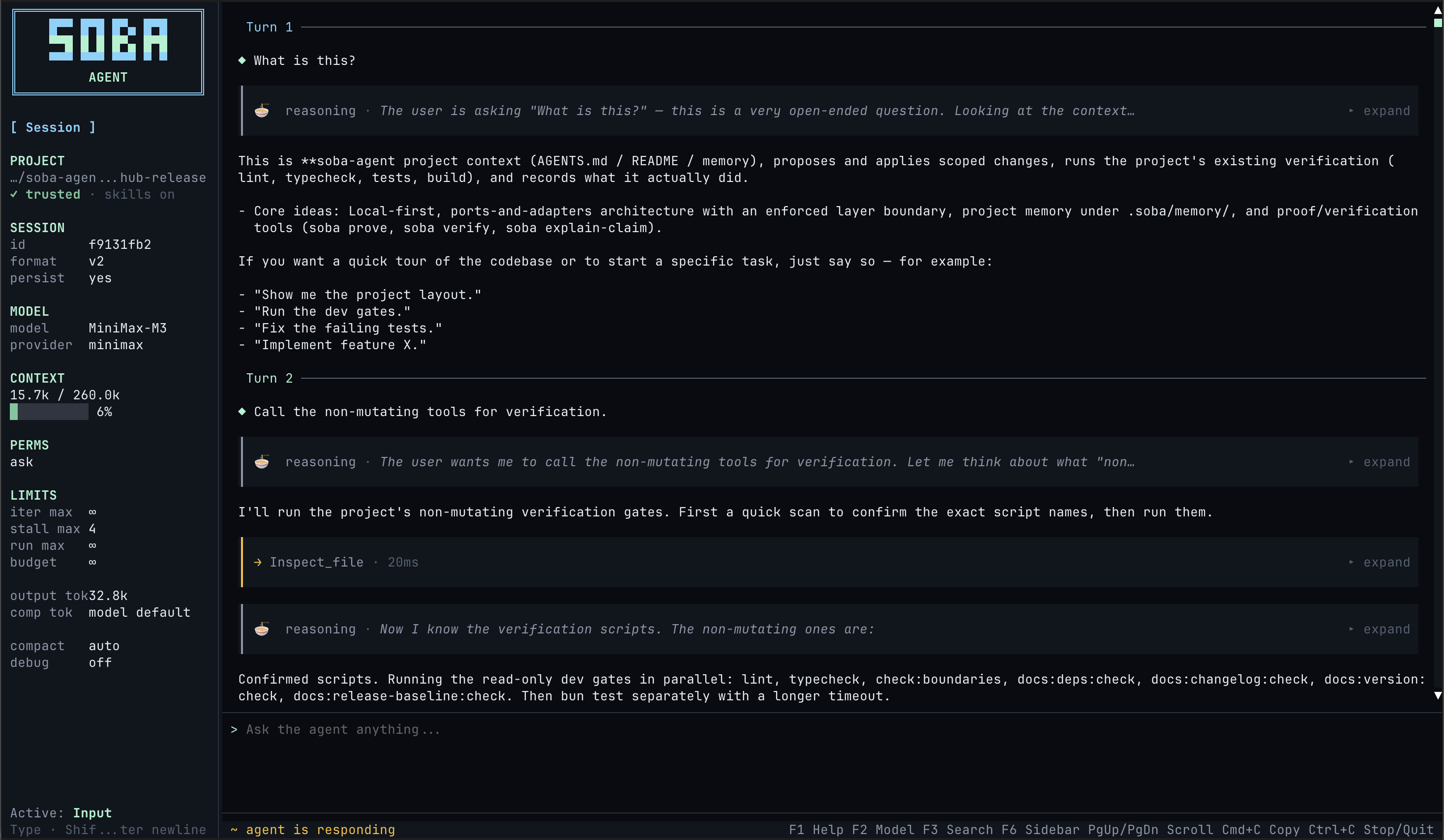
SOBA is built for engineers who want an agent to stay close to the repo: inspect before editing, ask for permission
before risky operations, run the project's own checks, and leave behind receipts that can be reviewed after the session.
What SOBA is for
SOBA is a coding agent with a local workflow:
- Interactive TUI for agent sessions, shell commands, slash commands, permissions, context, and model state.
- Sealed Proof Bundle v1 receipts in
.soba/evidence/*.soba-proof.json, with stable run/proof IDs, recursive
redaction, and whole-receipt SHA-256 integrity. - Proof claim mapping through
soba verifyandsoba explain-claim, making unsupported claims visible instead of
hiding them in prose. - Run metrics in sealed receipts for model calls and input/output/total tokens, so eval consumers do not have to
infer usage from terminal output. - Project Memory in
.soba/memory/with source receipts, stale checks, doctor output, and explanations. - Bounded permissions for dangerous operations, with permission receipts recorded in proof output.
- MCP support for local
stdioservers and remotestreamableHttpendpoints. - Skills for reusable project workflows, plus eval, bench, and trace commands for improving them over time.
- Portable capsules for compacting, resuming, and handing off long sessions.
The current 0.6.x line is focused on proof integrity, adversarial false-completion tests, and a real-model evaluation
baseline. A pinned ordinary-agent versus SOBA comparison now covers three task classes and two repetitions with external
acceptance outside producer workspaces, declared change scope, and six independently verified SOBA receipts. 0.7.0
targets a portable proof API, external run manifests,
and a generic CI gate; safe workspaces come
before any larger delegation loop.
Install
With npm:
npm install -g soba-agent
The npm package includes a pinned Bun runtime dependency, so users do not need to install Bun separately before runningsoba.
With Bun:
bun add -g soba-agent
Use the Bun install path when Bun is already part of your toolchain and you want Bun to manage the global package.
Check the CLI:
soba --version
soba --help
soba init --check
Start the interactive terminal UI:
soba -i
First workflow
Check providers:
soba provider listRun a minimal one-shot provider check:
soba --no-session --max-agent-iterations 1 "Answer with one word: ok"Open the TUI:
soba -i --lang en --theme graphiteIn the TUI, start with a bounded task:
Inspect this project.
Read package.json and the test layout first.
Then propose a short plan.
If edits are needed, keep them inside the plan and run a targeted test.
Do not create a git commit.
Run local checks from the TUI when you want direct control:
!git status --short
!git diff --stat
!bun test
Inspect the proof trail after non-trivial work:
soba prove --last
soba verify --last
soba explain-claim "No test regressions detected"
If a claim is not backed by evidence, SOBA should keep that visible. The receipt is the handoff artifact, not just a
transcript summary.
New receipts are sealed before persistence. soba verify returns exit 0 only for an accepted verified proof;
invalid, partially verified, unverified, and blocked outcomes return stable non-zero exit codes and machine-readable
reasons. Legacy receipts without integrity metadata remain readable with a warning but are not tamper-evident.
Work modes
Use /plan agent, /plan plan, or /plan goal to choose whether SOBA should implement, prepare a decision-complete
plan, or clarify the objective and success criteria. In Plan and Goal modes, mutation tools and bash/local_shell
are removed from the model's tool schemas before inference while the runtime denial remains as a second safety layer.
Implementation-style prompts in Plan Mode are automatically treated as requests to inspect and plan, without asking
the user to switch modes. See the Plan and goal modes guide.
Project Memory
Project Memory stores durable project facts under .soba/memory/ so future sessions can reuse context without relying
only on a long chat transcript.
Ask SOBA to save facts with source receipts:
Update Project Memory:
- architecture: core modules and data flow;
- conventions: Bun only, strict TypeScript, tests with bun test;
- known-errors: recurring failures and verification commands;
- dependencies: important runtime and dev dependencies.

Use project memory tools. Include source.file, source.lines, source.lastVerified, source.confidence, and staleIfFilesChange when a source can be verified.
Do not store secrets.
Then inspect memory health:
soba memory doctor
soba memory stale
soba memory verify
soba memory explain "provider registry"
Skills
Skills are reusable workflows that live with the project or the user environment. In the TUI:
/skill list
/skill:commit-message Suggest a conventional commit message for staged changes.
/skill deactivate commit-message
Activated skills are session-scoped, restored on session resume, and can be deactivated explicitly when they no longer apply. Bundled skills are included in both package and standalone binary distributions.
Project skills require trust:
/project-trust status
/project-trust approve
For skills that should stay reliable, use the eval loop:
/skill eval <name>
/skill bench <name>
/skill trace <name>
MCP tools
MCP servers are configured in .soba/mcp.json. From the TUI:
/mcp status
/mcp start <server>
/mcp reload
/mcp status
SOBA supports local stdio servers and remote streamableHttp endpoints. Remote credentials should come from
environment-backed auth such as bearerEnv or apiKeyEnv.
Session controls
Common ways to continue work:
soba -i
soba -c -i
soba -r
soba -s <SESSION_ID> "Continue the task"
Useful TUI commands:
/session
/sessions list
/budget
/permissions ask
/permissions repo
/auto-compact on
/compact Preserve the goal, decisions, changed files, checks, risks, and next step.
/capsule
/rewind
Auto-compaction is a deferred preflight barrier: turn and milestone triggers mark
work as pending, then SOBA shows live progress and waits immediately before the
next model call. The TUI remains responsive and queues new input. Disabling/auto-compact affects soft triggers only; hard-limit and overflow recovery stay enabled.
From source
git clone [email protected]:avacadorun-dev/soba-agent.git
cd soba-agent
bun install
bun run build
bun run src/cli.ts --help
Development gates:
bun run lint
bun run typecheck
bun test
bun run build
SOBA uses Biome for linting/formatting and Bun for scripts, tests, and builds.
Standalone binaries
Tagged GitHub releases build standalone binaries for macOS and Linux. Download the matching soba-* asset from the
release, make it executable, and run it directly:
VERSION="$(node -p "require('./package.json').version")"
chmod +x "./soba-linux-x64-v${VERSION}"
"./soba-linux-x64-v${VERSION}" --version
For normal use, prefer the npm or Bun global install path. Use a standalone binary when you do not want a global package
manager install.
Documentation
The documentation site source lives in docs-site/.
License
MIT © 2026 avacado.run [email protected]
Reviews (0)
Sign in to leave a review.
Leave a reviewNo results found