agentry
Health Uyari
- License — License: MIT
- Description — Repository has a description
- Active repo — Last push 0 days ago
- Low visibility — Only 7 GitHub stars
Code Gecti
- Code scan — Scanned 12 files during light audit, no dangerous patterns found
Permissions Gecti
- Permissions — No dangerous permissions requested
Bu listing icin henuz AI raporu yok.
OpenAI-compatible API backed by your Copilot / Codex / Claude Code / Grok CLI subscription. Reverse MCP: the agent becomes the model endpoint.
Agentry
Point your OpenAI SDK at the coding-agent subscription you already pay for.
The agent built to call tools becomes the tool.
Agentry wraps a coding-agent CLI — GitHub Copilot, OpenAI Codex, Claude
Code, or Grok Build — holds it as one persistent process, and serves the model behind it as
an OpenAI-compatible HTTP API on localhost. Your scripts and pipelines talk togpt-5.6-luna or claude-sonnet through the subscription you're already
logged into: no separate API bill, no per-call spawn tax (~8 s in -p mode
drops to the model's own ~1.5 s floor).
Three lines to see it work (Python 3.11+, copilot login done once):
git clone https://github.com/aweussom/agentry && cd agentry
.\start.ps1        # ./start.sh on Linux and WSL2; makes venv/, listens on :8765
from openai import OpenAI
client = OpenAI(base_url="http://localhost:8765/v1", api_key="unused")
r = client.chat.completions.create(model="gpt-5.6-luna", messages=[{"role": "user", "content": "hi"}])
print(r.choices[0].message.content)
Quota resets every month whether you spent it or not. Other backends and
flags are under Quick start; the terms-of-service note is under Known
limits.
Prefer the unhinged origin story to sysadmin-grade docs? The dev.to version
is here.
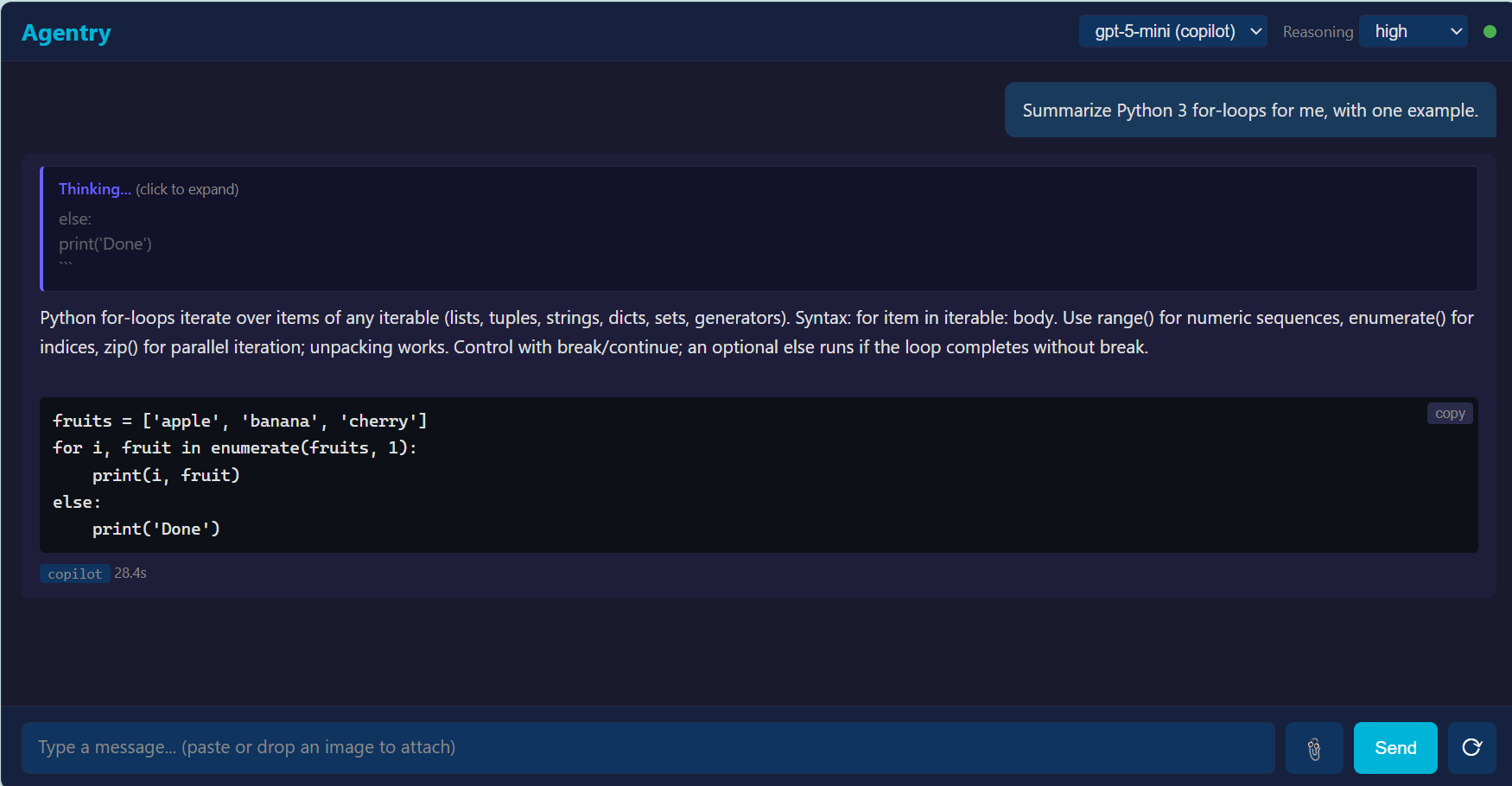
A minimal chat web UI ships with the proxy — markdown with code-copy,
image attach, live collapsible thinking blocks, a model picker fed by/v1/models, and an artifact side panel that renders fenced html/svg/markdown blocks. On the codex and grok backends it also generates
and edits images through the CLI's built-in image tool (codex'sgpt-image-2, grok's image_gen/image_edit), billed to the subscription
rather than an API — inline in chat, and as OpenAI-shaped/v1/images/generations and /v1/images/edits routes (see API). It is not the point of the project, just proof the API
works end-to-end. The launcher prints the URL (http://localhost:8765).
The idea: reverse MCP
MCP standardizes one direction: how a model consumes tools
(LLM ──▶ tools). Agentry points the arrow the other way. A coding-agent CLI
is an MCP client — it exists to call tools. Agentry confiscates them and
serves the bare model back out, so ordinary software consumes the model
instead (code ──▶ LLM).
Copilot sessions use an empty tool allowlist and a deny-all permission handler.
Claude disables built-in tools and MCP servers at launch. Codex refuses
client-side requests at the wire (JSON-RPC -32601) and usesapprovalPolicy: never, a read-only sandbox, an empty working directory and
chat-only instructions, with an explicit image-generation exception. Those
Codex settings do not establish that every runtime-internal tool is disabled.
The intended result is a language service behind an OpenAI-shaped API.
Backends
Selected with --backend. Adding one means implementing a single Backend
class in backends.py.
| Backend | Wraps | Cost tier | Defaults |
|---|---|---|---|
copilot (default) |
the official Copilot SDK | Copilot AI credits per token (1 credit = $0.01); gpt-5.6-luna is the cheap band ($0.20/M in), ~10× under gpt-5.6-terra, ~20× under gpt-5.6-sol (live rate card 2026-09) |
gpt-5.6-luna @ low |
codex |
codex app-server (persistent JSON-RPC stdio) |
ChatGPT Go $8 / Plus $20; Codex credits per token, luna 25× cheaper than sol |
codex's own configured model @ low |
claude |
persistent claude -p stream-JSON, conversation cleared per request |
Claude subscription (premium) | claude-sonnet-4-6 |
grok |
grok agent stdio (Grok Build, Agent Client Protocol over stdio) |
SuperGrok / X Premium+ subscription via grok login; no quota readout in the CLI |
grok-4.7 @ high |
All four backends reuse a runtime process. Claude clears its conversation
before every subsequent request, preserving independent tasks without paying
startup each time. Both the reset acknowledgement and its completion must
arrive; otherwise agentry falls back to fresh workers for the rest of that
backend's lifetime. Model changes restart the worker. Cancellation, timeouts,
failed turns and disconnected streams retire it so the next request starts clean.
Claude uses --safe-mode, --strict-mcp-config, --tools "", and--no-session-persistence to skip customizations, MCP, tools and saved
transcripts while retaining subscription authentication. Use a current Claude
Code CLI supporting these flags (validated on 2.1.281). --bare is not
used because its authentication behavior differs. Startup measurements and
reproduction commands are in the benchmark record.
Grok opens one ACP session per chat (session/new is ~0.6 s). It switches
model and reasoning effort as session state before each turn.
The shipped agent profile grok-agent-profile.md removes its tools. grok agent accepts none of the headless --tools / --deny flags, an emptytools: list is ignored, and permission prompts never reach the client. So a
non-empty allowlist is the only thing that works. Validated on 1.0.46, plan
and probes.
Four tools stay in: image_gen and image_edit (same carve-out as codex),read_file, which is how grok sees attachments, and image_to_video for/v1/videos. The profile is set per process, and there is one grok process,
so chat sessions get the video tool too.
The ACP prompt takes no image content. So an image_url attachment is written
under the scratch cwd's refs/<session>/ and the message names the path.
grok's read_file returns it as an image block, so "what is in this picture"
works. A follow-up "now make the collar blue" hands the same path toimage_edit.
Every tool call passes a client hook agentry registers on session/new
(_meta["x.ai/hooks"], reverse request _x.ai/hooks/run). read_file andimage_edit are denied for any path outside that refs dir or grok's own image
output dir. image_to_video is denied except on the session a /v1/videos
call runs. image_gen passes. Any other tool is denied outright.
Grok fails OPEN if the hook reply is late or malformed. For read_file andimage_edit the profile is the first line and the hook the second. For video
in chat the hook is the only line, apart from the profile prompt asking the
model not to.
Grok also reads Claude Code's ~/.claude skills and hooks by default; the
profile keeps them from mattering.
XAI_API_KEY is stripped from grok's environment so turns bill the
subscription, not the metered API.
Sessions and generated images persist under ~/.grok/sessions/ and are left
for the user to clean up. Attachment copies are removed when the chat ends.
Quick start
Prerequisites: Python 3.11+ plus the CLI login for the backend you use:
copilot—copilot loginonce from any installed Copilot CLI. The SDK
downloads its own pinned native runtime (Node.js not needed to run
agentry) and reads the same~/.copilotcredential store. With a
Microsoft Store Python the runtime lands in.copilot-runtime/inside the
repo instead of%LOCALAPPDATA%, whose Store virtualization breaks the
native loader.codex— Codex CLI on PATH,codex login(ChatGPT account, no API key).claude— Claude Code CLI on PATH and logged in;-pnever prompts.grok— Grok Build CLI (irm https://x.ai/cli/install.ps1 | iexorcurl -fsSL https://x.ai/cli/install.sh | bash),grok loginwith the
grok.com account.~/.grok/binis found even before PATH is refreshed.
LeaveXAI_API_KEYunset.
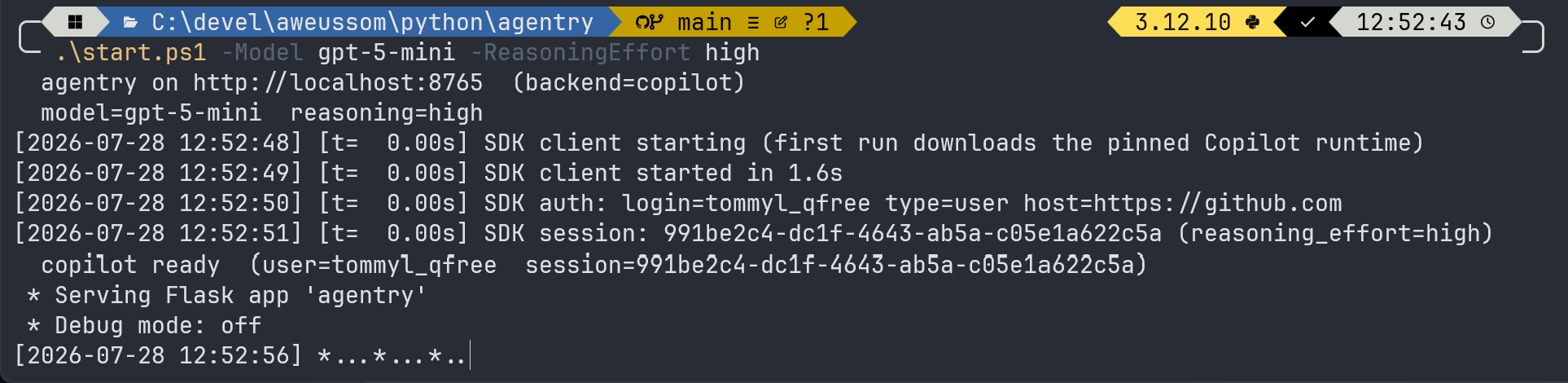
Windows (PowerShell 7+) — run from the same logon session as your
interactive copilot login, or the credential-store token is unreachable:
.\start.ps1                          # copilot, gpt-5.6-luna, effort=low
.\start.ps1 -Backend codex           # model from codex config
.\start.ps1 -Backend claude
.\start.ps1 -Backend grok             # grok-4.7, effort=high
.\start.ps1 -Port 9000
.\start.ps1 -Model gpt-5.6-terra -ReasoningEffort high   # or --model/--reasoning-effort
start.ps1 takes PowerShell flags (case-insensitive, prefixes like-Reasoning work) and forwards GNU-style --flags to agentry.py
unchanged, so the start.sh spelling works on Windows too.
Linux / WSL2 — log in inside your Linux environment (in WSL2: inside WSL,
not via the Windows host; npm is only needed for this login step):
npm install -g @github/copilot && copilot login     # one-time
./start.sh                           # flags: --backend codex|claude|grok, --port 9000
Open http://localhost:8765 and chat. From WSL2 the same URL works in a
Windows browser via automatic port forwarding.
Configuration
Launcher params (start.ps1 -Flag / start.sh --flag; start.ps1 accepts
both spellings):
- Port — HTTP port, default
8765. - Backend —
copilot(default),codex,claude, orgrok. - Model — override the default.
copilot: set as the SDK session's model, validated against your plan'smodels.list. The available set tracks Copilot's plans — check your
model picker, not this README. Nothing is hardcoded: a model that
appears in the Copilot CLI picker (e.g.gpt-5.6-terra) is usable
immediately, per request or via-Model.codex: sent perturn/start. When unset, each thread runs whatever~/.codex/config.tomlsays — and the codex TUI writes your last picked
model there, so agentry silently follows TUI switches unless you pin-Model. Deliberate (it tracks OpenAI's model migrations for free), but
pin for prod. The startup log'scodex thread: ... (default model=...)
line shows what each thread resolved to.claude: passed toclaude --model.grok:session/set_modelon the chat's ACP session.grok-4.7
(default),grok-4.6,grok-4.5; the CLI also listsgrok-4.7-build-fast("2x the price"), which agentry hides.- A pinned model is validated at startup against the backend's model list
(copilotmodels.list, codexmodel/list, grok'sinitialize
model state); an unknown id exits with
code 2 and prints what is available, instead of coming up "ready" and
failing every turn. Codex's ids are OpenAI's (gpt-6-sol/-astra/-luna,gpt-5.6-sol/-terra/-luna,gpt-5.5as of
2026-10;model/listis the authority). There is no Claude on codex.
- ReasoningEffort —
none/minimal/low/medium/high/xhigh/max/ultra. What applies
is per model: copilot's gpt-5.6 models advertisenone→max, codex takesnone→ultra(ultrais codex-only: "maximum reasoning with automatic
task delegation"); a model that rejects a level keeps its previous one
(WARN, not an error). grok takeslow/medium/high/xhigh(noneandminimalmap tolow,maxandultratoxhigh, andgrok-4.5has noxhighso it getshigh); the launcher default ishighthere,low
elsewhere. No-op onclaude— agentry does not yet forward the CLI's--effortsetting.
Per-request model and effort
Launcher values are only defaults. Like a normal OpenAI endpoint, model and
effort are request fields, not server state — each turn runs on exactly
what its request asked for, applied atomically with the turn:
"model"— copilot: the live session is switched under the turn lock
(conversation history preserved); codex: aturn/startparam; claude: the
worker's--model(restarted when it changes); grok:session/set_model
plussession/set_config_option reasoning_efforton the chat's session,
inside the turn lock, only when they differ from what the session already
runs. Ids are validated against the account's model list;
unknown ids return an OpenAI-style404 model_not_foundinstead of
silently running a fallback. Requests that omitmodelrun the launcher
default (or the backend's own default when unpinned) — selection is never
sticky."reasoning_effort"— same vocabulary as-ReasoningEffort, same
per-turn semantics.
Concurrent clients can safely request different models: turns serialize
through one lock and each runs its own selection. On copilot they still
share one conversation (single session), so history is common even though
the model per turn is not. /health and the active flag in /v1/models
report the model a selection-less request runs on, verified against the
runtime where possible — a pin silently overridden by org policy shows up
there as the override, not the wish.
Console & quota
Idle, the console pulses an in-place heartbeat; during a turn it becomes a
news ticker scrolling the model's current reasoning/output line. Each backend
also meters spend live:
- copilot — per-turn AI-credit cost from the SDK's usage events
(turn cost 0.011 credits (session total 1.455)), plus this machine's
calendar-month total read from the Copilot runtime's own ledger
(~/.copilot/session-store.db). The account-wide plan meter counts every
device and isn't in any public API, so the machine figure is a floor. The
ready-line prints which login (user=...) is paying. - codex — a quota line at idle and every ~10 min
(codex plus quota | weekly 99% left (resets 20 Aug 17:04)), plus each
turn's exact tokens and rate-card cost estimate
(tokens in=12677 (cached 9984) out=6 ~0.019 credits). Primed at startup
and kept fresh by codex's own push notifications — no extra API calls. - claude — real 5-hour/weekly OAuth usage when
claude-code-quotais
installed (agentry reads its cache passively); otherwise the coarserate_limit_eventclaude streams per turn (status + reset, no %). - grok — per-turn tokens and the dollar estimate grok itself reports,
plus a this-run total at idle. Model tokens only: images and video are not
in it, and the CLI has no subscription quota readout.
API
GET /health— readiness probe.GET /v1/models— the account's real model list (copilotmodels.list,
codexmodel/list, grok'sinitializemodel state) with anactiveflag and creditprice_category;
single synthetic entry when the backend can't enumerate.POST /v1/chat/completions— SSE streaming in standard OpenAI delta
format; images ride asimage_urldata: URIs; copilot's streamed reasoning
summaries are forwarded asdelta.reasoning_content(the
DeepSeek-popularized extension; standard clients ignore it). Images the
backend generates (codex or grok, see below) arrive asdelta.images/message.images— OpenRouter's convention, a list ofimage_urldata:
URIs — never inline incontent, so a client parsing JSON out of the
reply is unaffected.POST /v1/images/generations— OpenAI Images API shape over codex's
(or grok's) built-in image tool:{"prompt": ...}→{"data": [{"b64_json", "revised_prompt", "size"}], "output_format": "png"|"jpeg"}. One image per call.sizeis honored as an
aspect ratio, not a pixel count: codex pinsgpt-image-2atsize=auto, which reads the prompt, so agentry turns1536x1024,1024x1536,1024x1024or anyWxHinto explicit orientation wording,
and the output lands at that ratio inside a fixed ~1.57-megapixel budget
(1536×1024, 1024×1536, 1254², 1672×941 for 16:9). Eachdata[]entry
carries the PNG's realsize; resize downstream if you need exact
pixels.qualityis accepted and ignored (hardcodedauto). Other
backends answer 501.POST /v1/images/edits— the same, anchored on reference images: OpenAI's
multipart form (image/image[]file parts +prompt), or JSON withimageas a data: URI (or a list). The ceiling is the tool's own: 5
references on codex, 3 on grok, 400 above that. On codex the references
ride the turn as attached images; on grok they are written to the scratch
cwd and passed toimage_editby path. Withoutsize, the output takes the reference's proportions but the prompt
decides orientation (a downstream 16:9 reference came back 941×1672 for
"a standing figure filling the frame"); passsizeto pin it.maskis
rejected (400):
neither tool takes one. Both Images routes run each call on a throwaway
codex thread or grok ACP session, so a batch of edits never
accumulates old references in one context and never disturbs the chat
session; they still serialize with chat turns through the one turn lock.POST /v1/videos— the OpenAI Videos API shape over grok'simage_to_video(grok only, 501 elsewhere).promptplus a mandatoryinput_reference(multipart file part, or JSON{"image_url": "data:..."});
grok has no text-only video.seconds(grok's floor is 6) andsizeare
advisory like the Images routes. Generation is synchronous, ~45 s end to
end for a 6 s clip, so the returned video object is alreadycompleted(orfailed
witherror), with the deliveredsizeandsecondsread from the MP4.GET /v1/videos/{id}returns the object,GET /v1/videos/{id}/content
the MP4 (variant=videoonly),GET /v1/videoslists,DELETEforgets
the id and leaves the file. Ids live in memory; the clips stay under~/.grok/sessions/<cwd>/<session>/videos/. Chat completions carry no
video: the backend's hook denies the video tools outside a/v1/videos
turn.POST /v1/cancel— cancels the in-flight turn (copilotsession.abort(),
codexturn/interrupt, groksession/cancel, claude kills the process).
Image generation (codex)
codex-cli ≥ 0.149 ships image generation as a stable, on-by-default
built-in tool, and it works over app-server under agentry's locked-down
thread (no approvals, read-only sandbox, empty cwd — probed on 0.154.0,_bench/codex_imagegen_probe.py). agentry's chat-only developer
instructions carve it out as the one permitted tool, only when the user
explicitly asks for an image, so enrichment prompts stay image-free. Ask
for a picture in the web UI and it renders under the reply.
It is slow on real work. A short prompt takes ~15-20 s, but a comic pipeline
with long prompts and 4-5 references took 2.5-3.5 min per image, against ~25 s
for the same job on OpenAI's Images API. For a batch the trade is wall clock
against plan quota, not just money. A long prompt plus one 0.7 MB reference
was ~45 s (downstream measurement). Calls serialize through the one turn lock, so a
batch of 30 is ~20 min of wall clock. ~0.7–1.4 MB PNG; a copy is also left in~/.codex/generated_images/<thread>/ by codex itself.
The pipeline run, 2026-10-04: prompts of 1,000-4,800 chars, 4-5 reference
images, size 1024x1536, gpt-6-sol @ medium. Three edits/generations measured 3 min 23
s, 2 min 40 s and 3 min 32 s from the client. 152-195 s of that was the singleimageGeneration item. One tool call per turn, near-empty reasoning, agentry
overhead ~5 s. Dropping from 5 to 4 references gained nothing measurable. Same
prompt and references against OpenAI's Images API with gpt-image-2.5-flare
took ~25 s. /v1/images/edits is a real edit, though. In both tests the strip
came back pixel-close with only the requested change (two deer added to one
panel, a pile of fur removed from another).
The chat model does not change the picture. Every model on the account in
the 2026-09-12 probe (luna, terra, sol, gpt-6-astra, gpt-5.5) gets the samegpt-image-2 tool, honored the aspect, and took 40–58 s
(_bench/codex_image_model_probe.py). What differs is the rewrite: the
chat model rephrases your prompt before handing it to the image model.luna forwards it almost verbatim; the bigger models triple it with
content you never asked for (sol added "no weapon required" and the
knight lost his sword). For a pipeline that wants its prompt to reach the
image model, the cheap default is the right choice. The tool is offered
only on a paid ChatGPT plan with ChatGPT login — a Free plan or anOPENAI_API_KEY login does not get it (codex spec_plan.rs).
Cost is the point: the image bills against the ChatGPT-plan window
(three probe images moved a Plus 5-hour window by at most one integer
percentage point in total), not against API pricing, where the same
image on gpt-image-* is ~1 US cent. OpenAI's own guidance is that
image turns consume included usage "3–5× faster" than text turns — that is
a server-side weighting, not extra tokens: an image turn reports ~10
output tokens, so agentry's per-turn credits estimate understates it.
For batch generation OpenAI points at OPENAI_API_KEY billing instead.
Image generation (grok)
Grok Build ships image_gen (plus image_edit, image_to_video,reference_to_video) as built-in tools. The agent profile keeps image_gen
and image_edit (and image_to_video, for /v1/videos only), under the same "only when explicitly asked" clause. So a
chat request for a picture on the grok backend renders inline too: the tool
writes a JPEG (1024×1024 for a square prompt, ~75 KB) under~/.grok/sessions/<cwd>/<session>/images/ and reports the path. Agentry reads
it back into delta.images / message.images with the model's rewritten
prompt as revised_prompt. Measured 2026-10-04 on 1.0.46: ~6 s from tool
start to file, ~12-14 s for the whole turn with a short prompt. Grok's
per-turn cost estimate does not include the image.
/v1/images/generations and /v1/images/edits work on grok too. Each call
runs on a throwaway ACP session. References for edits are written to the
scratch cwd and handed to grok's image_edit tool as file paths (the ACP
prompt itself takes no image content), then deleted. Differences from codex,
all measured 2026-10-04 with a four-panel strip prompt of ~1.5k chars: output
is JPEG (the response's top-level output_format says so), 832×1248 for a
2:3 request, 20-30 s per call including the model's rewrite, and at most 3
reference images - xAI's API rejects more ("This model supports at most 3
input image(s)"), so agentry returns 400 above that, as it does above 5 on
codex.
Style note from the first real strips: image_gen from canon text alone
followed a "modern 3D cartoon" instruction well. image_edit with character
cards kept the identities but drifted toward photorealistic rendering and was
more erratic (a head on the wrong body, a character swapped for a deer), with
or without reinforced style wording. The comic pipeline that drives agentry's
edits route tried it the same day with combined character cards: style and
lettering right, identities recognisable, but roles and figures swapped
between panels, a dog changed breed, and a character was doubled. Verdict was
"not a candidate for strips today", at ~1.2 cents a call.
Judge for your own material.
Video, too. Grok Build ships image_to_video and reference_to_video, and
both need an input image (reference_to_video without one fails with
"Provide at least one input: images (up to 14), voices (up to 3),first_frame, last_frame, and/or keyframes (up to 4)"). They also need
coding-data sharing on, or a user-hosted S3 bucket in managed_config.toml.
With /privacy ("Coding data, retention, and training") at Opt out, the
tools fail as "unavailable under zero data retention". Opt in is not scoped
to video. It is an account setting (coding_data_retention_opt_out in the
login), and it lets xAI retain and train on prompts, traces and metrics from
all grok use on the account, agentry chat and attachments included. Team
ZDR is a separate admin switch that locks this setting.
Measured 2026-10-05 on 1.0.46 with a character card as reference:
6 s clip (the tool's floor), 448x672 at the model's default 480p in 29 s,
768x1168 at 720p in 39 s, MP4 H.264 + AAC, 1.1 to 3.2 MB. The cost estimate
grok reports does not include the clip. Exposed as /v1/videos (see
API), not in chat.
Architecture
agentry.py is the Flask layer (routes, OpenAI shape, session reuse);backends.py holds the Backend ABC and the four implementations. Flask
talks only to the interface (new_session / prompt / cancel /is_alive / close), so swapping backends is a flag; per-request model and
effort ride as prompt() arguments, applied inside each backend's turn lock.
The turn lifecycle is hardened against the ugly paths: a codex turn/start
error (bad model, dead thread) surfaces to the client immediately instead of
stalling to the stream timeout; a turn abandoned by timeout is cancelled
server-side so it stops burning quota; and stray updates from an abandoned
turn are filtered by turn id, so a zombie turn can never bleed text into the
next request's response.
.github/copilot-instructions.md pins per-session behavior for the copilot
backend (treat prompts as standalone chat, no repo reads, no tool requests,
be terse), overriding any global ~/.copilot/ instructions that would leak
context hints into prompts.
File map
| Path | Purpose |
|---|---|
agentry.py |
Flask server + OpenAI surface + backend selection |
backends.py |
Backend ABC + copilot / codex / claude / grok implementations |
logutil.py |
Timestamped logging + idle heartbeat/ticker |
templates/, static/ |
Web UI |
.github/copilot-instructions.md |
Per-project chat-only instructions (copilot) |
grok-agent-profile.md |
Agent profile that strips grok's tools down to read_file, image_gen, image_edit and image_to_video, and sets its chat-only prompt |
test_*.py |
Offline regression tests: HTTP selection race, CLI model pin, Claude lifecycle, Grok ACP lifecycle, Videos API |
start.ps1 / start.sh |
Launchers (create venv, run agentry) |
TODO.md / TODONT.md |
Roadmap / paths intentionally not taken |
archive/ |
Backend design + validation records |
logs/ |
Runtime wire traces (gitignored) |
Known limits
- Terms of service. Personal, localhost-only adapter. Each
backend stays authenticated through its own official client and remains
subject to that provider's terms; agentry adds no access path, credentials
or multi-user service on top. Thecopilotbackend rides the official
Copilot SDK, a supported product surface.codex,claudeandgrok
wrap interactive CLIs programmatically and sit in the usual gray ToS zone:
use a non-critical account there, keep volume modest, never expose the
port publicly. - Tool requests are always denied — by design, with one carve-out:
codex's and grok's built-in image generation, and only when a message
explicitly asks for an image (see Image generation); on grok alsoread_file, gated to the attachment folder, because that is its only way
to see an image, andimage_to_videoinside/v1/videoscalls. Everything else — shell, other file reads, MCP — is
refused, so a prompt that genuinely needs a tool degrades or errors rather
than working around it. - The grok hook fails open. A late or malformed hook reply lets the
tool call through. Forread_filethat means any file the user can read
can end up in the model context at xAI; forimage_to_videoit means a
clip from chat. The trigger would be a prompt injection in an attachment
plus a slow reply. The handler is pure and fast to keep that window small,
not closed. - Reasoning trace depends on backend. Copilot's and codex's streamed
summaries reach the console ticker and the web UI think-block, grok's
thought chunks reach the web UI; claude forwards none. - Auth is inherited, not configured. There is no token setting: agentry
uses whatever login the backend CLI already has for the user running it
(copilot login,codex login,grok login, Claude Code's own login).
Grok's token expires after 7 days without a refresh; a failingsession/newthen surfaces as an error telling you to log in again. Start it from
that user's own shell. Running it as a Windows service or under another
account will not find the Copilot credential, which lives in the
per-logon credential store. - Single user, single session. Concurrent clients share one backend
session and serialize through one turn lock — personal use, not
multi-tenant. - Codex carries a fixed ~24.8k-token harness per turn (its agent system
prompt + tool schemas). Not reducible, cached server-side, not separately
billed on a flat subscription. Beyond cost, that prefix is agent
scaffolding the model reads before your prompt, so it can colour
responses. Copilot is not free of this either, just ~5x lighter: the
runtime's ledger shows a 22-byte prompt billed at ~5.3k input tokens ongpt-5.6-luna(~2.9k ongpt-5-miniin July), and about 900 of those
are agentry's own.github/copilot-instructions.md, which is the one
lever we do hold — it asks for terse, chat-only replies. Grok's default
harness is ~16.6k tokens (tool schemas plus every Claude Code skill it
finds under~/.claude); the agent profile cuts it to ~5.6k.
Related work
The same itch — "I already pay for this agent, let my own code call the
model" — has been scratched once per vendor, many times over. Ordered by
maintenance activity as of 2026-09-11 (most recently pushed first); stars
are from the same day and will drift.
| Project | Wraps | How | Status 2026-09-11 |
|---|---|---|---|
caozhiyuan/copilot-api |
Copilot, codex, third-party APIs | reverse-engineered HTTP; Chat Completions + Responses + Anthropic Messages; Electron desktop app | very active — releases several times a week; ~1k★ |
icebear0828/codex-proxy |
codex | ChatGPT backend API with the OAuth token; OpenAI/Anthropic/Gemini protocols; non-commercial license | very active; ~1.7k★ |
messense/copilot-api-proxy |
Copilot | Rust reverse proxy, OpenAI + Anthropic endpoints | active; small |
hotchpotch/openai-api-server-via-codex |
codex | Go server on the codex login token; PyPI/binaries | active; ~50★ |
wende/claude-max-api-proxy |
Claude Code | spawns claude -p per request; OpenClaw integration |
active; ~130★ |
theblixguy/copilot-sdk-proxy |
Copilot | the official Copilot SDK (TypeScript); Chat Completions + Anthropic + Responses; npm; the core of xcode-copilot-server |
dependabot-only since 2026-07; ~10★ |
rezrov/copilot-proxy |
Copilot | the official Copilot SDK (Node); client-owned tool loop; proposed in copilot-sdk discussion #218, unanswered by GitHub staff | quiet since 2026-07; ~10★ |
vkop007/codex-app-proxy |
codex | persistent codex app-server — the same surface agentry's codex backend uses |
abandoned 2026-02 |
anshulpatel25/copilot-sdk-gateway |
Copilot | Python Copilot SDK, one client per request | archived 2026-05 (author cites the move to usage-based billing) |
ericc-ch/copilot-api |
Copilot | reverse-engineered HTTP; the original | dormant since 2025-11, 130+ open issues; ~4k★ — use the caozhiyuan fork |
Where agentry sits: caozhiyuan covers several vendors over reverse-engineered
HTTP; the rest wrap one. Agentry puts Copilot, codex, Claude Code and Grok
Build behind the same endpoint, and drives each through its official surface (Copilot SDK, codex app-server,claude -p, grok agent stdio) rather than reverse-engineered HTTP. It is also the only one that
strips the tools — the others expose tool execution as a feature, agentry
serves the bare model (see reverse MCP above) — and the only one with a
live credit/quota line in the console, which matters once a batch can drain
a month's allowance overnight. Want a broad multi-client gateway with a GUI?
Pick caozhiyuan or icebear0828. Want a thin local wrapper over the official
surfaces, with backend choice per launch? That's agentry.
Acknowledgments
- Agent Client Protocol by Zed Industries —
the copilot backend's original transport, since replaced by the Copilot SDK. - Web UI based on NoLlama (an
OpenVINO-based LLM server for Intel NPU/GPU).
Yorumlar (0)
Yorum birakmak icin giris yap.
Yorum birakSonuc bulunamadi