sample-strands-agent-with-agentcore
Health Gecti
- License — License: MIT
- Description — Repository has a description
- Active repo — Last push 0 days ago
- Community trust — 134 GitHub stars
Code Basarisiz
- process.env — Environment variable access in agent-blueprint/agentcore-gateway-stack/infrastructure/bin/gateway-stack.ts
- rm -rf — Recursive force deletion command in agent-blueprint/agentcore-gateway-stack/infrastructure/lib/lambda-stack.ts
- network request — Outbound network request in agent-blueprint/agentcore-gateway-stack/infrastructure/lib/lambda-stack.ts
Permissions Gecti
- Permissions — No dangerous permissions requested
This tool is a reference architecture and sample project for building complex, multi-agent AI chatbots. It uses Strands Agents and Amazon Bedrock AgentCore to orchestrate workflows involving browser automation, code execution, and tool integration on AWS.
Security Assessment
Overall risk: Medium. The tool is designed to execute complex actions, which is reflected in the code analysis. It uses environment variables to handle configurations, which is standard, but one instance was flagged. A critical scan failure occurred due to a recursive force deletion command (`rm -rf`) found in the infrastructure code; while often used in deployment teardowns, this warrants manual review to ensure it cannot be accidentally misused. Additionally, the agent makes outbound network requests to support its web search and API integration capabilities. No hardcoded secrets or dangerous repository permissions were detected.
Quality Assessment
This is a highly trustworthy, well-maintained project backed by significant community interest. It is very active, with repository updates occurring as recently as today. It operates under the highly permissive and standard MIT license. Furthermore, it has garnered over 130 stars, indicating strong community validation and peer review.
Verdict
Use with caution. The project is an excellent and professionally maintained AWS reference architecture, but the presence of `rm -rf` and active network capabilities means you should review the codebase before deploying it in a production environment.
Reference architecture for agentic AI chatbots with Strands Agents and Amazon Bedrock AgentCore
Strands Agent Chatbot with Amazon Bedrock AgentCore
An end-to-end reference architecture for building agentic workflows using
Strands Agents and Amazon Bedrock AgentCore.
This repository demonstrates how to design and deploy a multi-agent chatbot that combines
tool execution, memory, browser automation, and agent-to-agent collaboration.
It is intended as a realistic, extensible sample for teams exploring advanced agent architectures on AWS.
Demo
https://github.com/user-attachments/assets/11b383c2-2e14-4135-833f-b0b2bce62953
Mobile App
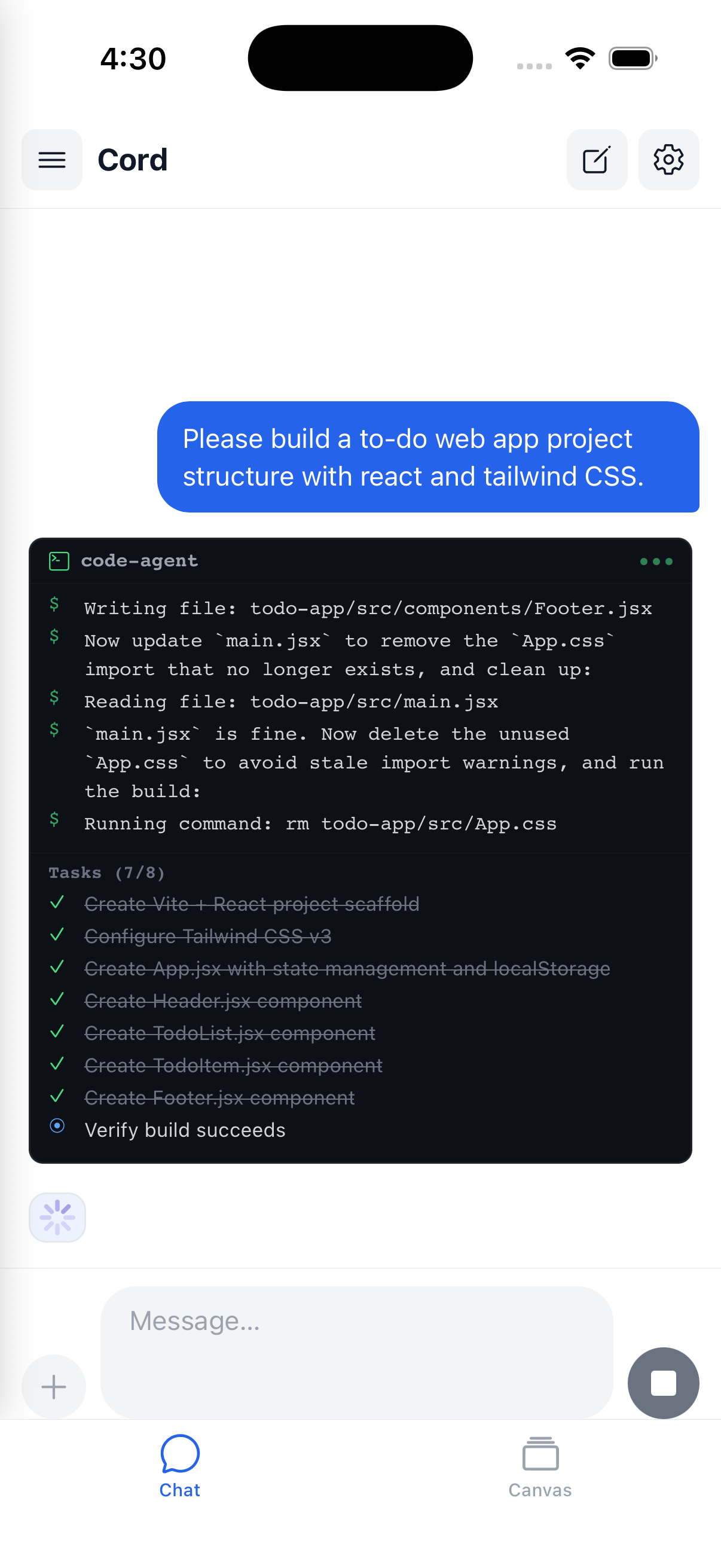 Coding Agent |
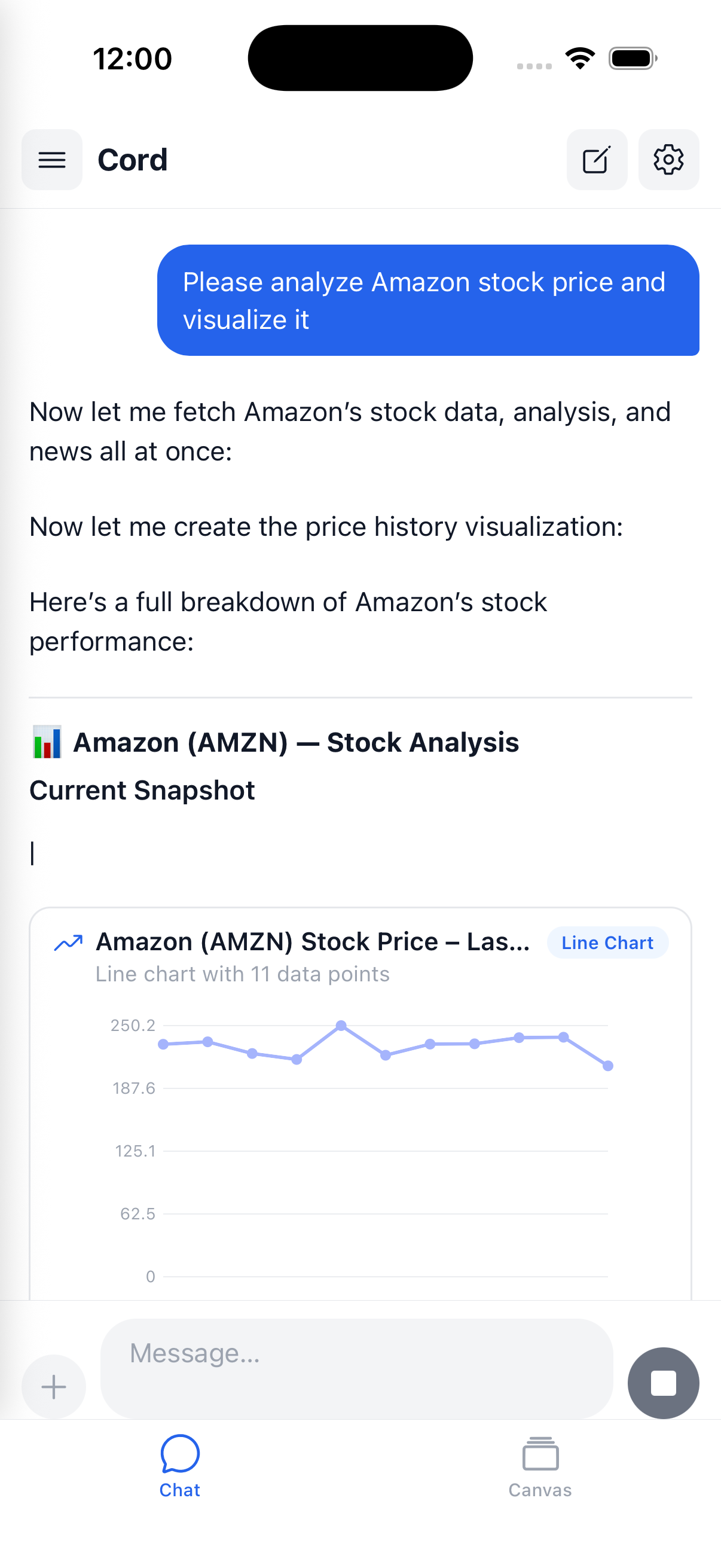 Financial Analysis |
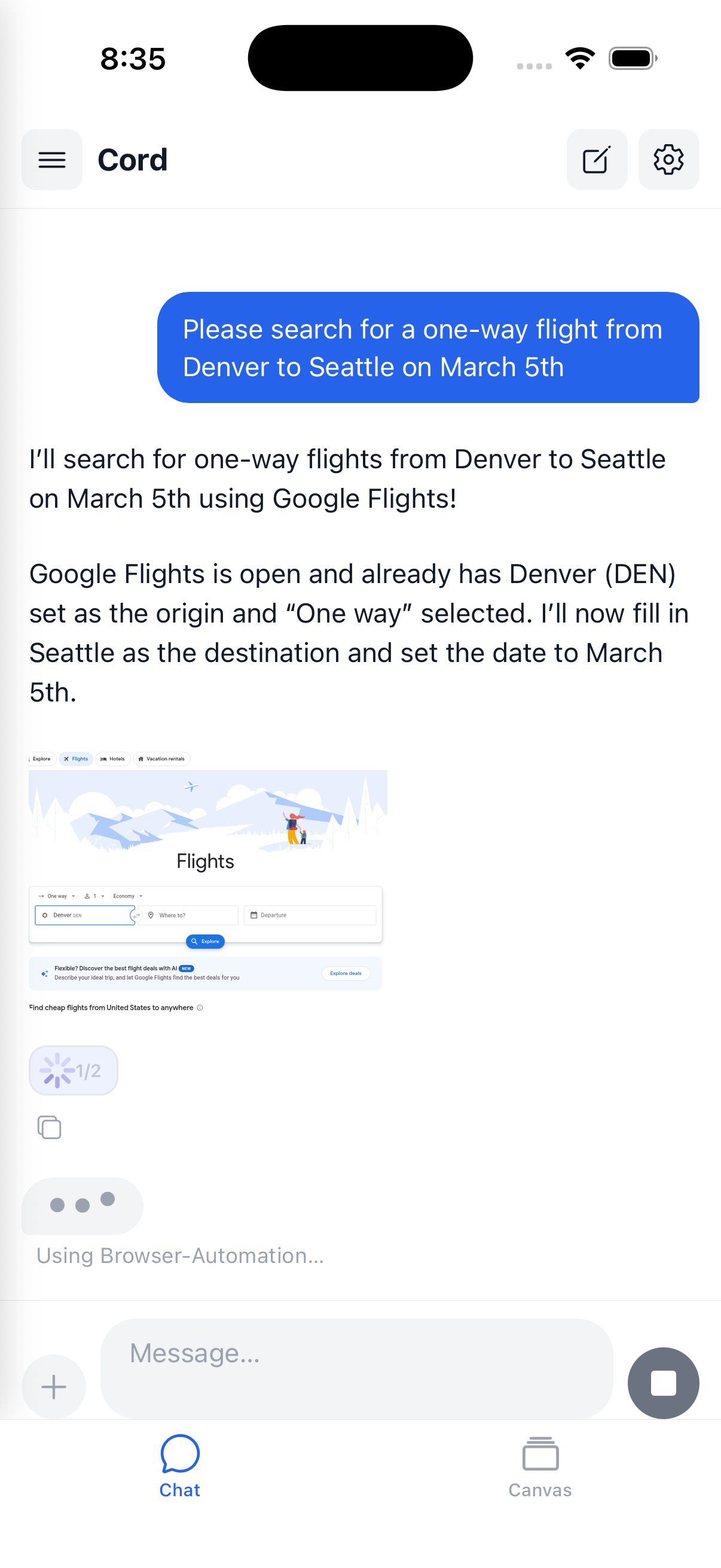 Browser Automation |
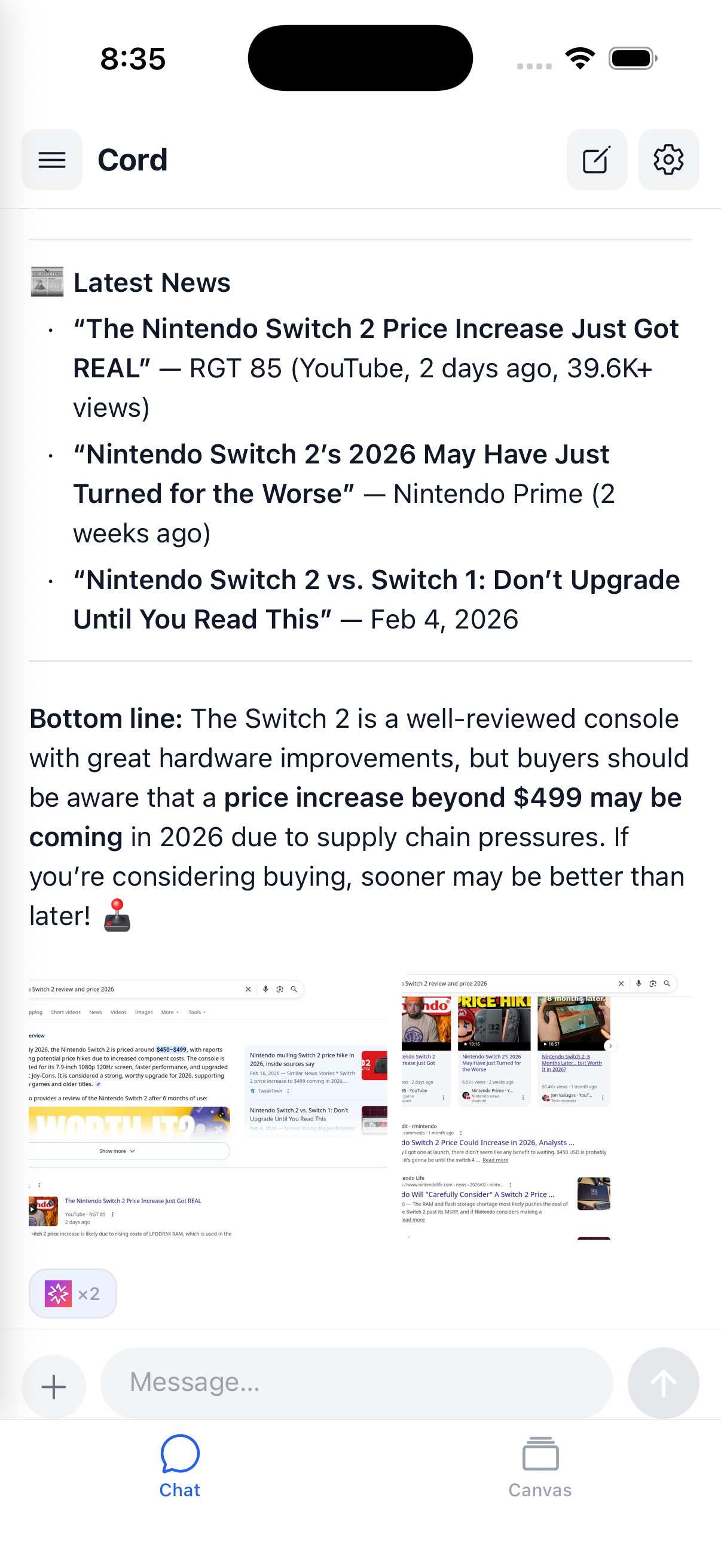 Web Search |
What this repository demonstrates
- Multi-agent orchestration with Strands Agents
- Integration with Amazon Bedrock AgentCore
- Tool-enabled agents (search, finance, weather, browser, code interpreter)
- Autonomous browser, documentation, and analysis workflows
- Modular architecture adaptable to real customer use cases
- Infrastructure-as-Code (CDK) for repeatable deployment
If you are building agentic AI applications on AWS and want a concrete, end-to-end example,
this repository is designed to be read, run, and extended.
Quick links:
Architecture · Key Features · Quick Start
Architecture Overview
This sample combines Strands Agent orchestration with Amazon Bedrock AgentCore services:
| Component | Role |
|---|---|
| Strands Agents | Multi-turn reasoning and tool orchestration |
| AgentCore Runtime | Managed, containerized agent execution |
| AgentCore Memory | Persistent conversation state and summarization |
| AgentCore Gateway | MCP-based tool integration with SigV4 authentication |
| AgentCore Code Interpreter | Secure Python execution for analysis and document generation |
| AgentCore Browser | Headless browser automation with live view |
| AgentCore Identity | End-user authentication and 3LO OAuth delegation |
| AgentCore Observability | Trace collection and agent execution monitoring |
| Amazon Nova Act | Visual reasoning model for browser automation |
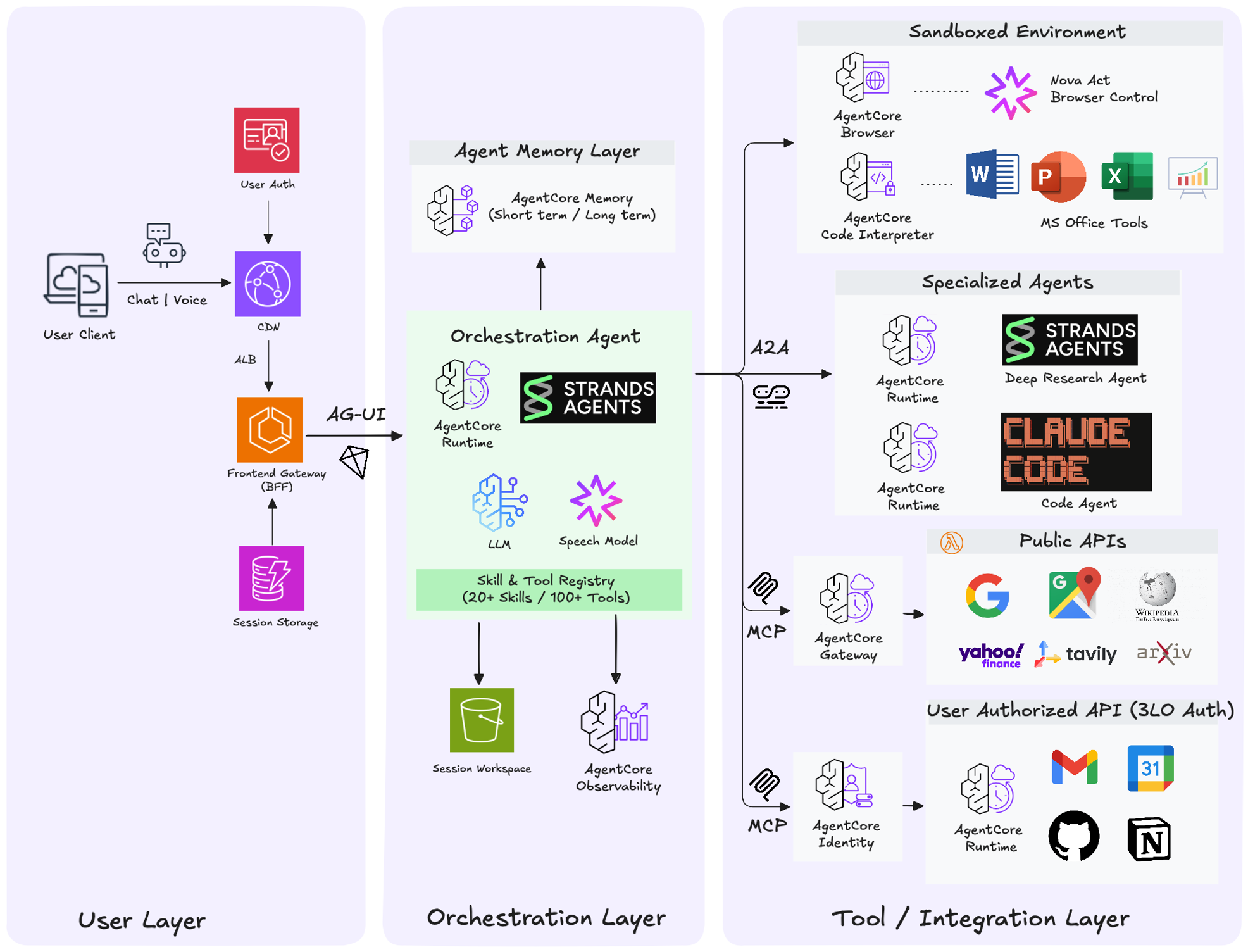
Key Features
- Strands-based agent orchestration
- Amazon Bedrock AgentCore Runtime, Gateway, and Memory
- MCP Gateway tools (Google, Wikipedia, ArXiv, Yahoo Finance, Tavily, Open-Meteo)
- Agent-to-Agent (A2A) collaboration — including remote Claude Agent SDK (Claude Code) for agentic coding tasks
- Built-in Code Interpreter for charts and documents
- Multimodal input and output (vision, charts, documents, screenshots)
- Real-time voice interaction with Amazon Nova Sonic 2
Skill System (Progressive Disclosure)
Tools are organized into skills — grouped units with SKILL.md instructions that the agent loads on demand.
Instead of injecting all tool documentation into every prompt, the agent activates only the skills it needs:
- L1 Catalog — Skill names and one-line descriptions (always in system prompt)
- L2 Instructions — Full SKILL.md loaded via
skill_dispatcherwhen activated - L3 Execution — Tool calls via
skill_executor
This keeps prompt size small while giving the agent access to detailed instructions when needed.
Design notes:
skills/
├── visual-design/          # Charts, posters, infographics (Code Interpreter)
├── code-interpreter/       # General code execution
├── browser-automation/     # Nova Act browser tools
├── word-documents/         # Word document generation
├── excel-spreadsheets/     # Excel spreadsheet generation
├── powerpoint-presentations/  # PowerPoint generation
├── gmail/                  # Gmail read/search/delete (3LO OAuth)
├── google-calendar/        # Calendar events (3LO OAuth)
├── notion/                 # Notion pages and databases (3LO OAuth)
├── github/                 # GitHub repos, issues, PRs, code (3LO OAuth)
└── ...                     # 20+ skills (web search, finance, maps, weather, and more)
Multi-Protocol Tool Architecture
| Tool Category | Protocol | Examples | Authentication |
|---|---|---|---|
| Local Tools | Direct Python | Web Search, URL Fetcher, Visualization | None |
| Built-in Tools | AWS SDK / WebSocket | Code Interpreter, Browser (Nova Act) | IAM |
| Gateway Tools | MCP | Google Search, Maps, Wikipedia, ArXiv, Finance | SigV4 |
| Private API Tools | MCP (3LO OAuth) | Gmail, Google Calendar, Notion, GitHub | OAuth 2.0 |
| A2A Tools | A2A | Research Agent, Browser-Use Agent | SigV4 |
Total: 100+ tools across 20 tool groups
See docs/guides/TOOLS.md for full details.
Voice Mode
Real-time voice interaction using Amazon Nova Sonic 2, Strands BidiAgent,
and AgentCore Runtime WebSocket.
- Seamless switching between voice and text within a single session
- Shared conversation history across both modes
- Full tool execution support during voice conversations
Memory Architecture and Long-Context Management
The system uses AgentCore Memory with:
- Short-term session memory
- Long-term summarized memory
Long conversations are compacted using a context summarization strategy to
retain key information while controlling token growth.
Design notes:
Token Optimization via Prompt Caching
Prompt caching reduces input token usage by reusing system prompts, stable instruction blocks,
and repeated conversation context across agent loop iterations.
This project originally implemented caching via custom Strands hooks.
The approach has since been upstreamed into the Strands SDK as a built-in feature
(strands-agents/sdk-python#1438):
from strands.models import BedrockModel, CacheConfig

model = BedrockModel(
    model_id="us.anthropic.claude-sonnet-4-6-v1",
    cache_config=CacheConfig(strategy="auto")
)
Design notes:
Multi-Agent Architecture
Agent-to-Agent communication is handled via the A2A protocol, allowing the supervisor agent to delegate tasks to specialized worker agents such as a deep research agent.
Multiple agents collaborating in sequence — each handling its own role — are coordinated using the Swarm pattern.
This architecture also includes a Claude Agent SDK (Claude Code) instance deployed as a remote A2A agent on AgentCore Runtime.
The supervisor delegates agentic coding tasks — multi-file implementation, refactoring, test suites — to this agent over A2A, with an S3-backed workspace that persists files across sessions.
Design notes:
Use Cases
- Financial research agents
- Technical research assistants using multi-agent patterns
- Autonomous web automation agents
- Memory-backed conversational assistants
- Hybrid research workflows using MCP, A2A, and AWS SDK tools
Quick Start
Prerequisites
- AWS account with Bedrock access
- AWS CLI configured
- Docker installed
- Node.js 18+ and Python 3.13+
Local Development
git clone https://github.com/aws-samples/sample-strands-agent-with-agentcore.git
cd sample-strands-agent-with-agentcore

cd chatbot-app
./setup.sh

cd ../agent-blueprint
cp .env.example .env
# configure credentials

cd ../chatbot-app
./start.sh
Frontend will be available at http://localhost:3000.
Cloud Deployment
The interactive deployment script supports:
1. AgentCore Runtime
2. Frontend + BFF
3. MCP Gateway tools
4. A2A runtimes
5. Full stack deployment
cd agent-blueprint
./deploy.sh
Project Structure
sample-strands-agent-chatbot/
├── chatbot-app/
│   ├── frontend/
│   └── agentcore/
└── agent-blueprint/
    ├── chatbot-deployment/
    ├── agentcore-gateway-stack/
    ├── agentcore-runtime-stack/
    └── agentcore-runtime-a2a-stack/
Documentation
- DEPLOYMENT.md
- docs/guides/TROUBLESHOOTING.md
License
MIT License. See LICENSE for details.
Yorumlar (0)
Yorum birakmak icin giris yap.
Yorum birakSonuc bulunamadi