mcp-mock
Health Gecti
- License — License: MIT
- Description — Repository has a description
- Active repo — Last push 0 days ago
- Community trust — 11 GitHub stars
Code Basarisiz
- network request — Outbound network request in scripts/fetch-schemas.ts
- exec() — Shell command execution in src/auth/index.ts
- process.env — Environment variable access in src/config.ts
Permissions Gecti
- Permissions — No dangerous permissions requested
Bu listing icin henuz AI raporu yok.
Self-hosted mock MCP server — test your MCP clients and agents with deterministic tools, resources and prompts, without connecting to real services. By Axium Lab.
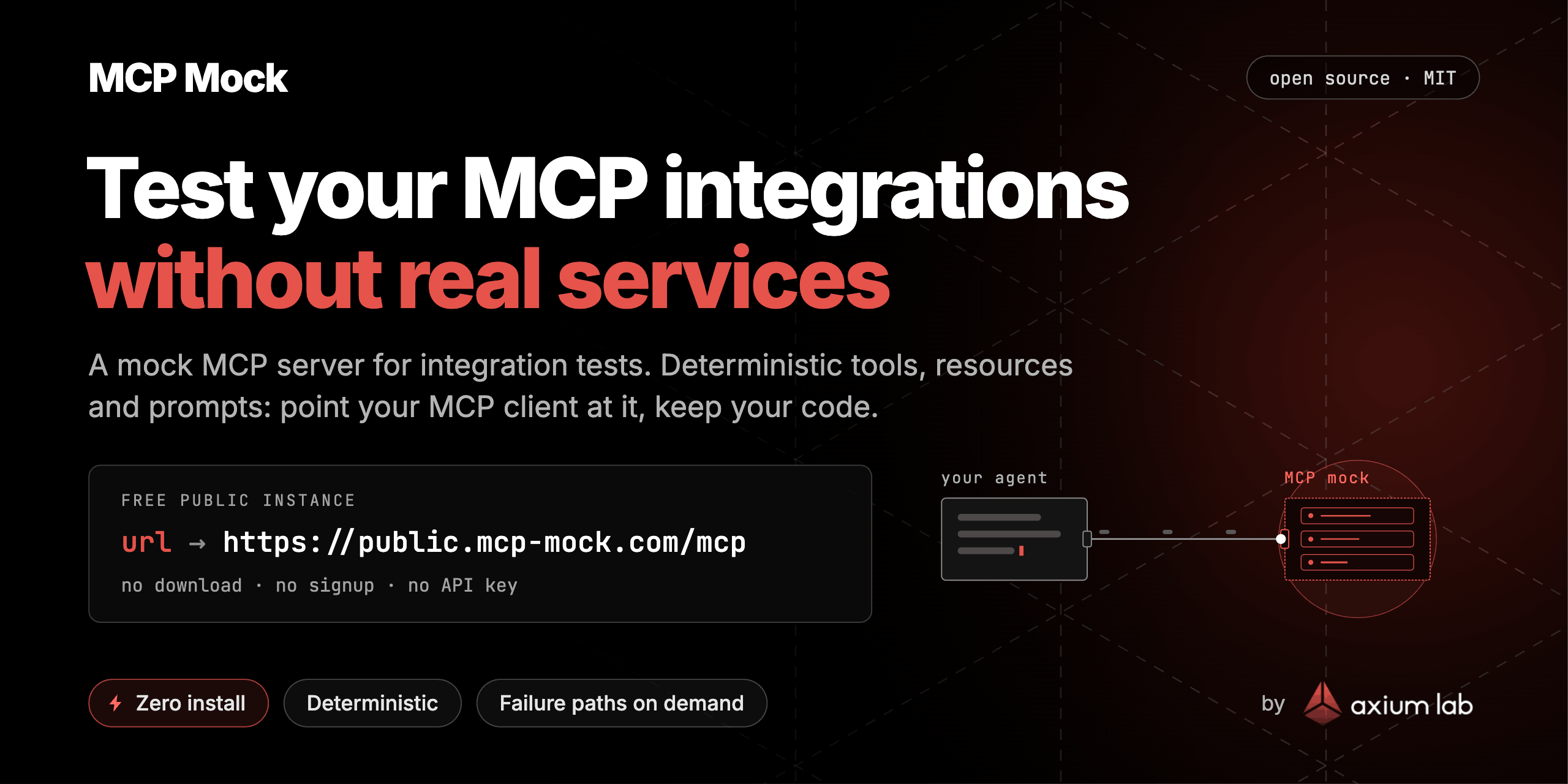
mcp-mock




A mock MCP server for integration tests. Point your MCP client at it, keep your code.
mcp-mock speaks the Model Context Protocol faithfully enough that the official SDKs cannot tell it from a real server, in every spec revision from 2024-11-05 to 2026-07-28. Its tools return deterministic, believable data, and a test can force any answer, error or HTTP failure from the request itself, with nothing to register beforehand.
⚡ Zero install: a free public instance runs at
public.mcp-mock.com. Point your MCP client athttps://public.mcp-mock.com/mcpand start in seconds; no download, no signup, no API key.
From the team behind llm-mock.
Quick start
Point your client at the free public instance, https://public.mcp-mock.com/mcp:
import { Client, StreamableHTTPClientTransport } from "@modelcontextprotocol/client";

const client = new Client({ name: "my-app", version: "1.0.0" });
await client.connect(new StreamableHTTPClientTransport(new URL("https://public.mcp-mock.com/mcp")));

const result = await client.callTool({ name: "get_weather", arguments: { city: "Madrid" } });
// result.structuredContent → { city: "Madrid", temperature: 14, conditions: "thunderstorm", … }
// Same call, same bytes, every time, on any machine.
Run your own
For CI, offline work, or to pin an exact release, run it yourself and use http://localhost:3000/mcp instead:
docker run --rm -p 3000:3000 ghcr.io/axium-lab/mcp-mock:0.1.0
See Docker for the available tags. Or from a clone of this repository:
bun install
bun start            # or, without Bun: npm install && npm run start:node (Node 22.18+)
Endpoints
Every endpoint is served on the public instance, https://public.mcp-mock.com, and on your own (http://localhost:3000 by default).
| URL | Serves |
|---|---|
/mcp |
Any client. Each request is served in the era it opens with: a request carrying the 2026-07-28 _meta envelope as 2026-07-28, an initialize as the legacy revision it negotiates. Use this one unless you need to pin a revision. |
/2026-07-28/mcp |
Only 2026-07-28, the stateless revision. |
/2025-11-25/mcp, /2025-06-18/mcp, /2025-03-26/mcp |
Only that legacy revision, over Streamable HTTP. |
/2024-11-05/sse, /sse |
The deprecated HTTP+SSE transport. The pinned one speaks only 2024-11-05; the root one negotiates any legacy revision. |
/protected/… |
Every endpoint above again, behind OAuth. See OAuth. |
/health |
{ "status": "ok", "version": "…" } |
A pinned endpoint is how you test what your client does when a server only speaks one revision, which is hard to reproduce against real servers.
What it serves
Tools
22 tools, listed in this order on every revision.
Real computations: echo, add, calculate (a safe arithmetic parser), transform_text, text_stats, sort_list, convert_units, hash_text, date_diff, color_swatch (a real PNG) and simulate_work (waits between steps; for progress, timeouts, cancellation and tasks).
Fake world: data derived from a hash of the normalized arguments, so the same call always returns the same data and different calls return different, internally consistent data (metric and imperial agree, currency conversions round-trip, a 3-day forecast is the start of the 7-day one).
| Tool | Fails on purpose with |
|---|---|
get_weather, get_forecast |
city: "Atlantis" |
geocode |
address: "Atlantis" |
search_web |
query: "error" |
get_stock_price |
symbol: "XXXX" |
convert_currency |
from or to: "XXX" |
get_user |
user_id: "missing" |
get_flight_status |
flight_number: "XX000" |
read_file, delete_file |
path: "/missing" |
send_email |
to: "[email protected]" |
Arguments are normalized before hashing and matching: " madrid " and "Madrid" are the same city. Results use every content type: text, structured content with an output schema, image, resource_link and embedded resource.
delete_file asks for confirmation through a multi round-trip request on 2026-07-28 (nothing is really deleted).
Resources and prompts
- Resources:
file:///etc/app/config.json,file:///docs/README.md,file:///data/report.csv,file:///images/logo.png(a binary blob), and the templatesweather://{city},user://{user_id}andfile:///{path}, drawn from the same fake world as the tools. - Prompts:
summarize,code_reviewandweather_report, the last with the city's weather embedded as a resource.
Controlling answers from the test
Each request carries what its own answer must be: identical requests always get identical answers, and nothing is shared between requests.
| Control | Effect |
|---|---|
_meta["com.mcp-mock/response"] on tools/call |
Replaces the result with the given text, content, structuredContent and isError, for any tool name. Adapted to each revision's format. |
_meta["com.mcp-mock/error"] on any request |
Fails it with the given JSON-RPC code, message and data. |
_meta["com.mcp-mock/input-required"] on tools/call (2026-07-28) |
Answers input_required with the given inputRequests and requestState; the retry returns what your client answered. |
_meta["com.mcp-mock/notifications"] on subscriptions/listen or resources/subscribe |
Scripts the change notifications the stream delivers (events, intervalMs, close). |
_meta["com.mcp-mock/task"] on tools/call (2026-07-28) |
Makes a task of the call (durationMs), for clients that declare the tasks extension. |
x-mcp-mock-status: 503 header |
Forces an HTTP failure from 400 to 599 on any endpoint; 429 adds Retry-After. |
await client.callTool({
  name: "get_weather",
  arguments: { city: "Madrid" },
  _meta: { "com.mcp-mock/response": { structuredContent: { city: "Madrid", temperature: 40 } } },
});
Faithful to each revision
What differs between revisions differs on the wire too, for example:
| 2024-11-05 | 2025-03-26 | 2025-06-18 | 2025-11-25 | 2026-07-28 | |
|---|---|---|---|---|---|
| Transport | HTTP+SSE | Streamable HTTP | Streamable HTTP | Streamable HTTP | Streamable HTTP, stateless |
| Handshake | initialize |
initialize |
initialize |
initialize |
none: _meta on every request, server/discover |
| JSON-RPC batches | no | yes | no | no | no |
| Structured content, resource links, titles | no | no | yes | yes | yes |
| Invalid tool arguments | protocol error | protocol error | protocol error | isError result |
isError result |
| Resource not found | -32002 |
-32002 |
-32002 |
-32002 |
-32602 |
Every message the mock sends is validated in its test suite against the official schema.json of its revision, and every endpoint is exercised through the official TypeScript SDK as the client.
On 2026-07-28 the mock also serves multi round-trip requests, progress over SSE, cancellation by closing the stream, subscriptions/listen, and the tasks extension (io.modelcontextprotocol/tasks). Legacy revisions are served without sessions, which the spec allows, so they keep no state between requests.
OAuth
Authorization is opt-in by URL: everything under /protected/ requires a bearer token, and everything else stays open. The mock is its own authorization server, on the same origin:
401withWWW-Authenticatepointing at the Protected Resource Metadata (RFC 9728) of each protected endpoint.- Authorization server metadata at
/.well-known/oauth-authorization-server(and as OpenID Connect discovery). /oauth/authorizeapproves at once and redirects back withcodeandiss;/oauth/tokenhandles the authorization code grant with PKCE S256 and refresh tokens;/oauth/registerhandles Dynamic Client Registration.- Tokens must be issued for the very endpoint they are used on, and carry the
mcpscope (403 insufficient_scopeotherwise). - To provoke failures: the
mcp-mock:denyscope makes the user deny access, andmcp_mock_expires_inon the token endpoint issues tokens that expire when you want.
The official SDK's OAuth flow runs end to end against it. Codes and tokens are signed with a fixed, public key and are not single-use: this is a test double, not an authorization server for real users.
Docker
Every release publishes an image to the GitHub Container Registry, for linux/amd64 and linux/arm64. No login is needed to pull it:
docker pull ghcr.io/axium-lab/mcp-mock:0.1.0
| Tag | Points to |
|---|---|
0.1.0 |
That exact release. Pin this one in CI so your tests don't change under you. |
0.1 |
The latest patch release of 0.1. |
latest |
The latest release. |
The container listens on port 3000 and reports its state to Docker through /health. To serve on another port, change both sides:
docker run --rm -p 8080:8080 -e MCP_MOCK_PORT=8080 ghcr.io/axium-lab/mcp-mock:0.1.0
Configuration
| Variable | Default | Meaning |
|---|---|---|
MCP_MOCK_PORT (or PORT) |
3000 |
Port to listen on. |
Not supported yet
stdio, Origin header validation, and sessions on the legacy revisions. Tell us what you need in the Discussions.
Contributing
See CONTRIBUTING.md and the CHANGELOG.
License
Yorumlar (0)
Yorum birakmak icin giris yap.
Yorum birakSonuc bulunamadi