ayder-cli
Health Uyari
- License — License: MIT
- Description — Repository has a description
- Active repo — Last push 0 days ago
- Low visibility — Only 5 GitHub stars
Code Basarisiz
- rm -rf — Recursive force deletion command in pyproject.toml
Permissions Gecti
- Permissions — No dangerous permissions requested
Bu listing icin henuz AI raporu yok.
Autonomous multi-agent software development harness, powered by local LLMs
ayder-cli
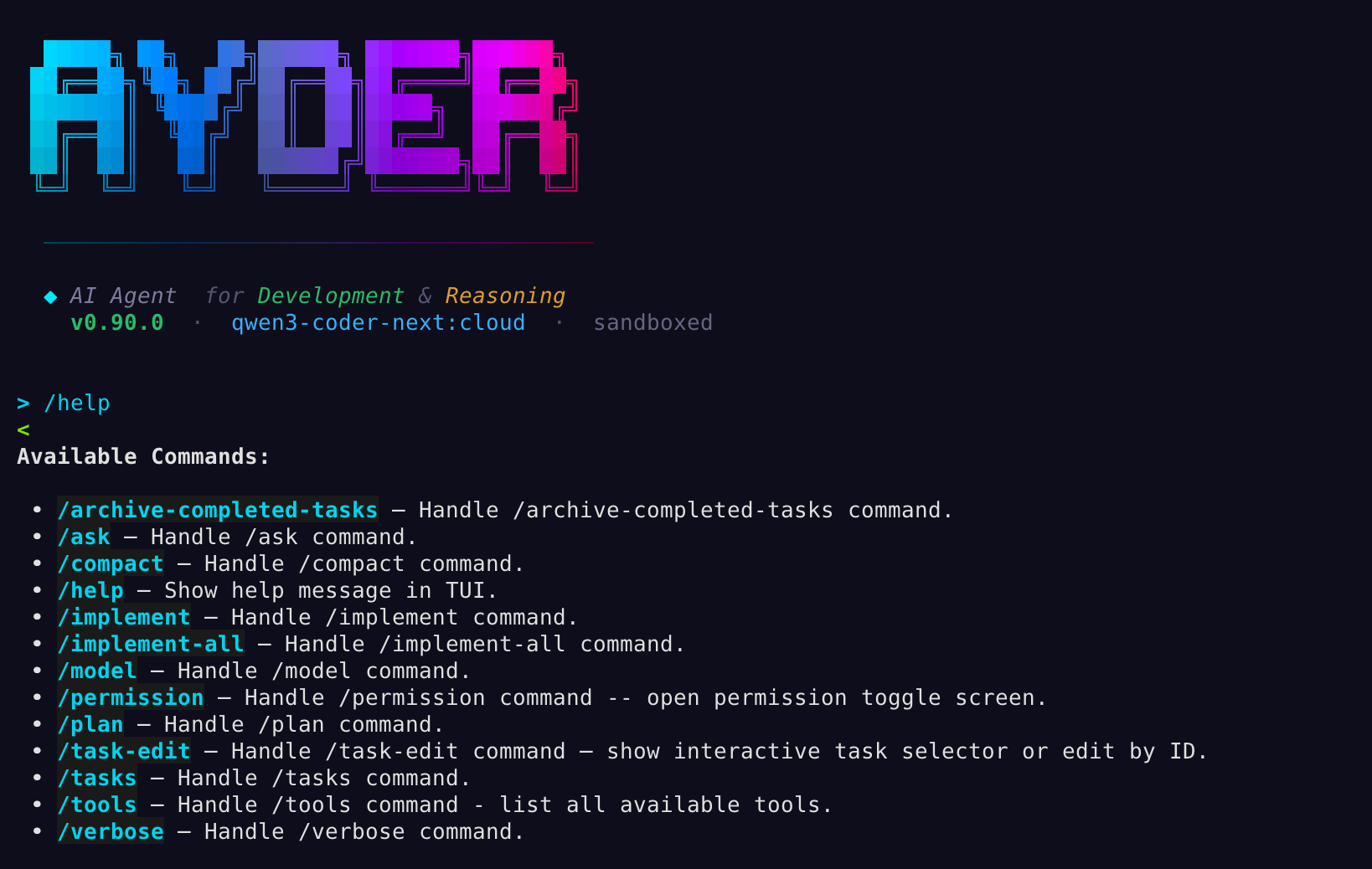
A multi-provider AI agent chat client for your terminal. ayder supports Ollama, Anthropic Claude, OpenAI, Gemini,
or any OpenAI-compatible API and provides an autonomous coding assistant with file system tools and shell access.
What's New in 2.0
Provider SDKs are now optional. The core install ships only OpenAI + Ollama (plus DeepSeek, which reuses the OpenAI SDK); Anthropic, Google, Qwen, and GLM are opt-in extras -- install only what you use. Selecting a driver whose package isn't installed fails fast with the exact pip install command and a list of the drivers available in your install. See CHANGELOG.md and Installation.
Upgrading from 1.x (breaking):
anthropicandpip install ayder-cli[anthropic]/[google](or[all]) if you use them.
Supported LLM providers
- Ollama (local or cloud)
- Anthropic Claude
- OpenAI
- Gemini
- DeepSeek (via OpenAI-compatible driver)
- Qwen (via DashScope native driver)
- GLM / ChatGLM (via ZhipuAI native driver)
Why ayder-cli?
Most AI coding assistants require cloud APIs, subscriptions, or heavy IDE plugins. ayder-cli takes a different approach:
- Multi-provider -- switch between Ollama, Anthropic Claude, Gemini, or any OpenAI-compatible API with a single
/providercommand. Each provider has its own config profile. - 7 native drivers -- Ollama, OpenAI, Anthropic, Gemini, DeepSeek, Qwen (DashScope), and GLM (ZhipuAI). Each driver guarantees native tool calling and streaming support.
- Fully local or cloud -- run locally with Ollama, or connect to any cloud provider.
- Agentic workflow -- the LLM reads files, edits code, runs shell commands, and iterates autonomously with configurable iteration limits per message.
- Multi-agent -- define specialized sub-agents in
config.toml. Each agent runs independently with its own LLM, model, and context. Results are injected back into the main conversation when complete. - Textual TUI -- an inline terminal interface with chat view, tool panel, thinking block toggle, slash command auto-completion, permission toggles, and tool confirmation modals with diff previews.
- Batteries included -- the OpenAI and Ollama SDKs ship with ayder-cli core. Anthropic, Google, Qwen, and GLM are optional extras (install only what you need). The terminal UI is built on Rich and Textual.
Tools
LLMs on their own can only generate text. To be a useful coding assistant, the model needs to act on your codebase. ayder-cli ships 16 built-in tools that the model can call, plus optional plugin toolsets (see Plugins):
Each tool has an OpenAI-compatible JSON schema so models that support function calling can use them natively. For models that don't, ayder-cli also parses a custom XML-like syntax (<function=name><parameter=key>value</parameter></function>) as a fallback.
- Path sandboxing: All file operations are confined to the project root via
ProjectContext. Path traversal attacks (../) and absolute paths outside the project are blocked. - Safe mode (TUI): Blocks
file_editor,run_shell_command,run_background_process,kill_background_process, andfetch_web. - Every tool call requires your confirmation before it runs -- you always stay in control. Use
-r,-w,-xflags to auto-approve tool categories. - You may also prefer to run ayder-cli in a container for additional security.
Installation
Requires Python 3.12+.
Works best with uv. If you don't have uv in your path, get it from
Astral uv.
Core install (OpenAI + Ollama, plus DeepSeek which reuses the OpenAI SDK):
pip install ayder-cli
Optional providers (install only what you use):
pip install ayder-cli[anthropic]   # Claude
pip install ayder-cli[google]      # Gemini
pip install ayder-cli[qwen]        # Qwen (dashscope)
pip install ayder-cli[glm]         # GLM (zhipuai)
pip install ayder-cli[all]         # everything
If you select a driver whose package isn't installed, ayder prints the exact
install command and lists the drivers available in your install.
# Install to user environment (uv tool)
uv tool install ayder-cli

# Or for nightly / development builds:
git clone https://github.com/ayder/ayder-cli.git
cd ayder-cli

# Install in development mode
python3.12 -m venv .venv
source .venv/bin/activate
uv pip install -e .

# Or as a uv tool (always on the path)
uv tool install -e .
Ollama setup (default provider)
# Make sure Ollama is running with a model
ollama pull qwen3-coder
ollama serve

# Optional: optimize Ollama for your model
export OLLAMA_CONTEXT_LENGTH=65536
export OLLAMA_FLASH_ATTENTION=true
export OLLAMA_MAX_LOADED_MODELS=1
Cloud providers
Add an API key to a profile in ~/.ayder/config.toml (see Configuration
below) and switch provider in the TUI:
/provider anthropic # or: openai, google, deepseek, qwen, glm
Note: anthropic and google require the corresponding optional extra
(see Installation above). openai, ollama, and deepseek are included
in the core install.
Configuration: Profiles and Drivers
ayder-cli uses a flexible profile-based configuration system. On the first run, it creates a config file at ~/.ayder/config.toml.
Key Concepts:
- Profile Name: A custom named section (e.g.,
[llm.my_ollama]). You can define as many profiles as you want. - Driver: The underlying native SDK or adapter used by the profile (
ollama,openai,anthropic,google,deepseek,qwen, orglm). Each driver guarantees full support for native tool calling and streaming. - Active Provider: The
providersetting under[app]determines which profile is currently active. - Chat Protocol: By default, all drivers use native tool calling (
chat_protocol = "ollama"). If you encounter a model that fails to trigger tools natively, you can setchat_protocol = "xml"in that profile to force an XML-based fallback.
Example: Running the Same Model via Different Drivers
Because profiles are just names, you can configure the same model to run through different drivers:
config_version = "2.0"

[app]
provider = "qwen_local" # <--- Currently using the local Ollama version

# --- Profiles ---

# 1. Local Qwen via Ollama driver
[llm.qwen_local]
driver = "ollama"
base_url = "http://localhost:11434"
model = "qwen2.5-coder:latest"
num_ctx = 65536

# 2. Cloud Qwen via OpenAI driver (e.g., DeepInfra, Together)
[llm.qwen_cloud]
driver = "openai"
base_url = "https://api.deepinfra.com/v1/openai"
api_key = "sk-..."
model = "Qwen/Qwen2.5-Coder-32B-Instruct"
num_ctx = 65536
In the TUI, typing /provider qwen_cloud seamlessly switches from your local GPU to the cloud endpoint.
Full Configuration Reference
config_version = "2.0"

[app]
provider = "openai"           # Active provider profile name
editor = "vim"                # Editor for /task-edit command
verbose = false               # Show file contents after write + LLM debug
max_background_processes = 5  # Max concurrent background processes (1-20)
max_iterations = 10           # Max agentic iterations per message (1-100)
max_output_tokens = 4096      # Max tokens in LLM response
max_history_messages = 30     # Messages kept in history
prompt = "STANDARD"           # System prompt tier: MINIMAL, STANDARD, EXTENDED
tool_tags = ["core", "metadata"]  # Enabled tool tags (see /plugin)
agent_timeout = 300           # Seconds before a background agent is cancelled

[logging]
file_enabled = true
file_path = ".ayder/log/ayder.log"
rotation = "10 MB"
retention = "7 days"

[context_manager]
enabled = true
max_context_tokens = 8192

[temporal]
enabled = false
host = "localhost:7233"
namespace = "default"
metadata_dir = ".ayder/temporal"

# --- Provider Profiles ---

[llm.my_local_ollama]
driver = "ollama"
base_url = "http://localhost:11434"
model = "qwen3-coder:latest"
num_ctx = 65536

[llm.openai_cloud]
driver = "openai"
api_key = "sk-..."
model = "gpt-4o"
num_ctx = 128000

[llm.anthropic]
driver = "anthropic"
api_key = "sk-ant-..."
model = "claude-sonnet-4-5-20250929"
num_ctx = 200000

[llm.gemini]
driver = "google"
api_key = "AIza..."
model = "gemini-3-pro"
num_ctx = 1000000
Please adjust num_ctx context size window according to your local computer RAM. If Ollama crashes, decrease the value.
Changing Models on the Fly (/model)
You do not need a separate profile for every model. The profile defines the connection (driver, base URL, API key).
Once a profile is active, use /model in the TUI to swap models on the fly:
- Interactive Picker:
/modelwith no arguments queries the active driver for available models and opens a picker. - Direct Switch:
/model <model-name>immediately switches to that model.
Changes made with /model apply to the current session only. To make a model the permanent default, update model = "..." in your config.toml.
Usage
# Start (launches TUI by default)
ayder

# Or run as a module
python3 -m ayder_cli
Command Mode (Non-Interactive)
# Execute a single command and exit
ayder "create a hello.py script"

# Pipe input (auto-detected, no flag needed)
echo "create a test.py file" | ayder

# Read from file
ayder -f instructions.txt

# Explicit stdin mode
ayder --stdin < prompt.txt

# Use a custom system prompt file
ayder --prompt prompt-file.md "refactor this code"
Task Commands (CLI Mode)
Execute task-related commands directly without entering the TUI:
# List all tasks
ayder --tasks

# Implement a specific task by ID or name
ayder --implement 1
ayder --implement auth

# Implement all pending tasks sequentially
ayder --implement-all
Tool Permissions (-r/-w/-x/--http)
By default, every tool call requires user confirmation. Use permission flags to auto-approve tool categories:
| Flag | Category | Built-in tools |
|---|---|---|
-r |
Read | file_explorer, read_file, search_codebase, get_project_structure, get_background_output, list_background_processes, list_tasks, show_task |
-w |
Write | file_editor, context, create_note, manage_environment_vars |
-x |
Execute | run_shell_command, run_background_process, kill_background_process |
--http |
Web/Network | fetch_web |
Installed plugins extend these categories (e.g. python_editor → write, virtualenv tools → execute, dbs_tool → web).
# Auto-approve read-only tools
ayder -r

# Auto-approve read and write tools
ayder -r -w

# Auto-approve everything (fully autonomous)
ayder -r -w -x

# Allow web tools without prompts
ayder -r --http

# Combine with other flags
ayder -r -w "refactor the login module"
echo "fix the bug" | ayder -r -w -x
Context Management
ayder-cli includes a context manager that automatically keeps your conversation within the model's token budget. The implementation is driver-aware — Ollama gets a specialized KV-cache-optimized manager, while cloud providers (Anthropic, OpenAI, Gemini) use a general-purpose tiered manager.
Ollama-specific optimizations (automatic when driver = "ollama"):
- KV-cache-aware: Messages are append-only and never reordered. The system prompt is frozen at session start. This preserves Ollama's KV-cache prefix between calls — subsequent prompts process only new tokens instead of recomputing everything.
- Real token counts: Uses Ollama's
prompt_eval_countandeval_countfrom native API responses instead of estimates. Compaction decisions are based on actual usage, not heuristics. - Cache monitoring: Tracks
prompt_eval_duration / prompt_eval_countratio to detect KV-cache hits (hot/warm/miss). When the cache is hot, compaction is delayed (threshold raised from 70% to 90%) to avoid invalidating it. - Auto-detected context length: On startup, queries
/api/showto get the model's real context length instead of relying onnum_ctx. Falls back tonum_ctxif detection fails. - Heuristic compaction: When the context fills up, oldest message units are replaced with a text summary — no LLM call needed.
- Native SDK: Uses
ollama.AsyncClientdirectly (not the OpenAI compatibility layer) for full timing data, native thinking support, andkeep_alive=-1to prevent model unloading.
General-purpose manager (Anthropic, OpenAI, Gemini, and other drivers):
Every message is assigned an importance tier (system > recent user > recent assistant > tool results > old history). When the conversation approaches the token budget, old tool results are compressed (JSON structurally summarized, large text head/tail truncated) and the lowest-priority messages are pruned. Tool call + result pairs are kept as atomic units.
The context manager is configured under [context_manager] in config.toml:
| Setting | Default | Description |
|---|---|---|
enabled |
true |
Master switch. |
max_context_tokens |
8192 |
Fallback token budget (Ollama auto-detects from model). |
reserve_ratio |
0.30 |
Fraction reserved for the LLM response. |
compaction_threshold |
0.70 |
Utilization ratio that triggers compaction. |
tool_result_compress_age |
5 |
Tool results older than N messages are eligible for compression. |
max_tool_result_length |
2048 |
Maximum character length for a compressed tool result. |
compress_tool_results |
true |
Enable automatic tool result compression. |
You can also manually manage context with the context tool and its slash-command shortcuts: /save-context, /load-context, /list-contexts, /context-stats, and /compact.
Slash Commands
| Command | Description |
|---|---|
/help |
Show available commands and keyboard shortcuts |
/provider |
Switch LLM provider (interactive selector or direct name) |
/model |
List available models or switch model (e.g., /model qwen3-coder) |
/plugin |
Toggle tool plugins by tag (e.g., venv, http, background, python, dbs) |
/tools |
List currently enabled tools and descriptions |
/permission |
Toggle permission levels (r/w/x/http) interactively |
/ask |
Ask a general question without using tools |
/plan |
Analyze request and create implementation tasks |
/tasks |
Browse and implement tasks from .ayder/tasks/ |
/implement [id] |
Interactive task picker, or implement by ID (e.g., /implement 1) |
/notes |
Browse and edit markdown notes |
/skill |
Activate a domain skill from .ayder/skills/ |
/verbose |
Toggle verbose mode |
/logging |
Set log level for current session (NONE, ERROR, WARNING, INFO, DEBUG) |
/compact |
Summarize conversation, save a context snapshot, clear, and reload |
/save-context |
Summarize conversation and save it to a named context slot (no clear) |
/load-context |
Load a saved context slot and restore it |
/list-contexts |
List saved context slots |
/context-stats |
Show current token and KV-cache usage |
/archive-completed-tasks |
Move completed tasks to .ayder/task_archive/ |
/temporal |
Start/status Temporal queue worker |
/agent list |
List configured agents and their current status |
/agent <name> <task> |
Dispatch an agent to run a task in the background |
/agent cancel <name> |
Cancel a running agent |
Logging
- Default: when logging is enabled, logs go to
.ayder/log/ayder.log(not shown on screen). - TUI
/loggingchanges are session-only and do not modifyconfig.toml. - CLI
--verbose [LEVEL]enables stdout logging for that run.
Keyboard Shortcuts
| Shortcut | Action |
|---|---|
Ctrl+Q |
Quit |
Ctrl+X / Ctrl+C |
Cancel current operation |
Ctrl+L |
Clear chat |
Ctrl+O |
Toggle tool panel |
Ctrl+T |
Toggle thinking/reasoning blocks |
PageUp / PageDown |
Scroll chat view |
Tab |
Auto-complete slash commands |
Efficiency & Optimization
ayder-cli is optimized for both large and small (local) LLMs:
- Dynamic Tool Loading: Only
coreandmetadatatools are loaded by default. Use/pluginto enable specialized toolsets (venv, python, http, background, dbs, temporal, env) only when needed. - Tiered Prompts: Use
prompt = "MINIMAL"in config for smaller models (7B-14B) to strip complex reasoning frameworks and improve follow-through. - Automatic Context Bounding: Conversation history is bounded based on
max_history_messagesto prevent context rot. - Tool System Prompts: Tool-specific prompt blocks (e.g., DBS instructions) are only injected when their tag is enabled, keeping the system prompt lean.
Operational Modes
Default Mode
The standard mode for general coding and chat. Uses the system prompt.
> create a fibonacci function
Available tools: file read/write, shell commands, search, context, notes, tasks.
Planning Mode (/plan)
Activated with /plan. The AI breaks down requirements into tasks stored in .ayder/tasks/.
> /plan add user authentication to the app
Task Mode (/implement)
Activated with /implement. The AI implements tasks from the task list.
> /implement        # Interactive task picker
> /implement 1      # Implement TASK-001 directly
Task Management
ayder-cli includes a built-in task system:
- Plan (
/plan) -- Break down requirements into tasks - Implement (
/implement) -- Work through tasks one by one - Archive (
/archive-completed-tasks) -- Move done tasks to archive
Tasks are stored as markdown files in .ayder/tasks/ using slug-based filenames (e.g., TASK-001-add-auth-middleware.md).
> /tasks            # Interactive task browser
> /task-edit 1      # Open TASK-001 in the in-app editor
> /implement 1      # Implement TASK-001
Pluggable Tool Architecture
Adding a new tool is as simple as:
- Create a definition file:
src/ayder_cli/tools/builtins/mytool_definitions.py - Implement the tool function: Add your logic in a corresponding
.pyfile - Done! Auto-discovery registers the tool automatically
The tool system:
- Discovers all
*_definitions.pyfiles automatically - Validates for duplicate names and required tools
- Registers tools with the LLM via OpenAI-compatible schemas
- Supports tag-based filtering for dynamic enable/disable
- Injects tool-specific system prompts when enabled
Built-in tools (16):
| Category | Tools |
|---|---|
| Filesystem | file_explorer, read_file, file_editor |
| Search | search_codebase, get_project_structure |
| Shell | run_shell_command |
| Context | context (save / load / list / stats / clear session context slots) |
| Notes | create_note |
| Background Processes | run_background_process, get_background_output, kill_background_process, list_background_processes |
| Tasks | list_tasks, show_task |
| Environment | manage_environment_vars |
| Web | fetch_web |
When agents are configured, the call_agent tool is also registered so the main LLM can dispatch them (see Multi-Agent System).
Plugin tools — python_editor, dbs_tool, temporal_workflow, virtualenv tools, and MCP integrations ship as optional plugins in the ayder/ayder-plugins repo (see Plugins). Once installed they are auto-discovered exactly like built-ins.
Multi-Agent System
ayder-cli supports user-defined specialized agents: each agent is an independent AI loop with its own LLM provider, model, system prompt, and context window. Agents run as background tasks — they never block the main conversation and their results are automatically injected back when they complete.
How Agents Work
Main LLM (your conversation)
    │
    ├─ calls `call_agent` tool  ─────────────────────────────────┐
    │   OR you type `/agent <name> <task>`                       │
    │                                                            ▼
    │                                            AgentRunner (background asyncio task)
    │                                            ┌─────────────────────────────────┐
    │                                            │  Isolated ChatLoop              │
    │                                            │  • own LLM provider + model     │
    │                                            │  • own context window           │
    │                                            │  • own ToolRegistry             │
    │                                            │  • auto-approves all tools      │
    │                                            │  • produces <agent-summary>     │
    │                                            └────────────────┬────────────────┘
    │                                                             │ completes
    │                                                             ▼
    │                                            AgentSummary → _summary_queue
    │
    ▼ (next main LLM turn)
pre_iteration_hook drains queue
    └─ injects AgentSummary as system message into main context
         └─ main LLM sees: "[Agent 'reviewer' completed] FINDINGS: ..."
Key properties:
- Separate context — agents have no access to the main conversation history. They receive only their system prompt and the task description.
- Non-blocking — dispatching an agent returns immediately. Both
/agentandcall_agentare fire-and-forget. - Concurrent — multiple agents can run simultaneously, each in its own async task.
- Summary injection — when an agent finishes, its structured
<agent-summary>block is injected as a system message into the main LLM's context at the start of the next turn. - Timeout — agents are automatically cancelled after
agent_timeoutseconds (default: 300).
Configuring Agents
Add [agents.<name>] sections to your ~/.ayder/config.toml:
[app]
provider = "ollama"
agent_timeout = 300           # Global timeout for all agents (seconds)

[llm.ollama]
driver = "ollama"
model = "qwen3-coder:latest"
num_ctx = 65536

[llm.anthropic]
driver = "anthropic"
api_key = "sk-ant-..."
model = "claude-sonnet-4-5-20250929"
num_ctx = 200000

# --- Agents ---

[agents.code-reviewer]
system_prompt = """You are a senior code reviewer. Review the code for bugs,
security issues, and style violations. Be concise and actionable."""
provider = "anthropic"         # Optional: use a different provider than main
model = "claude-sonnet-4-5-20250929"  # Optional: use a different model

[agents.test-writer]
system_prompt = """You are a test engineer. Write comprehensive pytest tests
for the code provided. Follow existing test patterns in the codebase."""
# No provider/model → inherits from [app] provider

[agents.doc-writer]
system_prompt = """You are a technical writer. Write clear, concise docstrings
and inline comments for the code provided."""
Each agent field:
| Field | Required | Description |
|---|---|---|
system_prompt |
Yes | The agent's role and instructions |
provider |
No | LLM provider profile name (inherits from [app] if omitted) |
model |
No | Model name override (inherits from provider profile if omitted) |
Using Agents
From the TUI (slash commands):
# List configured agents and their status
/agent list

# Dispatch an agent to review your authentication module
/agent code-reviewer Review src/auth.py for security issues

# Dispatch the test writer for a specific module
/agent test-writer Write tests for src/api/users.py

# Cancel a running agent
/agent cancel code-reviewer
Via the main LLM (automatic):
When agents are configured, the main LLM is told about them via its system prompt and can call call_agent autonomously:
You: Review the authentication module and write tests for it.

LLM: I'll dispatch two agents to handle this in parallel.
     [calls call_agent: name="code-reviewer", task="Review src/auth.py..."]
     [calls call_agent: name="test-writer", task="Write tests for src/auth.py..."]

     Both agents are running in the background. I'll incorporate
     their findings when they complete.

... (agents run independently) ...

LLM: [next turn, after agents complete]
     The code-reviewer found 2 issues: ...
     The test-writer produced 8 new tests: ...
Agent summary format:
Agents end their final response with a structured block that ayder-cli parses:
<agent-summary>
FINDINGS: Found a SQL injection vulnerability in login() and missing input validation in register()
FILES_CHANGED: none
RECOMMENDATIONS: Parameterize all DB queries; add Pydantic validators to all endpoints
</agent-summary>
This summary is injected into the main LLM's context as a system message so the main agent can act on it, summarize it for you, or chain it to further work.
Plugins
Official plugins (venv, python, dbs, mcp, temporal) are maintained in the ayder/ayder-plugins repository. Install any plugin directly from GitHub:
ayder install-plugin https://github.com/ayder/ayder-plugins/tree/main/venv-tools
ayder install-plugin https://github.com/ayder/ayder-plugins/tree/main/python-tools
Plugins can also be hosted in any public GitHub repository — point install-plugin at any repo or subdirectory containing a plugin.toml.
License
MIT
Yorumlar (0)
Yorum birakmak icin giris yap.
Yorum birakSonuc bulunamadi