knowledge-graph
Health Warn
- License — License: ISC
- Description — Repository has a description
- Active repo — Last push 0 days ago
- Low visibility — Only 5 GitHub stars
Code Fail
- rm -rf — Recursive force deletion command in audit-fidelity.sh
- fs module — File system access in build.js
- network request — Outbound network request in src/components/GraphView.tsx
Permissions Pass
- Permissions — No dangerous permissions requested
This is a personal knowledge base containing 133+ curated insights on AI product building and mental models, connected via wikilinks. It allows users to browse the data via a web interface or feed a compiled YAML file directly to AI agents like Claude Code for architectural brainstorming.
Security Assessment
The overall risk is Low. The tool does not request dangerous system permissions and no hardcoded secrets were found. However, developers should be aware of a few minor flags: an `rm -rf` recursive deletion command was found in an audit script, `build.js` contains file system access (typical for a static site generator), and the web interface makes outbound network requests. None of these indicate malicious intent; they are standard operations for building and hosting a web application. The tool does not access sensitive user data.
Quality Assessment
The project is highly active, with its last push occurring today, and is properly licensed under the permissive ISC license. However, community trust and visibility are currently very low. With only 5 GitHub stars, the tool has not yet been broadly reviewed or adopted by the open-source community. Developers should expect a solo-maintainer project with limited external validation.
Verdict
Safe to use, but keep in mind it is an early-stage, low-visibility personal project.
Personal AI knowledge graph — 133+ curated insights across AI product building and mental models, connected via wikilinks. Built with Claude Code.
Knowledge Graph



148 insights · 14 topics · 25+ sources · updated weekly
Munger says you can't really know anything useful by remembering isolated facts — they must hang on a latticework of theory. I was doing exactly that with AI articles: isolated facts scattered across dozens of chat threads, rediscovered months later with no connection between them.
Why this exists
I had dozens of Claude conversations, each exploring a different AI article. But I kept rediscovering the same patterns months later in different threads. I couldn't connect the dots across sources.
So I built a knowledge graph. Each article gets broken into 2-5 atomic insights, and those insights get linked to related ones from other sources. The connections are where the real value lives — not any single insight.
The agent use case works particularly well. The human browsing UX is catching up.
What's in it
148+ insights across 2 domains, updated weekly as I encounter new ideas:
AI Product Building (6 topics): Agents, Architecture, Coding Tools, Business Models, Knowledge Systems, Future of AI
Mental Models (6 topics): Psychology, Economics, Decision Making, Engineering, Philosophy, Mathematics
Sources: Charlie Munger's Almanack, Nicolas Bustamante, Dan Shipper, Andrej Karpathy, Anthropic Engineering, and 20+ other practitioners.
Two ways to use it
1. Browse the web app
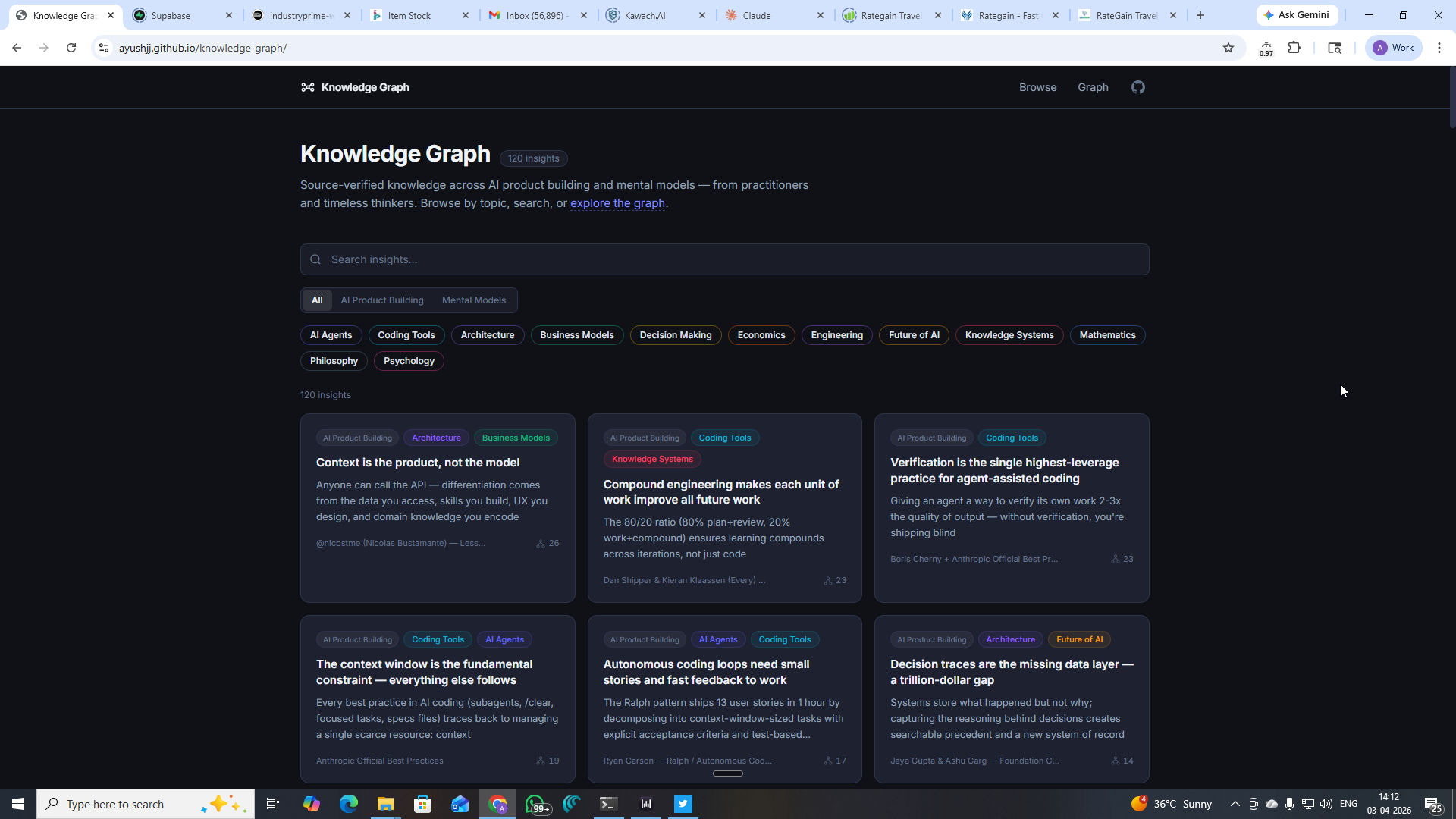
- Card feed sorted by most-connected insights, with topic filtering and full-text search
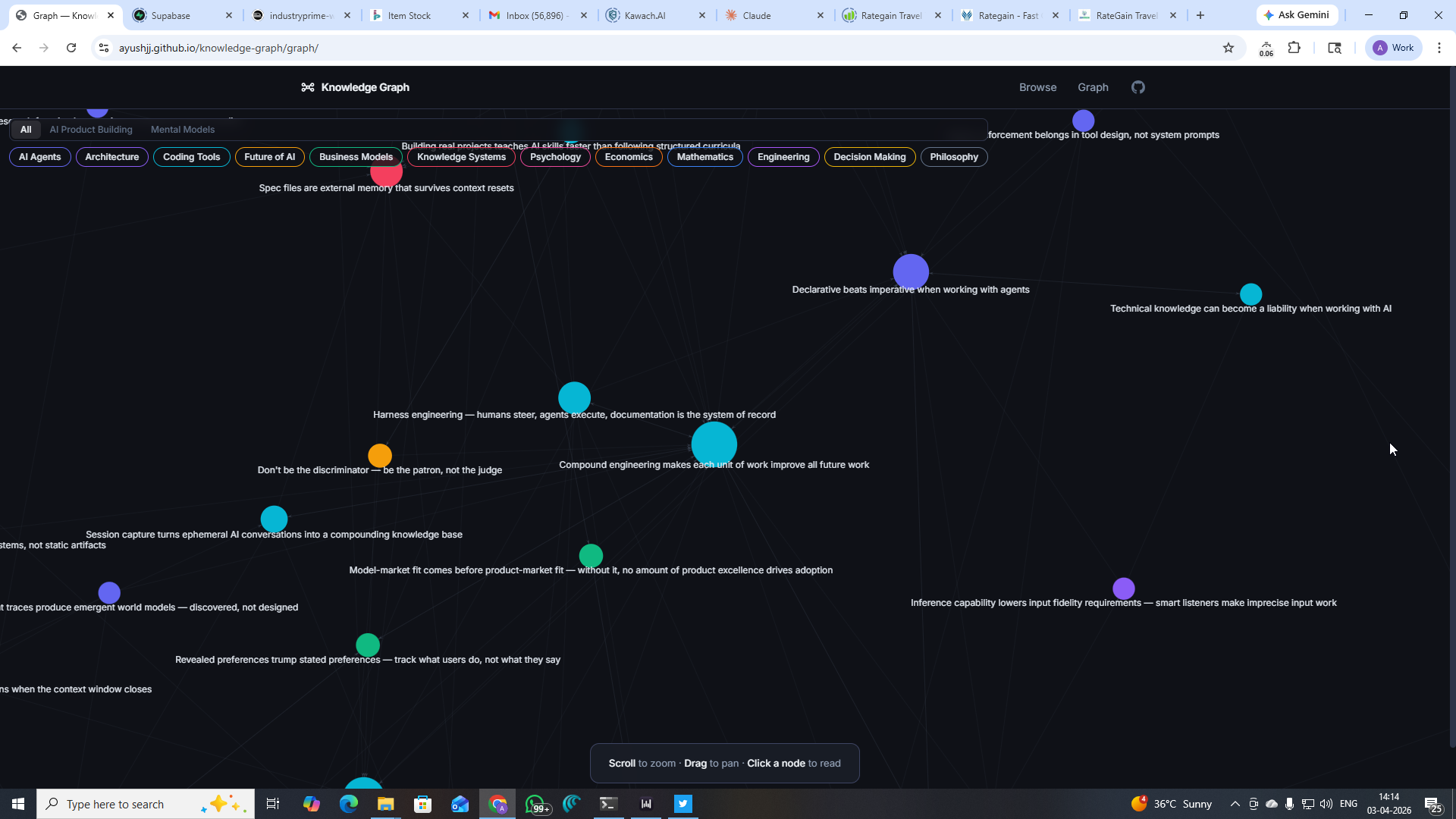
- Interactive force-directed graph visualization — see how insights cluster and connect
- Also works as an Obsidian vault (all
[[wikilinks]]resolve natively)
2. Feed it to an AI agent
This is where the real value is today. Point Claude Code (or any AI agent) at graph-index.yaml — one YAML file with all 148+ nodes, descriptions, and connections.
# Add this one line to your CLAUDE.md:
When making architectural decisions or reviewing plans, read `graph-index.yaml`
and check if any insights are relevant to the current decision.
Use cases: architecture brainstorming, plan review, understanding what practitioners are saying about a topic. An agent reading 142 connected insights produces genuinely different thinking than starting from scratch.
How it grows
This is a living graph, not a snapshot. I add insights every week as I encounter ideas that shift how I think.
- Source-verified: Every insight traced to original author + page number
/learn <url>extracts insights from any article automatically/learn-book <pdf>processes books chapter by chapter
Star or watch the repo to see new insights as they land.
Contributing
If you've found value in the graph, add an insight from an article that changed how you think. See CONTRIBUTING.md for the simple process: fork, add a file, submit a PR.
All PRs reviewed by maintainer before merging.
Repository structureknowledge-graph/
├── index.md # Entry point — topic map + cross-domain highlights
├── graph-index.yaml # Machine-readable graph (all nodes + links)
├── topics/ # 14 topic MOCs (Maps of Content)
│ ├── ai-agents.md
│ ├── business-models.md
│ └── ...
└── insights/ # 148+ individual insight files
├── context-is-the-product-not-the-model.md
├── features-are-prompts-not-code.md
└── ...
Sources
These ideas belong to the people below — I'm just the curator who connected them.
Major contributors (2+ insights):
- Nicolas Bustamante (@nicbstme) — AI agents for financial services, agent-native architecture, API-first SaaS
- Rohit (@rohit4verse) — Agent memory, knowledge transfer, tiered retrieval, embeddings, trace architecture
- Anthropic Engineering — Tool design, agent evaluation, best practices
- Boris Cherny — Claude Code team, agentic search, distributed agent workflows
- Ashpreet Bedi (@ashpreetbedi) — Spec-first development, error memory, Agno framework
- Dan Shipper — Every, agent-native architectures
- Alton Syn (@WorkflowWhisper) — Implementation gap, technical knowledge as liability
- Jason Cui (@jasonscui) — a16z, data agent context layers, tribal knowledge
- Gowri Shankar Nag (@GowriShankarNag) — Antler India, AI labeling market dynamics, platform economics
Single-insight contributors:
Andrej Karpathy ·
Clara Shih ·
Chrys Bader ·
Matt Shumer ·
Nader Dabit ·
Will Manidis ·
Steven Sinofsky ·
Natasha Malpani ·
Gokul R ·
Jaya Gupta ·
Akshay Pachaar ·
Vasuman ·
Benjamin De Kraker ·
Kushal Byatnal ·
Tobi Lutke ·
Ryan Carson ·
Heinrich ·
shadcn ·
Zain Hoda ·
Thariq ·
Databricks ·
Konstantine Buhler ·
VectifyAI ·
OpenAI Codex Team ·
Aravind Srinivas
Built by Ayush with Claude Code. New insights added weekly — feedback welcome.
Reviews (0)
Sign in to leave a review.
Leave a reviewNo results found