azure-finops-agent
Health Pass
- License — License: MIT
- Description — Repository has a description
- Active repo — Last push 0 days ago
- Community trust — 11 GitHub stars
Code Pass
- Code scan — Scanned 12 files during light audit, no dangerous patterns found
Permissions Pass
- Permissions — No dangerous permissions requested
No AI report is available for this listing yet.
AI-powered FinOps and InfraOps agent for Azure. Replace a multi-week assessment with one conversation: maturity scoring, quantified savings, CFO-ready deck, ready-to-run remediation scripts. Read and write on your behalf, never delete.
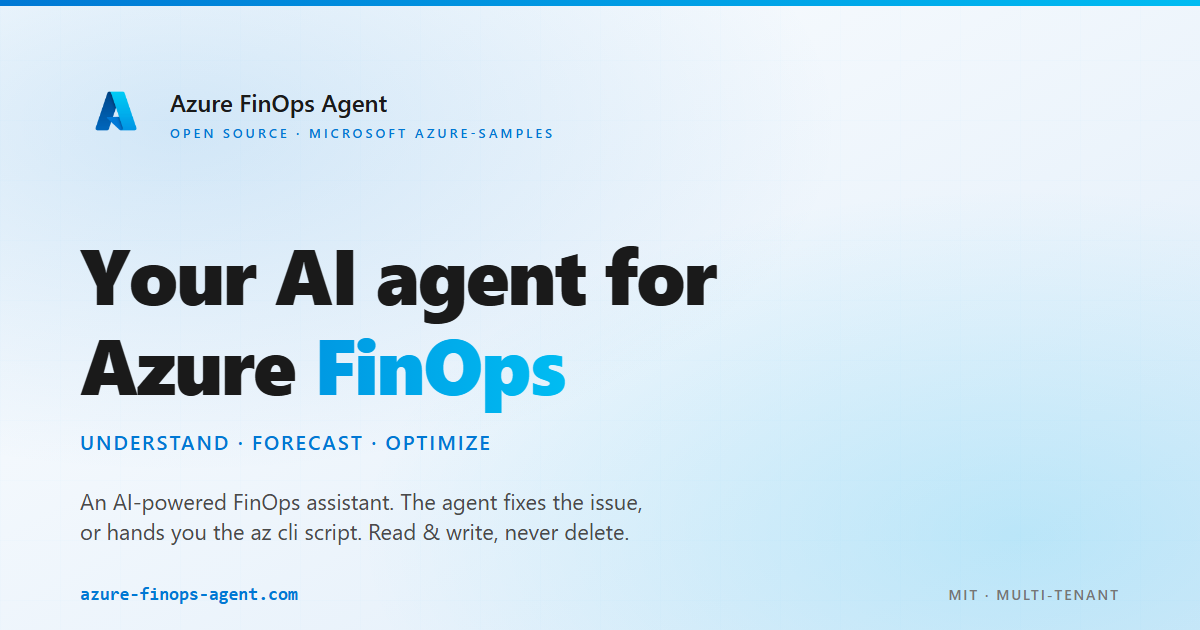
Azure FinOps Agent






Replace a multi-week FinOps assessment with a single conversation.
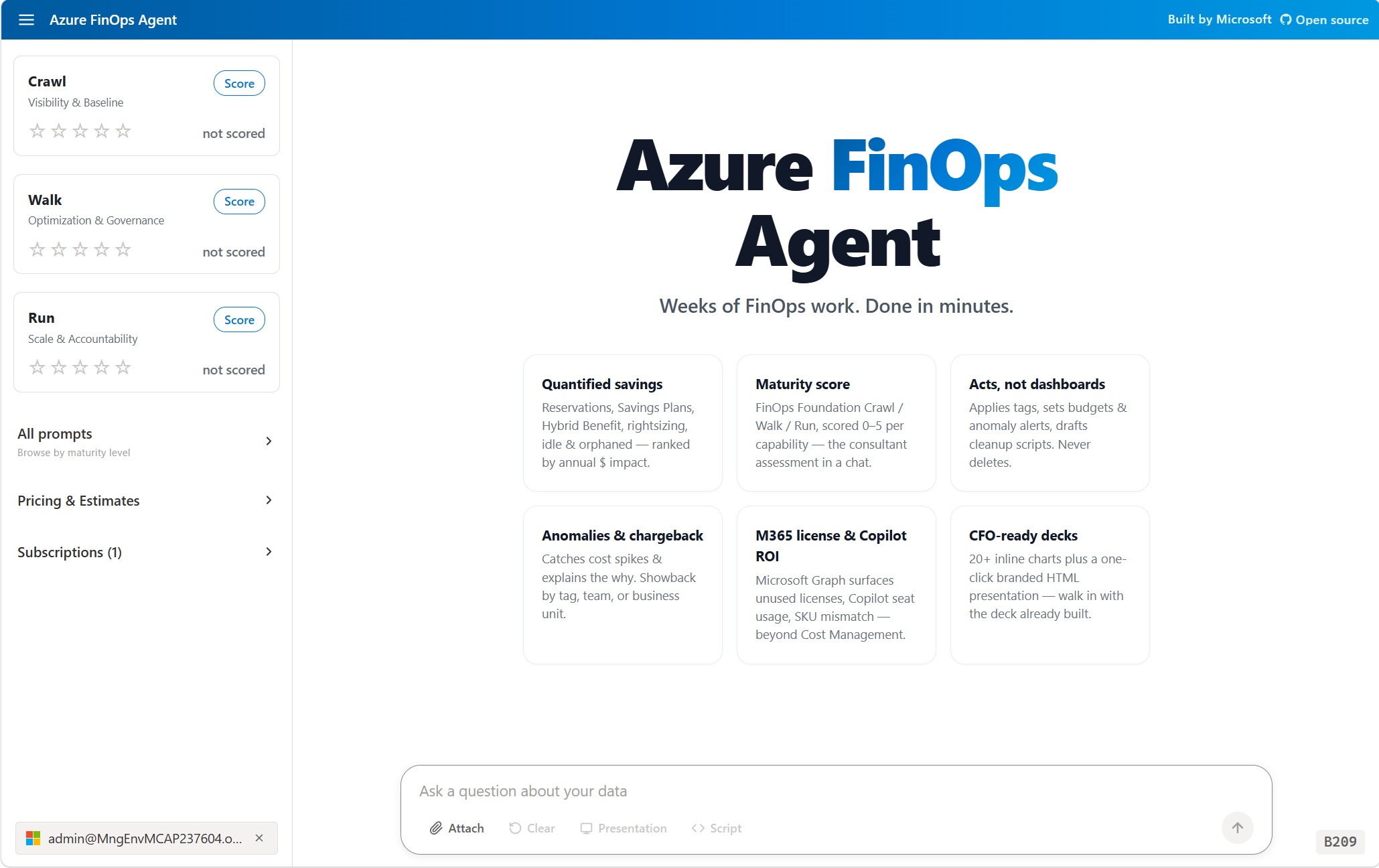
Quantified savings, a FinOps maturity score, a CFO-ready deck, and ready-to-run remediation scripts — in minutes.
The agent fixes the issue for you, or hands you the az cli script. Read & write on your behalf, never delete. Your tenant. Your tokens. Your control.
Try it live → 📊 Pitch deck →
Try it without signing in
No Azure tenant? Two ways to demo:
- Public pricing questions — ask about Azure VM SKUs, regions, reservations, savings plans. Agent uses the public Retail Prices API (no auth).
- Drop a sample file — drag any CSV/JSON/XLSX/PDF from
demo-data/into the chat. The agent inspects the schema, runs aggregates, and answers without ever loading the raw payload into the LLM. Includes realistic cost exports, Advisor JSON, audit logs, and FinOps notes.
How it works
Vue 3 SPA → .NET 10 minimal API → GitHub Copilot SDK → Azure read APIs (Cost Management, Resource Graph, Microsoft Graph, Log Analytics) using your delegated Entra tokens. Hosted on Azure App Service or Container Apps. OpenTelemetry to your Application Insights.
See the architecture diagram →
Running Locally
Prerequisites
- .NET 10 SDK
- Node.js 22+
- Azure CLI — authenticated via
az login - An Azure OpenAI resource with a deployed model (e.g.,
gpt-5.4)
One-time secret setup
Secrets are stored via .NET User Secrets — outside the repo, in your OS user profile. They cannot be accidentally committed.
cd src/Dashboard

# Required — the app throws InvalidOperationException on startup if this is missing:
dotnet user-secrets set "AzureOpenAI:Endpoint" "https://YOUR-RESOURCE.openai.azure.com/"

# Optional — set the model deployment name (defaults to gpt-5.4 if omitted):
dotnet user-secrets set "AzureOpenAI:DeploymentName" "gpt-5.4"

# Optional — enables the "Connect Azure" OAuth flow for Cost Management, Advisor, etc.:
dotnet user-secrets set "Microsoft:ClientId"     "YOUR-ENTRA-APP-CLIENT-ID"
dotnet user-secrets set "Microsoft:ClientSecret" "YOUR-ENTRA-APP-CLIENT-SECRET"
dotnet user-secrets set "Microsoft:TenantId"     "common"

# Optional — enables Application Insights telemetry:
dotnet user-secrets set "ApplicationInsights:ConnectionString" "InstrumentationKey=...;IngestionEndpoint=https://...;"
AzureOpenAI:Endpointis the only fail-fast key — the app will not start without it.
All other keys degrade gracefully (Azure connect is disabled, telemetry is skipped, etc.).
Run dotnet user-secrets list (from src/Dashboard) to verify what's stored.
Build the frontend
cd src/Dashboard/frontend
npm install
npm run build    # outputs to src/Dashboard/wwwroot/
Run the backend
cd src/Dashboard
$env:ASPNETCORE_ENVIRONMENT = "Development"
dotnet run --project Dashboard.csproj --urls "http://localhost:5000"
Open http://localhost:5000.
If
AzureOpenAI:Endpointis not set, the app intentionally crashes with anInvalidOperationExceptiontelling you exactly whichdotnet user-secrets setcommand to run. This is the fail-fast safety net.
Where do my secrets live?
User Secrets are stored outside the repo — they can never be accidentally committed:
- Windows:
%APPDATA%\Microsoft\UserSecrets\1190b8a4-6595-436b-9479-b9951bd00f16\secrets.json - macOS / Linux:
~/.microsoft/usersecrets/1190b8a4-6595-436b-9479-b9951bd00f16/secrets.json
Production
In production (Azure App Service), the same configuration keys are sourced from environment variables / App Service application settings via the standard IConfiguration environment-variable provider — e.g., AzureOpenAI__Endpoint, Microsoft__ClientId. Environment variables always take precedence over User Secrets; User Secrets only loads when ASPNETCORE_ENVIRONMENT=Development.
Deployment secrets
The deploy workflow (deploy.yml) injects secrets into App Service as application settings at deploy time. Add them under Settings → Secrets and variables → Actions → New repository secret in the GitHub UI.
| GitHub Secret name | App Service setting | Purpose |
|---|---|---|
AZURE_OPENAI_ENDPOINT |
AzureOpenAI__Endpoint |
Azure OpenAI resource URL — required |
AZURE_CLIENT_ID |
(OIDC login) | Managed identity / service principal client ID |
AZURE_TENANT_ID |
(OIDC login) | Azure AD tenant ID |
AZURE_SUBSCRIPTION_ID |
(OIDC login) | Target subscription ID |
Convention: App Service application settings use
__(double underscore) to map to .NETIConfigurationhierarchy —AzureOpenAI__Endpointmaps toAzureOpenAI:Endpoint. Follow the same pattern for any future secrets (e.g.,Microsoft__ClientId→Microsoft:ClientId).To add a new secret: (1) create it in the GitHub UI, (2) add
KEY="${{ secrets.SECRET_NAME }}"to the--settingslist in theConfigure App Service settingsstep ofdeploy.yml.
Tip for local dev: Besides
dotnet user-secrets, you can also exportAzureOpenAI__Endpointas a shell environment variable ($env:AzureOpenAI__Endpoint = "..."in PowerShell) — environment variables are picked up byIConfigurationautomatically and take precedence over User Secrets.
License
MIT · See CONTRIBUTING.md · Code of Conduct
Reviews (0)
Sign in to leave a review.
Leave a reviewNo results found