bamdra-openclaw-memory
Health Uyari
- License — License: MIT
- Description — Repository has a description
- Active repo — Last push 0 days ago
- Low visibility — Only 7 GitHub stars
Code Basarisiz
- rm -rf — Recursive force deletion command in package.json
- process.env — Environment variable access in packages/bamdra-memory-context-engine/src/index.ts
Permissions Gecti
- Permissions — No dangerous permissions requested
This agent provides a durable memory and context management runtime for OpenClaw sessions. It helps maintain conversation continuity and creates a searchable knowledge base from local markdown documents.
Security Assessment
The overall risk is rated as Medium. The tool accesses environment variables, which is typical for configuring memory and storage paths, but requires caution to ensure no sensitive credentials are leaked.
The most significant concern is a failed audit check for a recursive force deletion command (`rm -rf`) located in the `package.json` file. While this might simply be a cleanup script used during installation or updating, force deletion commands can be dangerous if they mishandle file paths. The tool does not request explicitly dangerous system permissions, and no hardcoded secrets were detected. Given its deep integration with local user files and directories, you should verify exactly what the deletion script targets before running it.
Quality Assessment
The project is actively maintained, with its most recent push occurring today. It uses the standard, permissive MIT license. However, it suffers from low community visibility, having only 7 stars on GitHub. This means it has not been widely vetted by the open-source community, increasing the risk of undetected bugs or vulnerabilities.
Verdict
Use with caution — manually verify the `rm -rf` script in `package.json` before installing, and be aware that the tool has very low community oversight.
Give one OpenClaw session durable memory, topic-aware continuity, and bounded token growth.
bamdra-openclaw-memory

The continuity-first memory runtime for OpenClaw.
Install once:
openclaw plugins install @bamdra/bamdra-openclaw-memory
Upgrade later with the same command. If you need to pin a release, add the version suffix, for example @bamdra/[email protected].
That single install now prepares the full Bamdra memory stack:
bamdra-openclaw-memorybamdra-user-bindbamdra-memory-vector
If you already have an older or broken local install, use the standalone Clawdhub repair skill:
clawdhub --workdir ~/.openclaw --dir skills install bamdra-memory-upgrade-operator --force
What it is
bamdra-openclaw-memory is the main runtime plugin in the Bamdra suite.
It helps OpenClaw:
- keep the right topic branch alive
- store durable facts
- assemble compact prompt context
- recover after interruptions and restarts
- work with a real identity layer and a real local knowledge base
Why teams install it
Without a continuity runtime, long OpenClaw sessions break down fast:
- users repeat the same background
- interruptions destroy flow
- stable decisions sink into chat history
- local docs and notes are not part of the recall path
With this suite, the assistant can gradually evolve with the user because profile, memory, and knowledge all become durable.
What makes the suite complete
bamdra-user-bind
Adds the stable user boundary and living profile layer.
It covers most of what a per-user USER.md would usually try to do:
- preferred address
- timezone
- tone preferences
- role and collaboration style
- long-lived user notes
Recent profile behavior improvements:
- profile updates now support semantic
replace,append, andremoveinstead of only blind overwrite - the Markdown mirror keeps machine-readable frontmatter as the controlled source
- the
Confirmed Profilesection in the body is now a human-readable mirror of the same structured fields
bamdra-memory-vector
Turns local Markdown into a real knowledge base.
It indexes:
knowledge/docs/notes/ideas/
and makes local recall happen before unnecessary web lookup.
Architecture
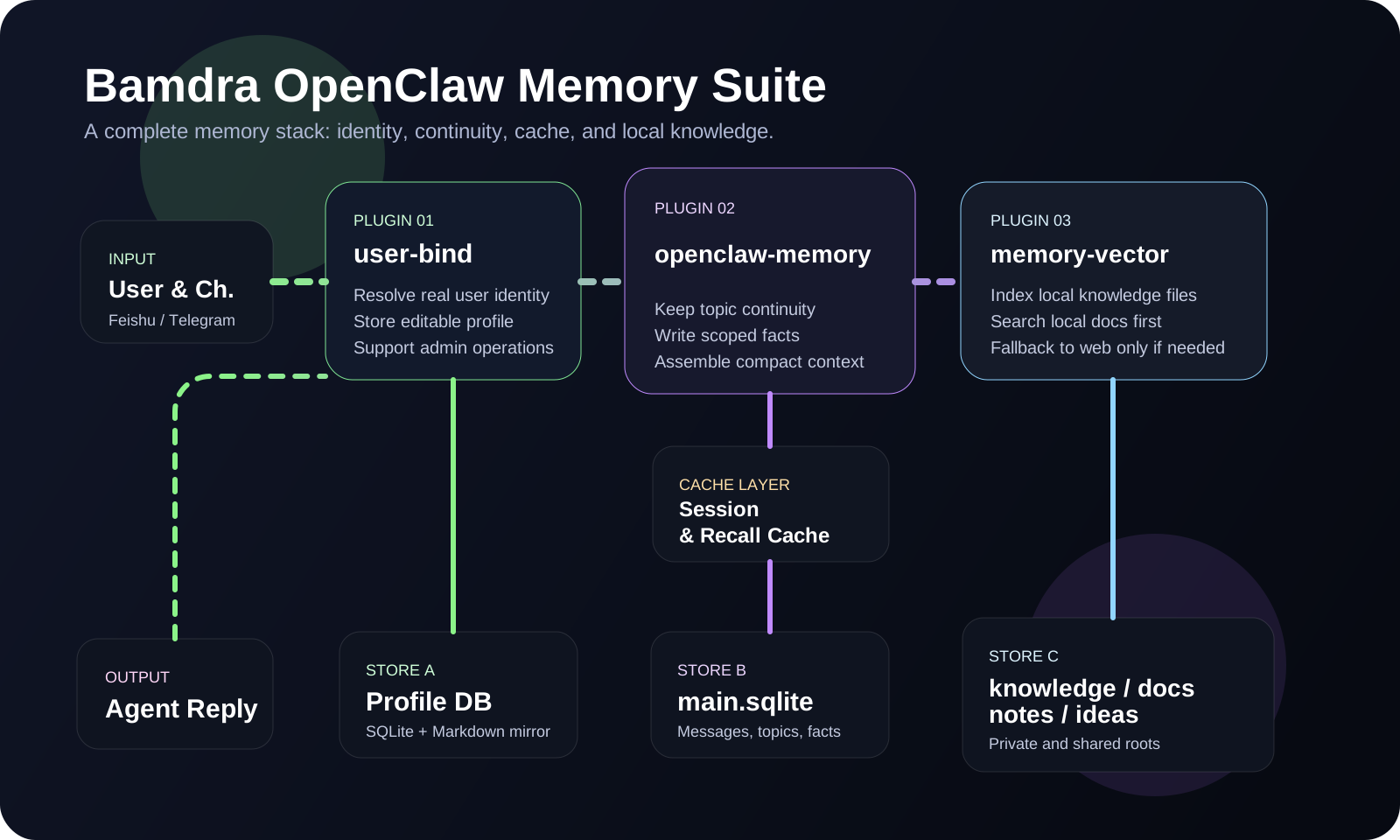
Best-practice setup
Use the suite like this:
- let
bamdra-openclaw-memoryown thememoryandcontextEngineslots - let
bamdra-user-bindown identity and personalization - let
bamdra-memory-vectorown local Markdown knowledge and semantic recall
Recommended vector roots:
{
  "plugins": {
    "entries": {
      "bamdra-memory-vector": {
        "enabled": true,
        "config": {
          "enabled": true,
          "privateMarkdownRoot": "~/Documents/Obsidian/MyVault/openclaw/private",
          "sharedMarkdownRoot": "~/Documents/Obsidian/MyVault/openclaw/shared",
          "indexPath": "~/.openclaw/memory/vector/index.json"
        }
      }
    }
  }
}
That gives you:
- a local-first memory runtime
- a living user profile
- a maintainable private and shared knowledge base
Profile update semantics
bamdra-user-bind no longer treats every profile change as a full replacement.
When the user says something new about how they prefer to collaborate, the runtime now distinguishes between:
- replacing an old preference
- appending another stable preference
- removing one specific old preference
This matters for fields like preferences, personality, and notes, where the right behavior is often incremental rather than destructive.
The Markdown mirror is also clearer now:
- frontmatter remains the machine-readable source of truth
- the body shows a synchronized human-readable summary
Supplementary Notesare reserved for durable context that does not fit the structured fields
Repository map
Yorumlar (0)
Yorum birakmak icin giris yap.
Yorum birakSonuc bulunamadi