proton-calendar-bridge
Health Warn
- License — License: MIT
- Description — Repository has a description
- Active repo — Last push 0 days ago
- Low visibility — Only 6 GitHub stars
Code Fail
- rm -rf — Recursive force deletion command in scripts/install.sh
- network request — Outbound network request in scripts/install.sh
- rm -rf — Recursive force deletion command in scripts/install_test.sh
Permissions Pass
- Permissions — No dangerous permissions requested
No AI report is available for this listing yet.
Your Proton Calendar in Thunderbird and AI agents: a local bridge that decrypts it and serves CalDAV and MCP

 proton-calendar-bridge




[!IMPORTANT]
proton-calendar-bridge is an independent project. It is not affiliated with, endorsed by or supported by Proton AG. Proton and Proton Calendar are trademarks of Proton AG.
Your Proton Calendar in Thunderbird and in your AI agents. The calendar counterpart of Proton Mail Bridge.
- What:
pcb, one Go binary that logs into Proton, decrypts your calendars on your machine and serves them over CalDAV (read and write) and MCP (for AI agents).pcb-uiis the same bridge as a desktop app for Linux and Windows. - Why: Proton Calendar is end-to-end encrypted with no public API, so standard calendar apps and agents cannot reach it. pcb does the decryption locally and speaks the standard protocols.
- Where it runs:
- Desktop, Linux or Windows 10 and 11:
pcb-ui, with a tray icon. - Headless, Linux only: a systemd service or a container.
- macOS: the
pcbcommand line only, untested.
- Desktop, Linux or Windows 10 and 11:
What it does for you
- Your calendars in Thunderbird, read and write: create, edit, move and delete events, single occurrences included. Each change goes to Proton and is read back before Thunderbird gets its answer.
- Your calendars for AI agents, through MCP: Claude Code or any MCP client lists, searches and, when you allow it, edits events. You decide per agent what it may do, and a delete asks you first, and is refused when the agent's client cannot ask, unless you allow it.
- Several Proton accounts in one bridge, each with its own CalDAV address, passwords, cache and sync, so one account's problem never stops another.
- Keeps your secrets yours. The cache is encrypted, the Proton session is sealed with a key held in your desktop keyring or a key file, and passwords never go through command-line arguments. Calendar apps sign in with app passwords you can revoke one by one.
- Looks after itself. It follows Proton's change feed, survives restarts, and
pcb doctorsays what is wrong and how to fix it.
The desktop app
pcb-ui puts the bridge in your tray: add an account (password, 2FA code, CAPTCHA), copy the connection into Thunderbird, switch CalDAV or MCP per account, and get a notification when an account needs you. It follows your desktop's light or dark theme.
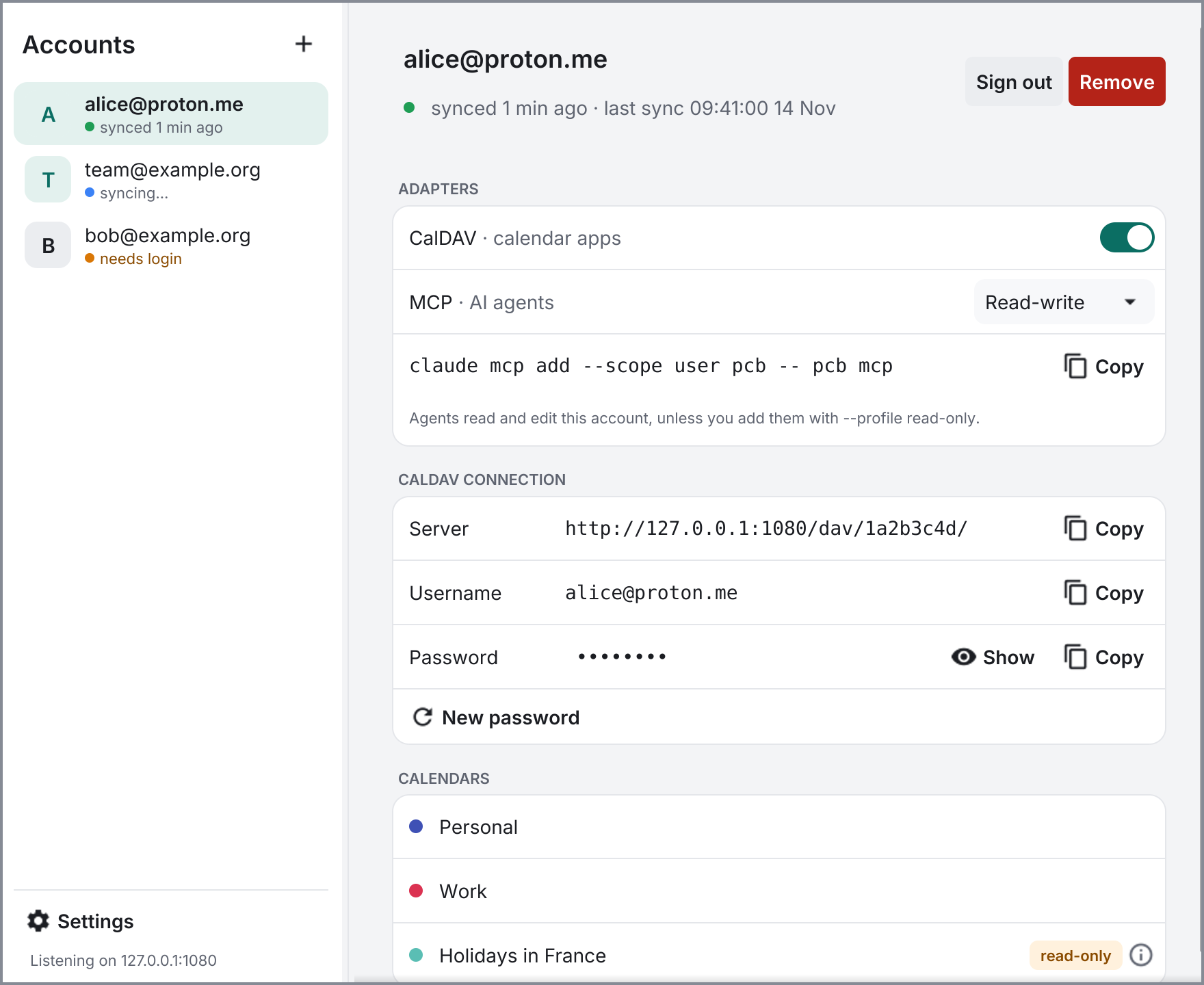
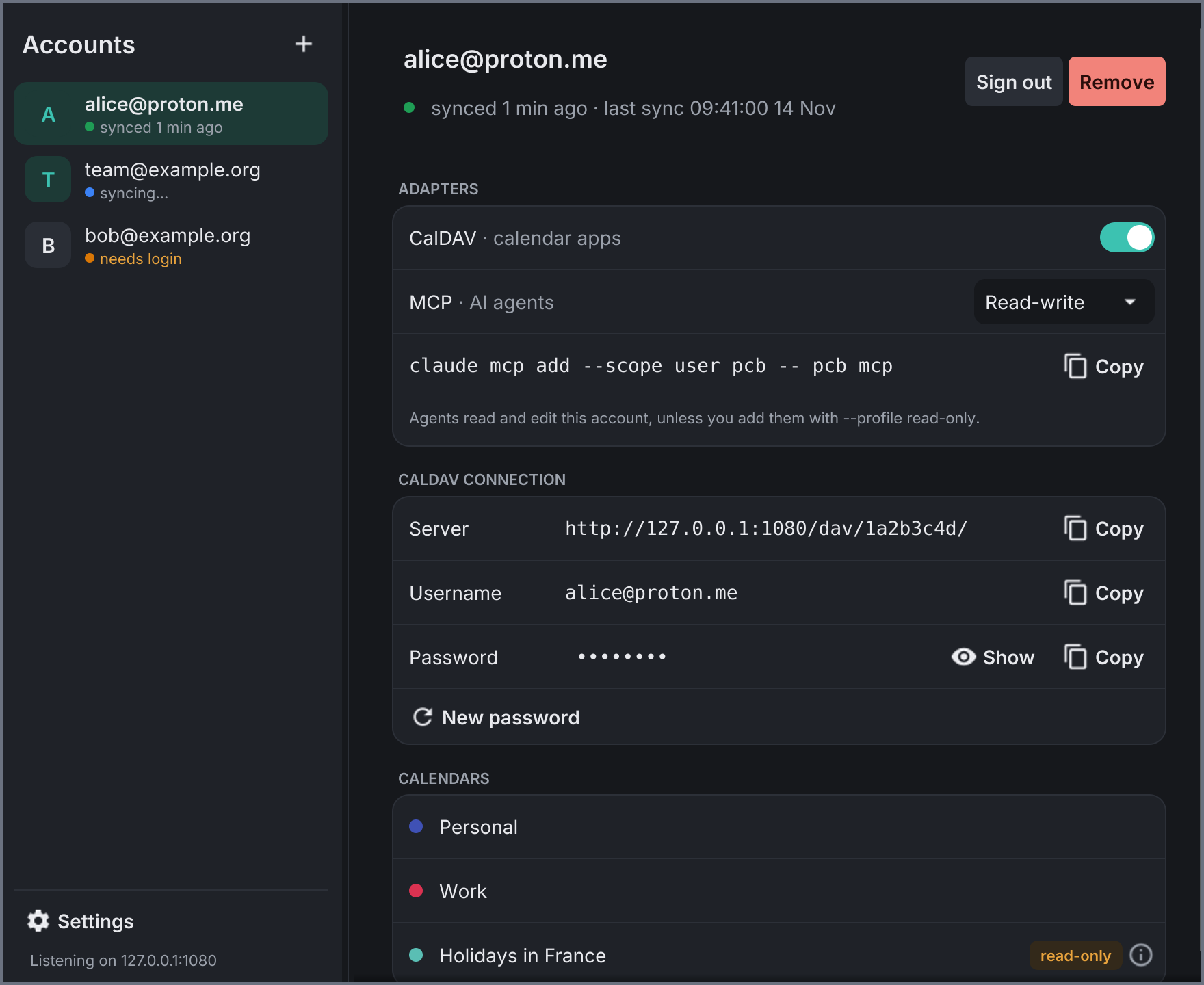
More pictures and every setting: docs/desktop.md.
How it works
flowchart LR
    proton[("Proton Calendar<br/>end-to-end encrypted")] <-->|"sync and writes"| pcb["pcb<br/>decrypts locally,<br/>encrypted cache"]
    pcb <-->|"CalDAV, app password"| tb["Thunderbird"]
    pcb <-->|"MCP, stdio or token"| agent["AI agent"]
    pcb <-->|"CLI, --json"| you["You, scripts"]
One process serves every account: the desktop app, the pcb serve daemon (systemd or container), or pcb mcp started by an agent. The CLI (pcb status, pcb login, pcb client show) talks to whichever one runs, over a local socket (a named pipe on Windows) only your user can open.
Choose how to run it
| You want | Run | Guide |
|---|---|---|
| The bridge on your desktop (Linux, Windows 10 or 11), with a tray icon | pcb-ui |
desktop |
| An always-on bridge on a server or a home lab | pcb install (systemd) |
service |
| The same, in Docker | the container image | container |
| Only an AI agent on this machine, no daemon | pcb mcp, started by the agent |
agents |
Install a release (Linux and macOS, amd64 and arm64; no sudo):
curl -fsSL https://github.com/Barben360/proton-calendar-bridge/releases/latest/download/install.sh | sh
It puts pcb and pcb-ui in ~/.local/bin, plus the desktop entry on Linux. Flags, checks and macOS: docs/install.md. Or build from a clone with Go (version in go.mod); the "On a Linux desktop" and "Headless" steps below do.
On Windows, run the installer pcb_windows_amd64.msi (from v0.2.0) or unzip pcb_windows_amd64.zip from the releases page and start pcb-ui.exe: no administrator rights either way (Windows).
On a Linux desktop
git clone https://github.com/Barben360/proton-calendar-bridge && cd proton-calendar-bridge
make install install-ui      # pcb and pcb-ui into ~/.local (pcb-ui needs the GL/X headers: docs/install.md)
pcb-ui                       # then Add account in the window
On GNOME, the tray icon needs the AppIndicator extension; without it, the window stays open. Settings, "Start at login" starts it with your session.
Headless (systemd)
make install                 # pcb into ~/.local/bin
pcb install                  # a user service running pcb serve; it waits for your login
loginctl enable-linger "$USER"
pcb login                    # username, password, 2FA code at a prompt
pcb client show              # the CalDAV URL, username and password for Thunderbird
pcb doctor                   # every check, with the fix for each failure
A system-wide service (sudo pcb install --system) and the container are in service and container.
Connect Thunderbird
In Thunderbird: New Calendar, On the Network, format CalDAV. Use the URL, username and password that pcb client show prints (or the desktop app's Copy buttons), and keep "Offline support" checked. Each device can have its own revocable password: pcb client add laptop.
Proton cannot store everything Thunderbird can: pcb refuses what it cannot keep faithfully (invitations and attendees, some recurrence rules) and never notifies attendees. The list: docs/thunderbird.md.
Give an AI agent your calendar
claude mcp add --scope user pcb -- pcb mcp                         # read, create, edit, delete events
claude mcp add --scope user pcb -- pcb mcp --profile read-only     # read events, start a login
The same commands work with pcb-ui running: pcb mcp hands the session to it, with no port to set. The account's MCP setting (pcb account mcp, or the selector in pcb-ui) and the agent's profile both apply, and the stricter wins: an agent edits unless the account is set to Read-only or the agent was added with --profile read-only (details).
You type passwords and 2FA codes yourself, in the desktop app or on a one-time local page, never the agent. Text from calendars reaches the agent marked untrusted. An agent on another machine uses /mcp with its own token: docs/agents.md.
Scripts and automation
Every command takes --json and prints one envelope, {schema_version, command, ok, data | error}, with stable exit codes: 0 done, 2 bad invocation, 10 you must act, 20 blocked or transient, 30 failed and rolled back, 40 partly done and resumable. Secrets come from a prompt, a file descriptor (--password-fd) or the environment (PCB_USERNAME, PCB_PASSWORD, PCB_TOTP, and PCB_MAILBOX_PASSWORD for a two-password account). Every command: docs/commands.md.
Documentation
| Page | What is in it |
|---|---|
| install | Installing a release, building, platforms, upgrading. |
| desktop | pcb-ui: the tray, the window, adding accounts, connecting an agent, start at login, removing it. |
| service | pcb serve as a systemd user or system service. |
| container | The image, compose, the key file, a container that restarts in a loop. |
| Thunderbird | Connecting, app passwords, several accounts, what writes Proton accepts, the listener and TLS. |
| agents | MCP over stdio or remote, grants, tokens, logins from an agent, audit. |
| commands | Every command, account selection, --json, exit codes. |
| security | Logins and secrets, the sealing key and the desktop keyring, CalDAV passwords, TLS. |
| troubleshooting | Symptoms, causes and fixes. |
| status | What is built, what was checked live, what is still to check. |
| development | Tests, the fake Proton, live sessions, screenshots, the design spec. |
The design and its decisions are in spec/.
Contributing
Issues and pull requests are welcome: CONTRIBUTING.md says how to build, test and propose a change.
Credits
Logic reused from another project is audited, rewritten with our own tests and credited here. Nothing below was copied.
Projects this one learned from or depends on- cheeseandcereal/proton-cal (Unlicense): the reverse-engineered API and crypto documentation (
docs/api.md,docs/crypto.md,docs/overview.md): the key chain, the locked scope and Proton code 9101, member-level calendar metadata, the v2 bootstrap and the default-calendar setting. Used byinternal/proton/auth,keysandcalendar. - Barben360/proton-cal, our fork: the two-step CAPTCHA login, the env/TOTP login, and the refresh-token race lesson (one refresh at a time across processes, behind
internal/proton/apiand the token store). Sources audited and rewritten:pkg/auth(auth.go,unlock.go,loginopts.go) forinternal/lab/sessionandinternal/proton/auth(SRP login, CAPTCHA stop and resume, TOTP, locked-scope unlock with server-proof check, lock) andinternal/proton/keys(salts with scope elevation, salted key passphrase check, key unlock);pkg/calendar(calendar.go,keys.go) forinternal/proton/calendar(calendar list, default calendar, bootstrap, member passphrase decryption, calendar key unlock);pkg/auth/totp.goforinternal/otp. The fork's CLI is also run as an external tool by the data-set seeder (internal/lab/seed). - go-proton-api, go-srp, gopenpgp (MIT, used as libraries). go-proton-api's in-memory test server pattern is the model for and the engine behind our shared fake Proton (
internal/proton/protontest, an httptest front over its server, which the lab'sinternal/lab/labtestbuilds on). The developer-onlypcb-lab probe sessionstakes the sessions endpoints and their auth from go-proton-api'sAuthSessionsandAuthRevoke(GET /auth/v4/sessions,DELETE /auth/v4/sessions/{UID}, the session's own token, no extra scope), on our own code and transport (internal/lab/probe/sessions.go). - develonrails/carbonate, WentTheFox/caloxide, ProtonMail/WebClients (GPL-3.0): read only for the client identity strings tried in experiment E03 (
spec/experiments/E03-client-identity.md). No code from any of them; WebClients is never copied. - emersion/go-webdav (MIT): audited in experiment E17 (
spec/experiments/E17-go-webdav-audit.md) and not used as the server; its CalDAV client, withgo-ical(MIT), is a test-only dependency that checks our server from the outside and never reaches the binary. It movedgo-vcardto a newer revision through module version selection (only README and an example differ). - modelcontextprotocol/go-sdk v1.8.0 (the official MCP Go SDK; Apache-2.0, with the contributions not yet relicensed under MIT): the MCP server, transports and test client of the MCP adapter, used as a dependency, nothing copied; audited in experiment E19 (
spec/experiments/E19-mcp-go-sdk.md). It bringsgoogle/jsonschema-go(MIT),segmentio/encodingandsegmentio/asm(MIT),yosida95/uritemplate(BSD-3-Clause) andgolang.org/x/oauth2(BSD-3-Clause). - Fyne v2.8.2 (fyne.io/fyne/v2, BSD-3-Clause): the toolkit of
pcb-ui(window, tray, notifications, headless test driver, which also renders the screenshots), used as a dependency, nothing copied (internal/ui/desktop,cmd/pcb-ui). - Inter 4.1 (rsms/inter, SIL Open Font License 1.1, license in
internal/ui/desktop/fonts/OFL.txt): the text font ofpcb-ui, four static files from the release archive (Regular, SemiBold, Italic, SemiBoldItalic) embedded unmodified (internal/ui/desktop/theme.go). - fyne-io/oksvg (BSD-3-Clause, Fyne's fork of srwiley/oksvg) and srwiley/rasterx (BSD-3-Clause), both already in Fyne's dependencies: they render
pcb-ui's SVG icon to the PNG that becomespcb-ui.exe's icon at build time (cmd/pcb-ui/winres), used as libraries, nothing copied. - WiX Toolset 7.0.1 (wixtoolset.org, MS-RL, used under its Open Source Maintenance Fee EULA, which the author accepted): builds
pcb_windows_amd64.msifrompackaging/windows/pcb.wxs(scripts/release/mkmsi.ps1), run as a pinned tool. Its UI and Util extensions put their standard installer screens and their custom actions (a quiet command, openingpcb-uiat the end) into the MSI; nothing copied into this repository. - tc-hib/go-winres v0.3.3 (0BSD): writes
pcb-ui.exe's icon and version resource at build time (make winres), run as a pinned tool, never linked into a binary. - Microsoft/go-winio v0.6.2 (MIT): the named pipe of the control channel on Windows, private to the user (
internal/ctl), used as a library, nothing copied. - golang.org/x/sys/windows (BSD-3-Clause): the Windows calls for the file locks, the replacement of files, DPAPI, the access lists, the registry, the time zone, and
pcb-ui's console, session end and file opening, used as a library, nothing copied. - godbus/dbus v5.2.4 (BSD-2-Clause): the D-Bus client of the Secret Service sealer and of the desktop notifications, used as a dependency, nothing copied. The Secret Service client is written from the freedesktop.org specification, with no other implementation read (
internal/store/seal). - Thunderbird's CalDAV provider (mozilla/releases-comm-central, MPL-2.0): read for experiment E08 (
spec/experiments/E08-thunderbird-caldav.md), source only, no code copied. - develonrails/carbonate (MIT), jmdlab/cal-gateway (MIT) and WentTheFox/caloxide (MIT; derives from hydroxide, ferroxide and protoxide, all MIT), for the sync design notes (ideas audited, no code copied; the feed research is in
spec/experiments/raw/m2-feed-research.md, citations by file and line): carbonate's measured pitfall that a cursor derived atlatestloses events and its ID-driven re-read that ignoresAction; jmdlab's order (read the feed head before the full listing) and its rule that a re-read row answering 404 is a delete; caloxide's feed endpoint shapes and its 30 s poll with exponential backoff. Rewritten with our own tests (internal/syncer,internal/store/cache). - WentTheFox/caloxide, develonrails/carbonate, jmdlab/cal-gateway (all MIT) and cheeseandcereal/proton-cal (Unlicense), for the CalDAV design notes (research, no code copied): what each had to patch around go-webdav (getctag and
supported-report-set, privileges, sync-collection, body limits), the Proton card-to-iCalendar merge and the one-object-per-UID rule, tolerance of undecryptable events. Rewritten with our own tests (internal/caldav,internal/ical,internal/proton/cards). - jmdlab/cal-gateway (MIT), cheeseandcereal/proton-cal (Unlicense), develonrails/carbonate (MIT) and WentTheFox/caloxide (MIT), for the write design (research
spec/experiments/raw/m4-research.md, citations by file and line; no code copied, every rule rewritten with our own tests):- cal-gateway's alarm rules (
internal/proton/notifications.go, which it says it ported from the web client): EMAIL to an email notification, DISPLAY and AUDIO to a device one, relative-to-start triggers only, nothing after the start except on all-day events, Proton's per-unit bounds, at most 10, and the tri-state ofNotificationson update (internal/ical/alarms_write.go,internal/service/writeplan.go); also its refusals of floating times andRANGE=THISANDFUTURE, its RRULE INTERVAL bounds, its mirroring of a full PUT onto master and exception rows, and its rule that a refusal must be an honest 403, never a 2xx no-op; - proton-cal's RRULE limits (
docs/api.md: FREQ, COUNT ≤ 49, UNTIL ≤ 2037-12-31, COUNT and UNTIL exclusive, MONTHLY and YEARLY forms;internal/ical/validate.go), its documentation of the sync endpoint, the property routing table, the fragment form, the sealing of each part, session-key reuse on update and full-replace semantics (docs/api.md,docs/crypto.md;internal/proton/cards,internal/proton/events,internal/ical/write.go), and its patch-in-place update; - carbonate's and caloxide's live notes on Proton's refusals (signing with the member's address key, bare
SEQUENCE, RECURRENCE-ID with RRULE), and caloxide's member permission bits (Write = 8,internal/proton/calendar).
- cal-gateway's alarm rules (
- WentTheFox/caloxide (MIT), for the idle cadence: its standby idea, slowing the poll when nobody uses the bridge (idea audited from the sync research, no code copied). Rewritten with our own definition of idle (no authenticated request for 35 minutes, longer than Thunderbird's 30-minute refresh), a wake on the first request, and our own tests (
internal/service,internal/syncer). - Proton Mail Bridge (and the author's headless Bridge container), for the container and credential model: one
/datavolume, login withdocker exec -it, state kept in the volume, and a bridge password the user can look up again (pcb client show). The usage model only: ideas, no code read or copied; our own image, units and tests (Dockerfile,internal/install,internal/ctl). - Unicode CLDR
windowsZones.xmlrelease 49 (Unicode License v3, https://www.unicode.org/license.txt): the mapping of Windows time zone keys to IANA zones, territory 001 entries only, kept as a table generated bygo generate(internal/winzone, version inwinzone.CLDRVersion, source file pinned by SHA-256 in the generator). Data, no code. - The other prior art listed in the design spec: design references only; nothing from them is used in this repository so far.
License
MIT, see LICENSE.
Reviews (0)
Sign in to leave a review.
Leave a reviewNo results found