vite-devtools-svelte
Health Gecti
- License — License: MIT
- Description — Repository has a description
- Active repo — Last push 0 days ago
- Community trust — 17 GitHub stars
Code Uyari
- process.env — Environment variable access in .claude/skills/full-code-review/scripts/plan-review-chunks.mjs
- process.env — Environment variable access in compat/kit3/vite.config.ts
Permissions Gecti
- Permissions — No dangerous permissions requested
Bu listing icin henuz AI raporu yok.
Svelte 5 DevTools for Vite: component and reactivity inspection with MCP access, standalone or in the Vite DevTools dock.
vite-devtools-svelte
Svelte DevTools for Vite, built on Devframe. Provides 15 specialized panels for debugging, profiling, and inspecting Svelte/SvelteKit applications. The same tool runs standalone at /.svelte-devtools/ on your dev server, or inside the Vite DevTools dock when @vitejs/devtools is installed.
Status: Early development. APIs may change. This README describes 0.4.0 (Devframe host: standalone or inside the Vite DevTools dock). 0.3.x rendered only inside
@vitejs/devtools; see Upgrading from 0.3.x.
Features
- Component Inspector — View component hierarchy, props, state, and reactive values in real-time
- Reactivity — A whole-app overview of the busiest components, then the current dependencies of one component's
$state,$derivedand$effectsignals (signals created during component init and shared.svelte.js/.tsmodule state, plus a markup node for reads from the template; edges are "can affect", not a recorded cause, and not the complete app graph) - Render Profiler — Track component render counts, render times, and identify bottlenecks
- Route Viewer — Explore SvelteKit file-based routing structure with dynamic parameters
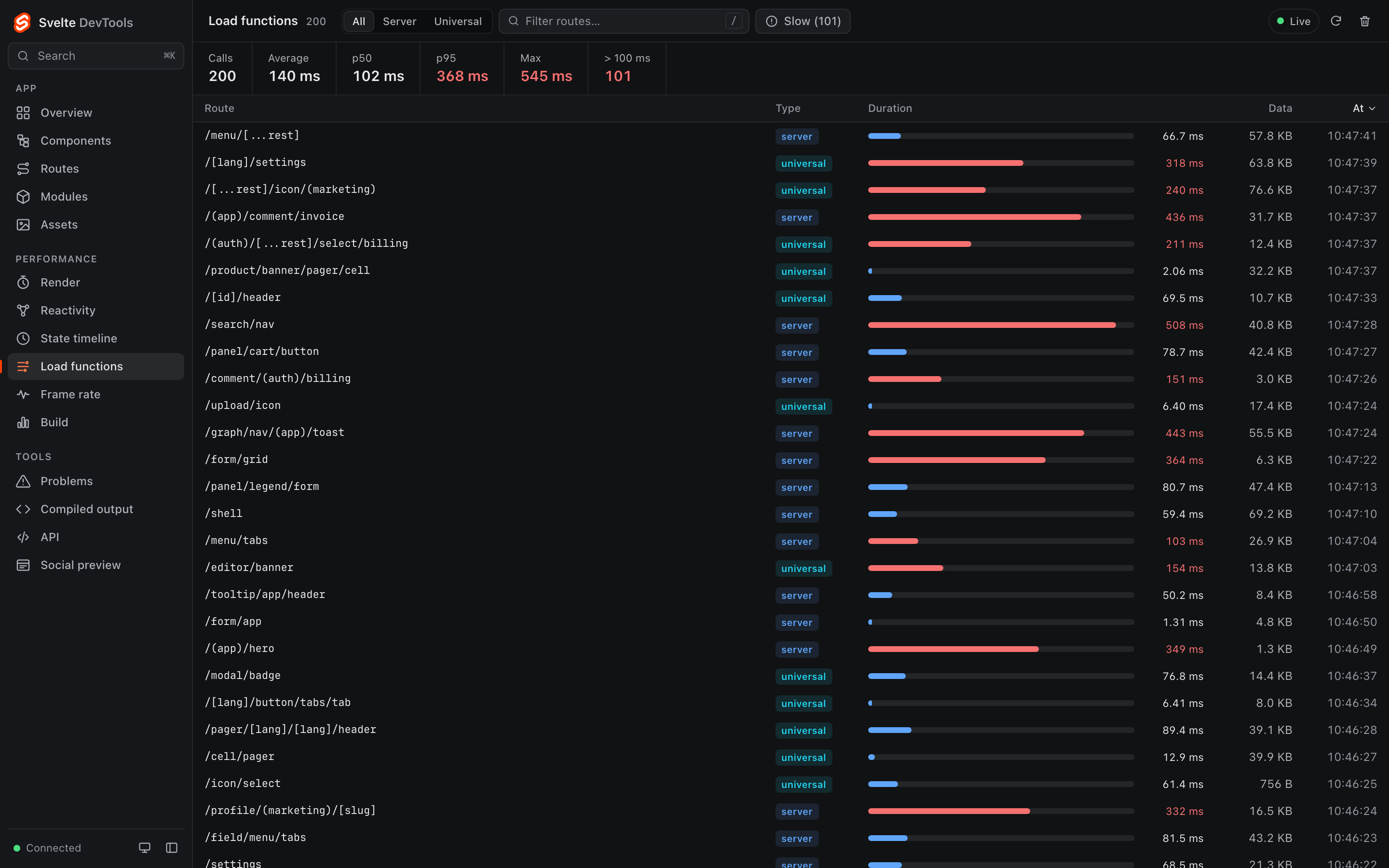
- Load Profiler — Monitor SvelteKit
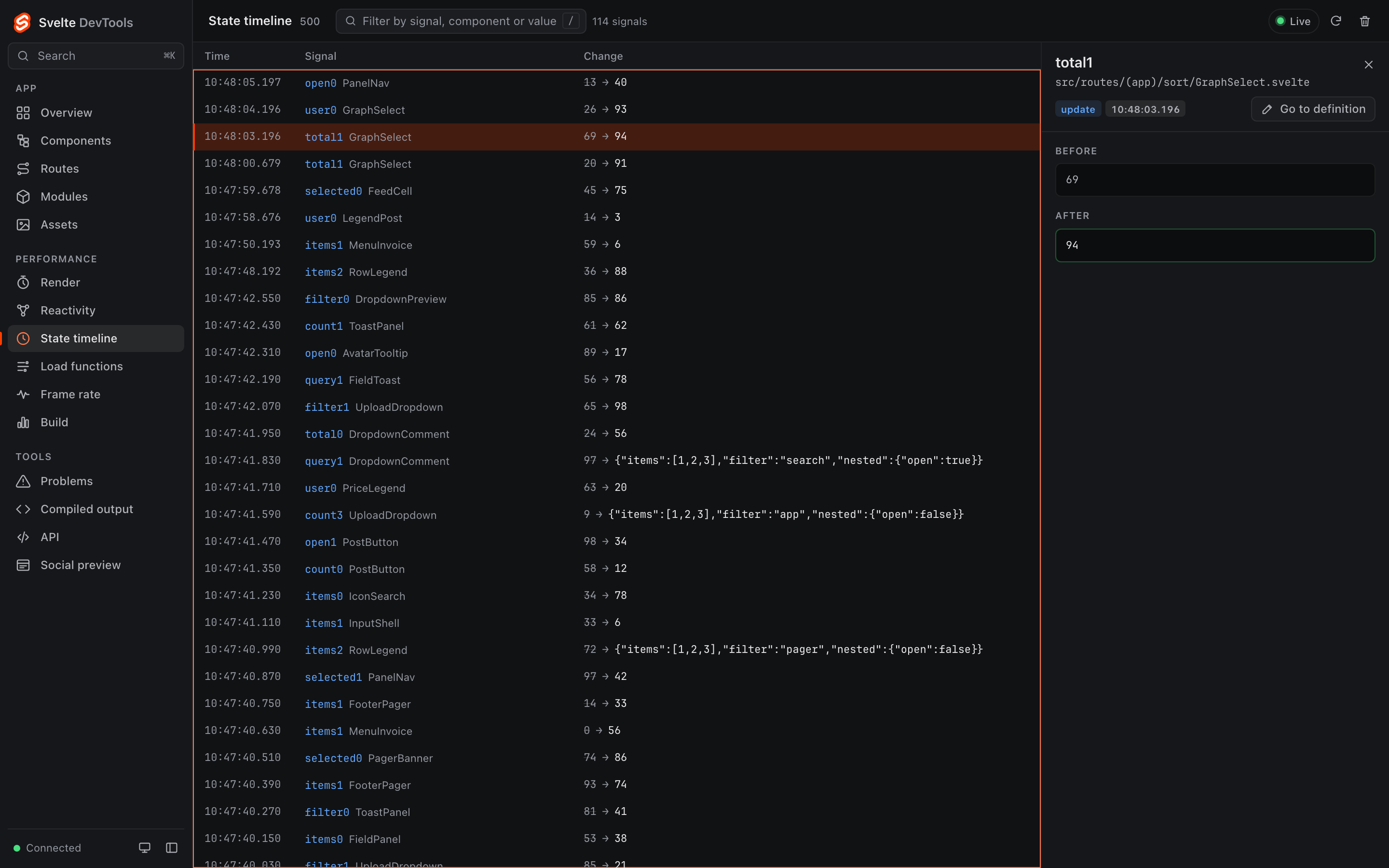
loadfunctions with waterfall visualization - State Timeline — Record and replay state changes across the application
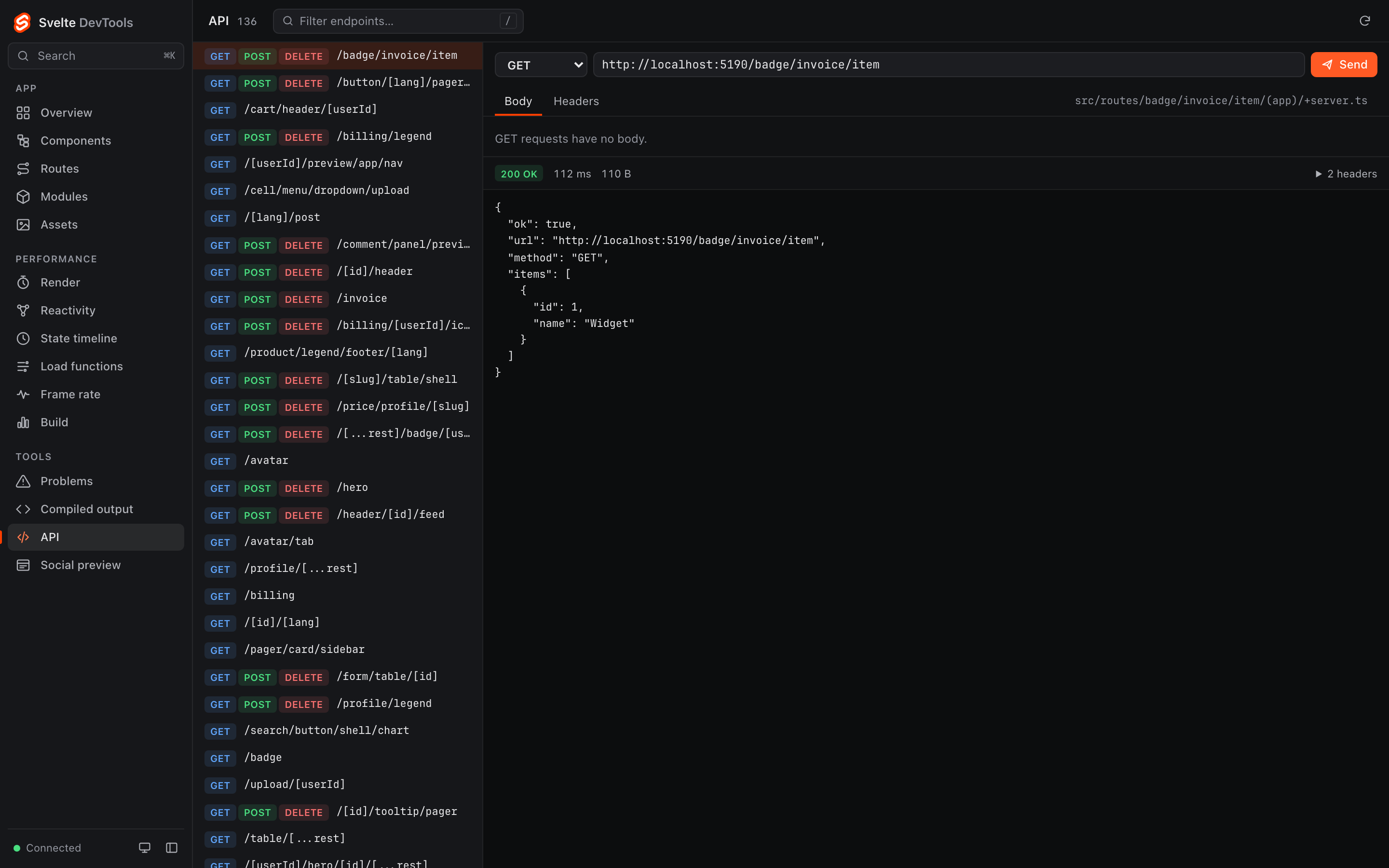
- API Playground — Test SvelteKit server endpoints (
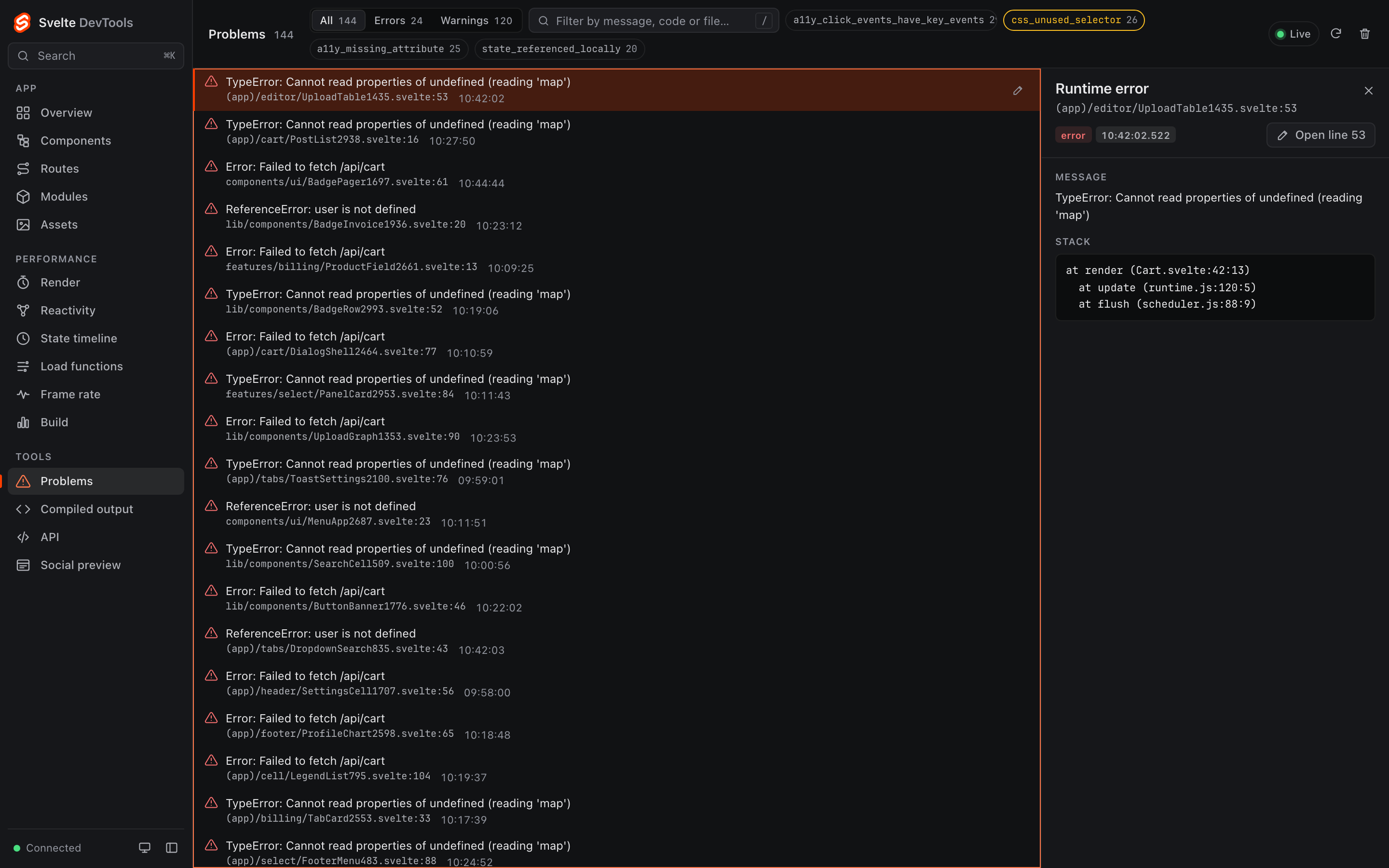
+server.ts) directly from DevTools - Error Dashboard — Centralized view of compiler warnings and runtime errors
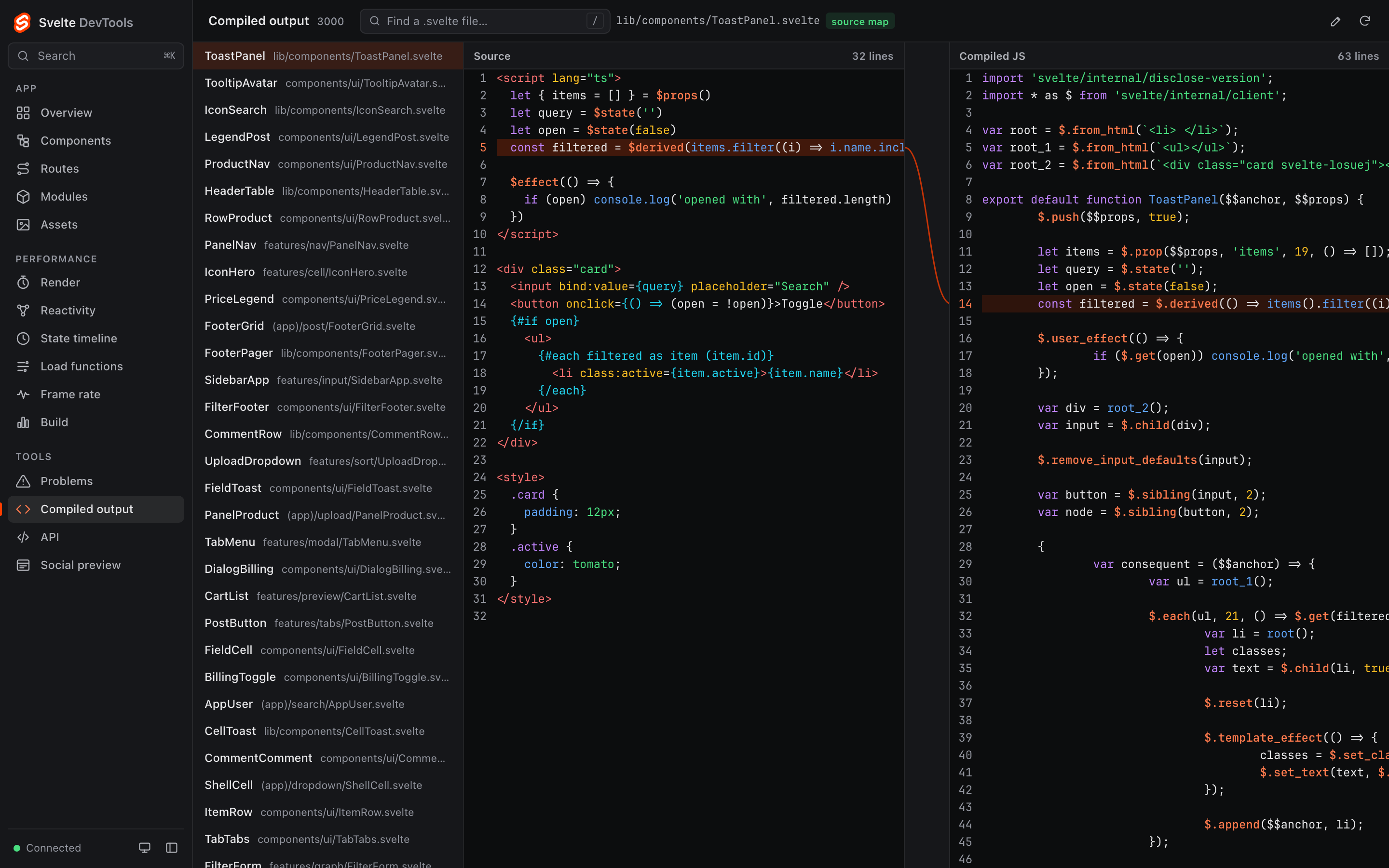
- Code Inspector — View compiled Svelte output with source mapping
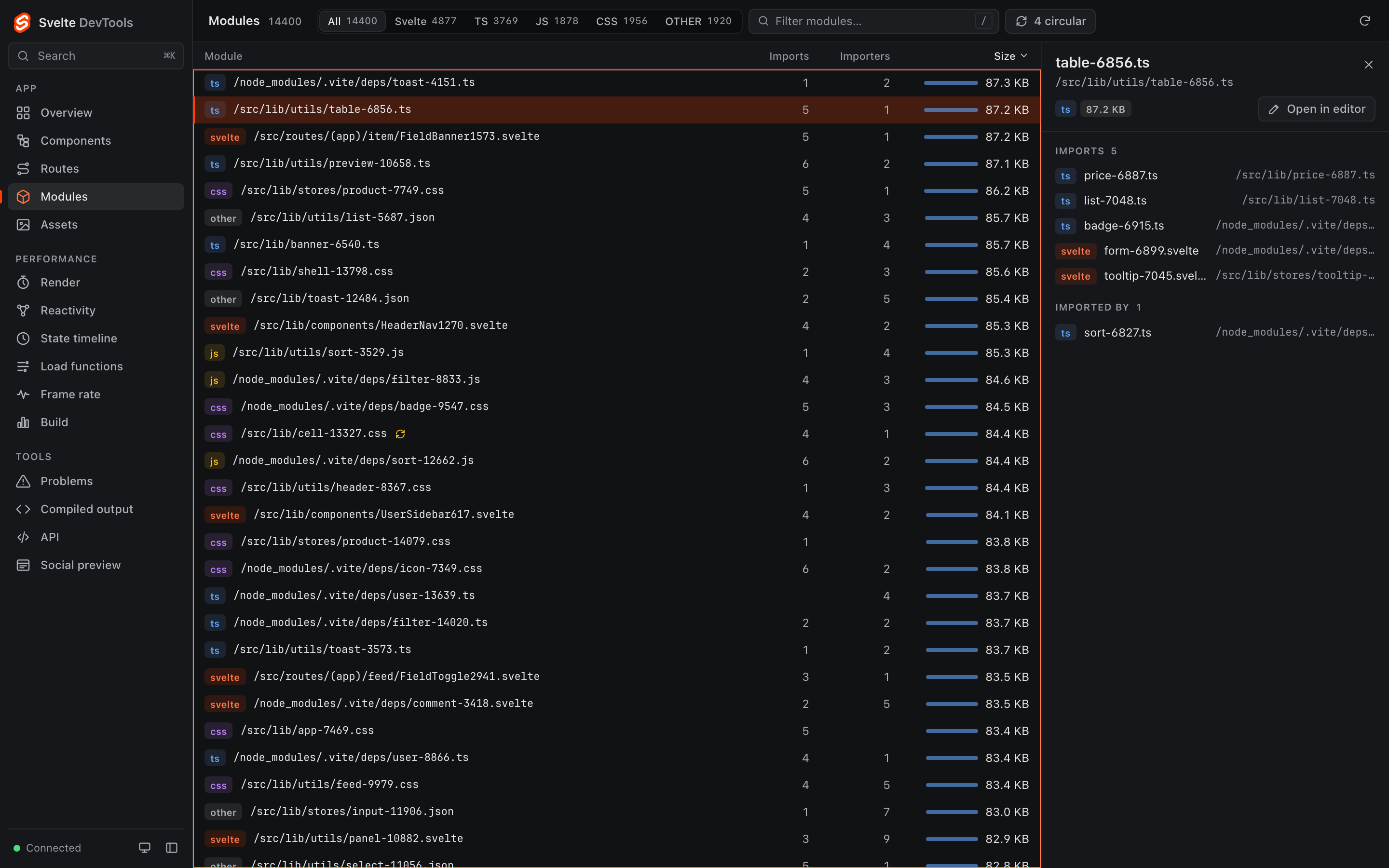
- Module Graph — Visualize module dependencies and detect circular imports
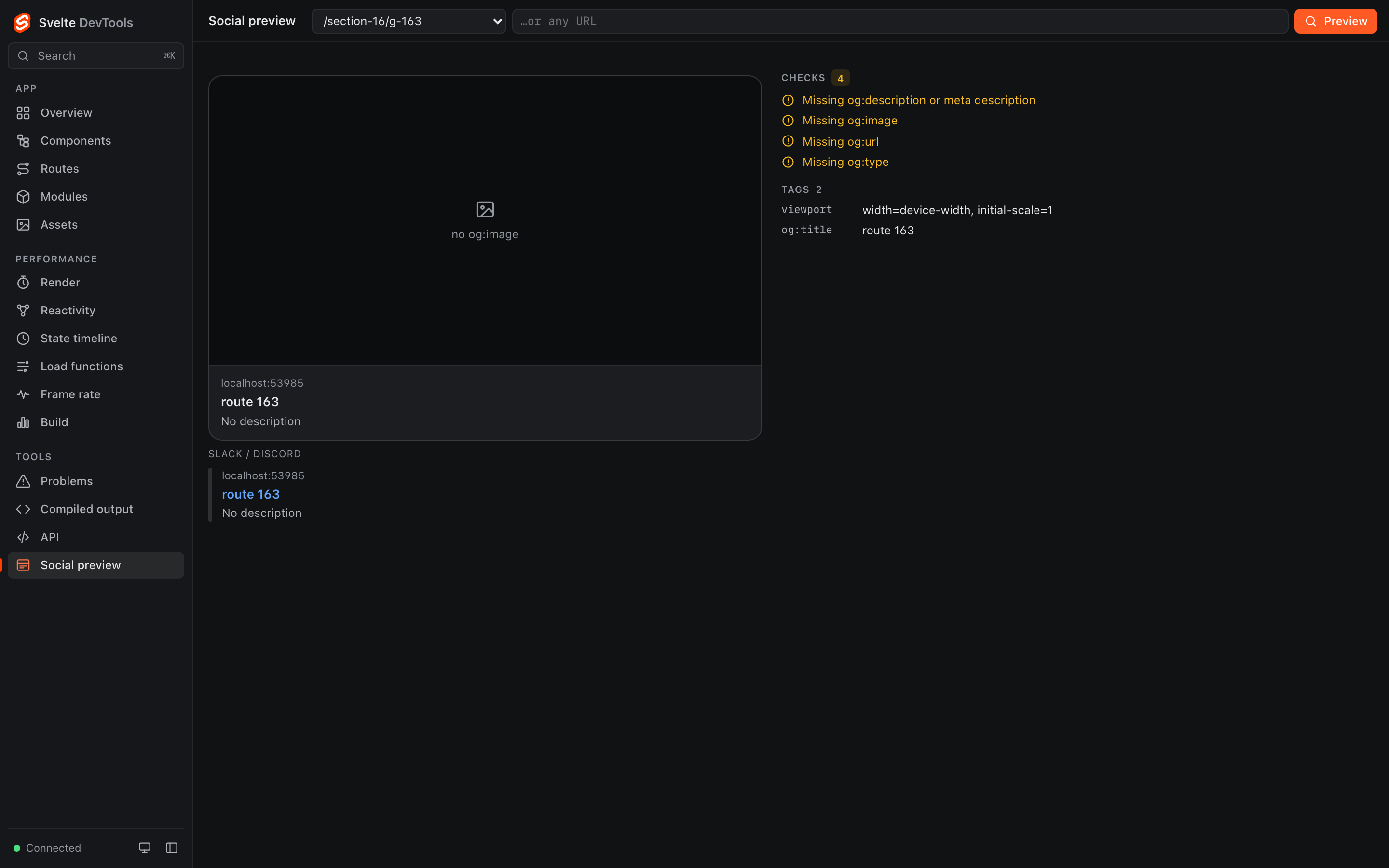
- OG Preview — Preview Open Graph meta tags for SEO validation
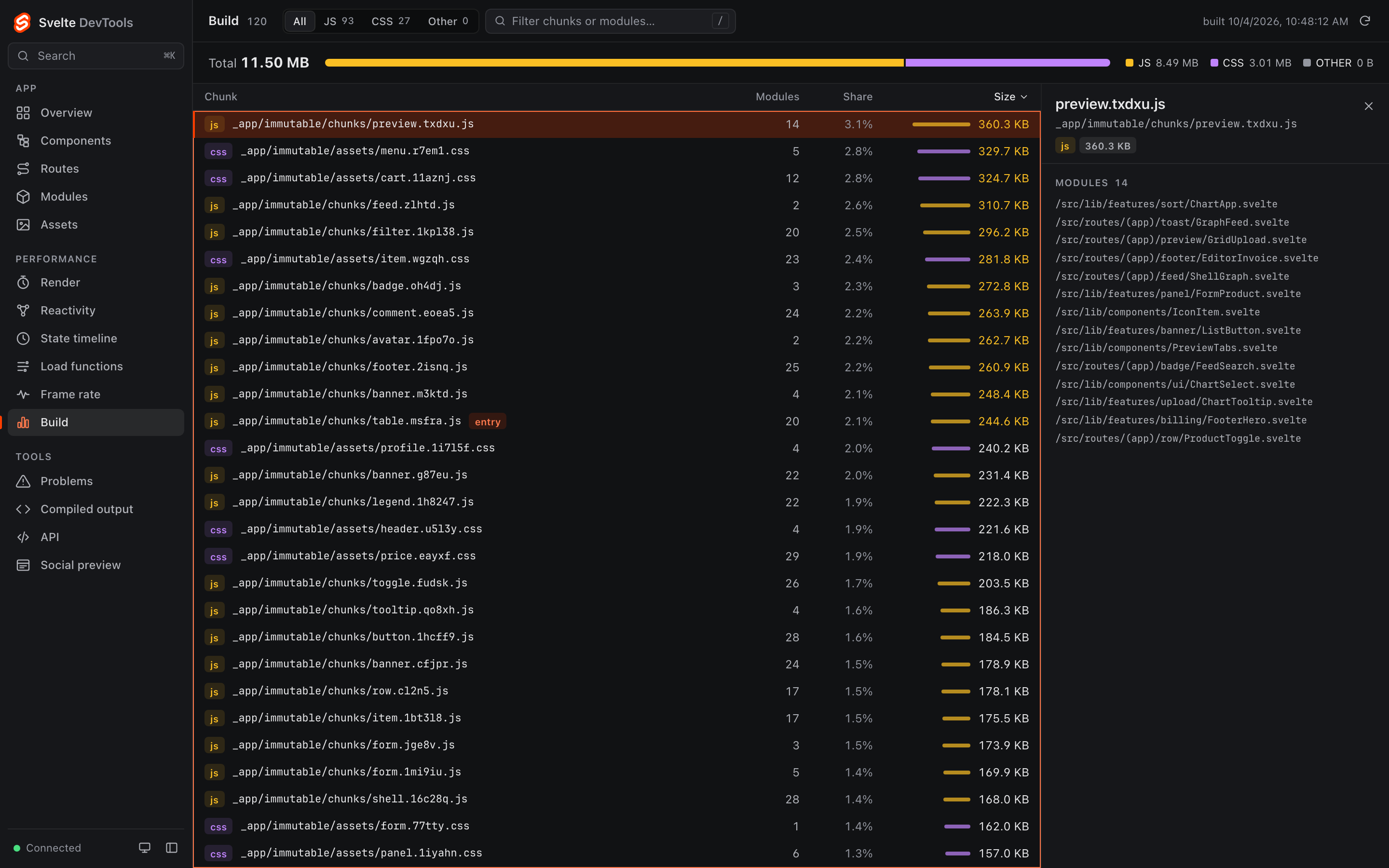
- Build Analysis — Analyze build chunks and bundle composition
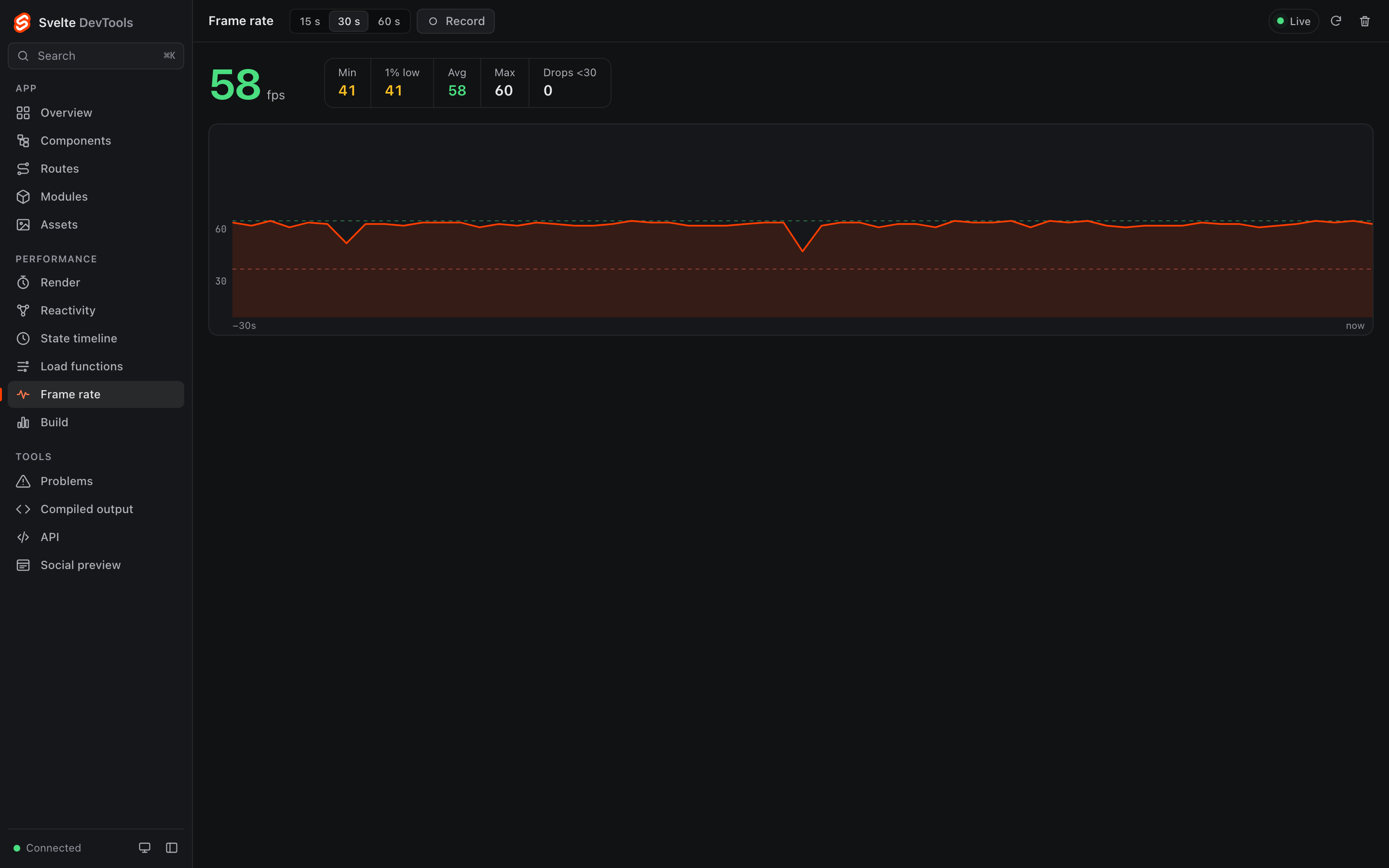
- FPS Monitor — Real-time frame rate monitoring with historical data
- Asset Browser — Browse and preview static assets with metadata
- Overview — Project summary with versions and dependency info
Screenshots
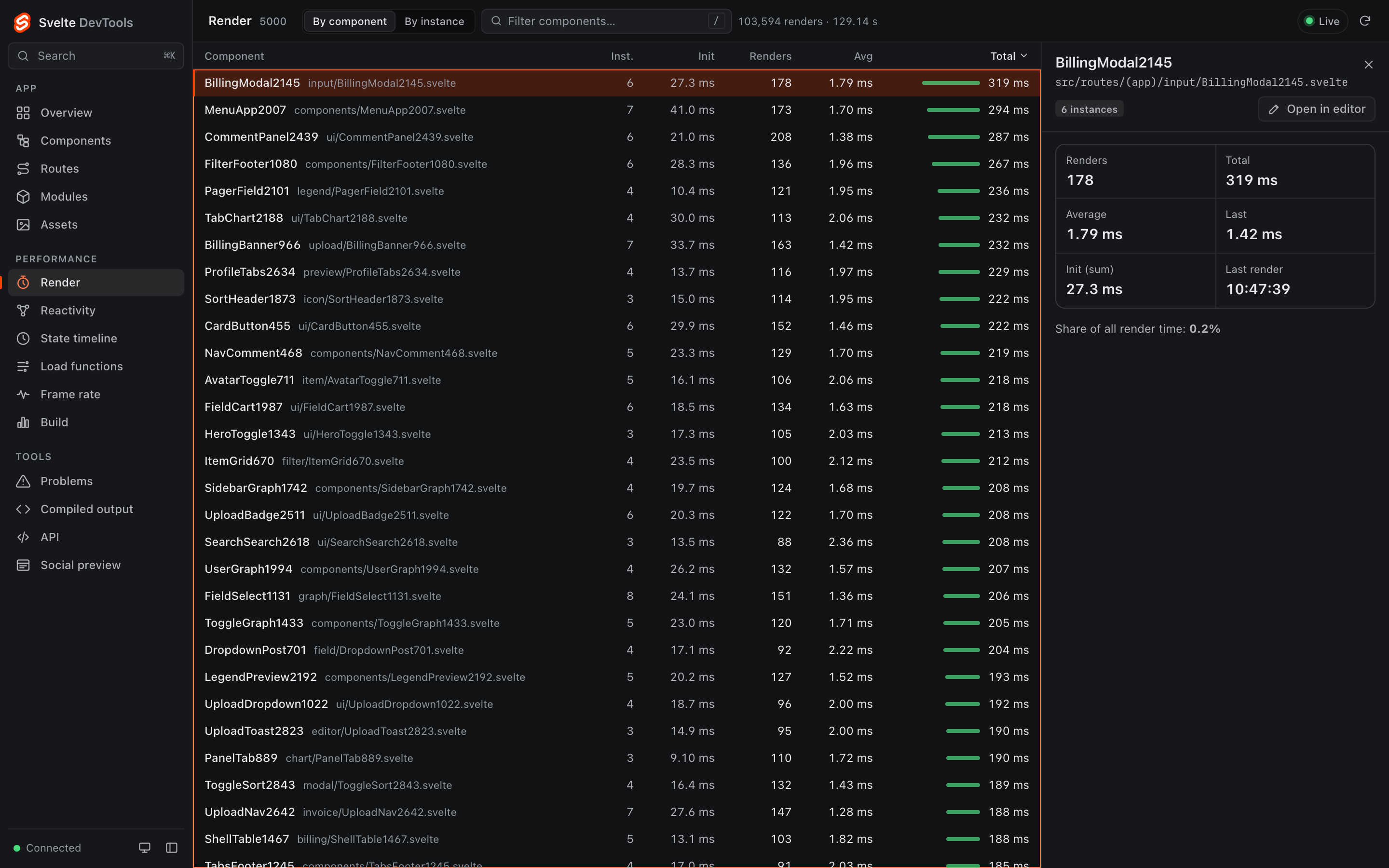
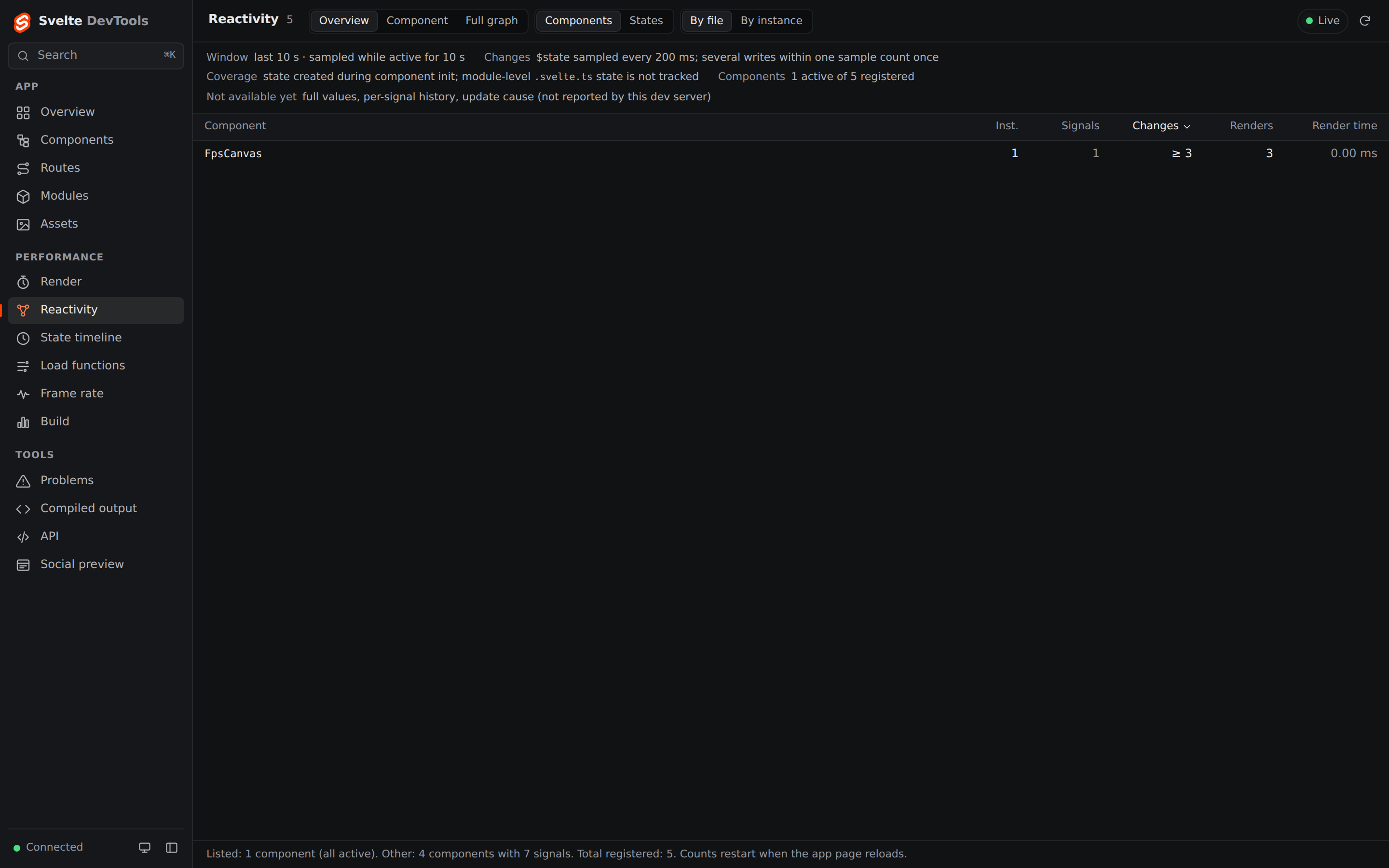
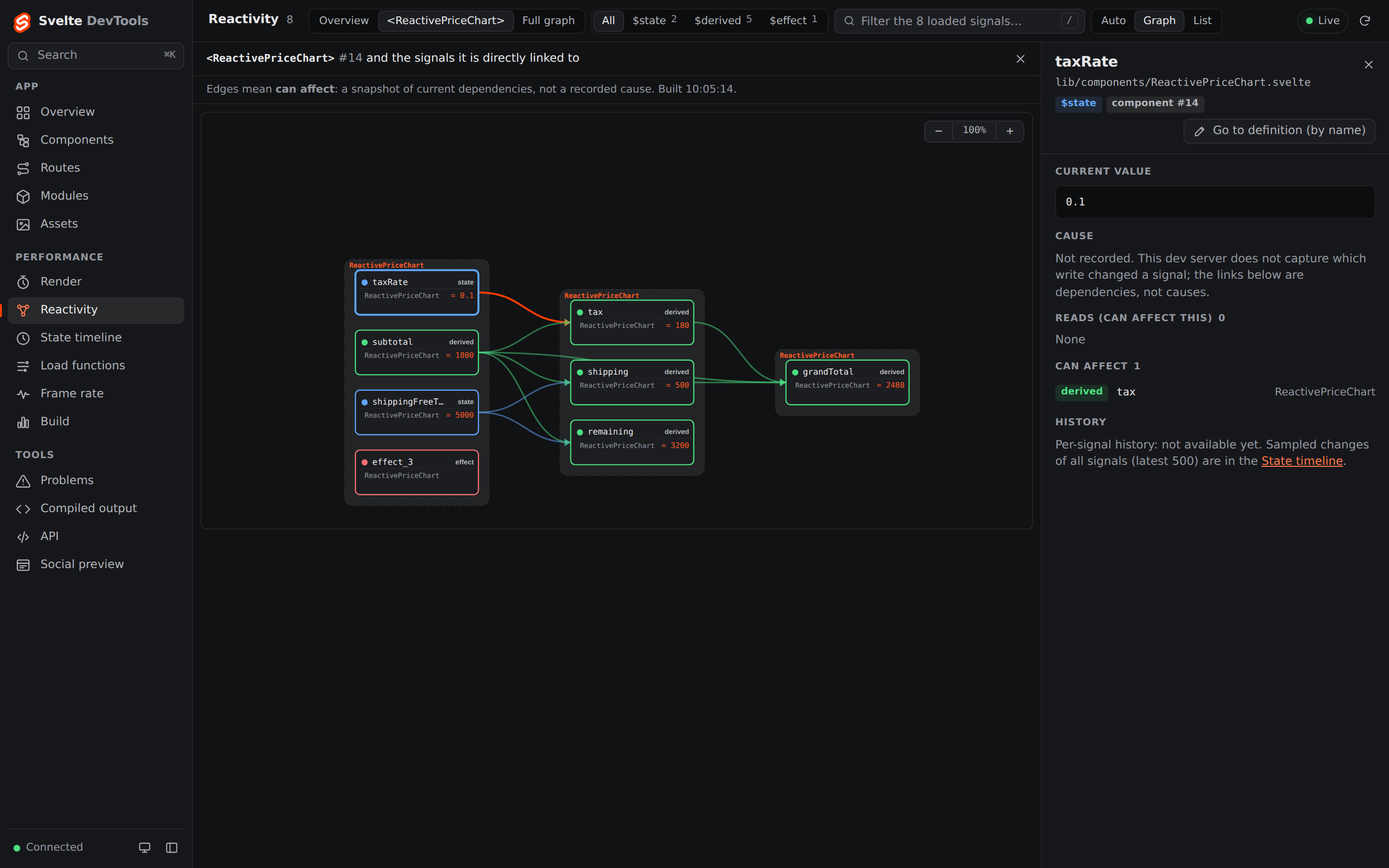
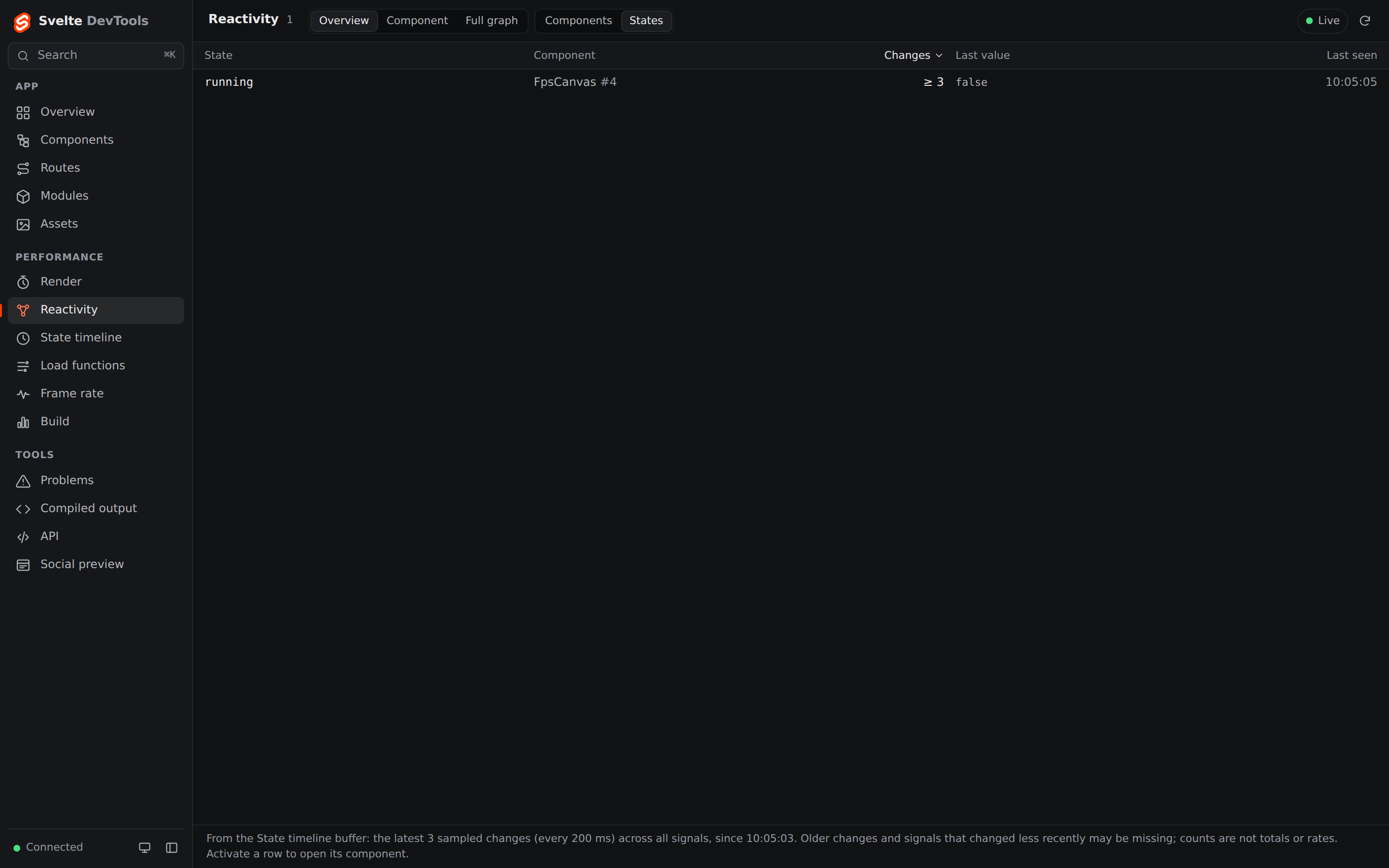
Panel shots: captured from the UI in dev-mock mode with synthetic data, before the reactivity update (Social preview: a generated SvelteKit test app). Reactivity shots: captured in CI from the real runtime, against the synthetic demo app in examples/sample-app.
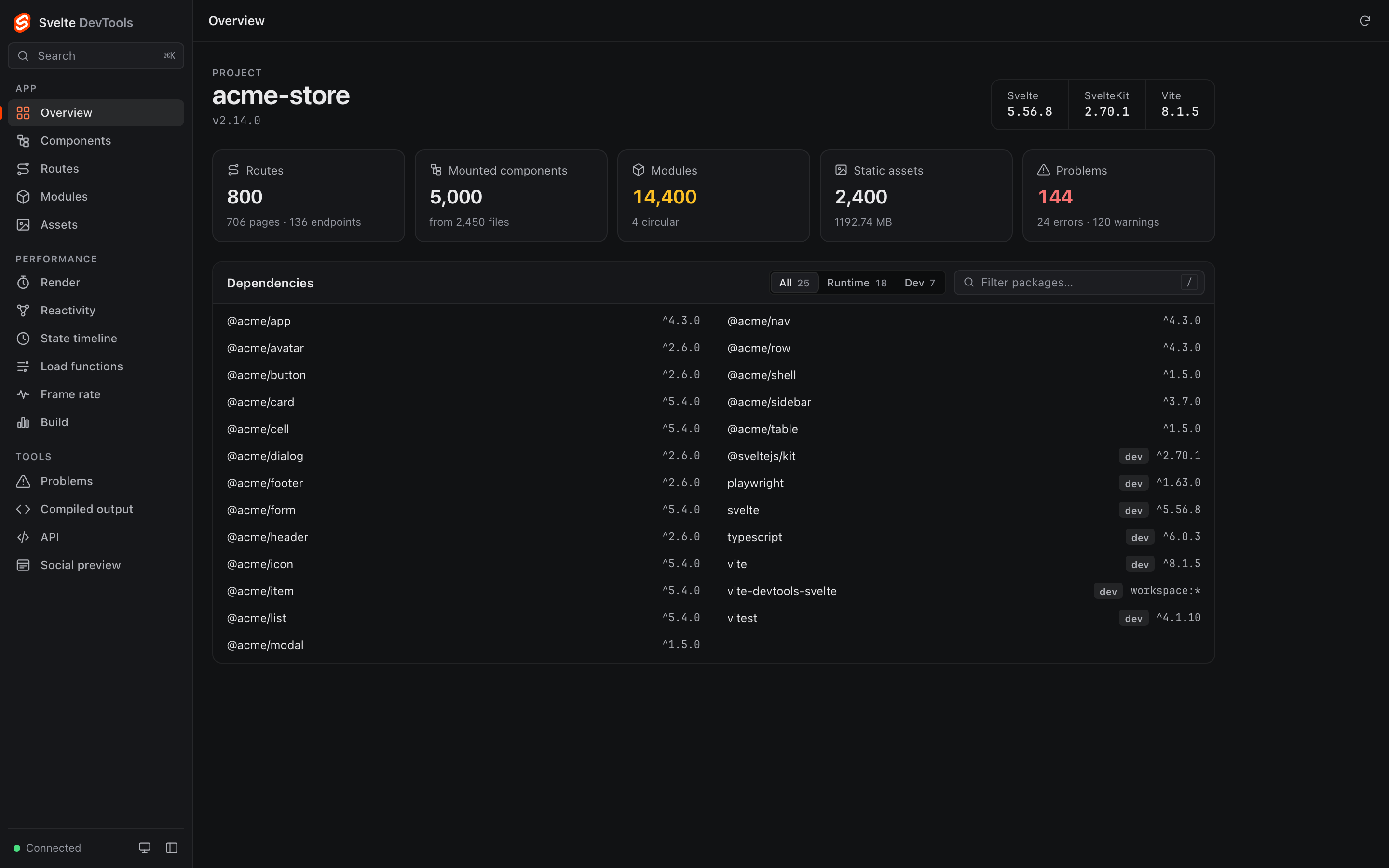
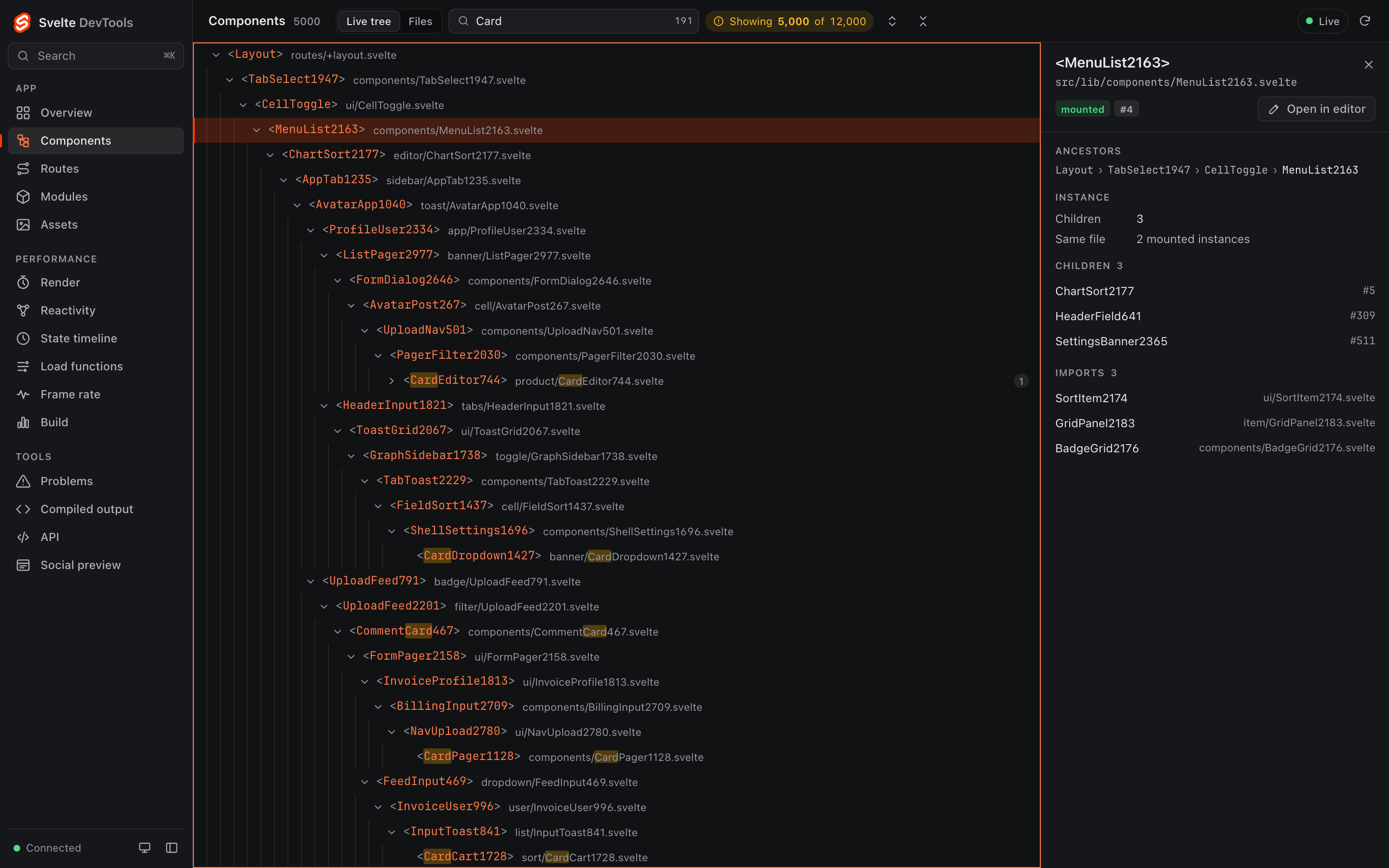
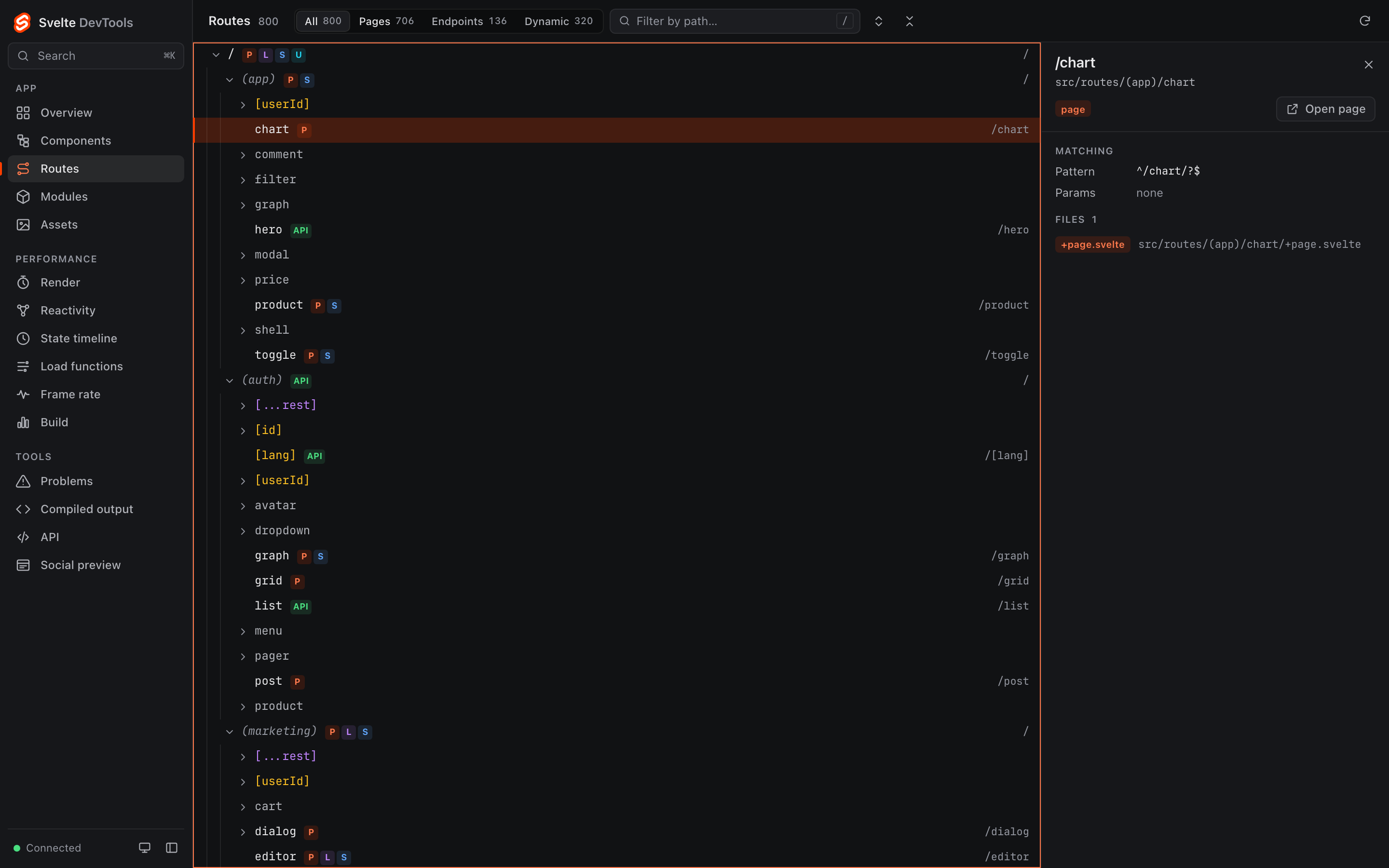
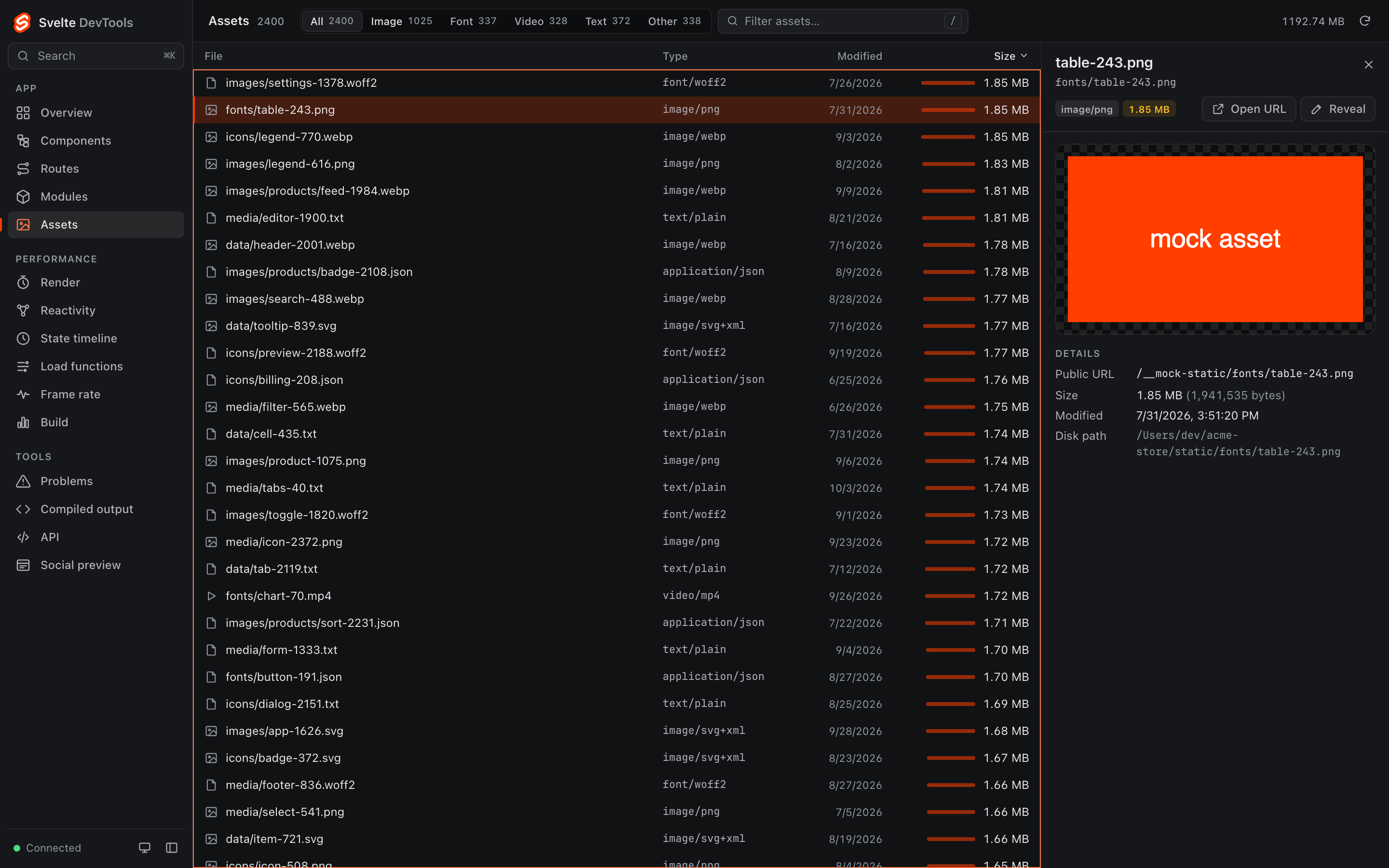
Overview: what the counts cover and the most active components:
One component (ReactivePriceChart) and the signals it is directly linked to; edges mean "can affect", not a recorded cause:
$state signals by sampled changes in the timeline buffer:
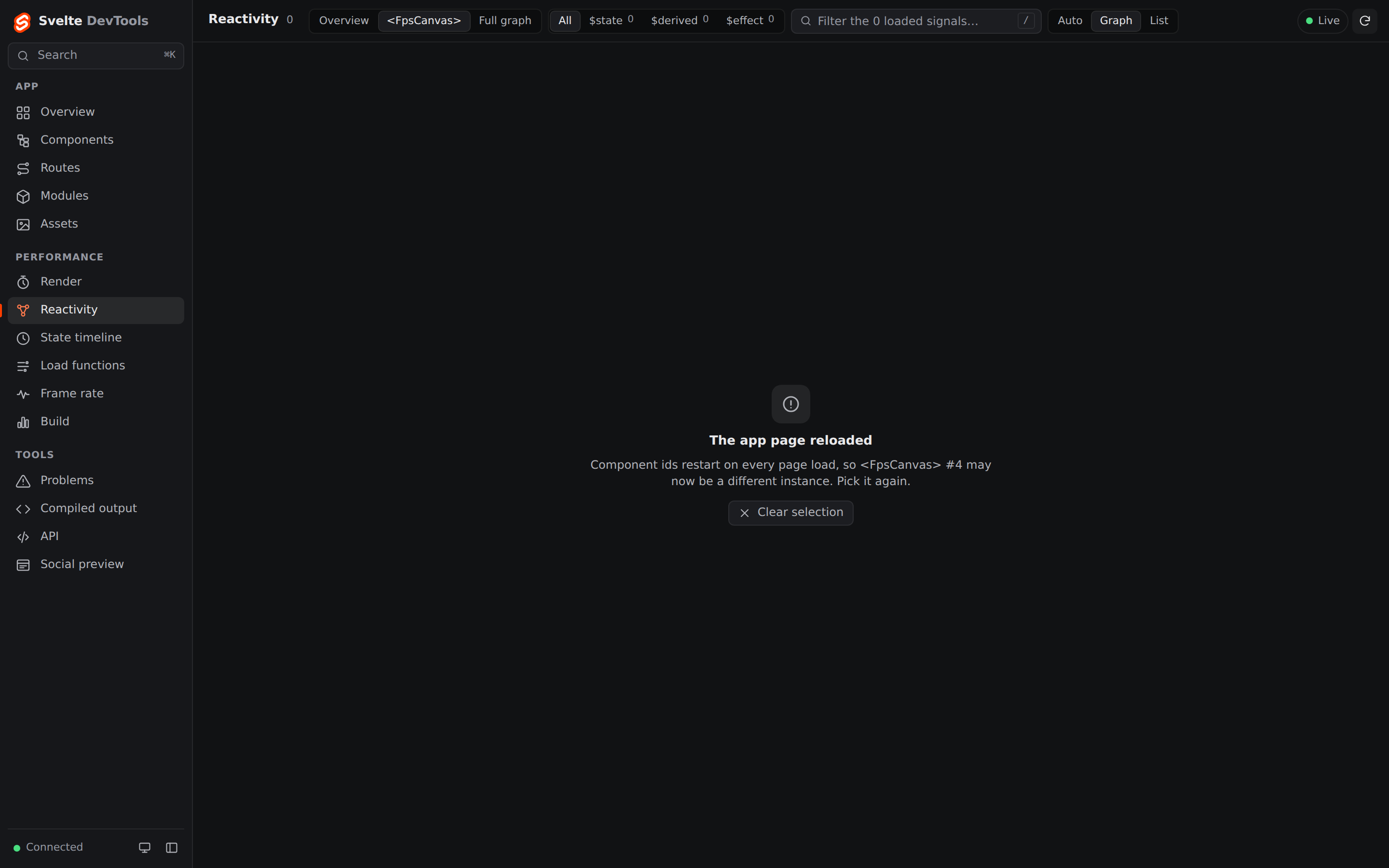
After the app page reloads, a selected component id may belong to another instance, and the panel says so:
Requirements
- Vite >= 8.3.2
- Svelte 5 (runes mode)
- SvelteKit (recommended, but not required for basic features)
- @vitejs/devtools >= 0.7.6 — optional; only for the in-page dock
Installation
npm install -D vite-devtools-svelte
# optional: show the panels inside the Vite DevTools dock
npm install -D @vitejs/devtools
Setup
Register the plugin in your vite.config.ts. svelteDevtools() must come before sveltekit() so that its transforms run before the Svelte compiler.
// vite.config.ts
import { sveltekit } from '@sveltejs/kit/vite'
import { svelteDevtools } from 'vite-devtools-svelte'
import { defineConfig } from 'vite'

export default defineConfig({
  plugins: [
    svelteDevtools(), // must come before sveltekit()
    sveltekit(),
  ],
})
Start your dev server as usual (npm run dev) and open the URL it prints:
➜ Svelte DevTools: http://localhost:5173/.svelte-devtools/
The first time a browser opens the DevTools it asks for a one-time code: request it from the page, and the dev server prints a 6-digit code plus a link (…/.svelte-devtools/#devframe_otp=…) in the terminal. Opening the link (or typing the code) trusts that browser; the token is remembered across reloads and dev-server restarts.
Inside the Vite DevTools dock
With @vitejs/devtools installed, add its plugin as well. The Svelte tool then mounts as a dock entry instead of standalone (never both), and authentication is handled once by Vite DevTools:
import { DevTools } from '@vitejs/devtools'

export default defineConfig({
  plugins: [svelteDevtools(), DevTools(), sveltekit()],
})
Open your app, click the floating Vite DevTools handle and switch to the Svelte tab. The panels are also reachable directly at /.svelte-devtools/.
Options
svelteDevtools({
  // Enable component lifecycle tracking (default: true)
  componentTracking: true,
})
How It Works
- Runtime wrapper — Intercepts
svelte/internal/clientto track component lifecycle and reactive signals ($state,$derived,$effect). It only polls state / samples FPS while a DevTools tab or an MCP agent is watching. - HMR channel — Streams runtime data (component tree, render profiles, state-timeline deltas, reactive graph) from the browser to the dev server.
- Static analyzers — Extract routes, component relations, assets, and project metadata from the filesystem.
- Devframe tool — One portable Devframe definition exposes all of this over a typed, schema-validated RPC. It is served standalone (
initDevframeon Vite's own HTTP server) or mounted into Vite DevTools (createPluginFromDevframe); the UI connects withconnectDevframe()either way.
The plugin is development-only — every sub-plugin is apply: 'serve', so nothing of it reaches a production build. In development, the runtime only samples while a DevTools tab or MCP agent is watching (an activity lease), and the dev server keeps its buffers bounded.
Upgrading from 0.3.x
The public API is unchanged — still svelteDevtools({ componentTracking }), and the same 15 panels. MCP keeps every existing tool and adds four reactivity tools (see AI access). What changed is how the UI is hosted and how it talks to the dev server:
| 0.3.x | 0.4.0 | |
|---|---|---|
| Host | panels only rendered inside @vitejs/devtools (required) |
standalone at /.svelte-devtools/, or inside the Vite DevTools dock when @vitejs/devtools is installed (optional) |
| Transport | DevTools Kit RPC + HTTP fallback (/__svelte-devtools/rpc, /__svelte-devtools/asset) |
one Devframe WebSocket RPC (SSE in Vite middleware mode); the HTTP endpoints are removed |
| Auth | per-process token injected into the UI HTML | Devframe one-time code → per-browser token (secure by default); Vite DevTools' own auth when docked |
| Peer deps | vite >= 8.0.0 |
vite ^8.3.2 (uses the public closeServer hook), @vitejs/devtools >= 0.7.6 optional |
Static assets in the Assets panel are now served by Vite itself (their public URL) instead of a custom endpoint. The MCP endpoint (/__svelte-devtools/mcp) is unchanged.
Known limitations
- Very large apps (tens of thousands of live components): after the initial snapshot the runtime sends only component deltas (≤ 2 000 per message), with periodic full checkpoints. The panels, however, still fetch the whole stored tree (up to 50 000 instances) from the dev server whenever it changes — estimated at a few MB per refresh at that size, about once per second at most. Real-browser performance at this scale has not been benchmarked yet.
- Deep in-place mutations of very large
$statevalues are detected after about 1 s (reassignments and primitive changes are picked up on the next 200 ms tick). - Several app tabs: the panels show the tab that pushed most recently (up to 4 page loads are tracked); there is no per-tab selector yet.
- Components tree selection follows the same instance while the page stays loaded; after a reload, or when an instance is replaced (e.g.
{#key}, HMR), it is matched by its position in the tree instead. Instances beyond the 50 000 cap are counted but cannot be selected. - Components added after the first render (e.g. new
{#each}rows) are placed under their parent using Svelte internals (checked in a browser on Svelte 5.56.8; the CI compatibility profiles run Svelte 5.57.1); with a different internal layout they would appear as separate top-level entries instead. - Reactivity: which write changed a state is not recorded (the panel says "Cause: Not recorded"); full value inspection and per-signal history are not available (values are shown as bounded summaries; sampled changes are in the State timeline). Tracked: state created during component init and while a
.svelte.js/.tsmodule body runs (shared state); state created elsewhere (for example in an event handler, or inside a library innode_modules) is not, and a node that depends on such state reportsuntrackedDeps. Reads of object/array state are attributed through Svelte's dev labels, so the graph shows what the runtime observed, not a static analysis. Render profiles are still sent as a bounded full tail rather than deltas, and behaviour at very large scale (tens of thousands of components) has not been measured. - Restarts in Vite middleware mode dispose the DevTools via Vite's
closeServerhook, which is whyvite ^8.3.2is required.
AI access (MCP)
The plugin exposes an MCP (Model Context Protocol) endpoint so AI agents such as Claude Code can read performance metrics and run measurement sessions autonomously. The intent: surface the same data the panels show, in a shape an agent can act on — and let the agent's own file-editing tools propose fixes.
On dev-server startup the plugin prints a copy-pasteable registration command:
svelte-devtools MCP ready — register with Claude Code:
  claude mcp add --transport http svelte http://localhost:5173/__svelte-devtools/mcp --header x-svelte-devtools-token:<token>
The endpoint is gated by a per-process random token (MCP clients are local processes, not browser tabs, so they don't use the browser login). The token rotates every dev-server start, so you'll re-register after a restart.
The endpoint is served wherever your Vite dev server listens. With the default (localhost) only local processes can reach it; with server.host set to true or 0.0.0.0, other machines on your network can reach it too and only the token protects it. There is no separate Host/Origin check.
Tools exposed
| Tool | Purpose |
|---|---|
list_performance_issues |
Cross-cuts render / reactive / load / fps and returns ranked issues with suggestedTool for drill-down. Entry point. |
get_component_hotspots |
Top components by total render time. |
get_reactive_graph_problems |
Classified reactive-graph issues (over-connected effects, orphan deriveds, isolated nodes). |
get_load_waterfall |
SvelteKit load timings grouped by route. |
get_fps_drops |
FPS samples below threshold. |
get_render_profile |
Render profile entries for a specific file. |
get_project_info, get_routes |
Package and framework versions; the SvelteKit routes tree (static analysis). |
get_live_components, get_component_relations |
Mounted component instances (includeMeta: true adds the page-load epoch the ids belong to, totals and a limit); static import relations between components. |
get_reactive_summary |
Busiest component instances from runtime counters (sampled changes and renders in a time window), with totals; does not capture the whole graph. Repeated identical requests may get the same answer for up to 1 s; window.until says when it was computed. stale: true means the app did not answer and an earlier (or empty) answer was returned. |
get_reactive_scope |
$state / $derived / $effect nodes of one component instance and their direct neighbours. Edges mean "can affect", not a recorded cause. Repeated identical requests may get the same answer for up to 1 s; computedAt says when the app built it. |
get_state_timeline |
Sampled $state changes after a cursor, at most 500 per call, with large values replaced by a size summary. |
get_capture_info |
What is held versus what the app reported, per dataset (totals, truncation, dropped counts). |
start_session, end_session, compare_sessions |
Bracket a measurement window so the agent can diff before/after a fix. persist:true writes the session to node_modules/.vite-devtools-svelte/sessions/. |
list_sessions, load_session, delete_session |
Session inspection / cleanup. The agent owns disposal — the plugin never auto-persists. |
Skills
Two Claude Code skills ship under node_modules/vite-devtools-svelte/skills/:
vite-devtools-svelte:perf-audit— captures a baseline session, callslist_performance_issues, and presents the top issues for the user to triage.vite-devtools-svelte:perf-fix— one issue per run: baseline → edit → after →compare_sessions, withverdictreported verbatim and an explicit revert path if the change regresses or has no effect.
Skill names are namespaced with vite-devtools-svelte: so they don't collide with other skills in your .claude/skills/.
To install for a given project:
mkdir -p .claude/skills
cp -r node_modules/vite-devtools-svelte/skills/* .claude/skills/
Scope
What an agent can see: get_state_timeline and get_reactive_scope return values of $state in your running app (each timeline value capped, large ones summarised). Treat the token like any credential that grants read access to your app's state in development.
The MCP server is read + measure only — it never edits files. Editing is left to the agent's own tools (Claude Code's Edit/Write), which keeps the permission boundary clean and lets git own rollback.
Security model
Some RPCs read files from disk or open them in your editor, so the DevTools backend is authenticated even though the dev server is normally only reachable from localhost.
- Devframe auth gate. Every RPC connection must be trusted first: a browser exchanges a single-use 6-digit code (printed in the dev-server terminal, valid for 5 minutes) for a bearer token stored in that browser. Inside Vite DevTools the hub's own gate covers the tool.
- Origin checks. The RPC WebSocket only accepts loopback origins (plus the dev server's own LAN origins when you use
--host), which blocks cross-site pages and DNS-rebinding attacks. - Schema-validated arguments. RPC inputs are validated with zod schemas before any handler runs.
- Path sandbox.
inspect-file,open-in-editor, andopen-reactive-in-editorresolve their input throughfs.realpath()and refuse anything outside the project root. Symlinks inside the project are followed normally. - SSRF defenses. Outbound fetches from the API playground and OG preview block private / loopback / link-local IPv4 and IPv6 targets (also when a hostname resolves to one),
localhost,*.localand*.internal, and never follow redirects. The dev server's own origins are the only local targets allowed, so the playground can call your app's endpoints. - Dev-only by construction. Nothing is registered during
vite build.
Trusted-browser tokens are stored in your home directory (~/.svelte-devtools/devframe/auth.json) and shared across projects. The SSRF check resolves hostnames before fetching, so a resolver that changes its answer between that check and the request (DNS rebinding) is not fully excluded. If you bind your dev server to a non-loopback address, only use it on networks you trust.
Development
This is a pnpm monorepo.
# Install dependencies
pnpm install

# Build everything
pnpm build

# Run the playground app with DevTools
pnpm dev

# Run tests
pnpm -C packages/vite-devtools-svelte test

# Watch mode
pnpm -C packages/vite-devtools-svelte test:watch

# Lint and format (oxlint / oxfmt)
pnpm lint
pnpm format
Reproducible environment with Nix (optional)
A Nix flake is provided so every contributor
can pin the exact Node.js toolchain. With Nix installed:
nix develop # drop into a shell with Node 24 + corepack
If you use direnv, direnv allow in the repo root will
do this automatically. The shell uses corepack to materialize the pnpm version
declared by the packageManager field in package.json, so pnpm --version
matches across machines.
Project Structure
├── packages/vite-devtools-svelte/
│   ├── src/              # Vite plugin (instrumentation, collector, devframe tool, MCP)
│   ├── client/           # DevTools UI (Svelte 5 SPA)
│   └── dist/             # Build output
├── playground/           # Demo SvelteKit app for development
└── docs/images/          # Screenshots
Contributing
Contributions are welcome! Please open an issue first to discuss what you'd like to change.
License
Yorumlar (0)
Yorum birakmak icin giris yap.
Yorum birakSonuc bulunamadi