arbiter
Health Uyari
- License — License: MIT
- Description — Repository has a description
- Active repo — Last push 0 days ago
- Low visibility — Only 5 GitHub stars
Code Gecti
- Code scan — Scanned 12 files during light audit, no dangerous patterns found
Permissions Gecti
- Permissions — No dangerous permissions requested
Bu listing icin henuz AI raporu yok.
Live AI judge agent — watches hackathon demos in real-time via Gemini Live API, delivers British-accented commentary via TTS, scores with multi-model ensemble (Gemini + Claude + Groq), detects prompt injection attempts, and runs cross-team deliberation. Built for NEBULA:FOG 2026.
Arbiter






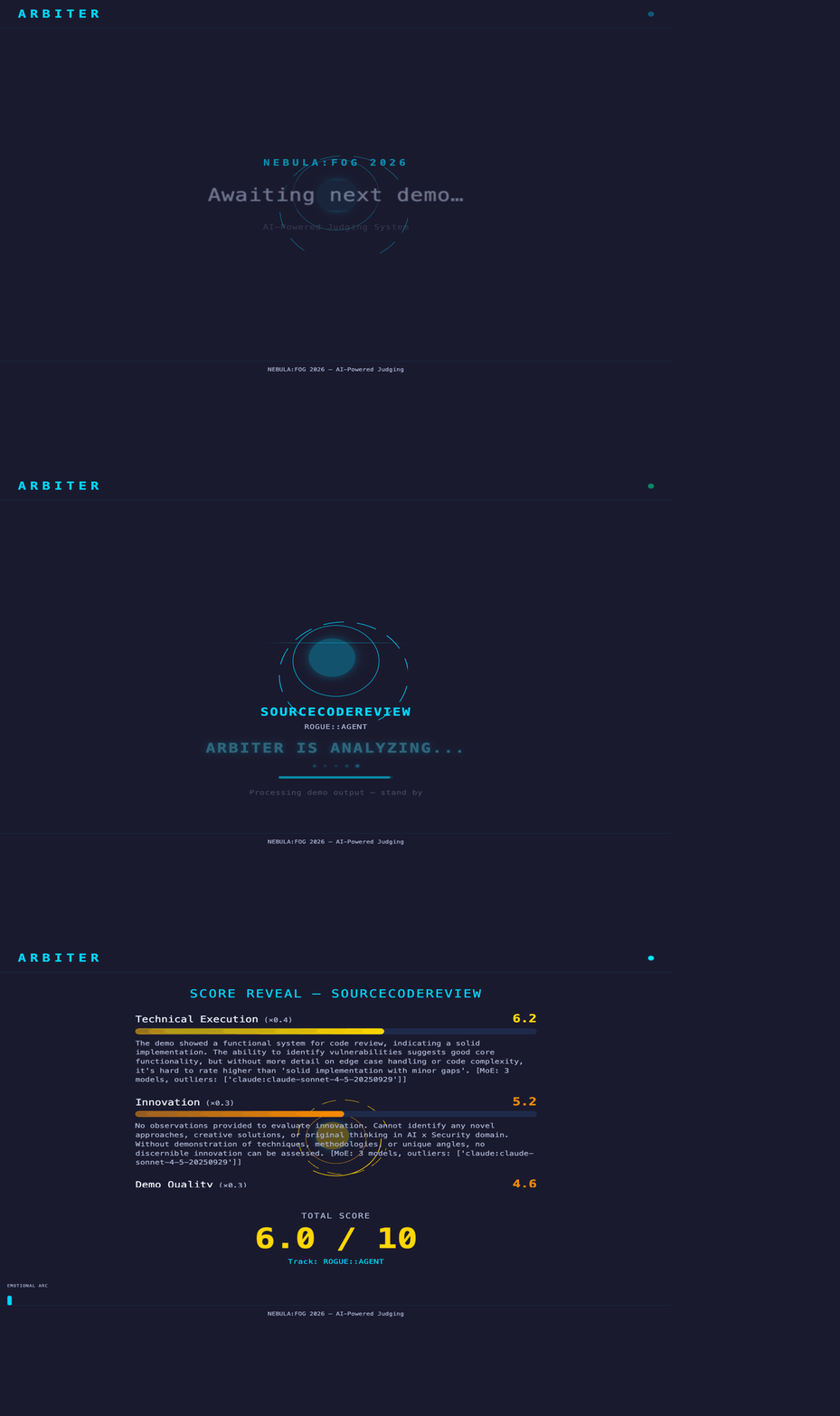
Live AI judge agent for hackathons. Watches demos in real-time via camera and microphone, delivers entertainment commentary with a British accent, scores projects against a rubric using a multi-model ensemble, detects prompt injection attempts, and runs cross-team deliberation with full memory of every demo.
Built for the NEBULA:FOG 2026 security hackathon, where it judged 25 live demos on March 14, 2026.
"Twenty-five teams walked in with 24 hours of code and a live demo slot. What they didn't expect: an AI judge watching every second."
What It Does
- Real-time observation — Connects to Gemini Live API, streams audio/video, generates observations as presenters speak
- Multi-layer injection defense — Regex denylist, semantic classifier (rubric echo, self-eval, fabricated evidence), multi-language detection (7 languages), XML boundary tags, dual-LLM privilege separation
- Runtime Alignment Control Plane — Every consequential effect (crossing the privileged-LLM boundary, scoring, speaking, writing a scorecard) is gated by an expiring, signed behavior lease. Preflight proves the detection policy still works before each demo, an independent monitor re-checks what the sanitizer produced, and effects fail closed with a hash-chained audit trail — see docs/racp.md and how it works
- AI commentary — Generates sharp, persona-driven reviews delivered via Cartesia TTS (British voice)
- Multi-model scoring — Gemini, Claude, and Groq independently score each demo, aggregated with outlier detection
- Theatrical score reveal — Animated criterion-by-criterion reveal on the audience display
- Q&A generation — Generates pointed follow-up questions based on what was actually said in the demo
- Cross-team deliberation — After all demos, compares every team against every other team for final rankings
- Operator dashboard — React WebSocket control panel for managing demo lifecycle
- Audience display — React real-time display for commentary, scores, and leaderboard
Architecture
Capture Layer ──→ Defense Pipeline ──→ Commentary ──→ Scoring ──→ Deliberation
  (audio+video)    (injection guard)    (persona TTS)   (MoE rubric)  (memory)
                          │                  │              │
                          └────────── RACP action gateway ──┘
                                (behavior lease required per effect)
Dual-LLM privilege separation: A quarantined Gemini Live session processes raw input. The privileged judging LLM only sees sanitized observations — never raw camera frames or audio.
| Module | Purpose |
|---|---|
src/capture/ |
Audio capture, camera, key frame detection, Gemini Live API session |
src/defense/ |
Regex + semantic injection detection, OCR scanning, roast generation, sanitization |
src/racp/ |
Runtime alignment control plane — behavior leases, preflight, monitors, action gateway, audit chain |
src/commentary/ |
Streaming LLM commentary, Cartesia TTS, Q&A generation, display server |
src/scoring/ |
Rubric-based scoring, MoE multi-model ensemble, theatrical score reveal |
src/memory/ |
Per-demo structured memory, deliberation engine, rankings |
src/operator/ |
WebSocket operator dashboard for demo lifecycle management |
src/resilience/ |
Circuit breakers, rate limiting, TTS failover, graceful degradation |
src/rehearsal/ |
Full pipeline rehearsal with synthetic events and canned responses |
src/replay/ |
Video analysis pipeline for scoring recorded demos offline |
operator-dashboard/ |
React operator control panel (Vite + TypeScript) |
audience-display/ |
React audience-facing display for commentary and scores (Vite + TypeScript) |
public/ |
Static pages — judge criteria, audience criteria, live scoreboard |
Quick Start
Prerequisites
- Python 3.11+
- uv (Python package manager)
- bun (JS package manager, for frontend builds)
- A Gemini API key
Setup
git clone https://github.com/basicScandal/arbiter.git
cd arbiter
uv sync
cp .env.example .env
# Edit .env — at minimum set GEMINI_API_KEY
Build frontends
cd operator-dashboard && bun install && bun run build && cd ..
cd audience-display && bun install && bun run build && cd ..
Run
# Live mode (requires camera + microphone)
uv run python -m src.main

# Rehearsal mode (no hardware or API keys needed)
uv run python -m src.main --rehearsal
URLs
| Page | URL |
|---|---|
| Operator Dashboard | http://localhost:8080/operator/ |
| Audience Display | http://localhost:8080/app/ |
| Live Scoreboard | http://localhost:8080/public/scoreboard.html |
| Judge Criteria | http://localhost:8080/public/judge-criteria.html |
| Health Check | http://localhost:8080/api/health |
Configuration
All configuration is via environment variables (see .env.example):
| Variable | Default | Description |
|---|---|---|
GEMINI_API_KEY |
required | Google AI Studio API key |
CAMERA_DEVICE_INDEX |
-1 |
OpenCV camera device index (-1 for auto-detect) |
DISABLE_CAMERA |
false |
Set to true/1/yes to skip camera capture entirely (prevents OOM on memory-constrained hosts) |
AUDIO_DEVICE_INDEX |
system default | PyAudio input device index |
FRAME_RATE |
1.0 |
Frames per second to capture |
CARTESIA_API_KEY |
— | Cartesia TTS API key (degrades to macOS say without it) |
CARTESIA_VOICE_ID |
— | Cartesia voice ID for the Arbiter persona |
ANTHROPIC_API_KEY |
— | Claude API key (MoE scoring) |
OPENAI_API_KEY |
— | OpenAI API key (TTS fallback) |
GROQ_API_KEY |
— | Groq API key (commentary and Q&A generation) |
MOE_SCORING_ENABLED |
false |
Enable multi-model scoring ensemble |
OPERATOR_TOKEN |
— | WebSocket auth token for operator dashboard |
DISPLAY_TOKEN |
— | WebSocket auth token for audience display |
Testing
# Full suite (1451 tests)
uv run pytest

# Smoke tests only (fast go/no-go gate)
uv run pytest -m smoke

# Specific module
uv run pytest tests/test_semantic_detection.py -v
Security
Arbiter is designed to operate in an adversarial environment where participants actively try to hack the judge. The defense stack has four layers:
| Layer | What It Catches |
|---|---|
| Regex denylist (11 patterns) | "ignore previous instructions", score manipulation, delimiter escapes |
| Semantic classifier | Rubric language echoing, self-evaluation phrases, fabricated evidence markers |
| Multi-language detection | Injection attempts in ES, FR, DE, ZH, JA, KO, RU |
| Structural defenses | Dual-LLM privilege separation, XML boundary tags, Python-side score clamping, base64 decoding, Unicode normalization (18 invisible characters) |
The system was red-teamed post-event by three parallel AI agents that identified 11 findings (all fixed in v1.1.0). See the full report and slide deck.
How Scoring Works
Each demo is scored across three criteria:
| Criterion | Weight | What's Evaluated |
|---|---|---|
| Technical Execution | 40% | Implementation quality, functionality, edge case handling |
| Innovation | 30% | AI x Security novelty, creative approaches |
| Demo Quality | 30% | Clarity of explanation, working live demo, compelling narrative |
Plus a track-specific bonus (+10%) based on the team's chosen challenge track.
Scoring uses a Mixture of Experts (MoE) approach: Gemini, Claude, and Groq independently evaluate each demo. Scores are aggregated with outlier detection — if one model disagrees wildly, it's flagged and its influence is reduced.
Event Day Results
The data/ directory contains all event outputs:
data/scores/— Per-team scorecards with criterion breakdownsdata/observations/— Raw observations and transcripts from each demodata/deliberation/— Cross-team comparative analysisdata/events.jsonl— Complete event logdata/audit.jsonl— Full audit trail
Docs
- How We Built Arbiter — full writeup with architecture, what broke, and lessons learned
- Red Team Report — 11 prompt injection findings from 3 parallel AI red team agents
- Red Team Slides — 10-slide HTML deck summarizing findings
- Architecture
- Operator Guide
- Pre-Event Checklist
- Judge Instructions
- Prize Breakdown
- Zoom Capture Setup
See It In Action
- SINGULARITY 2026 Results — full scoreboard with 25 teams
- PRIME 2025 Results — retroactive scoring of 15 demos from video
- YouTube: NEBULA:FOG — demo recordings
License
MIT
Yorumlar (0)
Yorum birakmak icin giris yap.
Yorum birakSonuc bulunamadi