OmniRank
Health Gecti
- License — License: MIT
- Description — Repository has a description
- Active repo — Last push 0 days ago
- Community trust — 14 GitHub stars
Code Gecti
- Code scan — Scanned 12 files during light audit, no dangerous patterns found
Permissions Gecti
- Permissions — No dangerous permissions requested
Bu listing icin henuz AI raporu yok.
OmniRank — the SEO/AEO/GEO auditor that runs inside your repo. Audits any site across search, answer and generative-engine gates, resolves each finding to the source file that owns it, and shows the diff that fixes it. Generates llms.txt + facts.json. Claude Code plugin + CLI.
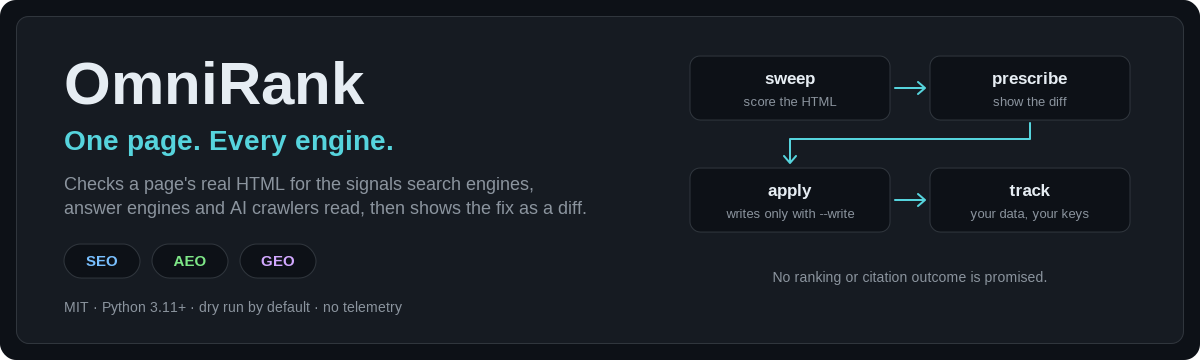
OmniRank
One page. Every engine.
An open-source CLI that checks your site's real HTML for the signals search engines, answer
engines and AI crawlers read, and shows each fix as a diff before anything is written.






See it work · Quickstart · Commands · Safety · Status · Architecture · Docs
OmniRank scores a website's live HTML against the concrete rules that search engines,
answer engines and generative AI systems use to crawl and read content, then
can generate llms.txt [experimental] (not a ranking or citation lever), llms-full.txt andfacts.json: agent- and developer-convenience files that state your site's facts and your reuse
terms. They are not a promise of citations or rankings.
See it work
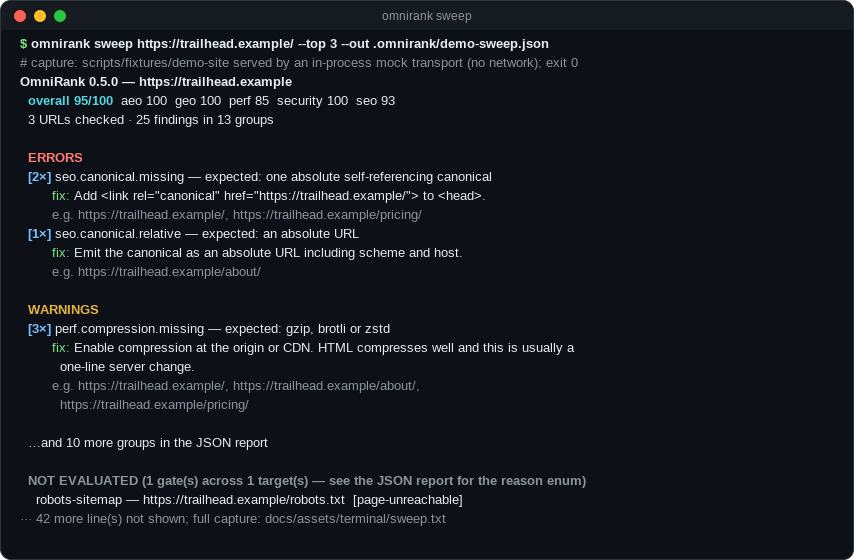
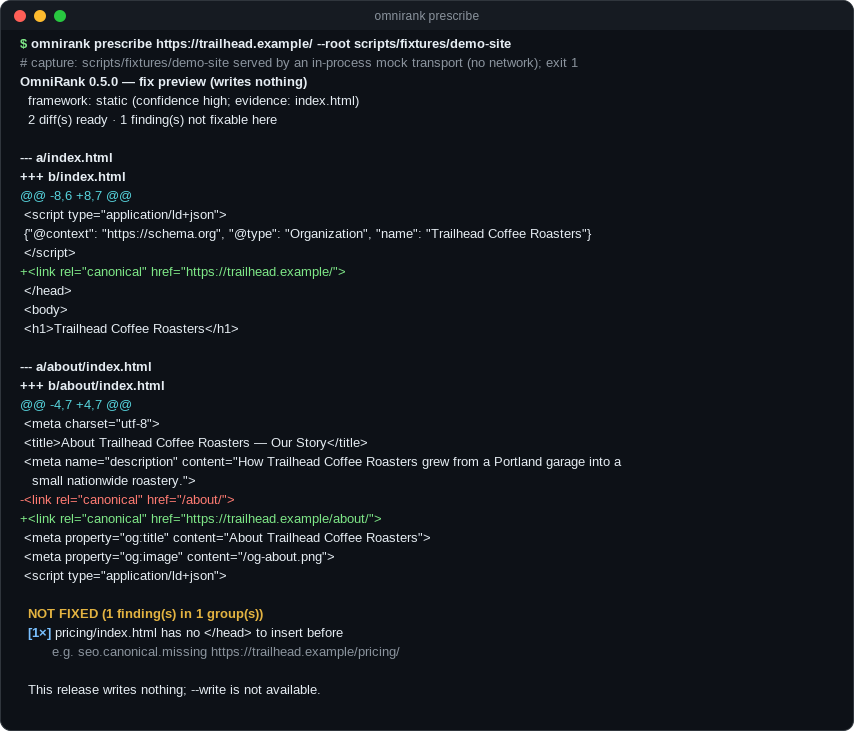
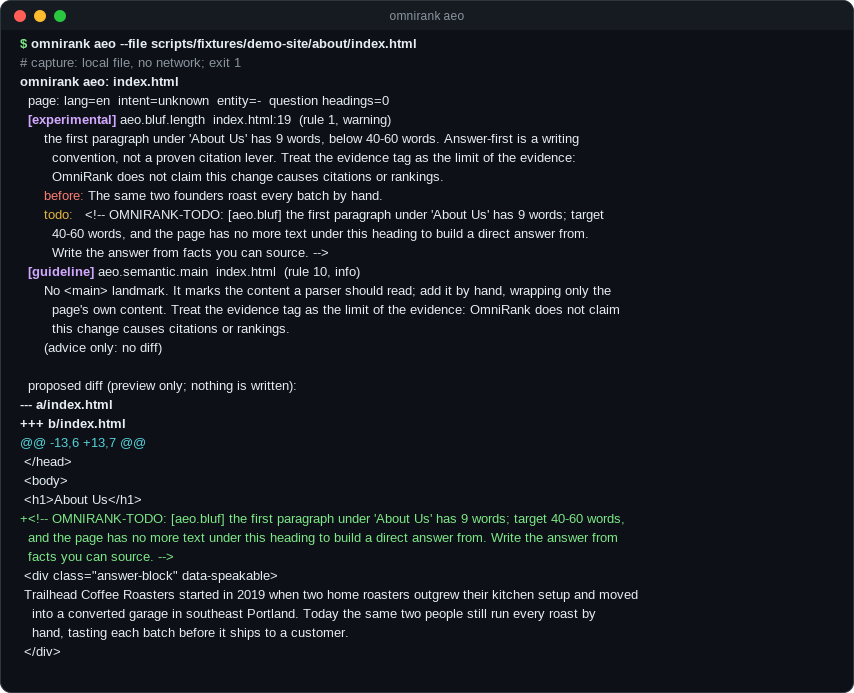
Every screenshot below is drawn from a real captured run of the CLI, nothing typed by hand.
The fetching commands ran against the committed fixture site inscripts/fixtures/demo-site/, served by an in-process mock
transport (no network), so you can reproduce them byte for byte:
PYTHONPATH=scripts/py python scripts/capture-terminal.py      # re-run the CLI, rewrite docs/assets/terminal/*.txt
python scripts/render-terminal-svg.py                         # redraw the SVGs from those captures
The raw text of each capture, with its exact command on the first line, sits next to its
SVG in docs/assets/terminal/. Colours are added by the renderer;
the CLI prints plain text. A screenshot that is cut short says so on its last line.
1. sweep: score the HTML, grouped by severity, with the fix for each group
2. prescribe: the exact diff OmniRank would apply, located in your source files (writes nothing)
 More captures:
aeo, schema validate, geo, doctor
aeo: on-page answer-engine rules, with an evidence tag on every finding
schema validate: valid markup versus markup that lacks Google's rich-result properties
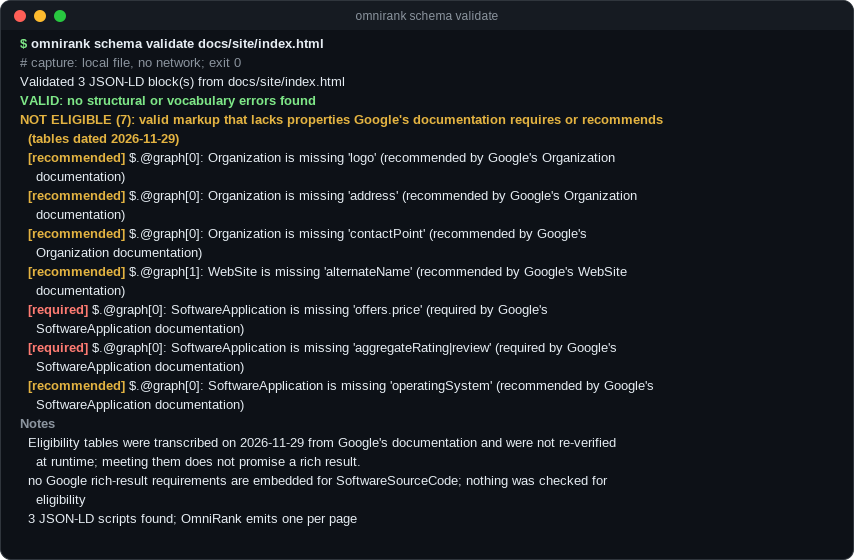
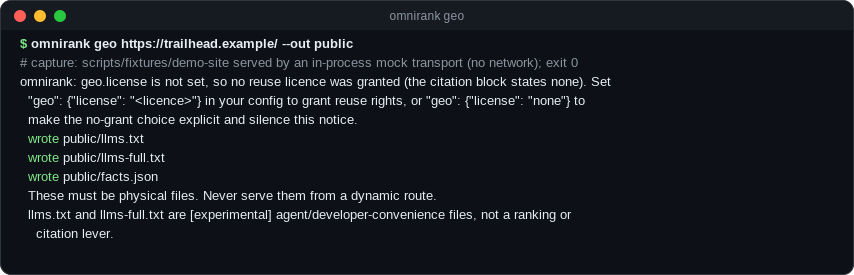
geo: generate the GEO files (and say plainly when no reuse licence is granted)
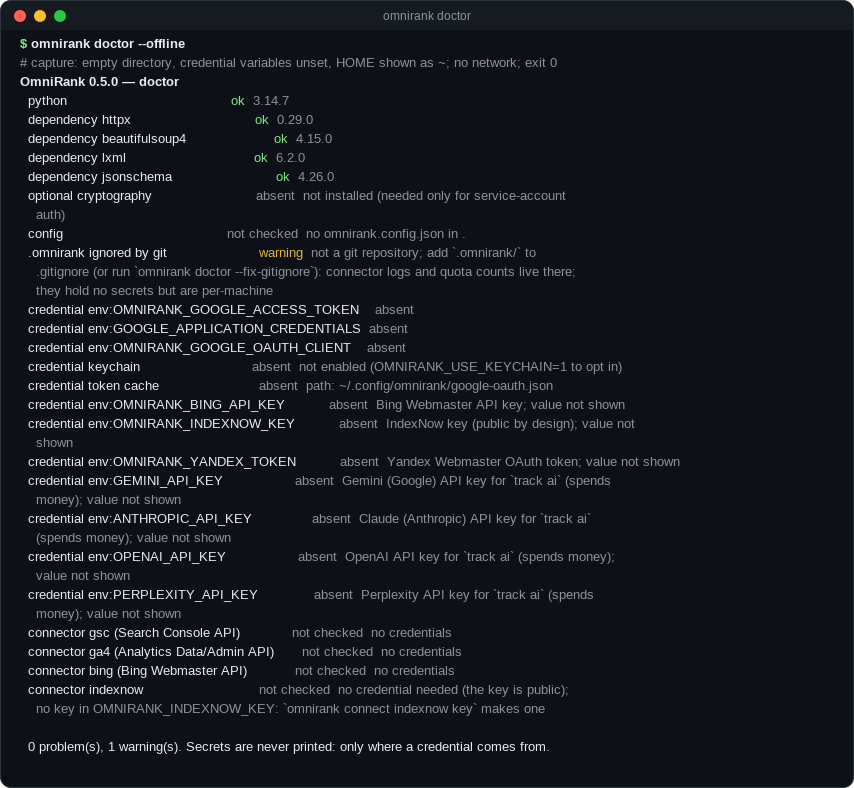
doctor --offline: setup check that never prints a secret
Dogfooding. OmniRank sweeps its own project site: docs/site/, served
offline by the same capture script, scores 95/100
(capture). The points it loses are perf
(no compression), because the mock transport sends no Content-Encoding or security
headers. It is not a measurement of a deployed site: the public site is not deployed yet.
An older animated recording, made when sweep was still called audit, is in.github/assets/demo.gif.
Quickstart
# 1. Install from git into a virtual environment (not on PyPI yet)
python3 -m venv .venv && source .venv/bin/activate
pip install "git+https://github.com/bemoshiur/OmniRank.git#subdirectory=scripts/py"

# 2. Score a site (read-only)
omnirank sweep https://example.com

# 3. See the diffs it would make in your repository (writes nothing)
omnirank prescribe https://example.com --root .

# 4. Apply them: a dry run unless you add --write; every write is journaled and undoable
omnirank apply https://example.com --root .
Exit codes: 0 clean · 1 a --fail-on gate failed · 2 usage or config error. Full
install options are under Download and install OmniRank.
Commands at a glance
| Command | What it does | Writes or sends? |
|---|---|---|
omnirank sweep <url> |
Scores SEO, AEO, GEO, perf, security and structured-data gates; JSON, SARIF, JUnit | Writes a report under .omnirank/ |
omnirank prescribe <url> --root . |
Locates each mechanical finding in your source and prints the diff | Nothing |
omnirank apply / omnirank undo |
Writes the prescribe diffs; restores them from the journal |
Dry run unless --write |
omnirank geo <url> |
Generates llms.txt [experimental] (not a ranking or citation lever), llms-full.txt, facts.json |
Writes those three files to --out |
omnirank schema generate|list|validate |
Schema.org JSON-LD from real page data; gaps listed, never invented | Nothing |
omnirank aeo |
12 on-page answer-engine rules with evidence tags and proposed diffs | Nothing |
omnirank pack blog|product|entity|local |
Read-only checks over a blog, an AI-product repo, entity and local SEO files | Nothing |
omnirank crawl <url> |
Polite crawler: redirects, broken links, orphans, duplicates, hreflang | Sends GET requests; writes reports to --out |
omnirank connect … |
Search Console, GA4, Bing, IndexNow, Yandex, Naver | Read-only; writes are dry runs unless --send, then y/N |
omnirank track / track ai |
Search Console deltas; sampled AI-answer tracking with your own keys | track ai spends money only after an estimate and y/N |
omnirank mcp --root . |
Read-only MCP server over stdio for AI agents | Nothing |
omnirank doctor |
Python, dependencies, config, credential presence | Nothing (optional --fix-gitignore asks first) |
Every command, with its limits, is documented in the sections below and in
docs/README.md.
Safety guarantees
- Dry run by default.
apply, connector writes,cms wordpress applyandmonitor --sendchange nothing without an explicit flag. - Confirm before any write or spend. Writes print the exact request and need
y/N
(or--yes); a non-interactive stdin without--yesis refused.track aiprints a cost
estimate and stops at--max-cost. - Journaled, reversible file writes.
apply --writeis hash-checked, atomic,
all-or-nothing and confined to--root; it refuses symlinks,.envfiles, keys and
lockfiles, andomnirank undorestores the files. - Egress guard. The MCP server, scanner and portfolio refuse private, loopback and
cloud-metadata addresses unless--allow-private-network. - Secrets are pointers. Config holds
env:NAMEonly;doctorreports where a
credential comes from, never its value. - No fabrication. No invented ratings, reviews, statistics or search volumes; an
unevaluated gate is reported as not evaluated, never as passed. - No promised outcome. Nothing here guarantees rankings or AI citations.
How these rails map to modules: docs/ARCHITECTURE.md.
Status: what is verified and what is not
- Verified by tests in CI: every command above, on fixtures and mocked HTTP responses.
- Not run against real accounts: the Search Console, GA4, Bing, IndexNow, Yandex,
WordPress and AI-provider connectors (mocked responses only). - Not done: PyPI release, a deployed project site, a public scanner instance, the
GitHub Marketplace listing, andcrawl --renderagainst a real browser.
The plan, with a status for every item, is in ROADMAP.md (a plan, not a
promise).
SEO, AEO and GEO read the same HTML
Three audiences parse one document. A crawlable, well-marked-up, machine-readable page wins
all three at once — that is the entire bet OmniRank makes, and why it audits one artifact
(your rendered HTML) instead of three separate tools.
| Layer | Audience | What it wants | What OmniRank does |
|---|---|---|---|
| SEO | Googlebot, Bingbot | Crawlable, canonical, correctly sized metadata, valid structured data | Checks h1, canonical, title/description length, OpenGraph, JSON-LD |
| AEO | AI Overviews, Copilot, voice assistants | A short, liftable, factual answer near the top of the page | Checks for a 40–60 word AnswerBlock, an FAQ section, and speakable markup |
| GEO | ChatGPT, Claude, Perplexity, Gemini | Machine-readable facts and a stated reuse licence (no promise of citations) | Generates and verifies llms.txt [experimental] (not a ranking or citation lever), llms-full.txt, facts.json with a licence statement |
The table above is not aspirational copy — it is also, deliberately, how this README is
written. It has one <h1>, an AnswerBlock-shaped opening paragraph, an FAQ section, and
descriptive headings. If OmniRank asked your page to do these things, it does them too.
Audit any site in one command
Renamed:
auditis nowsweepandfixis nowprescribe.sweepandprescribeare new in v0.5.0;auditandfixwere the only names up to v0.4.0. The old namesomnirank auditandomnirank fixstill work for one more release and print a notice to stderr.
Install
PyPI: not published yet. Until it is, install from git (inside a virtual environment):
pip install "git+https://github.com/bemoshiur/OmniRank.git#subdirectory=scripts/py"
Or run it once without installing, using uv:
uvx --from "git+https://github.com/bemoshiur/OmniRank.git#subdirectory=scripts/py" omnirank sweep https://example.com
From a source checkout, as described below, make install gives an editable install.
To develop OmniRank or get an editable install, use a source checkout. It is not published
to PyPI, npm or a container registry — install it from source into a virtual environment. Homebrew and other PEP 668-managed Python installs refuse a
bare pip install, so activate a venv first:
git clone https://github.com/bemoshiur/OmniRank.git && cd OmniRank
python3 -m venv .venv && source .venv/bin/activate && make install
python3 -m omnirank.cli sweep https://example.com
Real output, captured against https://example.com. Recorded terminal output below was captured under the old names (audit/fix).
OmniRank 0.2.0 — https://example.com
  overall 76/100  aeo 80  geo 60  perf 100  seo 67
  1 URLs checked, 10 findings
  [FAIL] seo.canonical.missing  https://example.com/
         observed: no rel=canonical
         fix: Add <link rel="canonical" href="https://example.com/"> to <head>.
  [FAIL] seo.description.missing  https://example.com/
         observed: no meta description
         fix: Add a meta description summarising the page.
  [WARN] seo.og.missing  https://example.com/
         observed: missing og:title, og:image
         fix: Add the missing OpenGraph tags so social unfurls render.
  [FAIL] aeo.answer-block.missing  https://example.com/
         observed: no element matching '.answer-block'
         fix: Add <div class="answer-block" data-speakable> with a 40-60 word plain-prose answer.
  [FAIL] aeo.faq.too-few  https://example.com/
         observed: 0 FAQ pairs
         fix: Add FAQs as semantic <dl>/<dt>/<dd> or <details>, mirrored by FAQPage JSON-LD.
  [FAIL] seo.schema.absent  https://example.com/
         observed: no application/ld+json blocks
         fix: Emit JSON-LD describing this page and cross-reference the site organisation by stable @id.
  [INFO] geo.llms.missing  https://example.com/llms.txt
         observed: HTTP 404 at llms.txt
         fix: Optional: generate llms.txt at build time and serve it as a static file (`omnirank geo` writes one). [experimental] llms.txt and llms-full.txt are agent/developer-convenience files, not a ranking or citation lever; Google has said it does not use it (attributed to the owner's notes; Google's own page was not read, so unverified here).
  [INFO] geo.llms-full.missing  https://example.com/llms-full.txt
         observed: HTTP 404 at llms-full.txt
         fix: Optional: generate llms-full.txt at build time and serve it as a static file (`omnirank geo` writes one). [experimental] llms.txt and llms-full.txt are agent/developer-convenience files, not a ranking or citation lever; Google has said it does not use it (attributed to the owner's notes; Google's own page was not read, so unverified here).
  [FAIL] geo.facts.missing  https://example.com/facts.json
         observed: HTTP 404 at facts.json
         fix: Generate facts.json at build time and serve it as a static file (`omnirank geo` writes one).
  [INFO] geo.ai-allowlist.missing  https://example.com/robots.txt
         observed: HTTP 404 at /robots.txt
         fix: Without a robots.txt no crawler is told anything. Whether to allow or block each AI-crawler category is your choice; see the crawler-policy section of this sweep and docs/crawler-policy.md. robots.txt is advisory.
  report: .omnirank/reports/2026-08-03-audit.json
example.com ships nothing but a static placeholder page, so this is close to a worst
case — real sites usually clear a handful of these on the first pass. Every finding
carries observed, expected, and fix — enough to act on without opening the code.
For a configured repo, copy the starter config and gate a build on specific gates:
cp templates/omnirank.config.example.json omnirank.config.json
python3 -m omnirank.cli sweep --config omnirank.config.json --fail-on h1 canonical schema
python3 -m omnirank.cli geo   --config omnirank.config.json --out public
Exit codes: 0 clean · 1 a --fail-on gate failed · 2 usage or config error. The
non-zero exit is what makes it a CI gate, not just a report — see
Use OmniRank as a CI gate below.
What's new in v0.5.0
v0.5.0 renames audit to sweep and fix to prescribe (the old names still work for
one more release, with a notice on stderr) and adds many read-only commands — apply /undo, schema, aeo, the packs, crawl, keywords, brief, logs, track,connect, mcp and the crawler-policy report — each described in its own section below.
Several of them talk to third-party APIs that were tested only against mocks; the full
list of what was and was not verified is in
docs/RELEASE_NOTES_0.5.0.md and the CHANGELOG.
What shipped in v0.4.0
| Skill | Status | What it does |
|---|---|---|
audit |
Shipped | Scores SEO, AEO, GEO, perf, security and structured-data gates against a site's real HTML — including a cross-URL pass over the whole crawled set — and reports observed / expected / fix for every gap |
geo-artifacts |
Shipped | Generates llms.txt [experimental] (not a ranking or citation lever), llms-full.txt and facts.json, each with an explicit reuse-licence statement |
fix (preview) |
Shipped | Resolves a finding's URL to the source file that owns it and prints the unified diff it would apply for the four mechanical findings. Writes nothing — there is no --write flag |
Still exactly two skills. v0.4.0 adds 18 new finding ids across four groups: a newsecurity layer (HSTS, nosniff, CSP absence, Referrer-Policy, mixed content, and a
missing HTTP→HTTPS redirect); indexability contradictions provable from a site's own
declarations (a sitemap URL its own robots.txt disallows, a canonical pointing at a
noindexed/redirecting/missing page, a hreflang alternate that is itself noindexed);
Google's required rich-result properties for eight structured-data types; and on-page
accessibility overlap (missing alt, skipped heading levels, empty or generic link
text, missing lang). It also normalises the score model so a layer's budget scales
with its own gate count instead of a flat constant — scores from 0.3.0 and 0.4.0 are
not comparable. omnirank prescribe still writes nothing to your project; file
modification ships once the locator is proven against real repositories and the write
guarantees in docs/research/2026-08-04-automation-architecture.md §2.5 are
implemented and tested. Everything under Roadmap below is not present in v0.4.0. New in v0.5.0: omnirank apply --write now
writes them, behind those guarantees — see Apply fixes, and undo them.
Roadmap
| Skill | Target | What it will do |
|---|---|---|
aeo-onpage |
v0.2 | Emit JSON-LD by entity type; draft AnswerBlocks and FAQs; Next.js codegen |
indexing |
v0.3 | IndexNow, GSC URL Inspection, Bing Submit, Wayback, hash-based freshness |
offsite-entity |
v0.4 | sameAs gap analysis, peer mention-gap detection, outreach drafts for human review |
measure |
v0.5 | Rank tracking plus real AI-citation testing across engines |
smm-content |
v0.6 | Repurpose published pages into platform-native assets |
smm-publish |
v0.7 | Gated publishing — dry-run by default, human approval required |
aeo-onpage's "v0.2" target above predates this plan and has already slipped: 0.2.0
shipped as a site-gates/AnswerBlock-bands/perf release instead, folded into the existingaudit skill rather than a new one. The omnirank aeo command (new in v0.5.0) covers the
on-page rule checks, but there is still no aeo-onpage skill and nothing writes to a site. Treat every target version in this table as
directional, not a commitment — none has a firm date. An Astro adapter already exists (see apply
below); adapters for WordPress, Jekyll, Shopify, Vue and Svelte land at v1.0. None of the skills in this table exist in the
installed package today — asking Claude Code to "write our JSON-LD" or "submit this URL to
Google" will not trigger anything, because aeo-onpage and indexing are not built yet.
Every gate OmniRank checks, grouped by layer
43 gate names exist in the config schema; 18 can fail a build (error-capable) and 25
cannot — 16 are warning-only, 8 are info-only (the 4 security header gates plus thellms-txt [experimental], llms-full, ai-allowlist and citation-licence gates), and one mixes
warning and info. (As of v0.2.1, crawl-hygiene — a gate name that could never actually
fire, since its only source was never called from audit_site() — was removed from the
schema rather than shipped as a config option that silently did nothing;hygiene.check_sitemap() was wired into sitemap-health instead, so a redirecting or
dead sitemap URL now gets its own dedicated finding.) Full detail, including which gates
can never trip --fail-on, is in audit-guide.md
and
ci-integration.md.
SEO
| Gate | Rule | Severity |
|---|---|---|
h1 |
Exactly one <h1> |
error |
canonical |
Present, absolute, self-referencing | error |
title-length |
Present, ≤60 characters | error if missing, warning if over |
description-length |
Present, ≤160 characters | error if missing, warning if over |
og |
og:title and og:image present |
warning |
hreflang |
If any hreflang, an x-default exists |
warning |
image-dims |
Every <img> has width and height |
warning |
AEO
| Gate | Rule | Severity |
|---|---|---|
answer-block |
40–60 word plain-prose element exists, no lists inside | error |
faq |
≥3 pairs as <dl>/<dt>/<dd> or <details> |
warning |
speakable |
Every speakable.cssSelector resolves to real markup |
error |
GEO
| Gate | Rule | Severity |
|---|---|---|
llms-txt |
/llms.txt (not a ranking or citation lever) returns 200 — [experimental], informational: never costs score or fails a build |
info |
llms-full |
/llms-full.txt returns 200 — [experimental], informational: never costs score or fails a build |
info |
facts-json |
/facts.json returns 200 and parses |
error |
ai-allowlist |
robots.txt does not Disallow: / any AI crawler — informational: a deliberate block is a legitimate choice; see crawler-policy |
info |
citation-licence |
llms.txt contains a licence or attribution statement — [experimental], informational: never costs score or fails a build |
info |
crawler-policy |
Informational: what robots.txt does per AI-crawler category (training / search / user-triggered fetch). Only if crawlerPolicy is set in config: whether it matches your stated choice (a mismatch is a warning). Never recommends allowing or blocking; see crawler-policy.md |
info (warning only for a configured mismatch) |
Structured data
| Gate | Rule | Severity |
|---|---|---|
schema |
At least one valid application/ld+json block with @type |
error |
schema-fabrication |
AggregateRating has a real ratingCount; every Review has an author |
error |
schema-required |
Google's rich-result properties (headline/image/datePublished, offers, mainEntity, …) are present for the types that need them | warning |
Security — new in v0.4.0; four header gates are info-only inventory, never graded
| Gate | Rule | Severity |
|---|---|---|
hsts |
Strict-Transport-Security present, max-age ≥ 180 days |
info |
nosniff |
X-Content-Type-Options: nosniff present |
info |
csp |
A Content-Security-Policy exists, by header or meta |
info |
referrer-policy |
A Referrer-Policy header exists |
info |
mixed-content |
An https:// page requests a blockable subresource (script, iframe, stylesheet/preload) over http:// |
error |
mixed-content |
An https:// page requests a passive subresource (img, favicon) over http:// — browsers auto-upgrade these |
warning |
https-redirect |
The site's http:// origin 3xx-redirects to https:// |
error |
Site-level (cross-URL) — new in 0.2.0; needs the whole crawled set, not one page
| Gate | Rule | Severity |
|---|---|---|
duplicate-title |
Two or more crawled pages share a <title> |
warning |
duplicate-description |
Two or more crawled pages share a meta description | warning |
noindex-in-sitemap |
A crawled noindex page is also listed in sitemap.xml |
error |
canonical-cluster |
A canonical points at a page that itself canonicalises elsewhere | warning |
hreflang-reciprocity |
An hreflang alternate does not link back |
warning |
Indexability contradictions — new in v0.4.0; 100% precision, both halves of every
contradiction come from the site's own declarations
| Gate | Rule | Severity |
|---|---|---|
robots-sitemap |
A sitemap URL is Disallow-ed by the site's own robots.txt |
error |
canonical-target |
A canonical points at a page that is noindexed, 404s/410s, or redirects | error / warning |
hreflang-noindex |
An hreflang alternate points at a page that is noindexed |
error |
Performance — new in 0.2.0; derived from one HTTP response, no browser involved
| Gate | Rule | Severity |
|---|---|---|
response-time |
Full response ≥ 2000 ms (warning) or ≥ 5000 ms (error) — OmniRank's own tunable thresholds. This is the complete time for OmniRank's own request (DNS through the last byte of the body), not time-to-first-byte; it measures a full download, not server think-time | warning / error |
page-weight |
Raw HTML exceeds 500,000 bytes before any subresource | warning |
compression |
No gzip/deflate content-encoding — the only encodings OmniRank's client ever requests, so br/zstd are matched if present but never verifiable |
warning |
render-blocking |
More than 2 blocking <script> tags in <head> |
warning |
perf never measures Largest Contentful Paint, Cumulative Layout Shift, Interaction to
Next Paint, or a Lighthouse score — OmniRank has no browser. See
audit-guide.md for the named threshold
constants and faq.md for the full
answer.
On-page — new in v0.4.0; body markup, not the <head> indexing signals above
| Gate | Rule | Severity |
|---|---|---|
image-alt |
Every <img> has an alt attribute (an empty alt="" is never flagged) |
warning |
heading-order |
The heading outline never skips more than one level | warning |
link-text |
Every link has an accessible name, and it isn't a generic phrase like "click here" | warning / info |
lang |
<html> declares a non-empty lang |
error |
Download and install OmniRank
Option 1 — packaged skill for Claude Code, no clone required:
curl -LO https://github.com/bemoshiur/OmniRank/releases/latest/download/omnirank-skill.zip
unzip omnirank-skill.zip -d ~/.claude/plugins/
The archive is built by scripts/build-skill-zip.sh and
published on every v* tag. It contains the plugin manifest, both skills, the Python
package, JSON Schemas and the config template — everything needed to run the CLI and have
both skills register, without the tests, CI config or Node sources. Build it yourself
instead of downloading it:
./scripts/build-skill-zip.sh # -> dist/omnirank-skill-<version>.zip
Option 2 — clone, for CLI use or contributing:
git clone https://github.com/bemoshiur/OmniRank.git ~/.claude/plugins/omnirank
This gets the full repository — tests, CI config, and the Node GEO-artifacts generator —
and lets you git pull to update instead of re-downloading a release archive. See
claude-code-setup.md for confirming the skills registered and
the real trigger phrases for each.
For agents
AGENTS.md tells coding agents how to run OmniRank safely (CLAUDE.md andGEMINI.md are generated copies). The skills live canonically in .agents/skills/ and are
mirrored to skills/, .claude/skills/, .codex/skills/, .gemini/skills/ and.github/skills/ by python scripts/sync-skills.py; CI runs it with --check, so edit
only .agents/skills/.
Generate and validate Schema.org JSON-LD
omnirank schema generate Article --file post.html --config omnirank.config.json
omnirank schema generate Event --file event.html --data event.json
omnirank schema list
omnirank schema validate https://example.com/blog/post
generate builds one linked @graph and emits a property only when its value is on the
page, in the config, in markdown frontmatter or in a --data JSON file you supply. Everything it could not source is listed
as a gap, never invented. validate reports invalid markup separately from valid markup
that lacks properties Google documents for rich results. Neither command writes files, and
schema markup is not claimed to increase AI citations. See
docs/schema-generator.md.
Check a page's on-page AEO rules
omnirank aeo https://example.com/guide --root .
omnirank aeo --file public/guide.html --json
New in v0.5.0. Evaluates the twelve on-page answer-engine rules (answer first, question
headings, self-contained passages, sourced facts, real lists and tables, definition
sentences, entity consistency, freshness, author, semantic HTML, quote-ability, language)
and prints each finding with file:line, before/after text and an evidence tag, plus one
unified diff. It never invents copy: rewrites move, trim or restate text already on the page,
and a missing fact becomes an <!-- OMNIRANK-TODO: ... --> block. It writes nothing, and[correlational] findings are not claimed to cause citations. See
docs/aeo-onpage.md.
Check a blog or an AI-product repository
omnirank pack blog --root content/ --gsc-csv gsc/now.csv --gsc-prev-csv gsc/before.csv
omnirank pack product --root . --robots-snippet training=block search=allow
New in v0.5.0; read-only. pack blog validates frontmatter and dates, finds duplicate slugs,
date mismatches between frontmatter, visible text, JSON-LD, sitemap and feeds, suggests
internal links from text already in your posts, warns when updated was bumped without a real
content change, and (from an optional Search Console CSV, no API) lists cannibalization
candidates and pages whose clicks fell. pack product builds SoftwareApplication markup only
from your manifest and pricing.json, checks docs health and agent-discovery files, and shows
the tradeoff of each AI-crawler category without recommending one. Both write nothing; a
robots.txt snippet goes to stdout. Nothing here is claimed to raise rankings or AI citations.
See docs/blog-pack.md and docs/ai-product-pack.md.
Apply fixes, and undo them
omnirank apply https://example.com --root .            # dry run: prints the diff, writes nothing
omnirank apply https://example.com --root . --write    # writes, journaled
omnirank undo --last --root .                          # restores the files
New in v0.5.0. apply runs the same plan as prescribe and writes only
the mechanical fixes located with exact confidence (inferred with--allow-inferred), into .html/.htm files; on Next.js App Router and Astro pages it
writes the canonical fixes through a framework adapter (the page's metadata export or<head>), refusing anything computed. It refuses paths outside --root or
through symlinks, .env files, keys, lockfiles and files with uncommitted changes
(--force overrides the last). Writes are hash-checked, atomic, all-or-nothing and
journaled in .omnirank/journal/; a second run writes nothing. prescribe --write still
exits 2. See docs/apply.md.
Connect Google Search Console, and check your setup
omnirank connect google-cloud                                   # print the setup steps
omnirank connect gsc login --client-file ~/.config/omnirank/client.json
omnirank doctor                                                 # never prints a secret
omnirank connect gsc query --site https://example.com/ --start 2026-10-01 --end 2026-10-31 \
  --dimensions query page --json > rows.json
omnirank connect gsc report --rows rows.json                    # offline
omnirank connect gsc sitemaps submit --site https://example.com/ \
  --sitemap https://example.com/sitemap.xml                     # dry run: sends nothing
New in v0.5.0. Reads Search Console over its REST API: properties, sitemaps, Search Analytics
(paginated), URL Inspection (with a local count that stops before Google's documented daily
quota) and offline reports (striking distance, low CTR for the position, several pages per
query, countries and devices, coverage by template). The only writes, sitemap submit and
delete, are dry runs unless --send, print the exact request, need y/N (or --yes),
refuse on a non-interactive stdin without --yes, and are logged without secrets. The
Indexing API is refused for everything but JobPosting and BroadcastEvent. Credentials stay
outside the project (the token cache is mode 0600 and refused inside the repository).
Tested against mocked responses only, never a real account. See
docs/connect/README.md.
GA4, Bing Webmaster Tools and IndexNow
omnirank connect ga4 tags --root . --expect-id G-XXXXXXXXXX    # offline tag check
omnirank connect ga4 report --property 123456789 --start 2026-10-01 --end 2026-10-31 \
  --preset ai-referrals                                         # read-only; a lower bound
OMNIRANK_BING_API_KEY=... omnirank connect bing crawl-stats --site https://example.com/
omnirank connect indexnow submit --host example.com --key KEY \
  --changed-since origin/main --sitemap public/sitemap.xml      # dry run: sends nothing
New in v0.5.0. GA4 is read-only: an offline check of your HTML for duplicate tags, wrong or
missing measurement IDs, page_view switched off and Consent Mode defaults missing or late
(findings only, it never measures traffic), Data API reports (channels, organic landing
pages, countries, devices) and Admin API reads; AI-assistant referrals are reported as a
lower bound because referrers are often stripped. Measurement Protocol is not built. Bing
reads crawl, query and page stats, crawl issues and inbound links, and submits sitemaps and
URLs within the live quota (dry run first). IndexNow makes a key, writes the key file inside
the project, and submits only URLs whose files changed in git, mapped through the locator;
it refuses mass resubmission. Google does not use IndexNow, so keep submitting sitemaps to
Search Console. Tested against mocked responses only.
Yandex and Naver
OMNIRANK_YANDEX_TOKEN=... omnirank connect yandex hosts
omnirank connect yandex verification --host-id https:example.com:443   # prints where to place the code
omnirank connect naver checklist --site https://example.com            # no network
omnirank connect naver check --root .                                  # offline readiness report
New in v0.5.0. Yandex uses the official Webmaster API v4 with your OAuth token: list sites,
summary, sitemaps, and verification instructions that never claim success; adding a site,
asking Yandex to verify it and adding a sitemap are dry runs unless --send and need youry/N. Naver has no official API OmniRank could verify, so connect naver prints the console
checklist and reports on your own sitemap, robots.txt and pages offline (it never advises
allowing or blocking its crawler). Nothing was run against a real Yandex or Naver account;
the auth scheme word and Naver details are marked UNVERIFIED in the docs.
Track Search Console history and AI answers
omnirank track --since 7d                                  # Search Console: deltas vs the previous run
omnirank track ai --prompts prompts.json --estimate        # cost estimate only: no key, nothing sent
omnirank track ai --prompts prompts.json --max-cost 0.50   # estimate, then y/N, then run
New in v0.5.0. track saves a read-only Search Console snapshot in .omnirank/history/ and
prints changes computed from stored numbers ("clicks +12 vs previous run"). track ai
uses your own Gemini, Claude, OpenAI or Perplexity API keys (environment variables only).
It sends each prompt at least 5 times per engine and reports per engine, never blended:
"your brand appeared in X of Y runs", citation rate (n/a when the API returns no
citations), order of first mention, a heuristic sentiment label, competitor co-mentions,
run-to-run variance and cross-engine source overlap. It is sampled model output, not
user-panel data. A real run always prints a cost estimate from a dated pricing table
(verify before relying), needs y/N or --yes, and checks --max-cost (default $1.00)
before each call from estimates, so one call that costs more than estimated can pass it once.
Tested against mocked responses only; no real-account run yet. See
docs/track.md.
omnirank track discover --gsc-csv queries.csv                    # preview prompts + cost estimate
omnirank track discover --gsc-csv queries.csv --out prompts.json # asks before writing
omnirank track ai --prompts prompts.json --budget 5              # what fits in $5 (nothing sent)
track discover builds a prompt set for track ai from your own Search Console queries
(CSV export or the read-only API); no LLM is called and nothing is spent, and --out writes
only after confirmation. Queries come from strangers: review the file before running it.track ai --estimate now prints a per-engine breakdown, a confidence note and its
assumptions; --budget USD is a what-if that sends nothing. Not run against a real Search
Console property or real provider accounts.
More commands (new in v0.5.0)
Each of these is tested on fixtures and mocked APIs only. The last column says what has
not been run or checked; take it literally.
| Command | What it does | Writes or spends? | Not run / unverified |
|---|---|---|---|
omnirank keywords --gsc-csv FILE (or --property SITE) |
Striking distance, decay, cannibalization, query clusters and questions from your own Search Console data; clusters, questions and intent are [experimental] heuristics; no volume is ever invented (docs/keywords.md) |
Read-only | --property never run against a real account |
omnirank brief "keyword" --serp-file serp.json |
Content brief: recommended terms, subtopics, questions, word-count band, internal links, optional score of your own page (docs/brief.md). Brief scores are heuristics, not ranking factors; competitor pages are used for word counts only | --serp-provider serper|dataforseo is a paid call with your key: estimate, [y/N], --max-cost, logged |
Live provider calls NOT RUN; Serper endpoint, header and price UNVERIFIED |
omnirank logs access.log |
Which AI crawlers fetched what, from your own server logs (nginx/Apache, Cloudflare, Vercel, gzip); counts are claimed by user-agent unless checked against operator IP ranges; IPs are never printed (docs/logs.md) | Read-only, offline | No real logs tested; reverse DNS not built; Cloudflare/Vercel fields not checked against a live export |
omnirank connect ga4 ai-referrals --property ID |
AI-assistant referrals next to the Organic Search trend; a lower bound (docs/connect/ga4.md) | Read-only API | Not run against a real GA4 property |
omnirank backlinks import links.csv |
Summary of a GSC / Bing / Ahrefs Webmaster Tools / generic link export (docs/backlinks.md) | Read-only, offline | Vendor column names UNVERIFIED; no Ahrefs/Semrush API import |
omnirank pack entity / omnirank pack local |
Entity footprint (sameAs, name consistency, outreach starting list) and local SEO (NAP, hours, LocalBusiness proposal, review-markup safety) from your site files (docs/entity-pack.md, docs/local-pack.md) | Read-only, offline | Checklist and guideline sources not fetched (UNVERIFIED) |
omnirank report [--format html|md|pdf|csv] |
Single-file report from a sweep report, with deltas and limits (docs/report.md) | Writes one file inside --root (--out - prints instead) |
PDF needs weasyprint or wkhtmltopdf |
omnirank monitor [--github-issue] [--slack] [--send] |
Weekly regression check against the previous sweep (docs/monitor.md) | Dry run by default; --send opens a GitHub issue or posts to Slack after confirmation |
The monitor/ Action and real GitHub/Slack calls NOT RUN |
omnirank portfolio <dir|config> |
One table over many sites (docs/portfolio.md) | A config file runs a sweep per site and keeps history on disk | Private-host check is literal only (no DNS) |
omnirank cms wordpress read|plan|apply|undo --site https://… |
Read and (with confirmation) fix SEO titles, descriptions and canonicals through the WordPress REST API (docs/cms/wordpress.md) | apply/undo write to a live site: dry run unless --send, confirmed, journaled; try a staging copy first |
Mock server only; staging check NOT RUN; Yoast/Rank Math keys UNVERIFIED |
omnirank scanner serve / scanner badge-url |
A local, rate-limited public read-only web scanner service and its README badge snippet (docs/scanner.md) | Fetches URLs for anyone who can reach it; binds loopback unless --public |
NOT DEPLOYED: no public instance exists |
omnirank crawl https://example.com/ |
Polite site crawl (robots.txt obeyed, identified user-agent, rate limit, same host only, URL/depth/byte/time budgets): redirect chains and loops, broken links, orphans, sitemap diff, exact and near duplicates, hreflang and canonical problems, internal link graph, custom --extract; JSON, CSV or SARIF (docs/crawl.md) |
Sends many GET requests to the site you name (SSRF-guarded: public addresses only unless --allow-private-network); writes reports only inside the current directory (--out) |
No real public site crawled; --render NOT RUN against a real Playwright/Chromium; Chromium egress containment UNVERIFIED |
The project site's source is in docs/site/ (its public address
https://bemoshiur.github.io/OmniRank/ is UNVERIFIED until GitHub Pages is enabled); see
also docs/launch-checklist.md (every item NOT DONE) and
docs/state-of-geo/ (method and tooling; no data collected).
Let an AI agent call OmniRank (MCP)
omnirank mcp --root /path/to/project # read-only MCP server over stdio
New in v0.5.0. A stdlib-only MCP server exposing read-only tools: sweep, prescribe,apply_preview (always a dry run), schema_generate, schema_validate, schema_list,aeo, pack_blog, pack_product, an offline presence-only doctor, track_estimate
(never spends), naver_check, and offline tools over files inside the root: keywords
(Search Console CSV only), logs, report (returns the rendered text, never writes a file),backlinks_import, pack_entity and pack_local. brief, track discover, cms,monitor, portfolio, scanner, connect ga4 ai-referrals and crawl are deliberately not exposed
(see docs/mcp.md). It cannot write files, undo, log in, call the connectors
or run paid tracking. Paths are confined to --root; URLs to private, loopback and metadata
addresses are refused (--allow-private-network for local development). Tested with a
scripted client only, not with a real MCP client; the client setup snippets in
docs/mcp.md are unverified examples.
Use OmniRank as a CI gate
omnirank sweep --fail-on <gates> exits 1 when a named gate has an error-severity
finding and 0 otherwise — that is the entire integration surface:
name: OmniRank audit

on:
  pull_request:
  push:
    branches: [main]

jobs:
  audit:
    runs-on: ubuntu-latest
    steps:
      - uses: actions/checkout@v4
      - uses: actions/setup-python@v5
        with:
          python-version: "3.12"

      - name: Install OmniRank
        run: pip install "omnirank @ git+https://github.com/bemoshiur/OmniRank.git#subdirectory=scripts/py"

      - name: Audit
        run: |
          omnirank sweep --config omnirank.config.json --out omnirank-report.json \
            --fail-on h1 canonical schema facts-json
# Fail the build while a mechanical fix is outstanding. Writes nothing.
python3 -m omnirank.cli prescribe --config omnirank.config.json --root .
Picking --fail-on h1 canonical schema (structural baseline) is a better starting point
than listing all 43 gate names — 25 of them are warning- or info-only and can never fail
a build.
The full reasoning, plus a GitLab CI job and a generic shell script, is in
ci-integration.md.
GitHub Action, SARIF and JUnit
omnirank sweep --sarif omnirank.sarif --junit omnirank.xml also writes the report as
SARIF 2.1.0 and JUnit XML, and the repository root holds a composite Action
(uses: bemoshiur/OmniRank@main) that wraps it. The Action is not published to the
GitHub Marketplace, and SARIF display in the Security tab has not been verified on a real
repository. See docs/github-action.md.
Design principles
Real-only. No fabricated statistics, ratings, reviews or testimonials. facts.statistics
carries only entries explicitly marked published; AggregateRating without a realratingCount is reported as an error, not a warning.
Never claim an unevaluated gate passed. An unreachable URL is an error. A layer whose
gates did not run is absent from the score map rather than scored 100.
Secrets are pointers. Config holds env:NAME only. A missing variable fails loudly —
a skipped submission is otherwise indistinguishable from a successful one in logs.
Audit diagnoses; it never edits. geo-artifacts writes the three GEO artifacts it
generates and nothing else — neither skill touches existing site source.
What OmniRank does not do
- It does not force rankings. Nothing can. It scores the signals search and answer
engines are known to use, and hands you a prioritised list of gaps to close. - It does not send cold email. Outreach text is drafted for human review and manual
send, never dispatched automatically. - It does not abuse the Google Indexing API. That API covers
JobPostingandBroadcastEventonly; misuse earns a manual action. - It does not generate AI slop. Every generated page expects a human edit pass before
publishing. - It does not ship thin programmatic pages. Matrices are pruned to real demand
signals, not generated to fill a sitemap.
Frequently asked questions
Does OmniRank guarantee my site will rank higher?No — nothing can guarantee a ranking, since search and answer engines rank content using
signals no third-party tool controls. OmniRank scores a site against the concrete,
checkable signals those engines are known to use and returns a prioritised list of gaps;
closing them improves the odds without touching what OmniRank cannot see, such as backlink
profile or content quality relative to competitors. See faq.md for the full
answer.
No — OmniRank runs entirely on your machine or CI runner and only makes outbound HTTP
requests to the URL you point it at, fetching pages, sitemap.xml, robots.txt,llms.txt [experimental] (not a ranking or citation lever), llms-full.txt and facts.json from that one site. There is no telemetry and
no third-party API call in the audit or geo-artifacts code paths.
audit reads a site and reports what's wrong, with no side effects. geo-artifacts writes
three new files (llms.txt [experimental] (not a ranking or citation lever), llms-full.txt, facts.json) and nothing else. They compose:
run geo-artifacts to generate the files, deploy them, then run audit to confirm they
actually serve in production — the GEO layer checks exactly that.
No — audit only diagnoses; SKILL.md states directly that "Audit only diagnoses. It
never edits the site." geo-artifacts does write files, but only the three GEO artifacts
it generates into the output directory you specify, never existing site source.
No, not as of v0.2.0. Install the Python CLI from source — clone the repository and pip install -e ./scripts/py inside a virtual environment, or install directly from git withpip install "omnirank @ git+https://github.com/bemoshiur/OmniRank.git#subdirectory=scripts/py".
The Node generator is likewise unpublished; import scripts/node/src/generate.ts directly
or copy it into your project.
Python 3.11 or newer is required for the CLI and both skills (pyproject.toml setsrequires-python = ">=3.11"; CI tests 3.11, 3.12 and 3.13). Node 22 or newer is needed only
if you use the in-repo Node GEO-artifacts generator instead of the Python crawl path — Node
is not required at all for the CLI.
No. llms.txt [experimental] and llms-full.txt follow the community
llms.txt convention and are an agent/developer-convenience
interface, not a ranking or citation lever (Google has said it does not use them; attributed to
the owner's notes, unverified here). The licence statement in them (and in facts.json) records
the reuse permissions you choose; it does not make any engine quote or cite you, and no engine's
retrieval or citation behaviour is under OmniRank's control. There is no evidence that
publishing them changes citations or rankings.
Yes, for both commands — omnirank sweep <url> and omnirank geo <url> both work with
just a URL, using an in-memory default config. Since the in-memory default config has nogeo section, a bare omnirank geo <url> has no configured geo.license either — as of
v0.2.1 that generates the artifacts anyway, stating plainly that no reuse licence is
granted, and prints a one-line notice to stderr saying so (a config's generated files are
published to your site, so OmniRank tells you rather than silently choosing "no rights"
on your behalf). Write a config with geo.license set to a real licence and pass it with--config to actually grant reuse rights, or set it to "none" explicitly to make that
choice permanent and silence the notice; see
geo-artifacts-guide.md. Beyond
that, a config file is also needed for CI gating with a committed audit.failOn,
first-party facts (nap, identifiers, statistics), or anything the roadmap skills
will eventually read from secrets.
Each GATE's contribution to its layer is capped at GATE_CAP = 15
(min(15, 10*errors + 3*warnings)), so one gate failing on every page of a large site
can no longer alone drag a layer to 0 — that would conflate issue COUNT with issue
SEVERITY (one broken template is one problem, not fifty). As of v0.4.0, the summed capped
cost is then divided by the layer's own scoring SURFACE — how many distinct gates could
move that layer's score — so a layer reaches 0 only when every one of its registered
gates is maxed, not after a fixed number of them. seo ships 24 scoring gates, and
measured directly: 7 maxed gates score 71, 12 score 50, 16 score 33, and only all
24 reach 0. A small layer still floors easily — security ships only 2 scoring gates
(mixed-content, https-redirect; its four header gates are info and excluded from
the surface entirely) — but a big layer like seo no longer floors on a handful of
broken gates the way it used to.
More questions, including secrets handling and where the JSON report schema lives, are
answered in docs/faq.md.
Documentation and guides
Every page is verified against the v0.2.0 source, generated from the JSON Schema where
applicable, and every command shown was actually run (recorded terminal output was captured under the old names audit/fix).
| Guide | Covers |
|---|---|
| docs/README.md | Documentation index and reading order by task |
| getting-started.md | Zero-to-first-audit: install, run, read the result, exit codes |
| configuration.md | Every omnirank.config.json field, with a complete example |
| audit-guide.md | The audit skill in depth: every gate, the scoring formula, a worked example |
| aeo-onpage.md | omnirank aeo: the 12 on-page rules, sourced diffs, TODO blocks, limits |
| schema-generator.md | omnirank schema generate, list and validate: the no-fabrication gate, the type catalog, eligibility limits |
| apply.md | omnirank apply and undo: dry run by default, journal, what --write refuses, exit codes |
| blog-pack.md | omnirank pack blog: frontmatter, dates, links, feeds, refresh warning, Search Console CSV |
| crawler-policy.md | AI-crawler policy in sweep: the dated taxonomy, per-category robots.txt state, crawlerPolicy, --crawler-snippet (informational, never recommends either way) |
| ai-product-pack.md | omnirank pack product: manifest-based markup, docs health, agent discovery, crawler policy |
| connect/README.md | omnirank connect and omnirank doctor: write confirmation, the action log, redaction, where credentials may live |
| connect/gsc.md | omnirank connect gsc: Search Analytics, URL Inspection quota, derived reports, verification helper, Indexing API rule |
| connect/google-cloud.md | Google Cloud setup: APIs to enable, OAuth client or service account, scopes |
| connect/ga4.md | omnirank connect ga4: offline tag check, read-only reports, AI referrals as a lower bound |
| connect/yandex.md | omnirank connect yandex: Yandex Webmaster hosts, sitemaps, verification helper, gated writes |
| connect/naver.md | omnirank connect naver: guided checklist and offline readiness report |
| connect/bing.md | omnirank connect bing: Bing Webmaster stats and quota-aware submission |
| connect/indexnow.md | omnirank connect indexnow: key file and changed-URL submission |
| track.md | omnirank track and track ai: Search Console deltas; BYOK AI-answer tracking with a cost estimate and a spending ceiling |
| keywords.md | omnirank keywords: striking distance, decay, cannibalization, clusters and questions from your own Search Console data |
| brief.md | omnirank brief: content briefs from a SERP file or your own SERP-provider key (paid call: estimate, y/N, log); heuristics only |
| logs.md | omnirank logs: AI-crawler hits from your access logs, user-agent claims vs operator IP ranges, privacy rules, budgets |
| backlinks.md | omnirank backlinks import: summarise a link export (no link index, no network) |
| entity-pack.md | omnirank pack entity: sameAs coverage, name consistency, presence checklist, outreach starting list |
| local-pack.md | omnirank pack local: NAP consistency, hours, LocalBusiness proposal, review-markup safety |
| report.md | omnirank report: single-file HTML/Markdown/PDF/CSV report, branding options, the consulting line |
| monitor.md | omnirank monitor and the monitor/ Action: regression check, dry-run notifications (Action NOT RUN) |
| portfolio.md | omnirank portfolio: many sites in one table, caps |
| cms/wordpress.md | omnirank cms wordpress: read, plan, confirmed apply and undo over the REST API (mock-tested; staging check NOT RUN) |
| scanner.md | omnirank scanner: public read-only web scanner service and README badge (NOT DEPLOYED) |
| crawl.md | omnirank crawl: polite site crawler, link graph, redirects, duplicates, hreflang, custom extraction, optional JS rendering (--render NOT RUN) |
| launch-checklist.md | Off-repo launch tasks (every item NOT DONE) |
| state-of-geo/ | State of GEO benchmark method, dataset schema and tooling (no data collected) |
| mcp.md | omnirank mcp: the read-only MCP server, its allow-listed tools, path and URL rules, protocol notes, unverified client snippets |
| geo-artifacts-guide.md | Generating the three GEO artifacts and the OpenNext/CloudFront 403 trap |
| ci-integration.md | GitHub Actions, GitLab CI, shell examples, and choosing --fail-on gates |
| claude-code-setup.md | Installing as a Claude Code plugin and the real trigger phrases per skill |
| troubleshooting.md | Real error text for likely failures, with the fix for each |
| faq.md | 17 direct, honest answers, including what OmniRank does not do |
Contributing
Read CONTRIBUTING.md before opening a pull request — it covers
the non-negotiables (real-only data, never claiming an unevaluated gate passed, env:
secrets only) and the test-driven workflow this project enforces on itself.
How decisions are made is in GOVERNANCE.md, the plan is in
ROADMAP.md (a plan, not a promise), and starter tasks are drafted in
docs/good-first-issues.md.
If OmniRank caught something on your site that you'd otherwise have shipped broken, a star
helps the next person searching "AEO audit tool" find it too — that's the only ask.
Credits & Standards
OmniRank implements and builds on public standards and published research:
- schema.org — structured-data vocabulary
- IndexNow — instant indexing protocol
- llms.txt (not a ranking or citation lever) [experimental] — the proposal for AI-readable site indexes
- Sitemaps XML and the Robots Exclusion Protocol (RFC 9309)
- arXiv 2311.09735 — GEO: Generative Engine
Optimization (Princeton, KDD 2024). Source of the finding that statistics, quotations
and cited primary sources lift AI visibility. - arXiv 2509.10762 — GEO-16, generative-engine
optimisation criteria - Ahrefs — AI-search and brand-mention correlation studies
- Seer Interactive — ChatGPT / Bing citation-overlap analysis
Correlations from that research are observational, drawn largely from English-language B2B
datasets, and are treated as directional. Validate empirically per site.
Built and maintained by S M Moshiur Rahman at
TICON System Limited, Dhaka.
Contact
S M Moshiur Rahman — Director, Business & Operations, TICON System Limited
| in/in-moshiur | |
| [email protected] | |
| 🌐 Web | ticonsys.com |
| 💻 GitHub | @bemoshiur |
For bugs and feature requests, use Issues
rather than direct message — it keeps the answer searchable for the next person.
Licence
Code is MIT. Documentation and the content corpus exposed via llms.txt [experimental] (not a ranking or citation lever) andllms-full.txt are CC BY 4.0.
Yorumlar (0)
Yorum birakmak icin giris yap.
Yorum birakSonuc bulunamadi