open-brain
Health Uyari
- No license — Repository has no license file
- Description — Repository has a description
- Active repo — Last push 0 days ago
- Community trust — 38 GitHub stars
Code Gecti
- Code scan — Scanned 12 files during light audit, no dangerous patterns found
Permissions Gecti
- Permissions — No dangerous permissions requested
Bu listing icin henuz AI raporu yok.
Open Brain is a user-owned memory and continuity layer for coding agents. It stores provenance-aware semantic memory in PostgreSQL + pgvector, builds trusted context across sessions, and supports reviewed learning through REST, MCP, CLI, a dashboard, and adapters for Hermes, Medusa, Codex, and Claude Code.
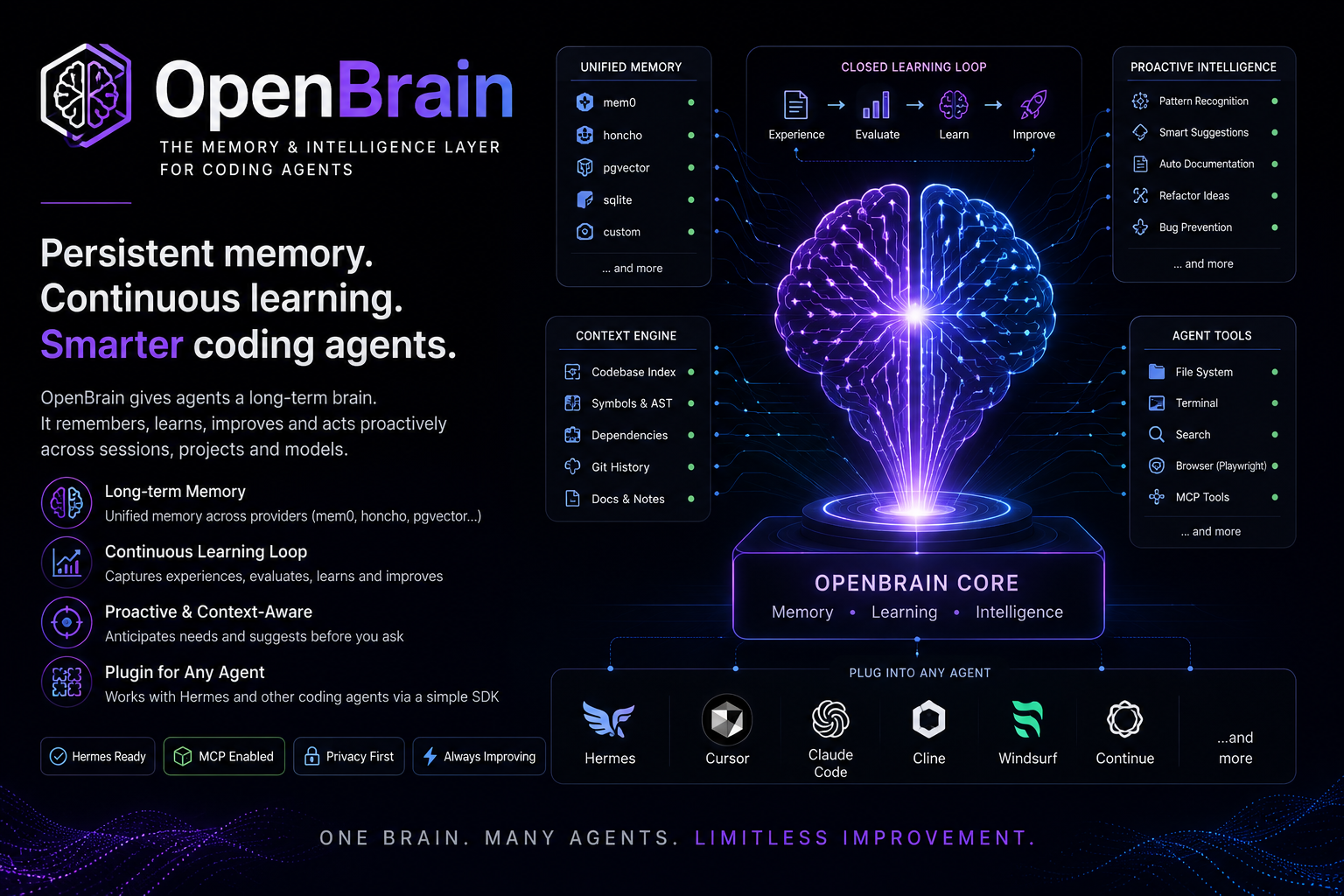
Open Brain
The user-owned memory and continuity layer for coding agents: durable evidence, decisions, tasks, outcomes, and reviewed learning across models, projects, and interfaces.


Overview
Open Brain gives coding agents a durable, model-independent brain. It stores semantic memory in PostgreSQL and pgvector, preserves where knowledge came from, follows work across sessions and agents, and assembles compact context for the next task.
Open Brain is the memory and intelligence layer, not the agent runtime. Connected agents remain responsible for reasoning, filesystem and terminal access, browser or computer use, and execution. Native integrations currently exist for Hermes, Medusa, Codex, and Claude Code; other agents connect through REST, MCP, the CLI, or the provider SDK.
It separates three concerns:
- Canonical evidence — append-only events, imported records, sessions, tool results, and artifacts.
- Knowledge model — current assertions, projects, tasks, decisions, procedures, and outcomes.
- Retrieval projections — embeddings, indexes, revisions, caches, and context packets that can be rebuilt safely.
Imported or provider-supplied records are never silently promoted into truth. They retain authority and provenance until reconciliation classifies them as durable facts, instructions, procedures, historical episodes, stale information, or inference.
How the banner maps to the code
| Promise | Current implementation |
|---|---|
| Persistent memory | PostgreSQL and pgvector semantic memory, hybrid search, canonical identities, append-only events, structured assertions, provenance, and exact agent attribution |
| Continuous learning | Retrieval feedback, contradiction reconciliation, compaction, and review queues for consolidation, lifecycle, and pruning proposals; durable changes require explicit acceptance and leave immutable receipts |
| Context-aware intelligence | Trust-labelled context packets use project, task, session, freshness, diversity, and token-budget signals, with revision-aware caching and feedback scoring |
| Works across agents | Native Hermes, Medusa, Codex, and Claude Code integrations plus REST, MCP, CLI, and a provider SDK with a conformance suite for additional hosts |
The Mem0, Honcho, and Hindsight integrations are provenance-preserving import adapters, not interchangeable live storage backends. Agents without a native adapter use the generic interfaces above.
What is implemented
| Area | Capabilities |
|---|---|
| Memory and retrieval | Semantic and filtered search, recent and related memory, entities, tags, trends, weekly reports, context packets, and retrieval feedback |
| Continuity and knowledge | Canonical user, agent, workspace, project, task, and session identities; session lineage; idempotent events; evidence-backed assertions; decisions, procedures, and outcomes |
| Learning and governance | Contradiction reconciliation, memory compaction, bounded maintenance, proposal generation, human review, reversible consolidation, lifecycle transitions, conservative pruning, and immutable automation receipts |
| Interfaces | FastAPI REST service and OpenAPI docs, MCP tools, CLI, Streamlit dashboard, provider SDK, and conformance checks |
| Imports and connectors | Staged and resumable imports for Hermes memory, context, sessions, skills, and cron jobs; Mem0, Honcho, and Hindsight exports; file watcher, Claude Code logs, Gmail Takeout, Telegram, and WhatsApp exports |
| Operations | API-key authentication, request-size and rate limits, explicit CORS, structured diagnostics, health and readiness probes, retry-aware database access, checksum-protected migrations, and openbrain-release-check |
Architecture
Hermes       Medusa       Codex       Claude Code       other agents
   │            │            │              │                │
 native      provider     provider       provider         REST / MCP
 provider      SDK          SDK            SDK
   └────────────┴────────────┴──────────────┴────────────────┘
                              │
                              ▼
┌──────────────────────────────────────────────────────────────┐
│                         Open Brain                           │
│                                                              │
│  Evidence        Knowledge model        Retrieval packets    │
│  ─────────       ───────────────        ─────────────────    │
│  events          identities             active context       │
│  sessions        projects/tasks         trust labels         │
│  imports         assertions             freshness            │
│  artifacts       decisions/outcomes     token budgets        │
└────────────────────────────┬─────────────────────────────────┘
                             │
                             ▼
                    PostgreSQL + pgvector
Agent integrations
| Agent | Integration | Lifecycle coverage | Offline behavior |
|---|---|---|---|
| Hermes | Native upstream-compatible memory provider | recall, remember, prefetch, turn sync, session switch, compression, delegation, session end | local spool and cached recall |
| Medusa | Provider SDK adapter | session start/end, user and assistant messages, tool results, compression, delegation | local spool and replay |
| Codex | Explicit host lifecycle bridge | session start/end, user and assistant messages, tool results, compression | host-controlled failure handling |
| Claude Code | Explicit host lifecycle bridge | session start/end, user and assistant messages, tool results, compression | host-controlled failure handling |
| Other agents | REST, MCP, or provider SDK | capability-dependent | integration-defined |
The Codex and Claude Code bridges deliberately avoid undocumented local transcript formats. A host wrapper supplies stable session, workspace, version, and scope identifiers and calls explicit lifecycle methods.
Integration guides:
docs/HERMES_INTEGRATION_ARCHITECTURE.mddocs/HERMES_INTEGRATION_PROGRESS.mddocs/MEDUSA_INTEGRATION.mddocs/CODEX_ADAPTER.mddocs/CLAUDE_CODE_ADAPTER.md
Installation
Open Brain requires Python 3.11+ and PostgreSQL with pgvector.
For a reproducible v1.0.0 installation, review and run the release-pinned installer:
curl -fsSL https://raw.githubusercontent.com/benclawbot/open-brain/v1.0.0/install.sh | sh
Verify:
openbrain --version
openbrain --help
The installer uses pipx, keeping Open Brain isolated from system Python packages.
Hermes
openbrain install-hermes
export OPENBRAIN_URL=http://127.0.0.1:8000
hermes memory setup
Select openbrain as the active memory provider when prompted.
Optional scope variables:
export OPENBRAIN_PROJECT_ID=<project-uuid>
export OPENBRAIN_TASK_ID=<task-uuid>
export OPENBRAIN_TIMEOUT=3
If Open Brain is unavailable, Hermes continues operating. Writes are appended to $HERMES_HOME/openbrain-spool.jsonl and replayed later.
Development
git clone https://github.com/benclawbot/open-brain.git
cd open-brain
python3 -m venv .venv
. .venv/bin/activate
pip install -e '.[dev]'
Database and local stack
DB_HOST=localhost
DB_PORT=5432
DB_NAME=openbrain
DB_USER=postgres
DB_PASSWORD=change-me
DB_TIMEZONE=auto
cp .env.example .env
docker compose up -d --build
docker compose ps
| Service | Address |
|---|---|
| REST API | http://localhost:8000 |
| API documentation | http://localhost:8000/docs |
| Dashboard | http://localhost:8501 |
| PostgreSQL from the host | localhost:5433 |
The API container applies pending migrations during startup. Containers reach PostgreSQL as postgres:5432; programs running on the host use the published port localhost:5433.
Already-applied migrations must never be edited. Add a new migration instead.
CLI
openbrain search "what did I decide about Hermes?"
openbrain store "Use upstream NousResearch/hermes-agent" --source cli --tag hermes
openbrain stats
openbrain import file ./notes.md
openbrain report --days 7
openbrain serve --host 127.0.0.1 --port 8000
openbrain install-hermes
openbrain update
MCP
The MCP server uses the standard stdio transport:
python -m src.main
It exposes memory_search, memory_store, memory_get_related, memory_get_entity, memory_today, memory_stats, and memory_weekly_report. Configure an MCP-capable host to launch that command from the repository or installed environment.
REST API
The complete, live contract is available through the OpenAPI documentation at http://localhost:8000/docs. Core semantic-memory endpoints include:
GET  /memories
POST /memories
POST /memories/search
GET  /memories/{memory_id}
GET  /stats
GET  /trends
GET  /report/weekly
Continuity endpoints:
POST /v1/events
POST /v1/identities/resolve
POST /v1/sessions/open
POST /v1/sessions/{session_id}/close
POST /v1/imports/hermes/markdown
GET  /v1/imports/providers
POST /v1/imports/providers
POST /v1/context
POST /v1/context/feedback
Reviewed automation is exposed under /v1/lifecycle, /v1/consolidation, /v1/pruning, /v1/compaction, and /v1/maintenance.
Context packets contain selected current state rather than raw transcript fragments. Items carry labels such as user_confirmed, tool_observed, curated_memory, inferred, stale, or contradicted.
Memory lifecycle
candidate → active → confirmed
                     ├→ superseded
                     ├→ contradicted
                     ├→ dormant
                     └→ archived → tombstoned → deleted
Open Brain prunes retrieval before storage. Old evidence can leave hot retrieval while remaining available for history, provenance, audit, and reconciliation. User-authored information is not automatically physically deleted.
Security and authority
Typical authority ordering:
- direct user statement
- user-curated memory
- tool observation
- provider inference
- Open Brain inference
- assistant claim
Sensitive records can carry sensitivity and retention classifications. Provider inference remains distinguishable from user-confirmed truth.
Review install.sh before execution in high-security environments. Use a reviewed release tag rather than the moving master branch for reproducible deployment.
Production readiness
Run the machine-readable gate before deployment:
openbrain-release-check --help
The gate validates production mode, authentication, API-key strength, and explicit CORS configuration. It also requires operator attestations for controls that cannot be inferred safely from application configuration:
- TLS termination verified
- backups verified
- restore drill completed
- monitoring enabled
- migration records confirmed
A deployment is not certified merely because configuration files exist. See docs/RELEASE_READINESS.md.
Validation
pip install -e '.[dev]'
python scripts/migrate.py
pytest -q
python -m build
GitHub Actions validates package installation, PostgreSQL and pgvector migrations, the full test suite, provider conformance, wheel creation, installed CLI execution, and Hermes provider installation smoke tests.
Project structure
src/
├── api/                         REST endpoints
├── cli/                         command-line interface
├── continuity/                  event, identity, and session contracts
├── context/                     context packets, caching, feedback, and revisions
├── lifecycle/                   evidence-backed knowledge-state proposals
├── consolidation/               duplicate and overlapping assertion proposals
├── pruning/                     conservative archival and restoration policies
├── compaction/                  durable memory compaction
├── maintenance/                 bounded maintenance orchestration
├── db/                          persistence, migrations, and queries
├── importers/                   staged and provider imports
├── providers/                   universal provider SDK and conformance
├── release/                     production readiness checks
├── openbrain_hermes_plugin/     standalone Hermes memory provider
├── openbrain_medusa_adapter/    Medusa lifecycle adapter
├── openbrain_codex_adapter/     Codex lifecycle adapter
├── openbrain_claude_adapter/    Claude Code lifecycle adapter
├── analytics/                   trends and reports
├── connectors/                  source connectors
├── extractors/                  entities and tagging
├── sandbox/                     optional isolated command execution
└── notifications/               notification integrations
Release status
Open Brain 1.0.0 is the first production/stable release. The coordinated production-readiness train delivered deployment hardening, database resilience, real adapter host wiring, durable reconciliation, staged imports, unified proposal review workflows, and a machine-readable release gate.
Production readiness still depends on the target environment. Operators must run the readiness gate and verify external controls such as TLS, backups, restore drills, and monitoring before serving real data.
See CHANGELOG.md for release details.
License
MIT.
Yorumlar (0)
Yorum birakmak icin giris yap.
Yorum birakSonuc bulunamadi