tandem
Health Warn
- License — License: MIT
- Description — Repository has a description
- Active repo — Last push 0 days ago
- Low visibility — Only 8 GitHub stars
Code Pass
- Code scan — Scanned 12 files during light audit, no dangerous patterns found
Permissions Pass
- Permissions — No dangerous permissions requested
No AI report is available for this listing yet.
One coding session. Two AI agents. Zero lost context. Run Claude Code and Codex CLI as a single paired session.
🤝 tandem
One coding session. Two AI agents. Zero lost context.
Run Claude Code and
OpenAI Codex CLI as a single paired
session — each model in its own native harness. Work in either one,
switch at any moment, and pick up exactly where you left off. No double
spend: only one model runs per turn; the other stays in sync through pure
local file translation.


uv tool install tandem-cli
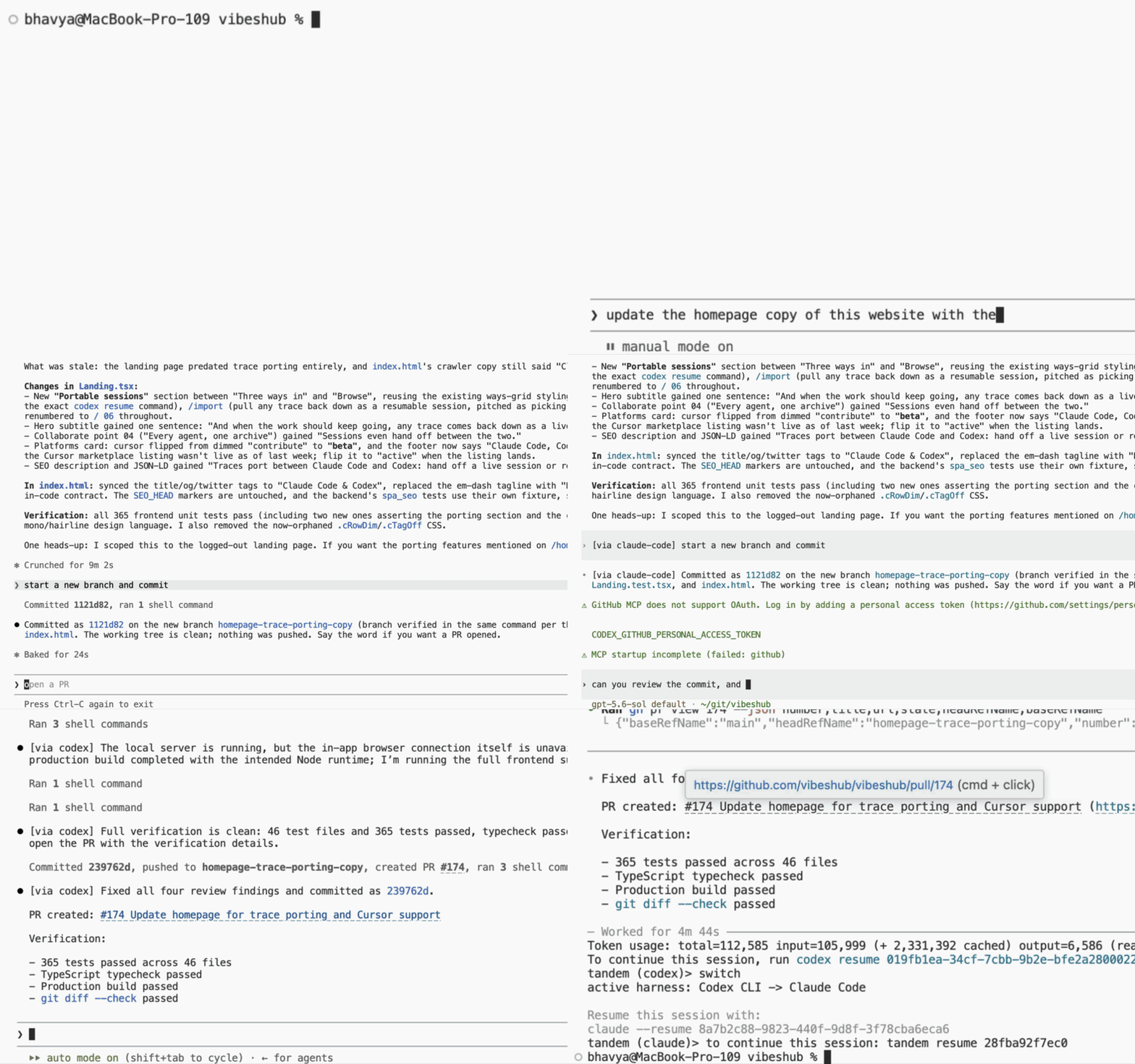
Why tandem?
⏳ Hit a usage limit? Just keep going.
Claude runs out of its usage window mid-refactor? Type switch and Codex
continues the same conversation a second later — same files, same
history, same plan. Your two subscriptions become one long runway instead
of two separate walls.
🌩️ Immune to outages.
An Anthropic or OpenAI outage doesn't stop your work. If the active
model's API goes down, switch — the same session continues seamlessly
in the other harness, and you can switch back whenever the outage clears.
💳 Subscriptions, not API bills.
tandem wraps the official CLIs under the auth you already have — your
Claude and ChatGPT subscription logins work as-is. No API keys to
provision, no per-token surprises. tandem itself makes zero network
calls; every model call happens inside the real CLI, on your existing
plan.
🧠 Two model families on one problem.
Claude and GPT have different strengths and different blind spots. Get a
second opinion with full session context — no copy-pasting walls of
text between terminals:
tandem run --on codex "second opinion: why is this test flaky?"
🐣 Subagents on the cheap model.
Load tandem's Claude Code plugin and Claude's subagent dispatches run on
the codex model you choose instead — automatically, with the task brief
forwarded verbatim and the result returned through Claude's own machinery.
Claude orchestrates; codex does the legwork; your Claude quota stays on the
main thread. The plugin lives in this repo (not in the wheel), so point
Claude at a clone:
git clone https://github.com/Bhavya6187/tandem
claude --plugin-dir /path/to/tandem/plugin
Then create ~/.tandem/config.toml and pick your plan's cheap model (ids
are listed in ~/.codex/models_cache.json):
[subagents]
model = "gpt-5.6-luna"  # ← the whole point: set this
route = "all"           # all | off
context = "match"       # match | task | full
keep_forks = false      # keep each worker's rollout for debugging
Without model, workers run on your codex account's default model —
probably not the cheap one. Every other key above is already the default;
that one is not, and routing is on as soon as the plugin loads, sotandem doctor warns until you set it.
Fork dispatches stay on Claude, each worker's full codex log is kept under~/.tandem/subagents/, and tandem status lists the workers running right
now. Drop the --plugin-dir flag and Claude is byte-for-byte stock again.
🏠 Every model in its native harness.
This is not a lowest-common-denominator wrapper UI. Claude runs in real
Claude Code; GPT runs in real Codex CLI. Your keybindings, slash commands,
MCP servers, and muscle memory all work exactly as they do today — tandem
sits underneath, not in between.
⚡ Switching is instant.
While one agent is active, tandem quietly keeps the other one's native
session file up to date by translating the transcript as it grows — pure
local file I/O, no model calls, no "exporting…" step. The other side is
always resume-ready.
🔒 Local, private, no lock-in.
Everything lives in the CLIs' own session files plus a small SQLite
database in ~/.tandem. No cloud sync, no telemetry. Uninstall tandem
tomorrow and both sessions still resume natively with claude --resume
and codex resume.
Quick start
You'll need Python 3.11+ and the claude and codex CLIs on your PATH.
uv tool install tandem-cli   # or: pip install tandem-cli
cd your-project
tandem                       # fresh paired session; drops you into claude
Work normally. When you exit the agent, you land at tandem's prompt
instead of your shell — that's where the magic lives:
tandem (claude)> switch      # continue instantly in codex
tandem (codex)> exit
to continue this session: tandem resume a1b2c3d4e5f6
Come back anytime:
tandem resume                # most recent session in this directory
tandem resume a1b2c3d4e5f6   # a specific one (id from the exit hint)
Command cheat sheet
| Command | What it does |
|---|---|
tandem |
Start a fresh paired session (Claude active; --active codex to flip) |
switch |
Flip active/shadow and enter the other agent — at the tandem prompt, or one-shot from your shell (one-shot only flips, it doesn't enter) |
tandem resume [id] |
Continue the most recent (or a specific) session |
tandem run --on codex "…" |
One-off prompt to the other agent, with full context |
tandem sub "…" |
Run one delegated task on a codex model (used by the plugin's reroute hook) |
tandem status |
Show pairing, roles, and sync position |
There are also three maintenance commands — tandem doctor (health
check: verifies both sessions are resumable), tandem sync (manual
catch-up translation), and tandem sync-mcp (share MCP server configs
between the tools).
How it works
- One model per command — always. Only the active harness's model is
ever invoked (or, forrun --on, the target's). The shadow side is pure
local file I/O: tandem tails the active transcript, translates each
entry, and appends it to the shadow's session file. The shadow's model
is never called to "catch up". - A persistent prompt, not the OS shell. Leaving the harness lands you
attandem (claude)>. There,switchflips roles and drops you
straight into the other tool, Enter re-enters the current one, andstatus/sync/doctor/run --on/sync-mcpall run against
this session.exit(or Ctrl-D) returns to your shell and prints the
resume hint. Every command also works one-shot from your shell,
targeting the directory's most recently used session. - PTY passthrough. tandem launches the real CLI on a pty (raw mode,
resize forwarding, signals through the line discipline) and never
scrapes terminal output — the transcript files are the source of truth.
Turn-complete hooks (claude --settingsStop hook,codex -c notify=[…]) are wired per-invocation as wake-up signals, with
fs-watching as the data path and fallback. If your codex config already
setsnotify, tandem leaves it alone. - Append-only, crash-safe sync. Each transcript entry is translated as
it lands — no bulk re-export at switch time. Appends are whole-line +
fsync, and a write-ahead intent in the sync cursor makes translation
exactly-once across crashes; on restart, sync resumes from the last
confirmed entry. - Tool calls translate natively. The harnesses speak different tool
vocabularies, so each completed call+result pair is re-expressed in the
shadow's own terms —Bash↔exec_command,Edit/Write↔apply_patch,TodoWrite↔update_plan— and lands as a real
tool-call record, so shadow history reads as the shadow's own work.
Anything that wouldn't map truthfully passes through verbatim; a call
whose result never arrived is closed with a(tool result not recorded)
placeholder at handoff, since both replay APIs reject dangling calls. - Attribution stays legible. Every synced text message is tagged
[via claude-code]/[via codex](tandem's own notes use[tandem]),
so interleaved histories make sense to you and to the models. Tool
activity is untagged — it's mirrored as native records, not prose. - Errors are contained. An entry that fails translation becomes a
single per-turn placeholder in the shadow, with the raw entry
quarantined under~/.tandem/quarantine/…— and sync continues. The
shadow is never corrupted or truncated. - Memory files stay in step. Fresh launches and every switch sync
CLAUDE.md ↔ AGENTS.md: shared content lives in a<!-- tandem:shared:begin/end -->block (newer file wins),
tool-specific text outside the block is preserved, and a file without
markers is read from but never rewritten. Git state is never touched.
Compatibility
Session formats are internal to the CLIs and drift between releases.
tandem pins what it was built against (observed formats documented in
docs/formats.md):
| CLI | Tested | Accepted range |
|---|---|---|
| Claude Code | 2.1.220 | ≥ 2.0, < 3 |
| Codex CLI | 0.145.0 | ≥ 0.140, < 0.150 |
Outside the range, tandem warns and asks you to run tandem doctor.
Format knowledge is isolated per tool insrc/tandem/harness/claude_code.py and src/tandem/harness/codex.py.
Where your data lives
~/.tandem/state.db— SQLite: session pairing + per-source sync cursors
(override the directory withTANDEM_HOME)~/.tandem/quarantine/<session>/— raw entries that failed translation~/.claude/projects/<munged-cwd>/<session-id>.jsonl— claude transcript~/.codex/sessions/YYYY/MM/DD/rollout-<ts>-<session-id>.jsonl— codex
rollout (CLAUDE_CONFIG_DIR/CODEX_HOMEhonored)
Claude session ids are minted by tandem (claude --session-id); codex
mints its own on first run and tandem captures it from the new rollout
file.
Extending tandem
The sync engine talks to a small adapter interface
(tandem.converter.TraceConverter):
class TraceConverter(Protocol):
    def translate_entry(entry, direction, ctx) -> list[TargetEntry] | TranslationError
ReferenceConverter implements it via a normalized event model
(tandem/events.py) derived from the observed formats. Pass your own
converter to SyncEngine(store, session, source, converter=...).
Development
uv sync && uv run pytest
pipx install .        # or: uv tool install .
Dependencies are deliberately small: click (CLI), pydantic v2 (event
schema), watchdog (transcript tailing), pexpect/ptyprocess (PTY
passthrough); state is stdlib sqlite3.
License
Reviews (0)
Sign in to leave a review.
Leave a reviewNo results found