bicameral-mcp
Health Uyari
- No license — Repository has no license file
- Description — Repository has a description
- Active repo — Last push 0 days ago
- Low visibility — Only 6 GitHub stars
Code Basarisiz
- eval() — Dynamic code execution via eval() in .github/workflows/preflight-eval.yml
- rm -rf — Recursive force deletion command in .github/workflows/publish.yml
- eval() — Dynamic code execution via eval() in .github/workflows/test-mcp-regression.yml
Permissions Gecti
- Permissions — No dangerous permissions requested
Bu listing icin henuz AI raporu yok.
Decision ledger MCP server — ingests meeting transcripts, maps decisions to code, tracks drift
  ▸ BICAMERAL
  ┌───────────────────────────────────────────────┐
  │  what your team decided  ↔  what the AI built │
  └───────────────────────────────────────────────┘
Bicameral MCP




Bicameral eliminates redundant rework in the software development lifecycle (SDLC) by building the compliance layer between product decisions and code output.
Bicameral is a local-first MCP server that ingests your meeting transcripts, PRDs, and Slack threads, maps every decision to the code that implements it, and automatically surfaces alignment gaps — before they become bugs.
Compliance posture
bicameral-mcp's compliance stance is documented in six policy files:
docs/policies/host-trust-model.md— MCP host UX dependency declaration (closes OWASP LLM-07 / MCP-01 gap)docs/policies/acceptable-use.md— intended purpose + prohibited uses (NIST AI RMF MAP-3.1 + EU AI Act Annex III)docs/policies/install-trust-model.md— install + update supply-chain trust model (closes OWASP-03 + OWASP-05)docs/policies/audit-log.md— structured audit-log emission for self-hosted operators (closes SOC2-06 + OWASP-06 fold)docs/policies/diagnose-output.md—bicameral-mcp diagnoseoutput allowlist + privacy posture (#252 Layer 3)docs/sla.md— availability stance (operator-run-only; no hosted SLA)
The full compliance audit is at docs/research-brief-compliance-audit-2026-05-06.md. Per-release change-control evidence procedure: docs/RELEASE_EVIDENCE_PROCEDURE.md.
The Problem
Engineering teams make hundreds of product decisions per week. A tiny fraction end up in tickets. None are linked to the code that implements them.
When you build with an AI coding assistant, this disconnect accelerates:
- The agent has no memory of the sprint planning where you decided on the rate limit
- It implements checkout without knowing the compliance rule from last week's Slack thread
- By the time someone notices, the gap has compounded across three PRs
Bicameral solves spec-alignment friction. It acts as a persistent, auditable memory layer between your product decisions and your codebase — so your AI agent always has the right context before writing a line of code.
  meeting transcript       PRD / Slack thread       inline answer
         │                        │                       │
         └────────────────────────┼───────────────────────┘
                                  ▼
                          bicameral.ingest
                                  │
                    ┌─────────────▼──────────────┐
                    │       Decision Ledger        │
                    │   what was said  ↔  code    │
                    │  status:  reflected | drifted │
                    │           pending | ungrounded│
                    │  signoff: proposed | ratified │
                    └─────────────────────────────┘
                                  │
              ┌───────────────────┼───────────────────┐
              ▼                   ▼                   ▼
       preflight fires      dashboard shows      drift detected
     before you code        full picture        at review time
How It Feels
Before implementing a feature, your agent runs bicameral.preflight and surfaces:
(bicameral surfaced — checking Stripe webhook context)

📌 3 prior decisions in scope:
  ✓ Idempotency via Redis SETNX with 24h TTL
    src/middleware/idempotency.ts:checkIdempotencyKey:42-67
    Source: Sprint 14 planning · Ian, 2026-03-12

  ⚠ DRIFTED: Trust Stripe event.created, not server time
    src/handlers/webhook.ts:processEvent:80-92
    Drift evidence: switched to Date.now() in PR #287

~ 1 AI-surfaced question (no human source yet):
  • Should we deduplicate by event.id or (account_id, event.id)?
    Source: Slack #payments 2026-03-20
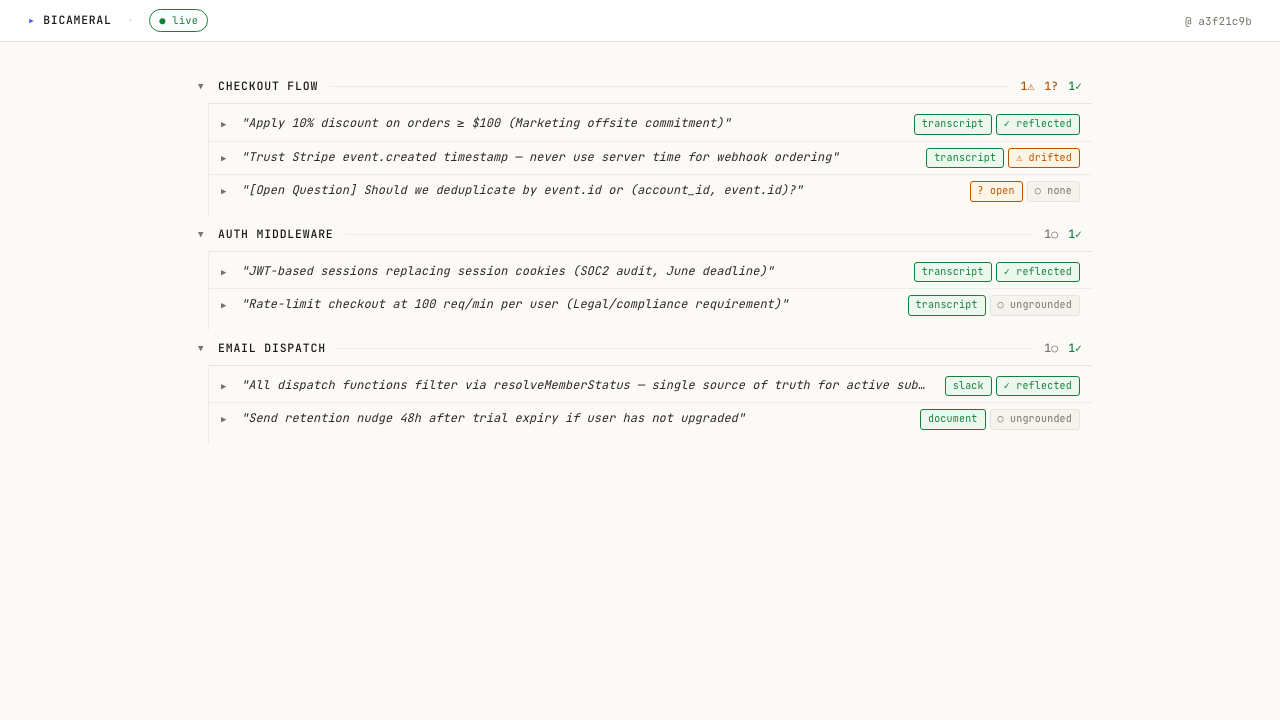
At any time, the dashboard gives you the full picture:
Quickstart
The fastest path is uv. If you don't have uv yet, the official installer is one line:
# macOS / Linux
curl -LsSf https://astral.sh/uv/install.sh | sh
# Windows (PowerShell)
powershell -ExecutionPolicy ByPass -c "irm https://astral.sh/uv/install.ps1 | iex"
Then:
uv tool install bicameral-mcp
bicameral-mcp setup
Prefer pipx? That works too:
pipx install bicameral-mcp
bicameral-mcp setup
The setup wizard detects your repo, installs the MCP server config into Claude Code, adds a git hook that automatically syncs the ledger after every commit, and adds a session-end hook that captures any design decisions you stated mid-session but didn't explicitly ingest. Restart Claude Code and you're done.
Verify it works:
bicameral-mcp --smoke-test
Don't have pipx?
macOS
brew install pipx
pipx ensurepath
Linux
python3 -m pip install --user pipx
python3 -m pipx ensurepath
Windows
python -m pip install --user pipx
python -m pipx ensurepath
Then restart your terminal and re-run the install command above.
Core Concepts
Two Orthogonal Axes
Every decision carries two independent signals:
Status — what the codebase says (derived at query time, never stored):
| Symbol | Meaning | |
|---|---|---|
| reflected | ✓ | Code was verified to implement this decision |
| drifted | ⚠ | Code changed since the decision was last verified |
| pending | … | Code region found, but not yet verified by the agent |
| ungrounded | ○ | Decision tracked, but no matching code region found yet |
Signoff — what humans decided (stored explicitly):
| Symbol | Meaning | |
|---|---|---|
| ratified | ✓ date | A human confirmed this decision |
| proposed | ○ | Ingested but not yet confirmed; drift tracking paused |
| AI-surfaced | ~ | Surfaced by the agent, no human-stated source |
| rejected | ✕ | Explicitly ruled out |
| needs context | ⚑ | Business driver unclear — parked until answered |
| superseded | — | Replaced by a later decision |
The two axes are independent. The most important combination to watch for is proposed × reflected: the code already implements this decision cleanly, but a human hasn't signed off yet. That's the hero case for the dashboard — the PM sees it, ratifies, and drift tracking activates.
Status is immune to rebase, squash, and cherry-pick because it's derived fresh at query time from content hashes, not stored as a flag.
When Does link_commit Run?
link_commit syncs a commit's changes into the ledger — it recomputes content hashes and re-evaluates drift for every bound decision.
It fires automatically in three ways:
- After every
bicameral.ingest— auto-chained by the server - After git commits/merges/pulls — via the PostToolUse hook installed by
setup - Before every
bicameral.preflight— lazy catch-up if HEAD has advanced since the last sync
If you commit outside of Claude Code (e.g., from a terminal), the next preflight call will sync the ledger before surfacing context.
Collaboration Modes
| Solo (default) | Team | |
|---|---|---|
| Who | Individual eval or single-dev use | Any mix of devs, PMs, designers |
| Storage | Local only (gitignored) | Local DB + git-committed event files |
| Sharing | Nothing shared | Normal git push/git pull |
| Merge conflicts | N/A | Zero — per-user append-only files |
In team mode, a PM ingests a PRD; when a dev pulls, preflight surfaces those decisions as coding context and the dashboard shows what still needs implementation.
.bicameral/
├── events/                ← committed to git (shared decisions)
│   ├── [email protected]    ← PM's ingested PRDs and transcripts
│   └── [email protected]   ← developer's commit syncs
├── config.yaml            ← committed (mode, guided flag)
└── local/                 ← gitignored (materialized state, DB)
What setup Installs
Running bicameral-mcp setup writes these files to your repo:
| File | What it is | Required? |
|---|---|---|
.mcp.json |
MCP server config for Claude Code | Yes — registers the server |
.bicameral/config.yaml |
Collaboration mode (solo/team) and guided-mode flag |
Yes — stores your preferences |
.bicameral/ledger.db |
SurrealDB decision ledger (solo mode) | Auto-created on first tool call |
.gitignore entry |
Ignores .bicameral/ in solo mode |
Recommended |
.claude/settings.json |
PostToolUse hook: auto-calls bicameral.link_commit after git commits |
Optional — improves sync |
.claude/settings.json |
SessionEnd hook: writes the session transcript to .bicameral/pending-transcripts/; next session drains the queue to surface uningested mid-session decisions |
Optional — closes correction capture gap |
.claude/skills/bicameral-*/SKILL.md |
Slash commands (/bicameral-ingest, /bicameral-preflight, /bicameral-capture-corrections, etc.) |
Recommended |
Removing Bicameral
To fully uninstall from a repo:
# 1. Remove the MCP server
claude mcp remove bicameral --scope project

# 2. Remove data and config
rm -rf .bicameral/

# 3. Remove skills
rm -rf .claude/skills/bicameral-*/

# 4. Remove the git hook (if installed)
#    Open .claude/settings.json and delete the PostToolUse entry
#    with "bicameral" in the command field.

# 5. Remove the .gitignore entry
#    Delete the "# Bicameral MCP" block from .gitignore.
Slash Commands
After setup, Claude Code gets these slash commands:
| Command | When to use |
|---|---|
/bicameral-ingest |
Paste a transcript, PRD, or Slack thread to track its decisions |
/bicameral-preflight |
Surface relevant decisions and drift before implementing |
/bicameral-history |
See all tracked decisions grouped by feature area |
/bicameral-dashboard |
Open the live decision dashboard in your browser |
/bicameral-reset |
Wipe and replay the ledger (emergency use) |
The agent also fires these automatically — preflight before any code change, ingest when you paste a document.
MCP Tools Reference
13 tools across three categoriesDecision Ledger
| Tool | Purpose |
|---|---|
bicameral.ingest |
Ingest a transcript, PRD, or Slack export into the ledger |
bicameral.preflight |
Pre-flight: surface prior decisions and drift before coding |
bicameral.search |
Search past decisions by topic |
bicameral.brief |
Full brief for a feature area (decisions, drift, divergences, gaps) |
bicameral.history |
Read-only snapshot of all decisions grouped by feature |
bicameral.link_commit |
Sync a commit — update content hashes, re-evaluate drift |
bicameral.drift |
Detect drift for decisions touching a specific file |
bicameral.judge_gaps |
Run the business-requirement gap rubric on a topic |
bicameral.resolve_compliance |
Write back caller-LLM compliance verdicts (compliant/drifted/not_relevant) |
bicameral.ratify |
Record product sign-off on a decision |
bicameral.update |
Check for and apply recommended version updates |
bicameral.reset |
Wipe the ledger for the current repo (dry-run by default) |
bicameral.dashboard |
Start the local dashboard server and return its URL |
Code Locator
The server exposes deterministic primitives only. Callers use their own
tools (Grep/Read/Glob) for code search and pass resolved file paths /
symbol names back to the server.
| Tool | Purpose |
|---|---|
validate_symbols |
Fuzzy-match symbol name hypotheses against the code index |
get_neighbors |
1-hop structural graph traversal (callers, callees, imports) |
Configuration
| Variable | Default | Description |
|---|---|---|
REPO_PATH |
. |
Path to the repository being analyzed |
SURREAL_URL |
surrealkv://~/.bicameral/ledger.db |
SurrealDB URL. Use memory:// for tests. |
CODE_LOCATOR_SQLITE_DB |
(auto) | Override path for the code index database |
BICAMERAL_AUTHORITATIVE_REF |
(auto-detected) | Override the main branch name (default: reads origin/HEAD) |
BICAMERAL_PREFLIGHT_MUTE |
0 |
Set to 1 to silence preflight for one session |
BICAMERAL_GUIDED_MODE |
(from config.yaml) | Set to 1 to force guided (blocking) mode |
All data stays local. The embedded SurrealDB instance runs in-process — no separate server.
Local Development
git clone https://github.com/BicameralAI/bicameral-mcp.git
cd bicameral-mcp
pip install -e "pilot/mcp[test]"
cd pilot/mcp && pytest tests/ -v
Tests use real adapters with SURREAL_URL=memory:// — no external services required. CI runs on PRs to main via GitHub Actions.
Telemetry
Bicameral collects anonymous usage statistics to improve reliability and prioritize development. No code, decision content, file paths, or personally identifiable information is ever collected.
What is collected:
- Tool name (e.g.
bicameral.ingest) - Server version
- Call duration (milliseconds)
- Error flag (boolean)
- Aggregate counts (e.g. number of decisions grounded per ingest call — integers only)
What is never collected: decision descriptions, transcript content, search queries, file paths, repo names, or any user-supplied text.
Opt out at any time:
export BICAMERAL_TELEMETRY=0
or add BICAMERAL_TELEMETRY=0 to the env block in your .mcp.json.
Collaborator access
Telemetry data is stored in a private PostHog project. If you are a design partner, contributor, or researcher who needs access to the usage dashboard, reach out directly at [email protected].
Contributing
Contributions welcome. Please open an issue before submitting large changes.
License
MIT
Yorumlar (0)
Yorum birakmak icin giris yap.
Yorum birakSonuc bulunamadi