FuguNano
Health Uyari
- License — License: Apache-2.0
- Description — Repository has a description
- Active repo — Last push 0 days ago
- Low visibility — Only 5 GitHub stars
Code Basarisiz
- spawnSync — Synchronous process spawning in backends/bin/cc-model-launcher.mjs
- process.env — Environment variable access in backends/bin/cc-model-launcher.mjs
- spawnSync — Synchronous process spawning in backends/install.ts
- process.env — Environment variable access in backends/install.ts
- spawnSync — Synchronous process spawning in backends/verify.ts
Permissions Gecti
- Permissions — No dangerous permissions requested
Bu listing icin henuz AI raporu yok.
Open & nano reimplementation of Sakana Fugu. A repo-native, multi-agent coding loop powered by 9+ LLMs (isolated via Claude Code) and an independent Codex reviewer. Lightweight, bounded, and self-improving (Self-Harness)—no coordinator training required.


FuguNano
Open & light-weight version reimplementation of Sakana Fugu.






Quick Start · Agent Runtime · Workflow · Self-Harness · Engine Parity · Attribution
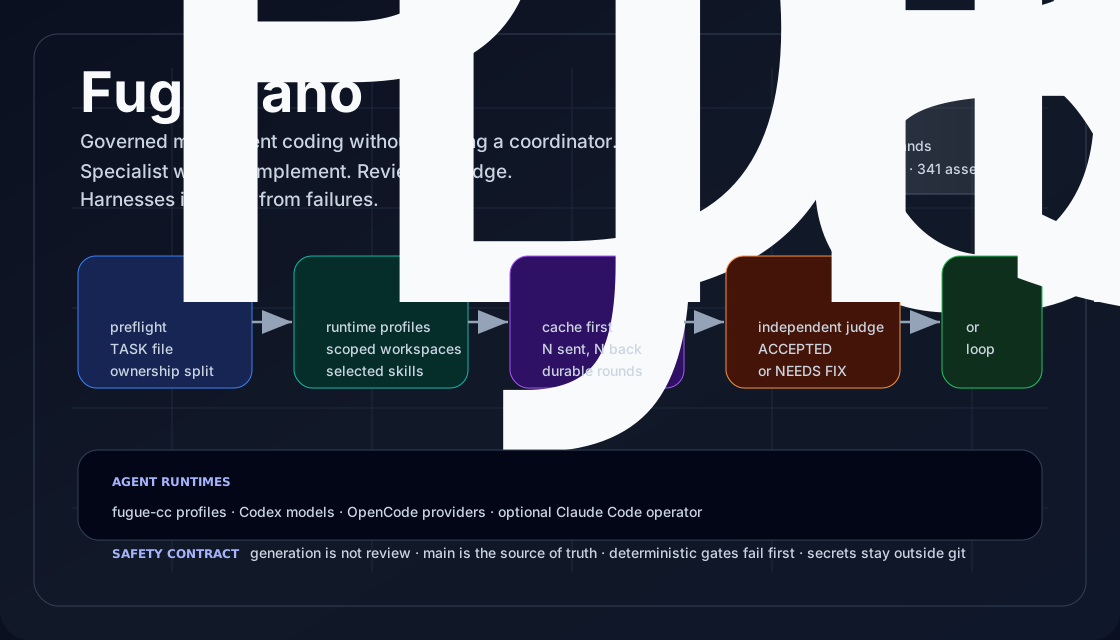
A repo-native, multi-agent coding loop powered by 9+ LLMs (isolated via
Claude Code) and an independent Codex reviewer. Lightweight, bounded, and
self-improving (Self-Harness) - no coordinator training required.
It is intentionally provider-neutral: use the accessible models you trust
today, add more runtimes tomorrow, and keep the engineering loop the same.
Highlights
- One operator surface -
fuguectldrives preflight, dispatch, cache,
integration, review, loop state, routing, skills, and runtime maintenance. - Runtime-neutral agents - logical agent profiles route work to Claude Code
provider instances, Codex models, OpenCode providers, or future harnesses
without changing the loop. - Extensible model pool - current profiles are just starting points.
Community adapters can add accessible commercial, open, private, local, or
self-hosted models without changing FuguNano's core contract. - Real isolation - workers edit separate worktrees with scoped workspaces,
selected skills, and optional ownership enforcement. - Review stays independent - implementers write, while Codex or another
configured independent reviewer returnsACCEPTEDorNEEDS FIX. - No lost outputs - dispatch can persist reviewer/agent output with
--out,
and the join barrier still enforces N sent, N returned. - Bounded repair - keep-best, confirmation passes, user escalation, and
non-convergence states keep the loop from spinning forever. - Learning without training - allocation blends benchmark priors with live
review outcomes, and completed TASK traces can be distilled into replayed
experience memory selected by the next task or prompt. - Self-Harness ready - the TypeScript engine can mine failed runs, propose
bounded harness edits, and promote only non-regressing changes.
Quick Start
Requirements: macOS or Linux, Node.js >= 18.18, git, tmux, and the model/API
credentials you choose to use. Codex is recommended for review.
git clone https://github.com/BicaMindLabs/FuguNano fugunano
cd fugunano

/path/to/fugunano/orchestration/fuguectl/fuguectl help quickstart
/path/to/fugunano/orchestration/fuguectl/fuguectl init --dry-run
make doctor       # inspect local CLIs and provider readiness
make install      # install model launchers
make verify       # verify launcher wiring
make ci-clean     # run the full local gate from a clean engine install
Real keys stay outside the repository:
mkdir -p ~/.config
$EDITOR ~/.config/cc-model-secrets.env
Choose the runtimes you want to use. The TypeScript engine now models agents as
profiles: a logical id, a harness (fugue-cc, codex, opencode), an optional
harness-native target, and a model family used by policy. See
docs/AGENT_RUNTIME.md.
For the optional fugue-cc worktree fleet, add a provider config to the project
you want the fleet to edit:
cp orchestration/fugue-cc/provider.config.example /path/to/project/.fugue-cc/provider.config
cd /path/to/project
fugue-cc
Then run the operator from another shell:
/path/to/fugunano/orchestration/fuguectl/fuguectl preflight --harness fugue-cc
/path/to/fugunano/orchestration/fuguectl/fuguectl fleet status
Operator Skill
make install-skill
This installs /fugunano to ~/.claude/skills/fugunano as a convenience operator
entry for Claude Code. The workflow itself is not Claude Code-specific: Codex,
OpenCode, Antigravity, and other agents can follow AGENTS.md and
dispatch through the same agent profiles. Smoke-test the installed bundle:
~/.claude/skills/fugunano/fuguectl selftest
How The Loop Works
fuguectl preflight --harness codex        # lite reviewer path
fuguectl preflight --harness opencode --target opencode/deepseek-v4-flash-free
fuguectl preflight --harness agy
fuguectl preflight --harness lite         # all lite runtimes: codex + opencode + agy
fuguectl preflight --harness fugue-cc     # full worktree fleet path
fuguectl task new "implement feature"
fuguectl plan "implement feature" --harness lite --codex-clean --allow-partial --out /tmp/fugunano-plan --task TASK.md
fuguectl dispatch cc-deepseek --template impl --task TASK.md --task-type backend
fuguectl cache barrier <round>
fuguectl integrate --work /path/to/project --agents "cc-deepseek cc-kimi"
fuguectl loop record --verdict NEEDS_FIX --round 1
fuguectl loop decide
| Phase | What FuguNano does |
|---|---|
| Plan | Run preflight, create a TASK file, split ownership, and pick workers. |
| Dispatch | Send scoped prompts through fuguectl dispatch. |
| Gather | Cache every terminal result and wait at the join barrier. |
| Integrate | Cherry-pick reviewed worktrees onto main; isolate conflicts and ownership violations. |
| Review | Ask an independent reviewer for an ACCEPTED / NEEDS FIX verdict. |
| Repair | Use the bounded loop state machine until accepted or escalated. |
Read the full walkthrough in docs/WORKFLOW.md.
Fugu, OpenFugu, And FuguNano
Sakana Fugu, OpenFugu, and FuguNano share the same direction: when a
single frontier model or hardware path is expensive, unavailable, or hard to
govern, coordination becomes the system capability. The difference is where
that coordination layer lives.
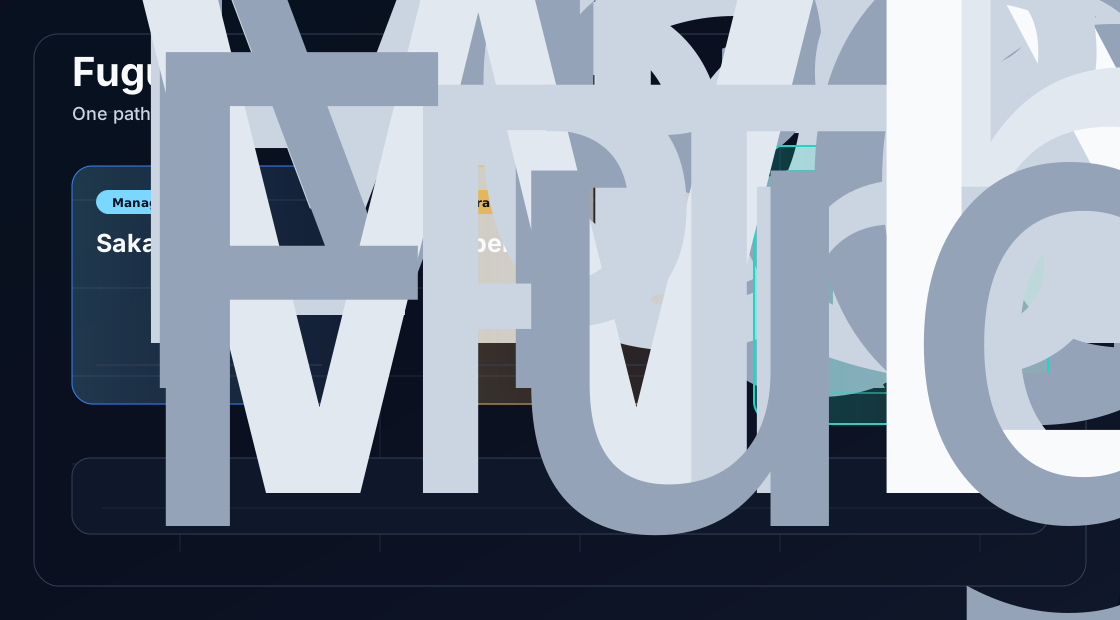
| System | Coordination layer | What it opens | Adoption shape |
|---|---|---|---|
| Sakana Fugu | Learned conductor behind an API | Frontier-style multi-model synthesis without binding the user to one model | Managed / closed service; conductor training and access live elsewhere |
| OpenFugu | Open training and serving stack | A readable route to rebuild Fugu-style conductor training and OpenAI serving | Best for teams that want to train, inspect, and serve the conductor path |
| FuguNano | Repo-native engineering loop | Multi-agent coding, independent review, and Self-Harness without training one | Cloneable, auditable, and light enough to run before training a router |
FuguNano is not a replacement for Fugu or OpenFugu. It is the lightest open
entry point on the same road: use policies, ports, review gates, and harness
improvement first, then decide whether a learned conductor is worth the cost.
The planning panel prints per-agent dispatch duration and, with --task,
persists planner status, output size or error kind/exit code, plus artifact
paths in the TASK log through append-safe writes, so concurrent planners do not
overwrite each other's audit lines. dispatch --verbose prints an obs line to stderr, and dispatches with --task persist
start status plus terminal status, duration, output size, error kind on failure,
and optional --out artifact path in the TASK log, so live Codex/OpenCode/AGY
runs leave an observable trace without contaminating model stdout or durable
artifacts. task new uses exclusive file creation for concurrent operators, and
all TASK audit appenders (task log, dispatch --task, plan --task,summary --task, integrate --task) share a lightweight lock with task done
so final status updates do not clobber concurrent audit lines.
Command Surface
orchestration/fuguectl/fuguectl is the production operator entry point. It has
24 subcommands and 25 test suites.
| Area | Commands |
|---|---|
| Setup and recon | fuguectl doctor, fuguectl init --dry-run|--write, fuguectl version, fuguectl preflight --harness fugue-cc|codex|opencode|agy|lite|all, fuguectl smoke, fuguectl fleet status|up|down |
| Planning | fuguectl task new|log|done, fuguectl template <name>, fuguectl plan "<goal>" [--harness h|lite] [--models a,b] [--out <dir>] [--timeout-ms n] [--allow-partial] [--codex-clean] [--harness-arg x] [--codex-arg x] [--opencode-arg x] [--agy-arg x] [--task f], fuguectl goal template|show|check |
| Routing and context | fuguectl allocate <type>, fuguectl workspace list|show|model|context, fuguectl agents template|validate|list|resolve, fuguectl skills index|list|match|show|inject|validate|forge |
| Dispatch and gather | fuguectl dispatch <target>, fuguectl cache init|put|fail|barrier|collect|resume |
| Integration and loop | fuguectl integrate --work <repo>, fuguectl loop init|record|decide|status, fuguectl run set|round|status|next|clear, fuguectl summary <round> |
| Memory and maintenance | fuguectl experience add|learn|list|recall|show, fuguectl self-harness template|run, fuguectl runtime check|adapt (provider + installed workflow bundle drift), fuguectl selftest |
TypeScript Engine
engine/ is the typed implementation: strict TypeScript, ports-and-adapters
layering, pure domain policy, and real harness/storage adapters.AgentRegistry is the engine-native step away from script-first orchestration:
the coordinator can dispatch one round across fugue-cc, Codex, and OpenCode
by resolving logical agent ids to runtime profiles.
cd engine
npm run check
npm run build
node dist/cli/main.js version
The engine CLI currently exposes:
fugue version
fugue doctor
fugue init [--dry-run|--write]
fugue fleet status|up|down
fugue allocate <task-type>|list|record|feed|stats|reset|decay
fugue smoke [--harness all|codex|opencode|agy] [--timeout-ms n] [--task <file>] [--out-dir <dir>]
fugue dispatch <target> --harness fugue-cc|codex|opencode|agy [--timeout-ms n] [--codex-clean] [--harness-arg x] [--out <file>] [--require-output] [--verbose] --template <name>|--prompt-file <file>|--prompt <text>
fugue integrate --work <repo> --agents "a b" [--ownership file] [--dry]
fugue skills index|list|match|show|inject|validate|forge
fugue preflight [--harness fugue-cc|codex|opencode|agy|lite|all] [--model provider/model|--target provider/model] [--config-only] [provider.config]
fugue cache init|put|fail|status|barrier|collect|list|resume --cache <dir>
fugue plan "<goal>" --harness fugue-cc|codex|opencode|agy|lite --out <dir> [--models m1,m2] [--timeout-ms n] [--allow-partial] [--codex-clean] [--harness-arg x] [--codex-arg x] [--opencode-arg x] [--agy-arg x] [--task <file>]
fugue task new|log|done
fugue template <name> --dir <templates> [--set KEY=VALUE ...]
fugue workspace list|show|model|context
fugue experience add|learn|list|recall|show --store <dir>
fugue summary <round> --cache <dir> [--task <file>]
fugue runtime check [--strict] --state <dir> [--skill <installed SKILL.md>] [--alias-skill <legacy SKILL.md>] [--repo-skill <repo SKILL.md>]
fugue runtime adapt --state <dir> [--skill <installed SKILL.md>] [--alias-skill <legacy SKILL.md>] [--repo-skill <repo SKILL.md>]
fugue run set|round|status|next|clear
fugue loop init|record|decide|next|status
fugue goal template|show|check
fugue agent-registry template|validate|list|resolve
fugue self-harness template|run
Quick live smoke, after preflight --harness lite passes:
fuguectl preflight --harness lite
fuguectl smoke --harness all --codex-clean --timeout-ms 120000 --task TASK.md --out-dir /tmp/fugunano-smoke
When --out-dir is set, smoke writes per-harness transcripts plussummary.json, a machine-readable result manifest with top-levelstatus/passed/failed/exitCode plus status, duration, output size, and
artifact path for each lite runtime. With --task, the audit log also records
the final summary path and pass/fail counts.
For OpenCode, preflight --target <provider/model> checks the localopencode models registry before dispatch, so a stale or unavailable model is
caught before the run starts.
For Antigravity, --harness agy dispatches through agy --prompt; targetdefault uses the current Antigravity settings, while any other target is passed
as --model.
For planning across the Codex Bar runtimes, fuguectl plan --harness lite
dispatches to Codex, OpenCode, and Antigravity in parallel. Custom lite planner
targets must be prefixed, for example--models codex:gpt-5.5,opencode:opencode/deepseek-v4-flash-free,agy:default.
Add --codex-clean when a Codex planner should ignore local config/rules while
keeping the plan output directory writable; OpenCode and Antigravity keep their
own runtime args.
Add --allow-partial during exploratory planning when a slow planner should not
discard successfully completed plans from the others.
When --out is set, planning also writes <out>/summary.json with top-levelstatus/exitCode/allowPartial/succeeded/available/failed plus each
planner's artifact status, duration, and error metadata. The summary is written
at dispatch start as status=running with per-planner artifactStatus=pending,
then atomically replaced by the final ok|partial|failed result.
runtime check also compares the repo's orchestration/fuguectl/ bundle with
the installed workflow bundle. Add --strict when automation should fail on
installed-skill drift:fuguectl runtime check --strict --skill ~/.claude/skills/fugunano/SKILL.md --repo-skill orchestration/fuguectl/SKILL.md.
By default, runtime sync also checks the legacy ~/.claude/skills/fugue alias
when the primary target is the canonical fugunano skill; use --alias-skill
to add explicit migration aliases. runtime adapt --apply syncs all configured
skill targets, so local agent instructions and helper entrypoints do not drift
behind the repo after the workflow evolves. If fugue-cc is unavailable, adapt
still syncs the bundle but exits non-zero so provider automation can detect the
skipped runtime restart/stamp.
Self-Harness
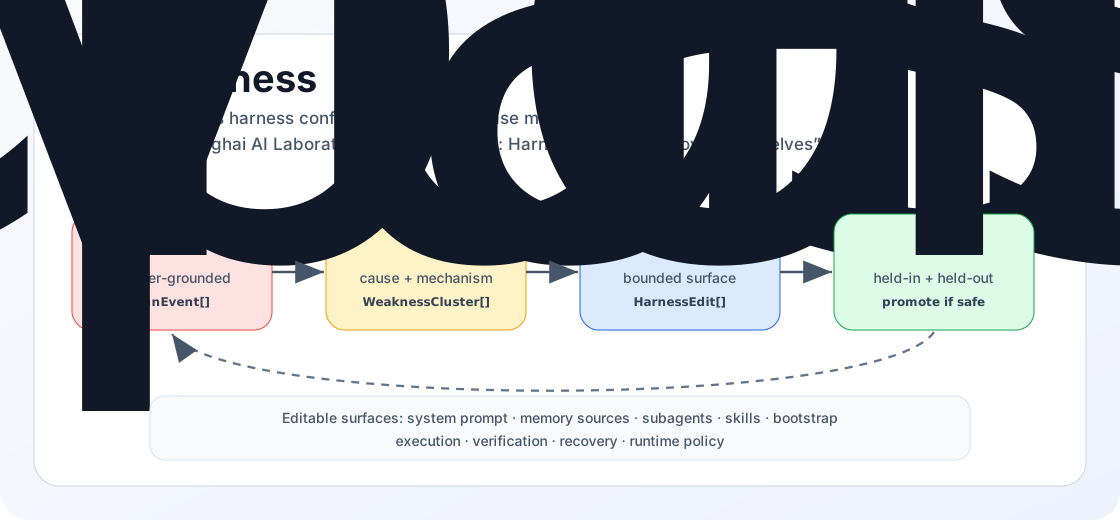
Self-Harness improves the harness configuration, not the base model. FuguNano's
implementation is an engine-native abstraction inspired by Shanghai Artificial
Intelligence Laboratory's paper
Self-Harness: Harnesses That Improve Themselves.
orchestration/fuguectl/fuguectl self-harness template > /tmp/self-harness.json
orchestration/fuguectl/fuguectl self-harness run \
  --spec /tmp/self-harness.json \
  --state ~/.config/fugunano \
  --cwd /path/to/workspace
The strict JSON spec, editable surfaces, validation rules, and smoke tests are in
docs/SELF_HARNESS.md.
Repository Map
| Path | Contents |
|---|---|
backends/bin/ |
Model launchers, registry, cc-models, and cc-sync. |
backends/{install,verify}.ts |
Local install and launcher verification. |
orchestration/fuguectl/ |
Node fuguectl wrappers, templates, workspaces, skill bundle, and tests. |
orchestration/fugue-cc/ |
Sanitized provider configuration template for the runtime bridge. |
orchestration/cn-plugin/ |
Claude Code /cn:* plugin and dispatch agent. |
orchestration/agent-team/ |
Higher-level multi-model planning example. |
engine/ |
TypeScript package, domain ports, adapters, CLI, and Self-Harness loop. |
scripts/ |
Secret scan, launcher lint, docs drift check, and skill installer. |
docs/ |
Agent runtime, workflow, architecture, parity, integrations, and Self-Harness guide. |
AGENTS.md |
Cross-harness operator entry read by Claude Code, Codex, and OpenCode. |
Safety Model
- Keep real keys in
~/.config/cc-model-secrets.envor ignored local config. - Keep
.fugue-cc/out of git. - Route review to Codex or another independent reviewer. Antigravity (
agy) is supported as an implementer runtime; legacygeminiCLI is retired. - Never advance a round until the join barrier has all terminal results.
- Let deterministic gates fail before spending reviewer tokens.
- Run
npm run cibefore pushing.
Development
make ci          # scan + launcher lint + docs + plugin/fuguectl + engine checks
make ci-clean    # same, but clean-installs engine dependencies first
make scan        # secret-leak gate
make lint        # Node launcher syntax check
make check-docs  # README + Self-Harness docs drift gate
make test        # cn-plugin + fuguectl selftest
make test-engine # TypeScript engine typecheck + lint + vitest
make doctor      # local environment recon
make help        # list all make targets
Root npm scripts mirror the same gates:
npm run ci
npm run ci:clean
npm run lint:launchers
npm run test:fuguectl
npm run test:engine
Security
See SECURITY.md. The repository contains only sanitized examples,
CI scans for leaks, and vulnerabilities should be reported privately through
GitHub Security Advisory.
Acknowledgements
- Sakana AI Fugu for the diverse-model orchestration framing.
- trotsky1997/OpenFugu for the complementary training-based reconstruction.
- openai/codex-plugin-cc for the plugin architecture that the
/cn:*layer derives from. - Zleap-AI/Zleap-Agent for workspace isolation and experience-memory inspiration.
- SeemSeam/claude_codex_bridge as a reference for the provider-runtime bridge.
- Shanghai Artificial Intelligence Laboratory's Self-Harness paper for the harness-improvement loop that inspired
fuguectl self-harness. - kunchenguid/no-mistakes and lavish-axi for loop-state and docs-drift ideas.
- merkyor/Lynn for orchestrator-side ownership enforcement inspiration.
- Anthropic's official
skill-creatormeta-skill for the skill authoring and validation flow.
See NOTICE for attribution detail.
License
Apache-2.0 © 2026 BicaMind Labs.
Yorumlar (0)
Yorum birakmak icin giris yap.
Yorum birakSonuc bulunamadi