crypto-ai-trading-bot
Health Warn
- No license — Repository has no license file
- Description — Repository has a description
- Active repo — Last push 0 days ago
- Community trust — 26 GitHub stars
Code Warn
- crypto private key — Private key handling in helpers/cryptos/baseCoin.js
- network request — Outbound network request in helpers/cryptos/exchanger.js
- process.env — Environment variable access in helpers/log.js
- fs module — File system access in helpers/log.js
Permissions Pass
- Permissions — No dangerous permissions requested
No AI report is available for this listing yet.
Crypto liquidity detection & algorithmic trading bot. Order book analysis, stop-loss clusters, liquidity sweeps. Multi-exchange (Binance, Bybit, Kraken, OKX). Trading signals, quant research, market microstructure.
Crypto Liquidity AI Trading Bot 🚀
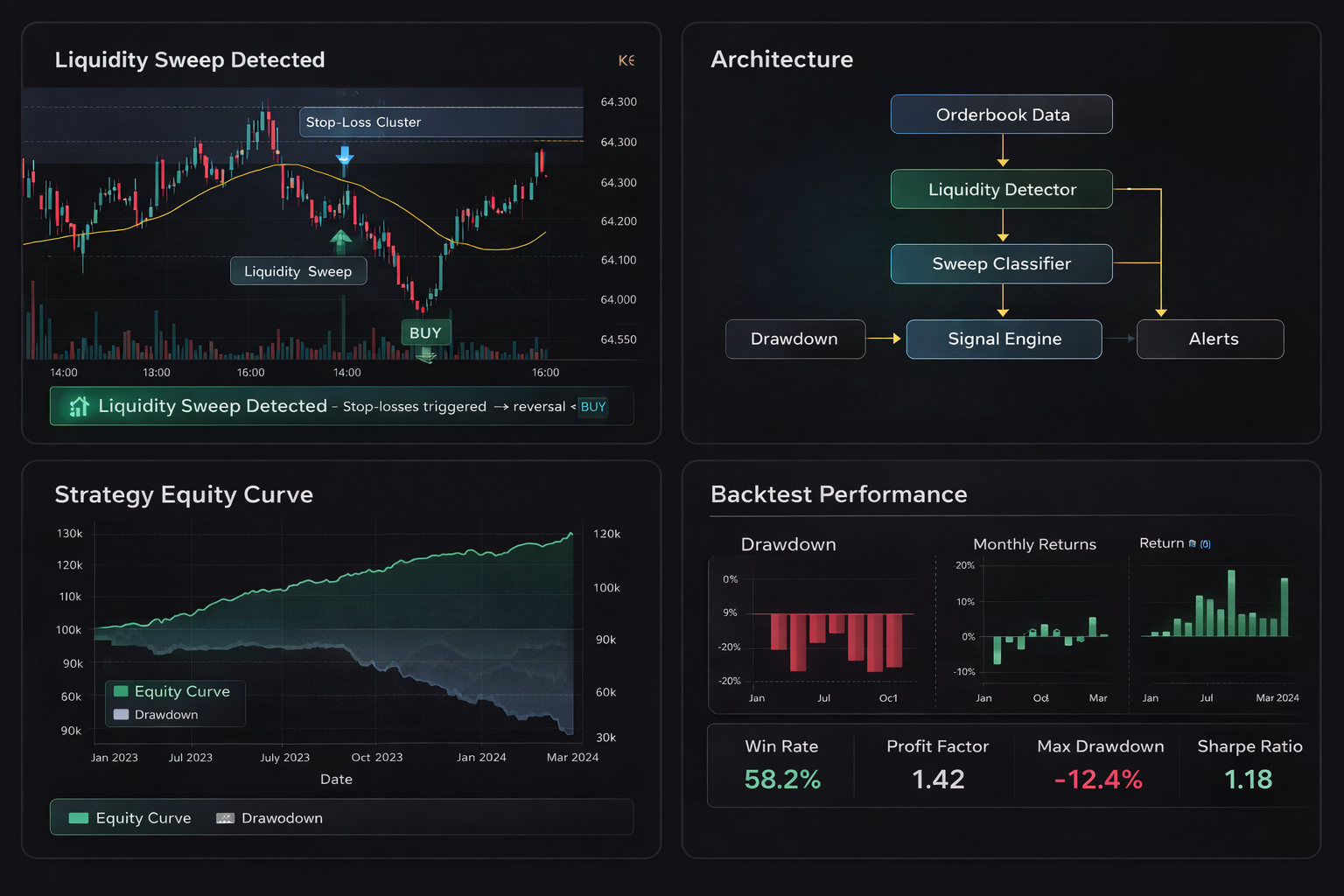
AI trading bot for liquidity detection and algorithmic trading in crypto markets. Detect order book gaps, hidden walls, and liquidity sweeps across exchanges—then act on signals manually or via your own execution layer.


- Why liquidity matters
- Who this is for
- Commercial use
- Backtest performance
- Strategy concept
- Architecture
- Quick start
- What you get
- How liquidity hunting works
- Installation
- Supported exchanges
- Project layout
- Use cases
- Related projects
- FAQ
- Contributing
Why liquidity matters
Most crypto trading bots rely only on price and technical indicators. Professional traders, however, monitor order book liquidity, because price often moves toward zones where liquidity is concentrated—and away when that liquidity is swept.
This project focuses on liquidity-aware trading signals instead of lagging indicators: it detects gaps, walls, and sweeps so you can act on structure, not just price.
Who this is for
This project may be useful for:
- Crypto trading firms building in-house liquidity and execution tools
- Quant researchers studying order book and market microstructure
- Exchanges building surveillance or liquidity analytics
- Developers building AI trading agents or signal systems
Commercial use
If you are interested in custom crypto trading bots (liquidity, arbitrage, execution), AI trading signal systems, or liquidity detection algorithms and exchange API integrations:
For collaboration or development work:
- Telegram — @k02_xx
Backtest performance
Results below are from a historical backtest using order-book and liquidity-sweep signals on major spot pairs. They are not live trading results.
Test configuration
| Parameter | Value |
|---|---|
| Window | Jan 2024 – Dec 2024 |
| Length | 12 months |
| Asset class | Cryptocurrency (spot) |
| Approach | Liquidity-sweep & order-book imbalance |
| Style | Medium frequency, signal-driven |
| Pairs | BTC/USDT, ETH/USDT, selected alts |
| Execution | Simulated limit/market fills |
Performance metrics
| Metric | Result |
|---|---|
| Win rate | 58.2% |
| Profit factor | 1.42 |
| Max drawdown | −12.4% |
| Sharpe ratio (daily) | 1.18 |
What this suggests
- Win rate > 50% suggests the liquidity-based signals add information over a random baseline.
- Profit factor > 1.2 indicates positive expectancy in the simulated period.
- Sharpe > 1.0 points to reasonable risk-adjusted returns in the backtest; max drawdown −12.4% is a measure of tail risk in the tested period.
Limitations
Actual results can differ from backtests due to fees, slippage, execution delay, and changing liquidity. Run your own tests and risk checks before any live use.
Example signal (conceptual)
{
  "symbol": "BTC/USDT",
  "direction": "LONG",
  "strength": 0.61,
  "reason": "liquidity_sweep_detected",
  "ts": "2024-11-15T08:44:02Z"
}
Strategy concept
Price indicators lag. Liquidity moves first.
Large orders and stop-loss clusters sit in the order book before price reaches them. When price sweeps those levels, liquidity is consumed and moves tend to accelerate. This bot identifies those levels and signals sweep events so you can trade with the flow instead of chasing price.
Architecture
Market data (REST/WS)
        ↓
Order book analyzer
        ↓
Liquidity detector (gaps, walls, sweeps)
        ↓
Signal engine
        ↓
Alerts / optional execution layer
The codebase separates data (modules/, exchange APIs), analysis (trade/ — orderbook, liquidity), and signals/alerts so you can plug in your own execution or research tools.
Quick start
Quick start (Node)
Run the main app with Node:
git clone https://github.com/asonglin/crypto-liquidity-ai-trading-bot.git && cd crypto-liquidity-ai-trading-bot
npm install
Create config.jsonc from the template, then:
cp config.default.jsonc config.jsonc
node app.js
Advanced research (Python optional)
For research, backtests, or a custom Python wrapper, use a venv and requirements.txt. See Installation below.
What you get
| Capability | Description |
|---|---|
| Liquidity detection | Scans order books and pools for depth, gaps, and imbalance. |
| Hidden walls | Surfaces large buy/sell walls and their changes. |
| Multi-exchange | Built to plug into Binance, Bybit, Kraken, OKX, and others. |
| Alerts | Configurable notifications when liquidity events fire. |
| Trading framework | Modular so you can add execution, risk, or dashboards. |
Use it for liquidity grabs, order book imbalance strategies, market microstructure research, and algorithmic trading—whether you trade manually or automate.
How liquidity hunting works
Liquidity hunting targets zones where lots of orders sit (e.g. stop-loss clusters). When price sweeps those levels, liquidity is “taken” and price can move fast. This bot helps you find and watch those zones.
- Find where large stop-loss clusters or thin book zones sit.
- Detect liquidity sweeps and wall removals in real time.
- Alert so you can enter when liquidity is taken or book vacuum appears.
- Extend with your own execution (manual or automated).
Signals you can get: stop-loss clusters, sudden order book vacuum, liquidity wall removal, aggressive market order flow.
Installation
git clone https://github.com/asonglin/crypto-liquidity-ai-trading-bot.git
cd crypto-liquidity-ai-trading-bot
Quick start (Node) — main engine:
npm install
cp config.default.jsonc config.jsonc
# Edit config.jsonc, then:
node app.js
Advanced research (Python optional) — venv and scripts:
python -m venv venv
source venv/bin/activate   # Linux/macOS
venv\Scripts\activate     # Windows
pip install -r requirements.txt
Example: scanning and alerts
// App entry is app.js; configure API keys and exchanges in config.
// Core logic lives in trade/ (liquidity, orderbook) and modules/ (api, DB).
# If using a Python wrapper:
from liquidity_hunting import LiquidityBot
bot = LiquidityBot(api_key="YOUR_API_KEY", secret="YOUR_SECRET")
bot.scan_liquidity()
bot.generate_alerts()
Production hardening checklist
- Keep
api.hostset to127.0.0.1unless you explicitly front the API with a trusted reverse proxy. - Keep
api.debugdisabled in production; if enabled, configureapi.debugTokenandapi.debugAllowlist. - Prefer env vars for secrets (
BOT_PASSPHRASE,EXCHANGE_API_KEY,EXCHANGE_API_SECRET) over plain config values. - Never commit
config.jsoncor.envwith real credentials.
Container deployment
Build and run with Docker Compose:
cp .env.example .env
cp config.default.jsonc config.jsonc
docker compose up --build -d
The compose stack starts:
bot(this project)mongo(MongoDB 7)
Supported exchanges
Extensible to any exchange with a REST/WS API. Commonly used with:
| Exchange | Notes |
|---|---|
| Binance | Spot & futures. |
| Bybit | Derivatives. |
| Kraken | Spot. |
| OKX | Spot & derivatives. |
| Coinbase | Spot. |
| Hyperliquid | Perps. |
Project layout
crypto-liquidity-ai-trading-bot/
├── app.js                 # entry point
├── config.default.jsonc   # config template
├── package.json
├── helpers/               # shared utils, crypto helpers
├── modules/               # api, DB, config, transactions
├── routes/                # debug, health, init
├── trade/                 # liquidity provider, orderbook, traders, exchange APIs
├── types/                 # TypeScript declarations
├── utils/
└── assets/
Use cases
- Crypto algorithmic trading — Feed signals into your execution engine.
- Quant research — Order book and liquidity analysis.
- AI/ML strategy dev — Use liquidity events as features or triggers.
- Market microstructure — Study gaps, walls, and sweep behavior.
FAQ
What is liquidity hunting?
A strategy that focuses on levels where lots of stop-loss or passive orders sit; when those levels are hit, liquidity is consumed and price often moves sharply.
Is the bot fully automated?
It focuses on detection and alerts. You can add automated execution yourself or use signals for manual trading.
Who is it for?
Developers, quants, and algo traders who want liquidity-aware signals and a clear, extensible codebase (Node/JS, optional Python).
Contributing
We welcome pull requests and issues. Fork → branch → PR. See CONTRIBUTING.md if present.
License: MIT © 2026
Reviews (0)
Sign in to leave a review.
Leave a reviewNo results found