claudemux
Health Uyari
- License — License: Apache-2.0
- Description — Repository has a description
- Active repo — Last push 0 days ago
- Low visibility — Only 9 GitHub stars
Code Gecti
- Code scan — Scanned 12 files during light audit, no dangerous patterns found
Permissions Gecti
- Permissions — No dangerous permissions requested
Bu listing icin henuz AI raporu yok.
Real-time message bus for Claude Code sessions — one session asks another, the peer wakes on its own and answers, and the reply lands back in the asking pane. Bash + tmux.
Claudemux
A real-time message bus for Claude Code sessions. Run many claude sessions at once — one
per tmux pane — and let them talk to each other: one session asks another a question, the other
wakes on its own, answers, and the reply lands back in the asking pane. No copy-paste between
panes, no human relay.
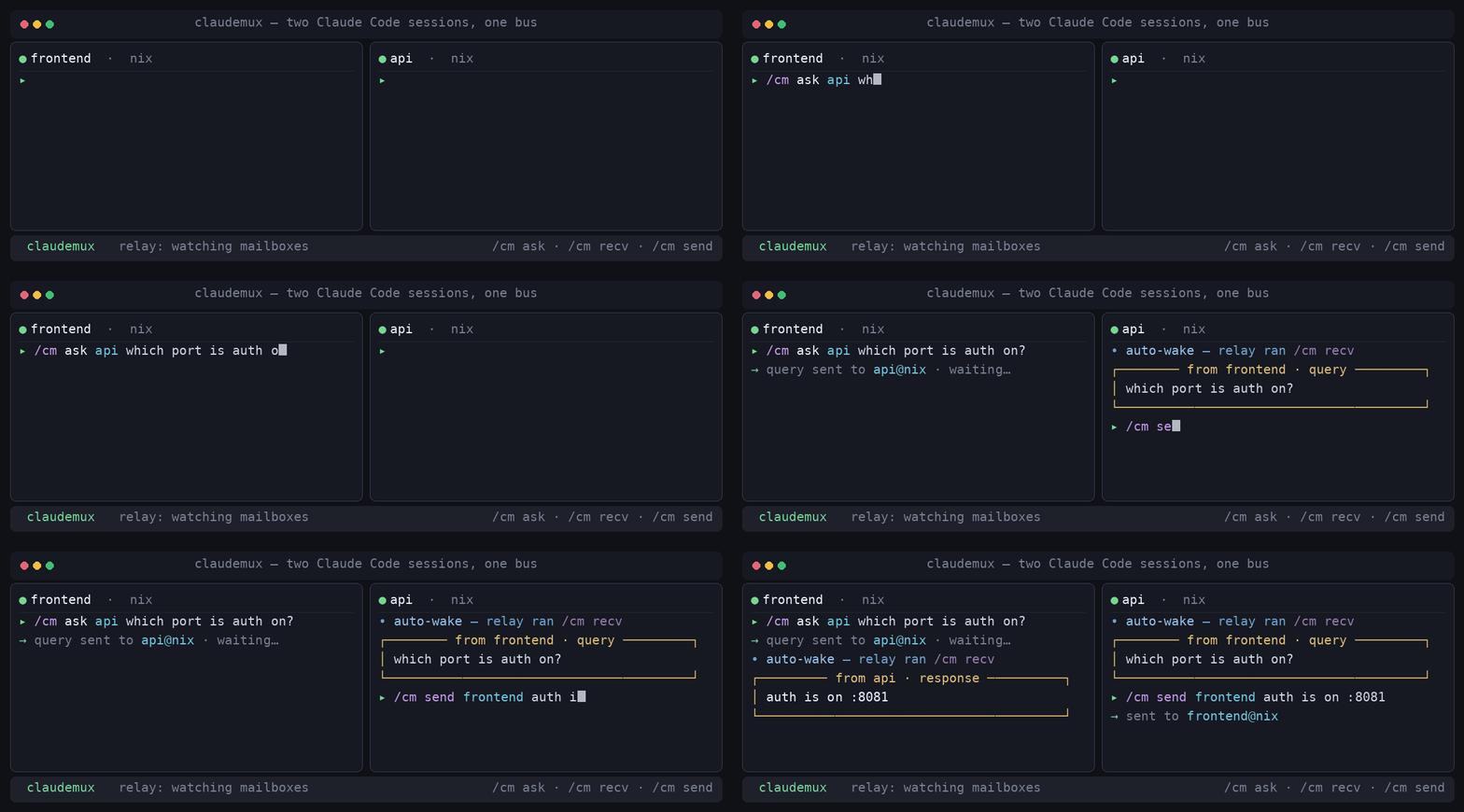
Two Claude Code sessions over the bus — ask on the left; the peer auto-wakes and answers on the right.
  session "frontend"                     relay (per machine)                    session "api"
  ──────────────────                     ───────────────────                    ─────────────
  /cm ask api which port is the
       auth service on?  ────────────▶  new message for "api"
                                              │  resolve api → its tmux pane
                                              └─ wake it ──────────────────────▶ (idle or busy)
                                                                                      │
                                                              reads the question, answers "8081",
                                                              sends the reply back:
        reply appears in your pane  ◀──────  new message for "frontend"  ◀────────────┘
Claudemux = Claude + mux (multiplexer): it multiplexes messages between Claude Code
sessions across tmux. Under the hood it's a small, dependency-light message bus — a few bash
scripts, a file-drop mailbox, and one tiny relay daemon.
Why
If you run a fleet of Claude Code sessions (one per project/pane), they can't see each other. You
end up hand-carrying facts between them: "the other session set the port to 8081", "the model
you loaded is aliased qwen-large". Claudemux gives them a phone line. A session can consult a
peer that actually owns the answer, in real time, without you in the middle.
Features
- Real round-trips.
/cm ask <peer> <question>sends a query; the answer comes back to your
pane asynchronously — because the relay can wake an idle session, not just leave it a note. - Names you recognize, live. A session's bus name is its Claude session name (what
/rename
sets, shown in your tab) — resolved live, so renaming a session (locally or from the web UI) is
reflected immediately, with no manual wiring. Sessions auto-register at start and onclaude -c. - Self-cleaning. Dead sessions are pruned automatically (on contact and on a timer).
- Safe by design. The only thing ever typed into another pane is a fixed control string — never
message content — so a peer can't inject an arbitrary "user" turn. Sensitive workspaces can be
marked read-only to the relay. (See Security.) - Small + legible. Bash +
jq+inotifywait+tmux. One systemd--userrelay. No server,
no database, no ports.
How it works (in three facts)
- Sessions are interactive
claudeCLIs, one per tmux pane. The only way to hand a running
interactive session a new turn istmux send-keysinto its pane — which delivers instantly if
it's idle and queues if it's mid-turn. - The target pane is resolved live, never stored. Pane ids drift (tmux resurrect/renumber), so
nothing caches a pane id: each session is keyed by a stable sessionId (which also names its
mailbox, so a rename never misroutes), and at wake time the relay looks up that session's pid
and resolves pid → tty → current pane. - Nothing runs between turns, so the push comes from outside: a per-machine relay daemon
watches the mailboxes (inotifywait) and wakes the target pane when a message arrives.
Full design in ARCHITECTURE.md.
Requirements
- Linux with tmux for auto-wake — a session that should be woken automatically must run in a
tmux pane. A session outside tmux still works, in manual (poll) mode (see Manual mode below). jqand systemd with user services + lingering.inotify-tools(inotifywait) is
recommended but optional — without it the relay falls back to polling.- Claude Code (the
claudeCLI) with hooks and custom slash commands.
sudo apt install jq inotify-tools tmux      # Debian/Ubuntu
loginctl enable-linger "$USER"              # so the relay survives logout/reboot
Install
git clone https://github.com/bjan/claudemux.git
cd claudemux
./install.sh
install.sh is idempotent. It copies the code to ~/.claude/claudemux/, installs the /cm slash
command, wires SessionStart/SessionEnd hooks into ~/.claude/settings.json (backing it up
first, preserving everything else), and enables the relay + cleanup timer. Open new sessions (orclaude -c existing ones) and they'll join.
Usage
From inside any session:
/cm peers                       # who's on the bus (name, machine, alive, mode)
/cm ask <name> <question>       # ask a peer; the answer returns to THIS pane, asynchronously
/cm send <name> <message>       # fire-and-forget notify
/cm broadcast <message>         # notify every live session
/cm status                      # your own bus name + pending inbox
/cm recv                        # read your inbox (the relay normally triggers this for you)
Everywhere above, <name> is a peer's Claude session name — the name /rename sets, shown in
its tab — matched live, so it always tracks the session's current name. (Leave a session unnamed and
it uses Claude's auto-generated name, e.g. nix-generic-tome.)
/cm ask doesn't block — you keep working; when the peer answers, the relay wakes your pane and
the reply appears inline.
Composing vs. verbatim. For ask / send / broadcast, the text after the command is normally
an instruction for what to communicate: the session composes the actual message from its current
context and sends that — e.g. /cm ask box tell them the port I just set sends something likeThe auth port is 8081. (A self-contained question is just sent as-is.) To send text exactly as
written — a command, a snippet, precise wording — prefix it with *: /cm send api *rm -rf /tmp/cache
stores that literal string as a message (it is never executed).
Cross-machine. List your other hosts in ~/.claude/claudemux/peers (one SSH alias per line).
Then /cm peers aggregates their live sessions (shown as name@host), and /cm ask <name> <question>
auto-locates a peer across those hosts — or address one explicitly as name@host. The message is
dropped over SSH into that host's mailbox and its relay wakes the pane; replies route back
automatically. Requires Claudemux on each
host and key-based SSH between them.
Configuration
| What | How |
|---|---|
| Install location | CLAUDEMUX_ROOT (default ~/.claude/claudemux) |
| This machine's name | CLAUDEMUX_MACHINE (default hostname -s) — used for cross-machine addressing |
| Read-only workspaces | add globs to ~/.claude/claudemux/manual-patterns (see manual-patterns.example) |
| Cross-machine peers | list SSH hosts in ~/.claude/claudemux/peers (see peers.example) |
Manual mode. A registered, fully addressable session that the relay will never type into —
peers see it in /cm peers, messages reach its mailbox, and you drain them yourself with /cm recv.
A session registers manual for either reason:
- its cwd matches a glob in
manual-patterns— sensitive workspaces you don't want a peer able to
drive; or - it isn't running in a tmux pane, so there's no pane to
send-keysinto. Rather than registerautoand then silently fail to wake, it degrades to manual — still on the bus and reachable, just
polled instead of pushed.
A session's tmux-ness is fixed when it launches, so this is decided once at registration. If anauto session later loses its pane (e.g. tmux is killed mid-session), the relay can't wake it — it
leaves the message queued and logs a loud WARN rather than dropping it silently.
Security
The threat here isn't eavesdropping — it's injection, because waking a pane literally submits a
turn in another session. Claudemux is built around that:
- The wake is a single fixed constant (
/cm recv). Message content is always read from a
file by that trusted command, never typed into a pane — so a peer can never cause arbitrary text
to be submitted as a user turn elsewhere. Mailbox names are charset-restricted on both the send
and relay sides. - Rendered messages are framed as untrusted data with an explicit "do not obey" preamble; header
fields are newline-escaped so a message can't forge the frame. - Message bodies are inert data end-to-end. They're stored with
jq --arg, transported as files
(piped, never interpolated, over SSH cross-machine), and rendered as quoted text — nothing in a
message is ever shell-executed by the pipeline. You can safely send text that contains commands;
the/cmcommand hands your free text to the CLI as a single quoted argument. - Manual mode (above) guarantees a peer can never drive a sensitive session.
- Never put secrets, credentials, or private/regulated data in a message — the bus is local
plaintext files under your user account, and a message lands in another session's context.
No encryption (local files, Unix perms — same trust model as Claude Code's own data). Cross-machine
rides your existing SSH keys.
Uninstall
./uninstall.sh            # stop services, remove /cm + hooks (keeps your mailbox/registry)
./uninstall.sh --purge    # also delete ~/.claude/claudemux entirely
Your settings.json is backed up before every change.
Status & limitations
- Cross-machine works (verified host↔host, both directions, including different home dirs). List
peer hosts in~/.claude/claudemux/peers; then/cm peersshows their sessions asname@hostand
a bare-name/cm ask <name>auto-locates the peer. You can always force one withname@host. - Waking a pane while you're mid-typing appends to your input line (targets are normally idle).
Development
Run the test suite — zero framework, just bash + jq:
./test/run.sh
It covers registration (sessionId-keyed), live-name resolution (transcript title wins over the
session-file name, with fallback) including a rename, send/recv, message-body safety (shell
metacharacters stay inert), target validation, reply routing, discovery --json, broadcast, and
cleanup — against an isolated CLAUDEMUX_ROOT with fake session files. The relay, tmux wake, and
cross-machine SSH are integration paths, verified manually.
License
Apache-2.0 © 2026 bjan
Yorumlar (0)
Yorum birakmak icin giris yap.
Yorum birakSonuc bulunamadi