uncut
Health Pass
- License — License: MIT
- Description — Repository has a description
- Active repo — Last push 0 days ago
- Community trust — 17 GitHub stars
Code Pass
- Code scan — Scanned 12 files during light audit, no dangerous patterns found
Permissions Pass
- Permissions — No dangerous permissions requested
No AI report is available for this listing yet.
Open-source AI video editor for macOS: your Claude Code or Codex edits on a real timeline
Uncut
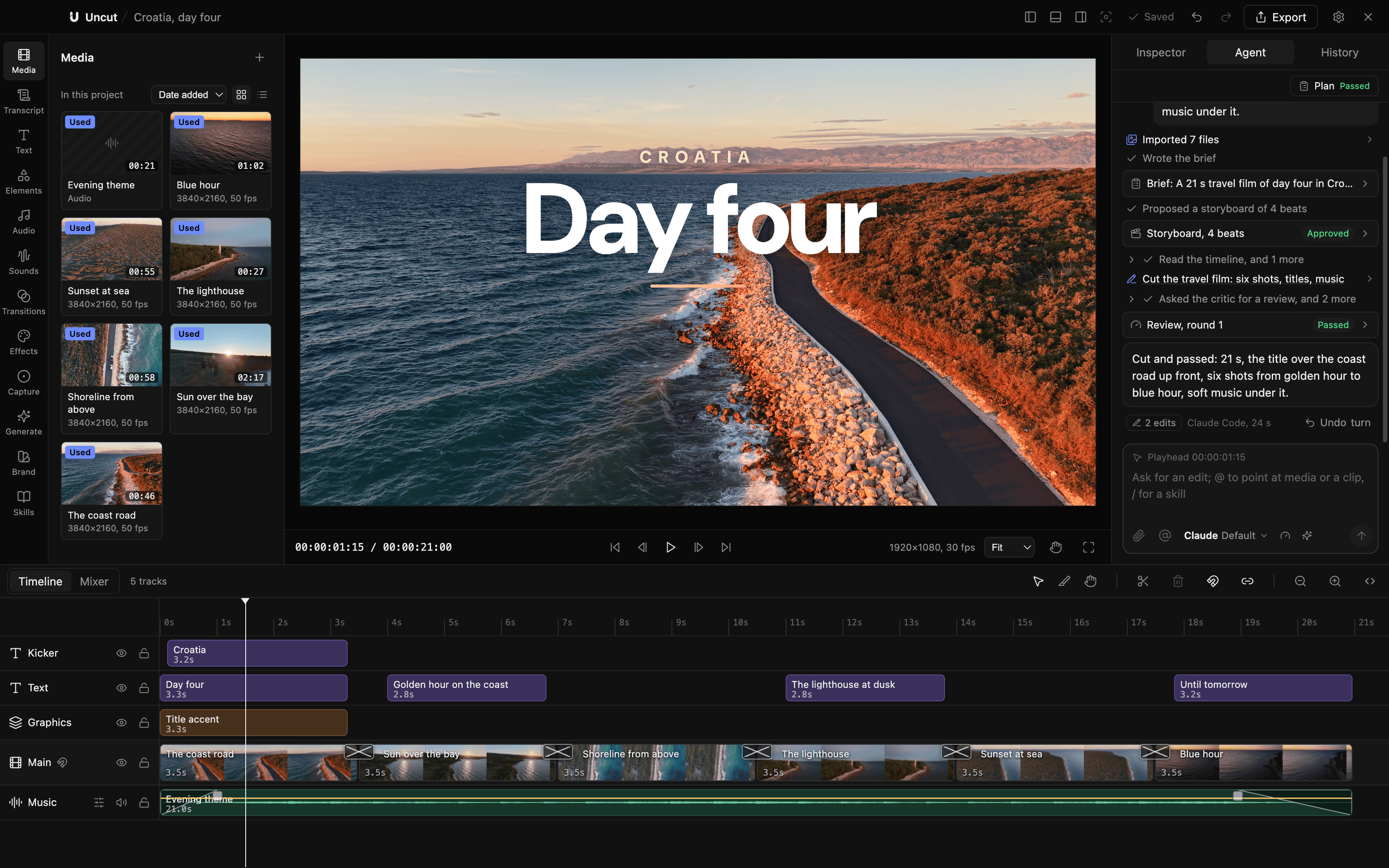
An AI-first video editor for macOS: it runs your installed Claude Code, which edits with you on a real timeline.
Download
Download Uncut for macOS (Apple silicon, macOS 13 or later). Signed and notarized, and it updates itself from GitHub releases. Website: uncut.video.
Or with Homebrew:
brew install --cask blazejkustra/tap/uncut
The cask lives in the blazejkustra/homebrew-tap tap and is updated by the release workflow when a release is published. The app updates itself after that, so there's no need for brew upgrade (brew uninstall --zap --cask uncut also removes its data).
On first launch Uncut checks what it needs and shows how to install anything missing:
- Claude Code, installed and signed in. Uncut uses whatever sign-in Claude Code has: a Claude subscription, an API key, or Bedrock, Vertex AI or Foundry. Usage is billed the way your Claude Code usage normally is.
- ffmpeg:
brew install ffmpeg. - whisper.cpp (optional, for transcripts):
brew install whisper-cpp. - Argent (optional, to record simulators, emulators and apps):
npx @swmansion/argent@latest init -y.
What it does
- An agent that plans before it cuts. It runs your installed Claude Code or Codex, with its own sign-in. It writes a brief and a storyboard for you to approve, builds the edit, then an independent critic reviews it. Every turn is one undoable step, and a meter shows how full the agent's context is.
- A real timeline. Tracks, trims, splits, snapping, keyframes, speed, and keyboard-first editing with Uncut, Premiere Pro, DaVinci Resolve or Final Cut Pro shortcuts.
- Transcript editing. Local transcription with whisper.cpp; cut by the words, or remove fillers and long pauses in one go.
- Captions and subtitles. Burned-in or word-by-word captions, SRT and WebVTT in and out.
- Text, graphics and elements. Text looks and animations, animated components (terminals, device frames, end cards), elements like follow handles with platform marks, and brand kits with your logos, colours and fonts.
- Sound. The Uncut sounds pack, your own sound folders, your Music library, and online search on Openverse or Freesound (with your own key). A mixer with ducking under speech and loudness targets for export.
- Effects, looks and transitions. Filters, colour looks and GPU shader effects, with the preview drawn on the GPU by default.
- Capture. Record your screen, camera and mic, or iOS simulators, Android emulators and apps through Argent, straight into the project.
- Generators with your own keys. Images with GPT Image, video with Veo, sound effects with ElevenLabs, with a cost estimate before you send.
- Plugins and skills. Looks, components, checks, shader effects, skills and agent tools in a folder, with a marketplace in Settings › Plugins (from
plugins/catalog). Skills are recipes the agent loads; type/in the composer to use one. - Export. H.264 or HEVC at the quality you pick, a range or the whole edit, with optional subtitles.
- Labs. Environments: pair a remote Uncut server and edit on another machine.
Coming soon: issues labelled coming-soon, including generated music and voiceover.
Development
You need an Apple silicon Mac, Node 24, pnpm (through corepack), Rust and ffmpeg.
git clone https://github.com/blazejkustra/uncut
cd uncut
corepack enable
pnpm install
pnpm dev            # builds the media core, server and shell, opens the app
pnpm test:fast      # typecheck and every test outside test/app
pnpm test           # everything, including the packaged-app tests (run pnpm dist first)
pnpm dist           # an ad-hoc signed .app and dmg in dist/
pnpm dist:signed    # a Developer ID signed, notarized dmg in release/
pnpm site:dev       # the website (site/, Next.js) at localhost:3000
pnpm site:build     # its static export in site/out, ready for Cloudflare Pages (site/DEPLOY.txt)
Releases. Bump the version in apps/desktop/package.json, then push a signed tag that matches it (git tag -s v0.0.2 && git push origin v0.0.2). CI builds, signs and notarizes the dmg with the auto-update feed and drafts a GitHub release. Publish the draft and installed apps pick up the update; publishing also pushes the Homebrew cask to blazejkustra/homebrew-tap (with the HOMEBREW_TAP_TOKEN secret; without it the job only leaves a notice). To render the cask by hand: node scripts/homebrew-cask.ts --version v0.0.4 --zip Uncut-0.0.4-arm64-mac.zip.
Nightly. Every night with new commits on main, CI publishes a signed, notarized Uncut Nightly as a GitHub prerelease (v0.0.5-nightly.<date>.<run>): download its dmg from Releases to try a version before it ships, on any Mac, without a checkout. It's a separate app (own name, icon, bundle id and data folder) that installs next to Uncut and updates itself to newer nightlies; releases never see it. To build any branch the same way, run Actions › Nightly › Run workflow on it.
Privacy
Uncut is made by Błażej Kustra, who is the controller for the usage data below. Contact: [email protected].
Usage data is anonymous and on by default. Uncut sends a few counts so we know how many people use it and what breaks. No identifier of any kind is sent: no install id, no session id, nothing derived from your Mac, your name or your account. Turn it off any time in Settings › App › Usage data (it stays off), or set DO_NOT_TRACK=1 or UNCUT_TELEMETRY=off; then nothing is sent. Builds made from source send nothing either way. The legal basis is our legitimate interest in knowing how Uncut is used and fixing crashes; turning it off is your objection, and it takes effect at once.
Uncut sends only these events, each with the app version, macOS or Linux, the processor type and whether it runs in the desktop app:
app:start: the app started (and whether it runs headless).app:crash: which process crashed, the error's class name and code, and a fingerprint of the top stack frames with folders and messages removed.export:complete,export:fail,export:cancel: how long the export took, its length, quality, codec, encoder, size and frame rate, whether it was a range or had subtitles, or the stage that failed.agent:turn,agent:fail: whether an agent turn finished, failed or was cancelled, how long it took, how many edits and steps, or a fixed word for why it failed (usage limit, rate limit, signed out and so on).
Never your footage, frames, transcripts, prompts, file names, paths or error messages. The events go through a Cloudflare Worker to Grafana Cloud's logs service in the EU, where they are kept for 14 days (the plan's retention) and then deleted. The Worker keeps no request logs and doesn't forward your IP address. To count daily users, our server computes a one-way hash of your IP address with a key that is replaced every day, then discards the IP; it can't be linked across days or to you.
What else leaves your Mac, and only when you use it:
- The agent. Uncut runs your own Claude Code, which sends Anthropic (or the cloud provider you use with it) what the agent works with: your prompts, frames from your video, transcripts, file and project names, under your Claude Code account and its terms.
- Generators. Image, video and sound effect generators send your prompts (and any image you give them) to OpenAI, Google or ElevenLabs with your own API keys, under their terms.
- Sound search. Searching for sounds online sends the search words to Openverse, or to Freesound with your key.
- Downloads. The speech model comes from Hugging Face; updates are checked for and downloaded from GitHub, which sees your IP address and the app version.
The website. uncut.video uses Google Analytics 4. Visitors from the EEA, the UK and Switzerland see a cookie banner, and Google Analytics loads only if they accept. Details are in the website's privacy notice.
Contributing
Bug reports, fixes and plugins are welcome. See CONTRIBUTING.md.
Licence
MIT, see LICENSE. Bundled fonts, sound effects, icons and packages, with their licences, are listed in THIRD_PARTY_NOTICES. Not affiliated with Anthropic or OpenAI.
Reviews (0)
Sign in to leave a review.
Leave a reviewNo results found