execkit
Health Warn
- License — License: Apache-2.0
- Description — Repository has a description
- Active repo — Last push 0 days ago
- Low visibility — Only 8 GitHub stars
Code Pass
- Code scan — Scanned 12 files during light audit, no dangerous patterns found
Permissions Pass
- Permissions — No dangerous permissions requested
No AI report is available for this listing yet.
Stateful, structured, safe command execution for AI agents - over local shells, SSH, and Docker.
execkit
Persistent, structured shell sessions for AI agents, on your laptop, your servers over SSH, and your Docker containers.





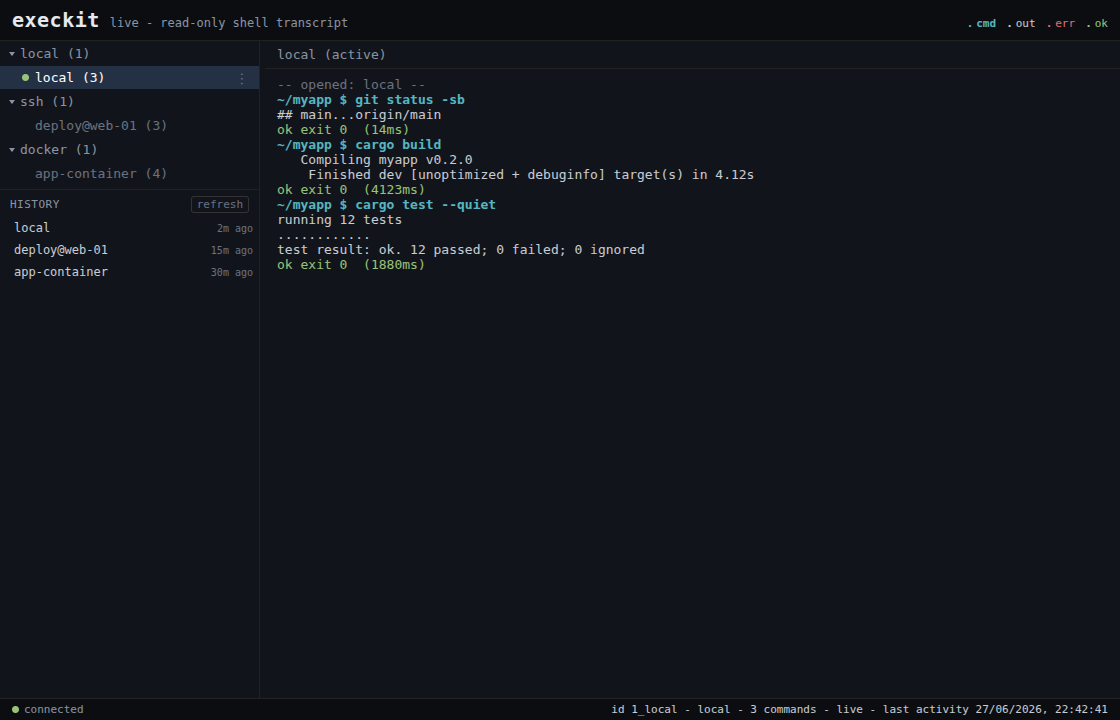
What you get that a built-in agent shell doesn't:
- Persistent sessions on local, SSH and Docker.
cdand env carry across
calls, and every command returns a structured result: split stdout/stderr,
exit code, duration, cwd. - Output that protects the agent's context. Secrets are redacted before the
model sees them, and output budgets (tail,head,grep, a char cap) keep a
noisy build from flooding the context window. - An audit trail, a live viewer, and undo. Every command can go to a JSONL
audit log, you can watch sessions live in a terminal or browser (above), and
remote sessions can checkpoint and restore the workspace files.
Install
Zero-install, with uv. Add this to your MCP client config:
{ "mcpServers": { "execkit": { "command": "uvx", "args": ["execkit-mcp"] } } }
Or install it and let execkit print the config for your client:
pip install execkit-mcp && execkit-mcp setup claude # or: cursor | gemini | codex | vscode | windsurf
Then execkit-mcp doctor checks your setup. More options (prebuilt binary,cargo install, building from source) are in the Quickstart.
Status: early 0.x. The API may change between minor versions. Read
Limitations before pointing it at anything important.
Where it fits
execkit complements your agent's built-in shell or sandbox; it does not replace
it. Use it when the agent needs to work on a remote host or inside a container,
when you want a record of what ran, or when you want to undo file changes on a
remote workspace.
The agent is the adversary. The LLM driving execkit can be prompt-injected by
anything it reads, so execkit contains its own caller: a command passes the policy
fence before it runs, secrets are redacted before output returns, and a changed
SSH host key fails loudly instead of reconnecting into a MITM.
flowchart LR
    A([AI agent]) -->|command| F{policy fence}
    F -->|blocked| X([rejected, never runs])
    F -->|allowed| T[transport: local / SSH / Docker]
    T --> O[raw output]
    O --> R[redact secrets, bound output]
    R --> E([structured ExecResult])
    E -.-> A
Use it from an agent (MCP)
The agent gets session_create (local, ssh, or docker), session_exec,session_list and session_destroy, plus session_checkpoint /session_checkpoints / session_restore for remote undo.
State persists across calls, and every result is parsed, not scraped from a terminal:
// session_exec {"command": "cd /app && npm ci"}   -> { "exit_code": 0, "cwd": "/app" }
// session_exec {"command": "npm run build"}        // cwd is still /app
//   -> { "stderr": "Error: Cannot find module 'webpack'",
//        "exit_code": 1, "duration_ms": 3420, "cwd": "/app",
//        "truncated": false, "timed_out": false }
Commands time out after 120 seconds by default (timeout_secs per call, up to
3600). On timeout execkit interrupts the command with Ctrl-C and returnstimed_out: true with exit code 124. The session keeps its cwd and env.
See crates/execkit-mcp/README.md for the operator
security settings (host-key verification, key dir, audit, session limits).
Watch what the agent does
Set EXECKIT_MCP_AUDIT_DIR and every session is recorded. execkit-mcp watch
shows it live in the terminal, and execkit-mcp watch --serve --open opens the
read-only browser viewer shown at the top.
 |
 |
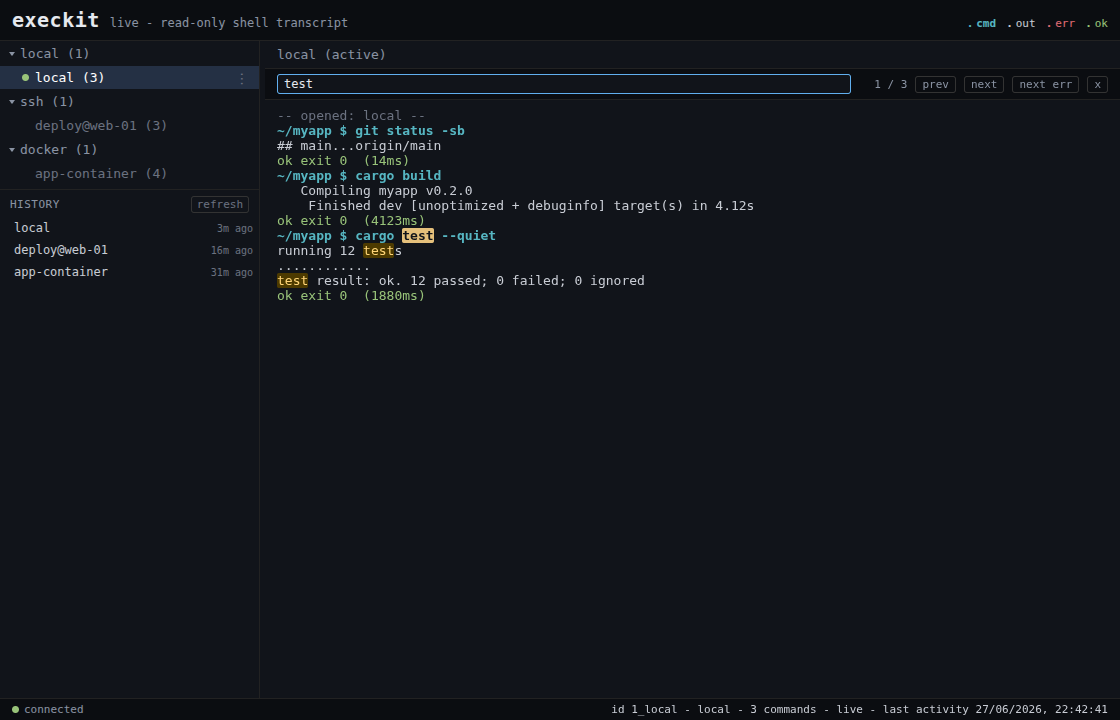
Search a transcript with / and jump between errors. |
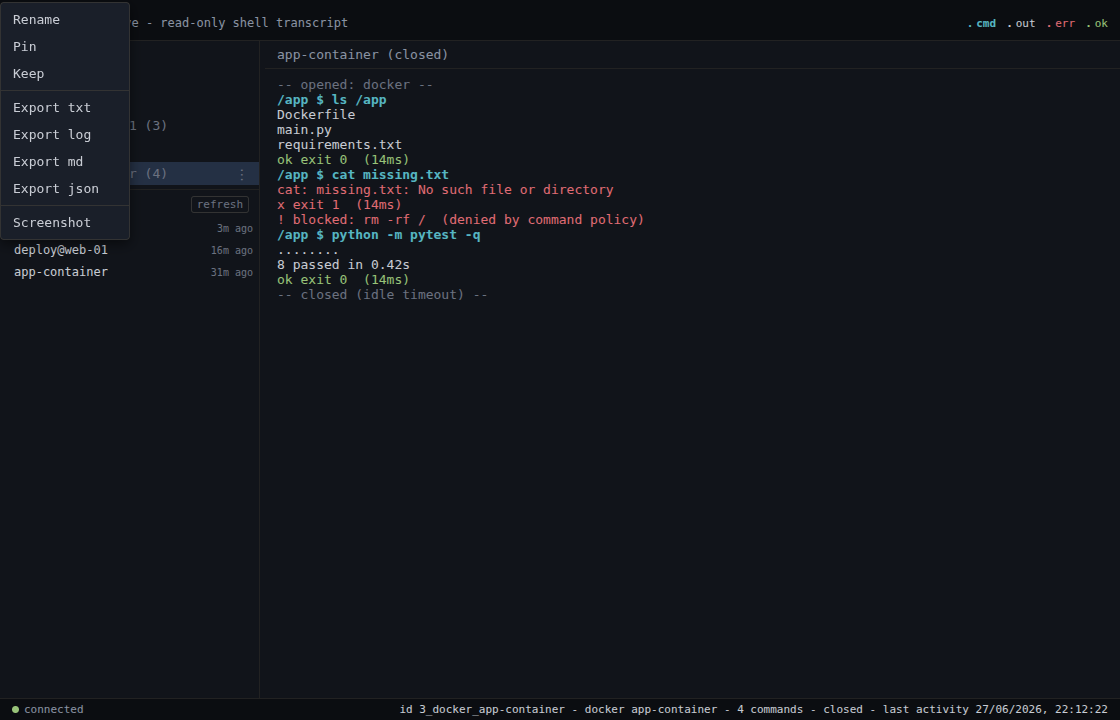
Rename, pin or keep a session, export it, or take a screenshot. Blocked commands show inline. |
Use it as a library
[dependencies]
execkit = "0.9"                                           # local + SSH + Docker
# execkit = { version = "0.9", default-features = false }  # local + Docker only (no SSH; no russh/tokio)
use std::time::Duration;
use execkit::{Policy, Session};

fn main() -> Result<(), execkit::Error> {
    let mut s = Session::local()?
        .with_policy(Policy { allow: vec![], deny: vec!["rm".into()] })
        .with_timeout(Duration::from_secs(60));

    let r = s.exec("echo hi; echo err 1>&2; cd /tmp")?;
    // r.stdout == "hi"  r.stderr == "err"  r.exit_code == 0  r.cwd == "/tmp"
    println!("{} (exit {})", r.stdout, r.exit_code);

    let r = s.exec_with_timeout("sleep 30", None, Duration::from_secs(1))?;
    // r.timed_out == true  r.exit_code == 124; the session is still usable
    Ok(())
}
Runnable examples: cargo run --example local,EXECKIT_SSH="user:password@host:22" cargo run --example ssh, andEXECKIT_DOCKER=<container> cargo run --example docker.
Python
The same sessions from Python. pip install execkit (native bindings, no Rust
toolchain needed):
from execkit import Session

with Session.local() as s:
    r = s.exec("echo hi; echo err >&2; cd /tmp")
    print(r.stdout, r.exit_code, r.cwd, r.stderr)   # hi 0 /tmp err
See crates/execkit-py/README.md.
What's in the box
- Persistent, stateful sessions over local PTY, SSH, or Docker. SSH
accepts host aliases from your~/.ssh/config. - Structured
ExecResult: split stdout/stderr, exit code, duration, cwd,truncated,timed_out. - Base64 command framing. Comments, heredocs,
!, trailing&, syntax
errors and long commands do not hang the session. - Timeouts that keep the session. A timed-out command is interrupted and the
session carries on. - Secret redaction of common token shapes (AWS, GitHub, GitLab, Slack, Stripe,
Google, Anthropic, OpenAI, JWTs, PEM private keys), URL passwords,password=/token=-style pairs, and values the session assigned to
secret-named variables. The echoed command is redacted too. - Output budgets:
tail/head/head+tailby line, agrepfilter with
context, and a char cap. Per call or a session default; the result reports what
was kept. - Undo for agent actions on remote sessions: snapshot the workspace and
restore files if a command goes wrong (needsgiton the remote and an
explicit workspace; files only, not side effects). - Audit log and live viewer, plus live MCP notifications to the client.
- Embeddable, never a service:
cargo add, in your process; no daemon, no vendor.
Upgrading to 0.9
Breaking changes from 0.8. The details are in
Upgrading to 0.9.
- SSH host keys are pinned in
~/.execkit/known_hosts, not~/.ssh/known_hosts.
Old pins are not read. The first connection re-pins, or copy them over withmkdir -p ~/.execkit && chmod 700 ~/.execkitthengrep -E '^[^ ]+ SHA256:' ~/.ssh/known_hosts >> ~/.execkit/known_hosts.
Old pins were keyed by bare host whatever the port: rewrite a line for a
non-22 port as[host]:port, or a later port-22 connection to that host fails
as a key mismatch. - stdin is
/dev/nullfor every command, and pagers are set tocat. - The target needs
base64. - A timeout returns exit code 124 with
timed_out: trueand keeps the session,
instead of an error that closed it.ExecResulthas a newtimed_outfield. - Session ids look like
a3f9-1_localinstead of1_local. SshConfighas a newconnect_timeoutfield (default 15 s). UseSshConfig::new.
Limitations
- Not a sandbox. The command policy is advisory string matching. It is easy to
bypass:deny: ["curl"]blockscurlbut notenv curl,sudo curlorsh -c curl. The real control is a least-privilege environment: run the agent
and SSH user with minimal rights. - No interactive input. stdin is
/dev/null, so prompts, REPLs and editors do
not work. Use non-interactive flags (sudo -n,apt-get -y). Pagers default tocat, but runninglessorvimdirectly hangs until the timeout and closes
the session. Shell history is off. - Timeouts interrupt, they do not kill everything. execkit sends Ctrl-C. A
command that ignores Ctrl-C ends the session. For long jobs, run them in the
background (nohup CMD > /tmp/job.log 2>&1 &) and poll the log. - The target needs a POSIX shell and
base64. Local sessions usebash.
Windows is not supported. - Synchronous core. Fine for typical agent use; not tuned for thousands of
concurrent sessions. - SSH
AcceptAnyhost-key mode exists for testing, behind an explicit insecure
opt-in. Never use it in production.
Found something rough? Open an issue.
Contributing & security
- Contributions: see
CONTRIBUTING.md. - Found a vulnerability? Follow
SECURITY.md. Please don't open a
public issue for security reports.
License
Apache-2.0: embed it freely, including commercially. See LICENSE andNOTICE.
Reviews (0)
Sign in to leave a review.
Leave a reviewNo results found