franklin-canvas
Health Uyari
- License — License: NOASSERTION
- Description — Repository has a description
- Active repo — Last push 0 days ago
- Low visibility — Only 8 GitHub stars
Code Basarisiz
- process.env — Environment variable access in account-auth.mjs
- crypto private key — Private key handling in account-auth.mjs
- fs.rmSync — Destructive file system operation in agent-tools.mjs
- os.homedir — User home directory access in agent-tools.mjs
- process.env — Environment variable access in agent-tools.mjs
- network request — Outbound network request in agent-tools.mjs
- crypto private key — Private key handling in agent-tools.mjs
- rm -rf — Recursive force deletion command in scripts/demo-gif.sh
- process.env — Environment variable access in scripts/start.mjs
- exec() — Shell command execution in server.mjs
- fs.rmSync — Destructive file system operation in server.mjs
- os.homedir — User home directory access in server.mjs
- process.env — Environment variable access in server.mjs
- network request — Outbound network request in server.mjs
- crypto private key — Private key handling in server.mjs
- network request — Outbound network request in src/api/franklin.ts
Permissions Gecti
- Permissions — No dangerous permissions requested
Bu listing icin henuz AI raporu yok.
Open-source node-based AI media studio — generate image, video & music on an infinite canvas, or let an AI agent build a whole short film from one prompt. Pay-per-use in USDC via x402.
Franklin Canvas
A node-based AI media studio — generate images, video and music on an
infinite canvas, chain them into visual workflows, and let an AI agent build them for you.
Use a BlockRun API key or pay per request in USDC via x402 — no subscription.




https://github.com/user-attachments/assets/7bbced39-90fd-4fb8-9346-83c0a52d6e49
▶︎ The 3-feature demo — prompt library · one-sentence AI short film · model comparison
Franklin Canvas is live — and fully open source. If it's useful, please ⭐️ the repo.
To try it, clone & run and create a free BlockRun account, add credits, and set an API key (pay-per-use, no subscription).
Drop a node, type a prompt, hit Send — then wire nodes into a workflow (image → animate →
stitch), or just describe what you want and let the Media Agent build it on the canvas.
An infinite canvas for image, video and music, with side-by-side model comparison,
in-canvas editing, a 848-case prompt library, timeline, and three themes. Generations use BlockRun account credits or pay per call from a local Solana/Base wallet
(built on the Franklin core SDK).
Demos
|
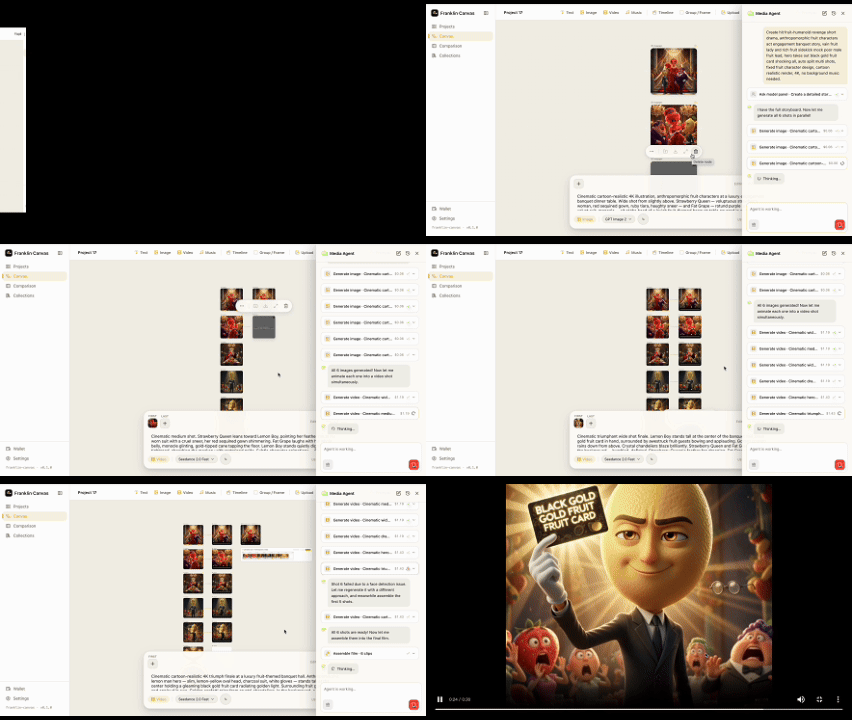
🤖 Media Agent One sentence → the agent storyboards, generates every shot, and cuts a whole short film on the canvas.
|
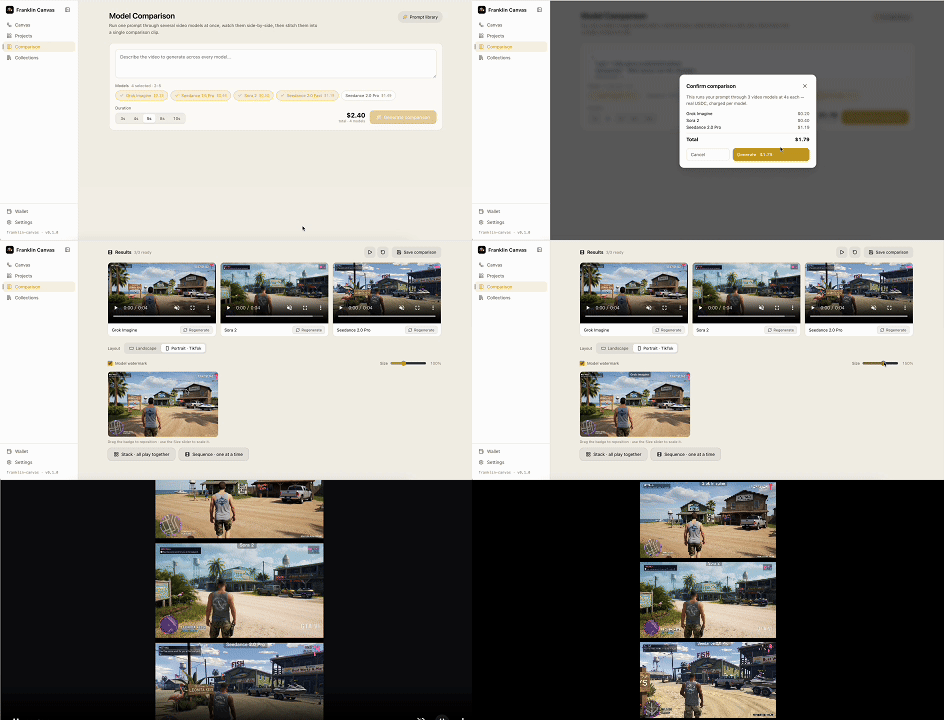
⚖️ Model Comparison One prompt → several video models in parallel → one stitched comparison clip.
|
Highlights
- 🤖 Media Agent. Describe what you want — "a cinematic fox clip in a snowy forest,
with a soundtrack" — and a real tool-calling agent builds it on the canvas step by
step. It generates, chains image→video, edits / inpaints, upscales, stitches, and
looks at its own results with vision before deciding the next move — and can search
the web, recall saved preferences, poll a model panel, or touch local files / shell
when a task needs it. Manual mode confirms each paid step with its cost; Auto mode runs
the whole workflow. A live tool trace shows every action as nodes appear on the canvas. - ⚖️ Model Comparison. Run one prompt through up to 5 video models at once, watch
them play in a synchronized grid, then stitch into a single deliverable MP4 — grid
(all together) or sequence (one at a time, others frozen on their first frame),
landscape or portrait 9:16 for TikTok. Per-clip model watermark is optional and
drag-to-position so it never covers the action. - Multi-model, multi-modal. 7 image models, 5 video models, 1 music model, plus the
full chat catalog — mix and match per node, with the live per-call cost shown next to Send. - Contextual PromptBar. Select a node and type — the bar binds to it. Attach a
reference image with the paperclip (or pick one already on the canvas) for
image-to-image and image-to-video. A gear opens video settings (aspect / resolution
/ duration / audio) without leaving the bar. - In-canvas image editing on any generated image (the ⋯ menu):
- Outpaint · Enhance · Cutout · Upscale — image-to-image through the gateway.
- Split 2×2 / 3×3 — pure client-side crop, no spend.
- Annotate — freehand pen + 7 colors, saved as a new node, no spend.
- Cutout → true transparent PNG via a client-side alpha pass after gen.
- Timeline. A real time-axis playlist with a
00:00 / 00:10 / 00:20 …ruler;
drop finished video / music clips, blocks sit at their actual duration. Pick a
cut at a glance. - Group / Frame. Drag the frame, the contents follow (Figma-style sync drag).
No data model rewrite — purely positional. - Prompt library. 848 ready-made cases scraped from the open
BlockRunAI Prompt-Case-Hub,
filtered two-tier: workflow (text→image · image→image · text→video · image→video)
then tag. Clicking Use drops the right node type (video prompts → videogen,
image prompts → imagegen). - Three themes. Dark (lime accent), Gold (warm cream + petrol-ink), Light (cool
minimal). Sidebar / toolbar / connection-line palette / floating panels all adapt. - View controls. Bottom-right pill bar with zoom +/− (live %), Fit-to-content,
and toggles for the background dot grid + minimap. - Projects. Each project is its own saved canvas; ProjectsView lists them with
cover thumbnails, rename, delete. Esc returns to the canvas. - Multi-project, undo/redo, ⌘V paste-to-upload, drag-from-handle to spawn next.
- Two pay-per-use options. Use a BlockRun account API key, or settle in USDC via x402
from a local wallet (Solana first, Base also supported). Account credentials stay in the local
backend and are never sent to the browser.
Quick start
Create a free account at user.blockrun.ai, add credits at
Billing, then create a key at
API Keys.
git clone https://github.com/BlockRunAI/franklin-canvas.git
cd franklin-canvas
npm install
BLOCKRUN_API_KEY=brk_... npm start   # → http://localhost:5173
The API key stays in the local Node backend. Franklin Canvas never stores it in browser
storage or returns it from an endpoint. To use a self-hosted account API, setBLOCKRUN_API_BASE_URL alongside the key. Requires Node 18+ (native fetch).
x402 wallet mode
If BLOCKRUN_API_KEY is unset, Canvas keeps the existing wallet flow. Wallet config is
shared with Franklin core. Solana is shown first
and Base remains available in Settings → Billing.
| Chain | Wallet file (auto-created) | Env override |
|---|---|---|
| Solana | ~/.blockrun/solana-wallet |
SOLANA_WALLET_KEY |
| Base | ~/.blockrun/wallet |
BASE_CHAIN_WALLET_KEY |
Fund the selected address with USDC on the same chain. Every generation settles per call
through x402. Do not set a wallet key together with BLOCKRUN_API_KEY; account mode takes
priority and does not create or read a wallet.
Running the halves separately
npm run server       # backend only (:3100)
npm run dev          # UI only (:5173), proxies /api → :3100
Deploying behind a real domain (optional)
If you serve the backend on a public host, set:
ALLOWED_ORIGINS=https://your.app # comma-separated whitelist; rejects everything else
Otherwise CORS stays wide open for localhost dev. The backend uses one billing
credential per process, so a public multi-tenant deployment needs per-user auth
and credential isolation.
Architecture
Browser  (Vite dev / built dist/)
   │  fetch /api/...  (billing · generate · prompts · agent · comparison · transactions)
   ▼
server.mjs  (holds account key or wallet credentials locally)
   │  @blockrun/llm  (account API or x402 on Solana / Base)
   ▼
BlockRun gateway  ──  image / video / music / chat models
The Media Agent is a real tool-calling loop, run frontend-driven: /api/agent/chat
does one model turn (returning OpenAI-style tool calls), the panel executes them, and
the results feed back until the model stops. Canvas/media tools run in the browser
(create/chain/edit/upscale/stitch/describe nodes); the rest — web search, memory,
mixture-of-agents, filesystem, shell — run on the backend via /api/agent/tool. Tool
specs and the backend executors live in agent-tools.mjs.
Model Comparison fans one prompt out to N video models in parallel, then composites
the finished clips with ffmpeg (/api/comparison/stitch) — grid or sequence, landscape
or portrait, with the model badge burned in at a caller-chosen position.
The frontend is model-agnostic: it POSTs { kind, prompt, model, … } to/api/generate, and the backend maps that onto the right @blockrun/llm client
(ImageClient, MusicClient, VideoClient for account billing; the existing signed flow for wallet video), pays per call, saves the
bytes locally, and returns a /api/generated/<id>.<ext> URL the UI renders.
Video generation uses the SDK's account-owned polling in API key mode. Wallet mode
keeps the signed submit + poll loop so it can refresh x402 authorization during long jobs.
Account video requires the account API video deployment to be enabled by the operator.
Pricing is read live from the gateway's /v1/models endpoint at edit time, sosrc/canvas/nodes.tsx's IMAGE_MODELS / VIDEO_MODELS mirror what the gateway
actually charges (not a hardcoded guess that drifts).
Node types
| Node | What it does |
|---|---|
| Text | Scripts / copy / brand voice via the chat models |
| Image | Text-to-image and image-to-image; ⋯ menu has Outpaint/Enhance/Cutout/Upscale/Split/Annotate |
| Video | 5–30s clips, multi-model, optional seed image, optional synced audio |
| Music | ~3-minute tracks with adaptive or custom lyrics |
| Upload | Drop or pick a reference image (paste with ⌘V on the canvas works too) |
| Timeline | Real time-axis playlist — drops finished video/music clips proportional to duration |
| Group / Frame | Visually group nodes; drag the frame and contents follow |
Tech stack
- Vite 6 + React 19 + TypeScript 5 (strict)
- @xyflow/react 12 for the canvas
- Zustand for state (per-canvas projects, theme, prefs)
- Vanilla CSS variables — three themes with shared accent + panel vars
server.mjs: Node, no framework, talks to@blockrun/llmscripts/start.mjs: zero-dep launcher that multiplexes both halves' stdout
Project layout
src/
  views/        CanvasView · ProjectsView · ComparisonView
  canvas/       nodes · edges · PromptBar · PromptLibrary · SettingsDialog ·
                VideoSettingsPanel · LyricsPanel · NodeActionMenu ·
                AnnotateModal · CanvasViewBar · prefsStore · themeStore ·
                CanvasContext · AgentPanel · agentTools · agentPrefsStore ·
                agentSessionsStore
  components/   Sidebar · ModelDropdown · NodeFrame · Lightbox · AgentMascot
  api/          franklin.ts  (HTTP client for /api)
  projects.ts   multi-project localStorage store
  uiStore.ts    cross-cutting UI state (prompt library open, etc.)
agent-tools.mjs    agent tool specs + backend tool executors (web · memory · fs · shell …)
server.mjs      self-contained backend (wallet · x402 · generate · prompts · agent · comparison)
scripts/start.mjs  one-command launcher (backend + UI multiplexed stdout)
Credits
- The Prompt Library lazy-loads cases from the open
BlockRunAI Prompt-Case-Hub
— credit goes to the original prompt authors. - Wallet + x402 payment is the Franklin core
SDK (@blockrun/llm).
License
Apache-2.0
Yorumlar (0)
Yorum birakmak icin giris yap.
Yorum birakSonuc bulunamadi