memnest
Health Warn
- License — License: MIT
- Description — Repository has a description
- Active repo — Last push 0 days ago
- Low visibility — Only 5 GitHub stars
Code Warn
- process.env — Environment variable access in adapters/generic-http/memnest-adapter.mjs
- process.env — Environment variable access in adapters/generic-http/test.mjs
- process.env — Environment variable access in benchmarks/memorybench/install-into-memorybench.mjs
Permissions Pass
- Permissions — No dangerous permissions requested
No AI report is available for this listing yet.
Source-backed local memory shared by Claude Code, Codex, pi, and MCP clients. No generative LLM.
memnest

한국어 | Install | Use it | Operations
Local memory for finding what you did with a coding AI, and why you decided to do it.
Memnest stores pi, Claude Code, and Codex conversation text on your machine. Connected AIs can search those records and read the source after a session ends. Connect several clients to the same Memnest service to use the same history.



A recorded lookup
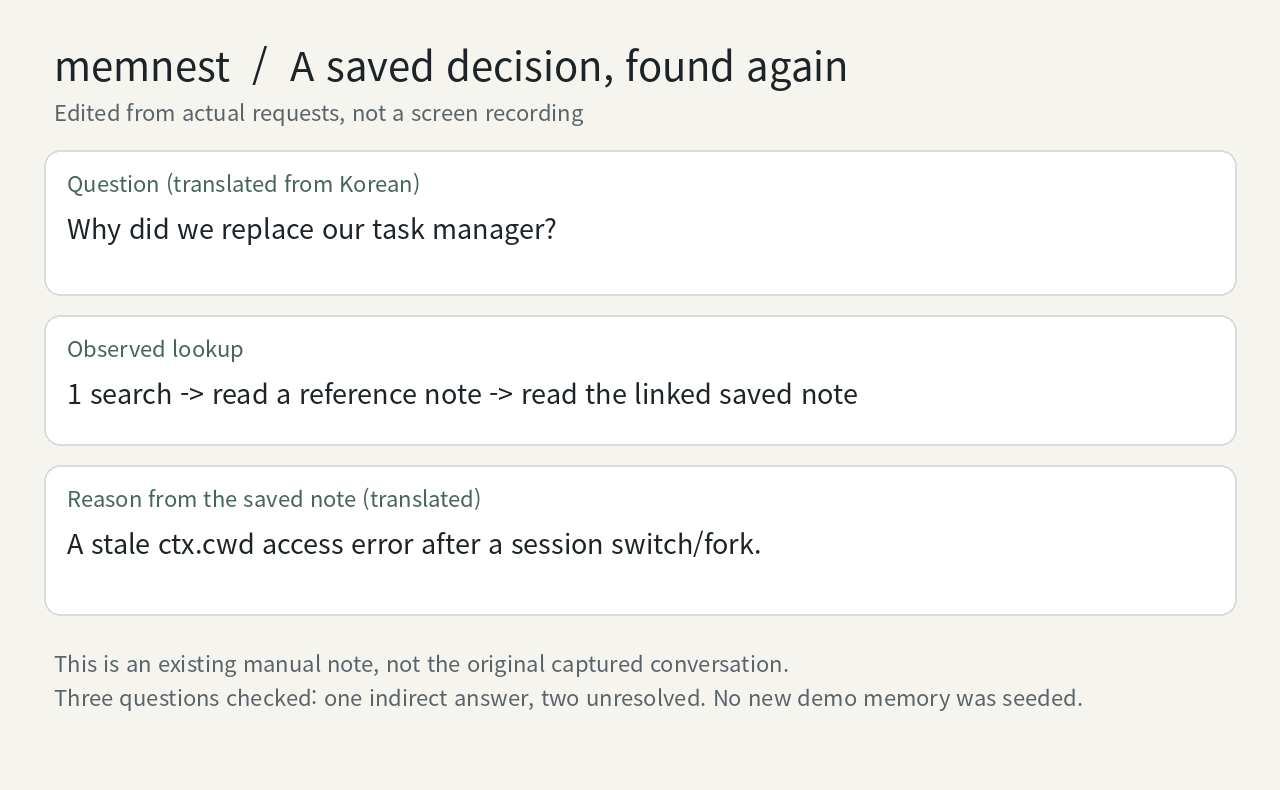
In this check, the AI searched for why a task manager had been replaced, followed a reference, and read an existing manual note describing the reason. It did not recover the original conversation in one search. The image is an edited request summary, not a screen recording; the three-question report also records the two unresolved questions.
When to use it
Use the accumulated record for questions such as:
Why did we switch task managers? Find the discussion behind that decision.
What deployment approach did we last settle on for this project, and why?
What did we try the last time this error happened?
The AI searches memory, reads the relevant source, and uses it to answer. Results include source IDs so you can check the evidence. These are example requests, not an autonomous demo or a guarantee that an answer will be found.
For a few rules that should apply every time, AGENTS.md or CLAUDE.md is simpler. Memnest is for a growing history of conversations and decisions that you want to look up when needed.
Install
Linux x86_64 and Arm64 archives are available; Rust is not required. The x86_64 archive needs glibc 2.35 or newer (Ubuntu 22.04, Debian 12 or later); the Arm64 archive needs glibc 2.39 (Ubuntu 24.04 or later). The first write or search downloads an embedding model of about 1.1 GB. Embedding can use about 1.9 GB of RAM.
Read the downloaded script before running it. Before upgrading an existing installation, back up memory.db together with master.key.
curl -fsSL https://raw.githubusercontent.com/Blue-B/memnest/v0.4.2/core/scripts/install.sh \
  -o /tmp/memnest-install.sh
VERSION=v0.4.2 bash /tmp/memnest-install.sh --user
Setup starts the server and conversation watcher and adds missing connections to supported Claude Code, Codex, and Cursor configurations. It backs up existing configuration before changing it and prints recovery commands.
Connect pi
With the core running, install the matching extension:
# Published extension for core 0.4.x
pi install npm:[email protected]

# Or connect a reviewed source checkout
pi install ./pi-extension
If Memnest is already registered from another source, remove that registration first to avoid loading it twice. Use /memnest in pi to check the connection. See extension settings.
The extension exposes only the five memory tools by default. To let pi store and retrieve credentials with secret_set, secret_get, secret_list, and secret_delete, enable the vault tools before starting pi:
export MEMNEST_EXPOSE_SECRET_TOOLS=1
pi
Restart pi after changing the variable; /reload alone cannot change the running process environment. /memnest reports whether the vault tools are available and shows this activation hint when they are hidden.
Other MCP clients connect to http://127.0.0.1:3111/mcp. See connection examples, other environments and source installation, and upgrade and recovery. macOS is source-only; native installation and removal have not been validated.
Use it
Ask your connected AI to look up a previous conversation or decision. Automatic recall is off by default; you can start by requesting a search when you need one. See extension settings to enable automatic recall.
Clients that call tools directly use this flow:
memory_search(query="reason for switching task managers")
memory_get(id="<ID returned by search>")
Five tools cover saving, searching, reading, correcting, and deleting. Use memory_remember to explicitly save an important decision. When a fact changes, save its replacement with supersedes=<old ID> to link it to the earlier record.
When the host provides the current directory, searches include that workspace and the shared playbook. Specify project=all for a deliberate cross-project search. See source reading for long records and nearby conversation entries.
Conversations from before installation are not all imported automatically. Select the original files you need with history import.
Source-backed coding records (0.4.0)
Save an approach as proposed, failed, or reported success without treating that report as verification. Optionally attach selected local files with memory_remember(code_files=["relative/file"]), then request memory_get(check_code=true) when you want to compare their bytes. Unrelated edits do not trigger warnings. See code evidence.
Optional team access adds named project grants, audit and retention. A free local comparison records where Memnest did and did not perform well; it does not claim universal accuracy superiority.
Important limits
- Retrieval is not truth checking. Search can miss a relevant record. Memnest cannot determine whether an old decision still holds. A following-source hint is not a verified reply relationship.
- Capture is selective. It stores visible conversation text, not reasoning, tool traffic, images, or subagent conversations. It does not import ChatGPT's or Claude's built-in memory.
- Storage is local; your connected AI answers. Default storage/search makes no generative LLM calls. Explicit
evidence_only=trueopts in to a configured local source-selector model, whose judgment remains unverified. A cloud AI provider receives retrieved text that you send to its model. - Regular memories are not encrypted. Redaction handles known credential patterns, not every possible secret. Do not expose port 3111 directly to the internet.
- A web connector is a network path into your memories. ChatGPT and Grok connectors need a public URL, retrieved text reaches the provider's servers, and that URL acts as a credential. See web connectors.
- Deletion is not immediate erasure. Records default to 30 days in trash. New plaintext archives are off by default; old archives, backups and external transcripts may still retain copies. See security and deletion limits.
Documentation and checks
One Rust service stores source records in SQLite and searches with BM25 plus local multilingual embeddings. Search indexes can be rebuilt from the source records.
- Web connectors for ChatGPT and Grok, real-client validation and reproducible shared-store demo
- Following-source checks and limits, retrieval evaluation
- Design decisions, operations and backups, contributing
- Latest release and changelog
License
MIT © Blue-B
Reviews (0)
Sign in to leave a review.
Leave a reviewNo results found